Matthew 1:18-25 Advent Action
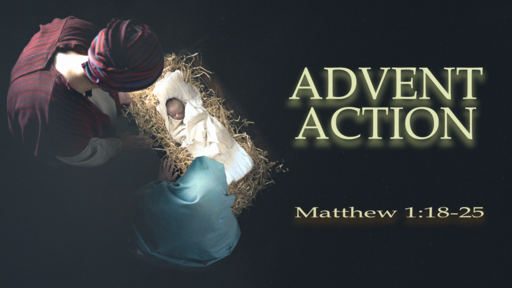

Matthew 1:18-25 (Evangelical Heritage Version)
18This is how the birth of Jesus Christ took place. His mother, Mary, was pledged in marriage to Joseph. Before they came together, she was found to be with child by the Holy Spirit. 19Joseph, her husband, was a righteous man and did not want to disgrace her. So he decided to divorce her privately. 20But as he was considering these things, an angel of the Lord suddenly appeared to him in a dream and said, “Joseph, son of David, do not be afraid to take Mary home as your wife, because the child conceived in her is from the Holy Spirit. 21She will give birth to a son, and you are to give him the name Jesus, because he will save his people from their sins.”
22All this happened to fulfill what was spoken by the Lord through the prophet: 23“Look, the virgin will be with child and will give birth to a son. And they will name him Immanuel,” which means, “God with us.”
24When Joseph woke up from his sleep, he did as the angel of the Lord had commanded him. He took Mary home as his wife, 25but he was not intimate with her until she gave birth to her firstborn son. And he named him Jesus.
Advent Action
I.
Slower and slower she walked as she made her way down the path. Even as her footsteps slowed, her mind raced. Did she need an outline of how to say what needed to be said? What was the best order? Where to start? How to finish? It was important that he hear the whole message and understand what had happened to her.
Surely Mary didn’t wait very long to tell Joseph all about it. In Wednesday night’s midweek Advent service we heard the angel announce to Mary that she would be the mother of the long-awaited Messiah. In simple faith, though Mary didn’t understand every detail, she believed it.
After the angel left her, however, what must have gone through her head? The angel’s visit probably didn’t take very long, but processing what he had said must have taken a great deal of time. Joseph had to be told.
When did Mary tell Joseph in the chronological order of the events leading up to Christmas? The Bible doesn’t say, specifically. We know Mary went to see Elizabeth, the mother of John the Baptist, soon after she knew she was pregnant. Did she go see Elizabeth before, or after, she told Joseph?
Surely Mary didn’t wait long.
“This is how the birth of Jesus Christ took place. His mother, Mary, was pledged in marriage to Joseph” (Matthew 1:18, EHV). Mary and Joseph were engaged. In their culture, engagement was a more formal arrangement than it is now. These days, engagements are broken off all the time. Back then, Joseph had to approach Mary’s father and pay a bride price agreed on by the bride’s father and the groom. That process helped create the betrothal document. The wedding ceremony with all its gifts and the big party would come later. The promises were binding—they were promised for life—but the bridal couple couldn’t live together or have a sexual relationship until the wedding day.
“Before they came together, she was found to be with child by the Holy Spirit” (Matthew 1:18, EHV). Mary had to take action and tell Joseph what the angel had told her. We can only imagine what their conversation might have been like. She had to tell Joseph the news in exactly the right way. She wanted him to hear all the important bits the angel had told her. She wanted him to be sure to know that this child was from the Holy Spirit—that this child was special—that this child was not the result of unfaithfulness on her part.
When she spoke, were the words and sentences measured and even? Or did they, instead, tumble out in a waterfall of sound because she needed the whole picture to get to Joseph as quickly as possible?
Joseph was completely unprepared for her words. I would imagine he heard only two: “I’m pregnant.”
Now, Joseph wasn’t one who would typically sit around the scholar’s table in the temple courtyard debating the finer points of God’s Moral Law or the Ceremonial Law, but he wasn’t stupid, either. Joseph knew how babies come to be. There’s a man and a woman. Certain biological facts are part of the process.
“Joseph, her husband, was a righteous man” (Matthew 1:19, EHV). Did you catch the first part of the phrase? “Her husband.” Matthew identifies Joseph as Mary’s husband. That goes back to the concept that the engagement was binding. They were already husband and wife, though the ceremony had not yet taken place.
Note carefully the last part. Joseph “was a righteous man.” Even in those days there were plenty of people who didn’t live up to the moral standards required during the engagement period. Joseph wasn’t one of those. He was righteous. No one, of course, is perfect, but Joseph did his best to live up to the standards of the Moral and Ceremonial laws as God required. He hadn’t been part of the process that had resulted in Mary’s pregnancy. That left only one possible, logical conclusion. Mary had been unfaithful.
Joseph had every right to drag Mary into court and accuse her of adultery. This would put her under a death sentence: death by stoning. Doing things this way would preserve Joseph’s reputation.
He couldn’t bring himself to do it. Joseph was in love. His actions prove it. His heart was broken by that “I’m pregnant” declaration, but he couldn’t bring himself to react the way some would expect. “Joseph... did not want to disgrace her. So he decided to divorce her privately” (Matthew 1:19, EHV). Since the engagement was really a binding marriage, Joseph would have to go through a divorce, but it didn’t have to be a public spectacle that would ruin Mary. He decided to break things off as quietly as possible and get on with his lonely life.
All that was required was for him to write things out in a formal document and present it to Mary in front of two witnesses. Then it would all be over. Perhaps he cried himself to sleep just thinking about it.
II.
The bottom line is, Joseph didn’t believe Mary. Either he didn’t hear the whole story in that gush of words, or he thought she was just making it all up.
He didn’t believe.
There is a long history of people not believing. Adam and Eve didn’t believe God wanted what was in their best interests. Instead, they listened to Satan. The People of Israel again and again failed to believe that God would protect them and chose to do things their own way. God sent his prophets to the people over and over with details about the coming Messiah, but so many seemed to read something different into his promises—they wanted their own version of the Messiah.
The message that God himself would come into the world as a tiny baby in order to be the sacrifice that God himself demands for sin is simply unbelievable. It’s not logical. Unbelief isn’t uncommon; it’s the norm.
III.
“But as he was considering these things, an angel of the Lord suddenly appeared to him in a dream and said, ‘Joseph, son of David, do not be afraid to take Mary home as your wife, because the child conceived in her is from the Holy Spirit. 21She will give birth to a son, and you are to give him the name Jesus, because he will save his people from their sins’” (Matthew 1:20-21, EHV). Joseph had a dream that night. The angel told him that Mary had not been unfaithful to him. She was a pregnant virgin.
As impossible as that message would sound to any normal human being, Joseph believed it. Instead of meeting Mary with a piece of paper and two witnesses the next morning, he went to her to tell her: “Mary, I didn’t understand, but God’s angel came to me and showed me the truth. I believe.”
“All this happened to fulfill what was spoken by the Lord through the prophet: 23‘Look, the virgin will be with child and will give birth to a son. And they will name him Immanuel,’ which means, ‘God with us’” (Matthew 1:22-23, EHV).
Matthew quotes today’s First Reading to explain that God has done the unbelievable.
God had a plan. At the very first sin, God announced his plan. He would send someone to deal with sin and the devil. Who knew that it would be “God with us”? God sees the salvation of his people as such an important matter that it couldn’t be left to just anyone. God knows that people aren’t capable of bringing off such a powerful plan. “God with us” came to do it himself.
“God with us,” Jesus, would fulfill every prophecy of the Old Testament concerning the Messiah. He came to complete God’s plan of salvation for all people. Sin was nailed to the cross when Jesus was nailed to the cross. “God with us” completed the unbelievable, and the Holy Spirit gave us the faith to believe it, just as he did for Joseph.
IV.
“When Joseph woke up from his sleep, he did as the angel of the Lord had commanded him. He took Mary home as his wife, 25but he was not intimate with her until she gave birth to her firstborn son. And he named him Jesus” (Matthew 1:24-25, EHV).
After Joseph was led to believe, his faith wasn’t casual. He didn’t just watch Mary as an observer from the sidelines, but took an active role.
Even after they were officially married, Joseph refrained from a sexual relationship with Mary until after the miraculous birth had taken place. There was much more. Joseph took the child to Jerusalem for the ritual purification and the official naming, just as if Jesus were his own son. When the boy’s life was threatened, Joseph took him and Mary to Egypt for safety. Back in Judea, Joseph took Jesus to Jerusalem for the Passover. When he thought Jesus was lost, Joseph went in search of him. He was always willing to do whatever was necessary.
God’s gift of his Savior had come in a surprising way to Joseph. It disrupted the plans for his life, but after the initial shock, Joseph was always moved to action. He served as God wanted him to serve. At times his service was dramatic, but there isn’t much in Scripture about him and the rest of that service. He just quietly did what God wanted him to do in care of Immanuel, God with us.
Perhaps that describes your service to God. Take Advent Action. Quietly you do what God asks of you. It might not be dramatic. It might not make any headlines. Whatever God calls you to do in your service to him, it’s important. Just as he was with Joseph, God is with you to carry out your part in his kingdom.
As you live your life this week looking forward to your Christmas celebration, remember Immanuel. God is not just with you, Immanuel means God with us. Share his coming, even as you cherish all these things and ponder them in your heart. Amen.
