Matthew 11:25-30 Connected

Matthew 11:25-30 (Evangelical Heritage Version)
25At that time, Jesus continued, “I praise you, Father, Lord of heaven and earth, that you have hidden these things from clever and learned people and have revealed them to little children. 26Yes, Father, because this was pleasing to you. 27Everything has been entrusted to me by my Father. No one knows the Son except the Father, and no one knows the Father except the Son and anyone to whom the Son wants to reveal him.
28“Come to me all you who are weary and burdened, and I will give you rest. 29Take my yoke upon you and learn from me, because I am gentle and humble in heart, and you will find rest for your souls. 30For my yoke is easy and my burden is light.”
Connected
I.
One word can often paint a very powerful picture. He was leading up to the word. He would get to the word. The word was “yoke.”
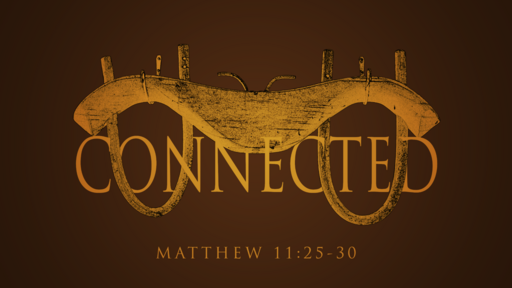
A yoke connects. The people of Jesus’ day would have gotten the picture immediately. The yoke, much like the one in our sermon slides today, connects two animals together so they can accomplish much more than either animal would be able to do alone.
Matthew begins today’s Gospel: “At that time...” (Matthew 11:25, EHV). Such a phrase indicates that it is important to connect with the things he had just written about. So, at what time? What was going on?
Jesus had just finished instructing the Twelve before he sent them out. Last week’s Gospel was part of what he told them: “I did not come to bring peace, but a sword” (Matthew 10:34, EHV). The disciples needed to know that the path of sharing with others the teachings of Jesus would not be easy, but fraught with peril. Everyone needed to hear that Jesus had come to bring real peace—peace between human beings and God. We know all the details about how things finally turned out.
They didn’t fully understand, but they were sent out, none-the-less. As they were sent out, they needed to know that there would be plenty of questions—plenty of rejection—plenty of persecution. Questions and rejection and persecution would come because the people they preached to and taught were connected to their own flawed ideas.
Meanwhile, as the Twelve journeyed around the countryside sharing what they had learned, Jesus also kept teaching and preaching.
In the verses before our text, some of John the Baptist’s disciples came to see if Jesus really was the Messiah. John had been proclaiming that the end was near. Messiah was right around the corner. Even John probably didn’t understand exactly what Jesus would do as Messiah. That’s why he had sent his disciples to ask some questions. John had prepared people for the coming Messiah, even if his own connections with the past contained some flawed ideas because he didn’t fully understand.
Later in this chapter, but still before our text, Matthew records: “Then Jesus began to denounce the towns in which most of his miracles were performed, because they did not repent” (Matthew 11:20, EHV). Connections with the ideas of the past meant that the people saw Jesus as a mere curiosity, not as the Messiah. They wanted to witness the miracles. They wanted to eat the food; to be healed of their diseases; not to listen to the truly important words that would bring real peace.
That’s the context Matthew was referring to. “At that time, Jesus continued, ‘I praise you, Father, Lord of heaven and earth, that you have hidden these things from clever and learned people’” (Matthew 11:25, EHV). The clever and learned were connected. The clever and learned thought they had all the answers. They knew the law of Moses. They were yoked to the Law of Moses. They knew all the rules. They followed the rules.
II.
Christianity still looks to the 10 Commandments. We know they are a summary of God’s Moral Law. The Bible is full of instructions about how to live and how not to live. We are connected to those rules, just as the people of Jesus’ day were. The Pharisees even chopped up the Laws of Moses and came up with additional rules they insisted everyone must follow to a T.
We, on the other hand, have to admit that we don’t follow all the rules. Paul put it perfectly in today’s Second Reading: “For I do not understand what I am doing, because I do not keep doing what I want. Instead, I do what I hate” (Romans 7:15, EHV). Try as we might, we understand we can’t follow all those rules.
I wonder if the clever and learned Pharisees convinced themselves that they really were able to keep all those little rules, or if they just lied about it. Was the whole thing a game to show others how pious they were even when they knew deep down they weren’t so righteous?
Maybe church people are clever and learned. We are connected to the rules. You and I don’t want the other people sitting in these pews to see the worst, most despicable parts of our lives. If those things could be seen—if people knew—they might never speak to us again. You might be an outcast if the other people here today knew everything about you.
So you lie. Christian life becomes nothing more than a facade. Each one has to hide his or her sins from all the others to keep up appearances. Christianity is all about being “good people.” That means that we have to make ourselves look good.
Naturally, like Paul, when we try, we fall short. It turns into a vicious cycle: try, fail; try, fail. Try harder; this time you’re really serious. This time you’re going to get it right. And it works. For a day or two. If you really look closely, it only worked for an hour or two—more like a minute or two.
If you connect a yoked team of animals to a burden that is too heavy, they just won’t be able to pull it. With all their might they can attempt to pull, but it just won’t work. Even animals understand that. If the load is too heavy, the team will stop pulling. Hitch them to a load beyond their capability too many times, and they won’t be as likely to even try the next time.
God’s Moral Law is a heavy burden. As Paul said: “The desire to do good is present with me, but I am not able to carry it out. 19So I fail to do the good I want to do. Instead, the evil I do not want to do, that is what I keep doing” (Romans 7:18-19, EHV). Try to do what God wants, and you fail. Every single time. Despair is the natural result of trying and failing again and again and again. We are forced to the conclusion that this is all a lie or that we have a fundamental flaw—that we are broken as individuals.
III.
“Come to me all you who are weary and burdened, and I will give you rest” (Matthew 11:28, EHV). Into our broken connection to God and his Moral Law Jesus speaks. You and I need rest from the burden of God’s Law, not help with it. Weary and burdened. Overcome. Panting with exhaustion.
Luther used to say that the Christian is both a saint and a sinner at the same time. The Christian life is not about being a better person. It never has been. We can’t live up to the demands of God’s Law. Christians are sinners; every single one of us. When we fall short and fail, there’s no need to be surprised.
We aren’t in heaven yet, so even the concept of trying harder is doomed to failure. Sometimes Christians fall into the trap of thinking that Jesus will help them pull the heavy burden. Connected to Jesus—yoked together with him—maybe we can pull our part of the load. Even that is doomed to failure, because it leaves some part of the burden on our own shoulders.
“Come to me...I will give you rest,” says Jesus. He was connected to God’s law and kept it in a way none of us could ever hope to do. God commissioned him to keep the whole thing flawlessly, just as we were commanded to do, but failed. Not only did he carry the burden of perfection, Jesus was connected to our burdens. Every time we failed to keep the rules, it was added to his load.
Jesus was connected to every single indiscretion, every single violation, any of us ever has done. He took the yoke of obedience that feels like being trapped in a vicious cycle.
“Take my yoke upon you and learn from me, because I am gentle and humble in heart, and you will find rest for your souls. 30For my yoke is easy and my burden is light” (Matthew 11:29-30, EHV). Jesus paid for every single one of our sins, but then he connected us to an easy, light burden. His payment on the cross for every sin is given to us—the sins we committed that were such a burden that they disconnected us from God have been taken away.
In place of those sins, Jesus connected us with his own righteousness and perfection. His own perfect obedience, his perfect keeping of every law, is given to us—counted as ours. When you stand before the throne of God, he sees you as righteous, perfect, and holy, because you are connected to Jesus and his perfection.
IV.
“At that time, Jesus continued, ‘I praise you, Father, Lord of heaven and earth, that you have hidden these things from clever and learned people and have revealed them to little children’” (Matthew 11:25, EHV).
Clever and learned people let their own cleverness get the best of them. Clever and learned people can’t see what is there in plain sight. Little children don’t find it difficult at all to sing: “Yes, Jesus loves me. The Bible tells me so.” Little children don’t find it hard to believe that One man died for all people and that because he died they will live with him. Little children don’t try to use cleverness and learning to explain what cannot be explained by logic. They just believe.
“My yoke is easy and my burden is light” (Matthew 11:30, EHV). We are connected to Jesus by faith. That yoke is easy. That burden is light. Jesus has already carried the load. Jesus has already pulled the weight.
That’s why we come here week after week. It’s too easy to get clever and learned again. It’s too easy to forget who we are. Many of us are going to walk through these doors and start thinking and living as if it all depends on us again—as if it all depends on how hard we try.
Week after week, every one of us needs to be reminded. You don’t have to pretend anymore. You are loved. Not because of what you have done or what you can or might do. You are loved because of what Jesus has done for you. You are connected with Jesus.
His connection is easy. His burden is light. Amen.
