Ac 6:1-9, 7:2a, 51-60 God Works in Mysterious Ways
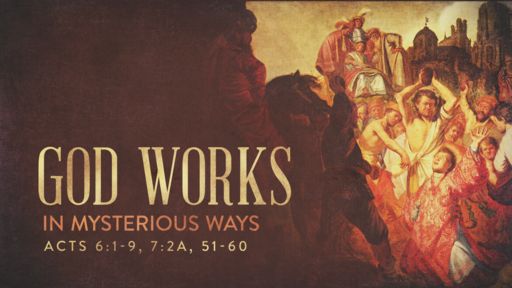

Acts 6:1-9, 7:2a, 51-60 (Evangelical Heritage Version)
Acts 6:1-9
1In those days, as the number of disciples was increasing, a complaint arose from the Greek-speaking Jews against the Hebrew-speaking Jews, because their widows were being overlooked in the daily distribution of food.
2So the Twelve called together the whole group of disciples and said, “It is not right for us to neglect the word of God in order to wait on tables. 3Brothers, carefully select from among you seven men with good reputations, who are full of the Holy Spirit and wisdom. We will put them in charge of this service. 4But we will devote ourselves to prayer and the ministry of the word.”
5This proposal pleased the entire group. They chose Stephen, a man full of faith and the Holy Spirit, also Philip, Procorus, Nicanor, Timon, Parmenas, and Nicholas, a proselyte from Antioch.
6They had these men stand before the apostles, who prayed and laid their hands on them.
7The word of God kept on spreading, and the number of disciples in Jerusalem increased greatly. Also a large group of priests became obedient to the faith.
8Now Stephen, full of grace and power, was doing great wonders and miraculous signs among the people. 9Some men who were from what is called the Synagogue of the Freedmen (Cyrenians, Alexandrians, and some from Cilicia and Asia) rose up and disputed with Stephen.
God Works in Mysterious Ways
I.
The new congregation was experiencing an explosion in growth. Some estimates say that it already numbered between 10,000 and 15,000 believers. These new Christians came from many different ethnicities and all kinds of different walks of life. Some were even priests from Judaism who had come to understand that Jesus had been the Messiah they had all been looking for.
The Apostles were the pastors of this huge congregation. Their number was back to Twelve again. After Jesus rose into heaven, they had selected a replacement for Judas from among all the rest of the disciples who had followed Jesus faithfully for years.
These twelve pastors began to get frustrated. It was understandable. The main job of every pastor is to preach and teach the Word of God. All these brand-new converts to Christianity needed to learn much more about who Jesus is and the great things he had done for their salvation. 10,000 or more new believers had a lot to learn.
But a congregation of more than 10,000 has lots of other needs, as well. Administrative needs topped the list, in this case. The twelve pastors found that way too much of their time was spent in taking care of the physical needs of the many poor members of their congregation. They wanted—they needed—to spend much more time in the Word of God and in prayer. They needed time to prepare for their tasks of preaching and teaching, and they needed to spend lots of time doing the preaching and teaching—not only to the newest converts, but even to those who had been with Jesus for all the years of his earthly ministry.
The solution was for a group of lay people to deal with distributing food and other administrative tasks so the apostles could get back to focusing most of their attention on their main task. 7 men were chosen, Stephen among them. These 7 were installed into their offices as lay leaders of the congregation by the pastors of the congregation—the apostles.
God works in mysterious ways. It seems obvious that preaching and teaching would be essential to a Christian congregation. But other things are necessary, as well. The pastors of the congregation—the apostles—saw the additional need and took steps to call and install people to deal with those needs.
II.
Congregations function like this to this very day. Every year in January we install the members of the various boards in our congregation. They are called by virtue of the Voters’ Assembly in the October meeting. Other committee members and people who serve in less formal areas of our congregation are called by those who ask them to volunteer to work in whatever capacity to serve the needs of Holy Trinity.
Today something on our agenda will highlight some of this work. After the main worship service we will gather outside for a groundbreaking service. The remodeling and improvement to our building, and the planning for future work, has been extensive and expensive. It has taken countless hours by the volunteers on the Project ReGen committee. It has taken additional work by the Boards of Stewardship and Trustees, and the other boards as well. Not only has it taken lots of planning from many members of Holy Trinity, it has also taken the financial support of the entire congregation. Without all of you, this groundbreaking would not be taking place.
While we will break ground officially for this project today, there have been numerous smaller projects going on at the same time and being completed. If all this planning were left to the pastor, there would be no work planned or completed. There are so many things needing to be accomplished in a congregation on a regular basis—they are too numerous to mention here. What happens to our church exterior in the days and weeks to come will be quite noticeable. Many other things are no less important, but you might not notice them as much.
God works in mysterious ways. The same kind of dedicated lay people are needed for congregations today as Stephen and the six others were in today’s Reading.
Every single individual who has helped in any way in this project is essential. That goes beyond Project ReGen, however; it includes all the work at Holy Trinity. They are needed to maintain the property of a congregation; to contact the straying; to help conduct worship services with music and screen projection and ushering and live streaming. Dedicated lay people are needed for all kinds of work in the church. Your prayers, your offerings, the things you might have thought were insignificant, are necessary to continue the work of God’s kingdom in this place.
III.
God worked through Stephen. He didn’t think of himself as “just” a lay person. He was called and installed to distribute food, but that wasn’t all he was able to do.
Peter would later write in his First Letter: “You are a chosen people, a royal priesthood, a holy nation, the people who are God’s own possession, so that you may proclaim the praises of him who called you out of darkness into his marvelous light” (1 Peter 2:9, EHV). Believers all have the privilege of sharing the Word of God, specifically the Good News of the gospel, telling other people what great things God has done.
Long, long ago and far, far away, my previous congregation had no evangelism board or committee when I first arrived there. I wanted to start one, but was having no success. One of the members told me: “that’s why we have two pastors.” Years later, that same member came to me with two others, saying they wanted to form the steering committee for a new evangelism committee and that they intended to have a number of subcommittees. I asked: “what about what you once said to me about two pastors?” “Well,” he said, “as I’ve traveled around the country with Builders for Christ I have learned that I had it completely backwards. We have to do the evangelism and bring them to you for further instruction.”
Each believer, whether on an active board or committee or not, is to share the message of Jesus with others. Don’t worry about whether you have all the details down pat. Do what the Board of Evangelism and those on the committees under them have been encouraging. Invite your friends and neighbors to join you for worship, or to come to learn more about what we teach an preach at Holy Trinity. I will work as the apostles did in the early church, and devote my efforts to furthering their instruction in the Word of God.
God works in mysterious ways. Evangelism isn’t really so mysterious. Live your faith. Tell others about Jesus. Bring them to church to learn more. That’s all there is to it.
IV.
Back to Stephen. We don’t really know much about him, except that he was a lay person who was filled with the Holy Spirit, and that he was willing to share that faith. The first part of the text we read earlier mentioned that he was given the power to do miracles among the people.
Sometimes in a Christian congregation, jealousy develops. I don’t know if it was jealousy, specifically, that started the hiccup in Stephen’s efforts, but something happened. You heard it at the end of the reading of the first part of the text. There was a dispute in the congregation about Stephen.
Those challenging him failed to stand up to the wisdom he had been given from the Holy Spirit. So, the verses between the parts of our text say: “They stirred up the people, the elders, and the experts in the law. They came, dragged Stephen away, and brought him before the Sanhedrin” (Acts 6:12, EHV).
So Stephen had to appear in court. He was forced to defend himself. That’s where we pick up Stephen’s story with the second part of the text.
Acts 7:2a, 51-60
7:2aStephen said, “Gentlemen, brothers and fathers, listen!
51“You stiff-necked people, with uncircumcised hearts and ears! You always resist the Holy Spirit! You are doing just what your fathers did. 52Which of the prophets did your fathers not persecute? They killed those who prophesied the coming of the Righteous One, and now you have become his betrayers and murderers—53you who received the law as transmitted by angels, but did not keep it.”
54When they heard these things, they were furious and gnashed their teeth at him. 55But Stephen, full of the Holy Spirit, gazed up into heaven and saw the glory of God and Jesus standing at the right hand of God. 56He said, “Look, I see heaven opened, and the Son of Man standing at the right hand of God.”
57But they screamed at the top of their voices, covered their ears, and rushed at him with one purpose in mind. 58They threw him out of the city and stoned him. The witnesses laid their cloaks at the feet of a young man named Saul.
59While they were stoning Stephen, he called out, “Lord Jesus, receive my spirit!” 60Then he fell to his knees and cried out in a loud voice, “Lord, do not hold this sin against them.” After he said this, he fell asleep.
If you were paying close attention you noticed that there were almost 50 verses between Stephen telling the court: “Listen!” and the next verses of the text.
I wonder if before this moment Stephen would have thought himself a great orator. Jesus told his followers long before his Ascension that sometimes they would be called on to confess their faith in him before powerful people. He said: “Do not worry about how you will defend yourself, or what you will say, 12for the Holy Spirit will teach you in that very hour what you should say” (Luke 12:11-12, EHV).
Whether Stephen was a great orator before his trial or not, surely the Holy Spirit gave him the words to say. In the 49 verses before his closing words Stephen talked about Old Testament figures like Abraham, Isaac, and Jacob. He spoke about God using Joseph in Egypt to rescue his Chosen People from the famine. He spoke about Moses eventually leading the people out of slavery in Egypt and toward the promised land. He spoke of David and Solomon.
Then, finally, Stephen accused the Sanhedrin of being stiff-necked and resisting the Holy Spirit. They were just like the people of old who had stoned the prophets and refused to listen to them—this bunch was among the leaders who refused to listen to Jesus and acknowledge him as the long-promised Messiah.
God works in mysterious ways. It was the power of the Holy Spirit in Stephen that gave him the courage to make such a strong statement of faith in Jesus in the face of such open hostility. He knew what the consequences might be, but also knew that God promises to preserve the believer in faith, even to the end. Death itself did not frighten him—he wanted to confess Christ.
Even as the rocks thrown by the crowd hit his body, Stephen continued strong in his faith. As Jesus had done before him, Stephen pleaded with God to not hold the sins of those executing him against them. One of those who watched him die, Saul, heard and witnessed all these things. It would still take him being struck blind on the road to Damascus, but I wonder if the future Paul already began to have a change of heart when he witnessed the death of the first Christian martyr.
God works in mysterious ways. I pray that none of you will ever have to face persecution to the point of death because of your faith in Jesus. The point is, however, that God continues to work in and through you. You are important to the work of God’s kingdom, whether a pastor, a teacher, a lay person who heads a board or committee, a person who serves as a member of such a committee, one who gives offerings to the church, or a person who prays that the work of Christ’s kingdom might continue to be done at this time and place.
God works in mysterious ways. As you carry on in your Christian life, know that God is at work in you, whatever your task in his kingdom. Anything and everything—even death—can be used by him to share his message with the world. God bless your Christian life. Amen.
