Mark 7:1-8, 14-15, 21-23 Clean?
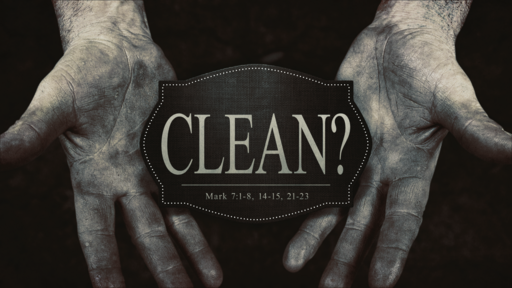

Mark 7:1-8, 14-15, 21-23 (Evangelical Heritage Version)
1The Pharisees and some of the experts in the law came from Jerusalem and gathered around Jesus. 2They saw some of his disciples eating bread with unclean (that is, unwashed) hands. 3In fact, the Pharisees and all the Jews do not eat unless they scrub their hands with a fist, holding to the tradition of the elders. 4When they come from the marketplace, they do not eat unless they wash. And there are many other traditions they adhere to, such as the washing of cups, pitchers, kettles, and dining couches. 5The Pharisees and the experts in the law asked Jesus, “Why do your disciples not walk according to the tradition of the elders? Instead they eat bread with unclean hands.”
6He answered them, “Isaiah was right when he prophesied about you hypocrites. As it is written:
These people honor me with their lips, but their heart is far from me.
7They worship me in vain, teaching human rules as if they were doctrines.
8“You abandon God’s commandment but hold to human tradition like the washing of pitchers and cups, and you do many other such things.”
14He called the crowd to him again and said, “Everyone, listen to me and understand. 15There is nothing outside of a man that can make him unclean by going into him. But the things that come out of a man are what make a man unclean.
21In fact, from within, out of people’s hearts, come evil thoughts, sexual sins, theft, murder, 22adultery, greed, wickedness, deceit, unrestrained immorality, envy, slander, arrogance, and foolishness. 23All these evil things proceed from within and make a person unclean.”
Clean?
I.
“This is an absolute disaster!” Each recruit was standing at attention next to his bunk in the barracks while the drill sergeant inspected everything from the way each bed was made, to the meticulous order clothing was stored in closets, to the shine on each recruit’s boots, to the way he wore his uniform.
Every day, without fail, the drill sergeant was able to find some private who’s cleanliness or orderliness simply didn’t meet the standards for “his” barracks or “his” soldiers. That private would have lots of work to do to get everything in order, because the bed would be overturned, everything in the closet dumped on the floor, the boots would be even more scuffed by the drill sergeant stepping on them and rubbing the shine off.
The whole goal of the religious establishment was to discredit Jesus. They had already taken the opportunity to level one of their major charges against him; they accused him of being in league with Satan. They had said: “He is possessed by Beelzebub... He drives out demons by the ruler of demons” (Mark 3:22, EHV).
It was important to them to tag him with another major charge. They wanted to establish that Jesus was a sinner. Part of their efforts to do that involved proving that he sanctioned breaches of the traditional laws in others—and that he committed such offenses himself.
“The Pharisees and the experts in the law asked Jesus, “Why do your disciples not walk according to the tradition of the elders?” (Mark 7:5, EHV).
“Are you cleansed and purified?” Maybe I’m the only pastor who asked in that particular way whether my kids had washed their hands before dinner or not. Maybe I scarred my children for life with my strange Bible references peppered in daily conversation.
I just wanted to know whether my kids had washed their hands before sitting down to eat. The Pharisees, by contrast, found the disciples’ failure to have a ceremonial cleansing a serious breach of etiquette—and even more—a violation of the ceremonial law.
Their objections were just like a drill sergeant confronting a private in the barracks. The ceremonial washing was an intense ritual. A person had to make sure that the water used had been set apart only for such ceremonial washings—maybe like holy water. A very specific amount of water had to be used: a measure equal to one and a half “egg-shells.” Each hand was rubbed with the fist of the other hand. The water had to be poured on both hands; the hands were lifted up so the water would run down to the wrists to make sure the whole hand was washed. If the water didn’t run down to the wrist, the hands were not clean. There were even more specifics than this to the ceremonial washing that was considered “absolutely necessary.”
If Jesus didn’t put the brim of his drill sergeant campaign hat right into the face of his disciples to berate them for not following the rules, clearly he must be a sinner, too.
There was a problem with the accusations against Jesus and his disciples. The Pharisees and experts in the law actually mentioned it themselves. They called this ceremonial washing “the tradition of the elders.”
“He answered them, ‘Isaiah was right when he prophesied about you hypocrites. As it is written: These people honor me with their lips, but their heart is far from me. 7They worship me in vain, teaching human rules as if they were doctrines’” (Mark 7:6-7, EHV).
All this hand-washing wasn’t actually the ceremonial law of Moses, but something that had been developed over time. Regulations from Moses concerning hand washing had only been given to the priests serving in the Tabernacle or Temple. Could they really accuse Jesus or his disciples of sin when the “regulations” were only traditions? The religious establishment acted as though traditions were really doctrine—things that God had commanded for everyone.
Can you imagine making a church uniform a requirement? It could be said that some have done that. Those who weren’t wearing the “right” clothing weren’t welcome at worship. Can you imagine insisting that every part of a worship service must be done in a certain style? Hymnal controversies of the past sometimes insisted new worship styles were sin—almost, at least.
II.
“He called the crowd to him again and said, ‘Everyone, listen to me and understand. 15There is nothing outside of a man that can make him unclean by going into him. But the things that come out of a man are what make a man unclean’” (Mark 7:14-15, EHV).
Washing the hands a certain way was only a tradition of the elders. Clean and unclean foods were actually part of the Ceremonial Law. Moses gave dietary restrictions. Some foods Jewish people were allowed to consume, others they were not. Jesus tells the crowds that true “uncleanness” does not come from lack of washing, or even from eating the wrong foods. Real uncleanness comes from the inside.
In today’s Second Reading Paul said: “But Israel, while pursuing the law as a way of righteousness, did not reach it. 32Why? Because they kept pursuing it not by faith, but as if it comes by works. They stumbled over the stumbling stone” (Romans 9:31-32, EHV). That’s exactly what the Pharisees were demanding of Jesus’ disciples: that they pursue righteousness by works. The Pharisees thought they were quite righteous because they believed they had done a good job of adhering to all these traditions of the elders. That doesn’t make a person right with God, however. They were unclean by their very nature, not merely because of what they did or failed to do.
“In fact, from within, out of people’s hearts, come evil thoughts, sexual sins, theft, murder, 22adultery, greed, wickedness, deceit, unrestrained immorality, envy, slander, arrogance, and foolishness. 23All these evil things proceed from within and make a person unclean” (Mark 7:21-23, EHV). Real uncleanness is much more serious than violating a tradition of the elders. It’s even more serious than an actual breach of the Ceremonial Law God prescribed to his Old Testament people for worship.
If you are concerned about traditions and the ways some might violate them, take a look in the mirror of God’s Law at all the evil things inside yourself.
Some things go beyond violating tradition. You might be quick to see the flaws and faults in others, whether it’s actual criminal activity or merely being Christians who don’t display faith as well as you think they should. If you take note of sin in others, don’t fail to look in the mirror of God’s Law at your own sinful heart. All kinds of evil lurks inside.
Paul talked about the Jews pursuing the law as a way to righteousness and failing. But you and I can do the same thing. Being too quick to point out the flaws and faults in others but failing to recognize all the evil things that lurk inside our own hearts make us unrighteous, unclean, the same as anyone else.
III.
One day when I was quite young I had to stand for inspection after taking a bath. “Did you wash your neck?” my mother asked. “Of course,” I answered, “I’m perfect!” What I really was, was a liar; I knew it, but thought maybe I could get away with it. Without thinking I had been stretching out my neck in mock innocence as I declared my perfection, but there was the evidence as clear as could be: a nice, unmistakable ring of dirt around my neck. An imperious finger directed me right back to the bathroom to do a better job.
Drill sergeants were nothing new to me when I first got to basic training. “Nobody’s perfect,” goes the old saying, and if your drill sergeant looked long enough and hard enough they could find the one t-shirt that wasn’t quite rolled perfectly in your closet.
The Pharisees only wanted outward cleanliness. They wanted the ritual followed to the letter.
But how does one truly get clean? The answer was literally standing right in front of them. Jesus alone could keep God’s Moral Law absolutely perfectly. Jesus alone could be the sacrifice all those sacrifices of the Ceremonial Law had been pointing to for centuries.
Paul says: “Gentiles, who were not pursuing righteousness, have obtained righteousness, a righteousness that is by faith” (Romans 9:30, EHV). True righteousness, truly being clean, does not come by pursuing it, by trying really, really hard to keep God’s Moral Law perfectly.
A person can only stand before the throne of God as righteous by faith, but faith in what? Paul ends today’s Second Reading by telling us: “For to everyone who believes, Christ is the end of the law, resulting in righteousness” (Romans 10:4, EHV). Faith in Jesus is the only answer. Faith in Jesus is the only way for us to be clean.
IV.
“Are you cleansed and purified?” When you get right down to it, my question paraphrased James: “Cleanse your hands, you sinners, and purify your hearts, you double-minded people” (James 4:8, EHV). Double-minded people are believers, people who are sinner-saints, people who know the only way to be truly cleansed and purified is in Jesus.
We are cleansed and purified in Jesus. Now that he has made you clean, live your life in thanks to God. After all, no longer do all those things lurking within define you. No longer does a superficial spit-shine of your outward actions define you, either.
Day after day, make a commitment to live as God wants. Day after day, come back to him for mercy when you don’t live up to all he wants from you. What defines you is the Lord Jesus who lives inside you. What defines you is Jesus, who has made you truly clean. There’s no ring of dirt around your neck to mar your perfection; Jesus makes you truly clean before God. That cleansing will last for all eternity. Amen.
