Perspective

Notes
Transcript
You’ve likely heard the phrase, “The patience of Job.” Have you read the book of Job? It’s an interesting book. You could read chapters 1 & 2, and then skip to chapter 42, and basically know the whole story. Yet the book is 42 chapters long!
There is much to learn in this book and I promise not to spend 42 weeks going through it. So as you breathe a sigh of relief, some back ground.
Who was Job? When did he live? We just read an introduction and yet we know very little about him. He is not mentioned in any lineage. The time of Job has been suggested to be as early as the patriarchs (such as Abraham) to as late as Moses. However the writing of Job likely took place sometime between 1500 and 500 BC. He is mentioned in Ezekiel 14, and James 5, but other than that we don’t know anything about him other than what is said in this book.
Let’s be honest for a moment here.
Have you ever been angry with God? This book is for you.
Have you ever felt there was no purpose for what was happening around you? This book is for you.
Have you ever wanted to shout at God? This book is for you.
Have you ever sought to console a friend going through challenging times? This book is for you.
The book of Job challenges us because it will look at tragedy, our reactions, consoling friends, and perspectives. And that’s where we’re going to start.
So let’s dive in -
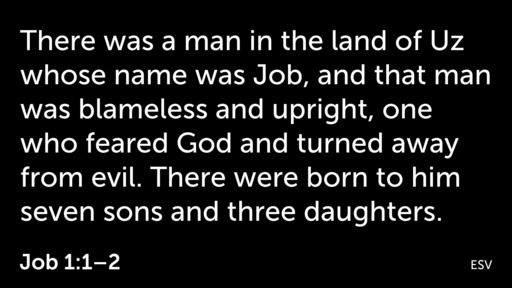
There was a man in the land of Uz whose name was Job, and that man was blameless and upright, one who feared God and turned away from evil.
The book opens with a description of Job’s heart, he’s blameless and upright, fears God and turns away from evil.
First of all, doesn’t that describe what all of us strive to be? We seek to do the right thing, we recognize God’s power, and seek to turn from evil.
Again this describes Job internally - his heart. The next verses describes him from an external point of view:
There were born to him seven sons and three daughters. He possessed 7,000 sheep, 3,000 camels, 500 yoke of oxen, and 500 female donkeys, and very many servants, so that this man was the greatest of all the people of the east.
Note that last statement: This man was the greatest of all the people in the east. Clearly the author seeks to set Job’s virtue and his social stature above everyone else.
Then we get a glimpse of his commitment not only for himself but for his children as he would make sacrifices on their behalf.
And then we get to this point where we get a glimpse into the heavenly realm, it’s sort of like the pulling back of the curtain we get to see what’s happening in the back ground. The sons of God came to present themselves before the Lord - “Sons of God” refers to heavenly beings gathered before God like a council before a king.
And Satan is there. Wait! What?
Apparently Satan crashes the party. It says that “Satan also came among them.” which seems to imply that he wasn’t invited. And then this conversation takes place.
Satan has been going to and fro on the earth and then we get into perhaps the scariest part of the book of Job, vs. 8
And the Lord said to Satan, “Have you considered my servant Job, that there is none like him on the earth, a blameless and upright man, who fears God and turns away from evil?”
So many things. There is almost a sense of pride the Lord seems to have regarding Job. Thus far in Job, he’s been listed as the greatest man of the East, and now the God of all creation says, “there is none like him on the earth.”
Satan counters, “Does job fear God for no reason?”:
As you read through Job, watch for “the reason” . Satan continues claiming that God has put a hedge around him and his house and all that he has, blessing his work and his possessions.
But stretch out your hand and touch all that he has, and he will curse you to your face.”
And how does God respond?
And the Lord said to Satan, “Behold, all that he has is in your hand. Only against him do not stretch out your hand.” So Satan went out from the presence of the Lord.
That’s where we’re at. And what happens? in the next verses in this chapter we have one tragedy after another taking place.
The oxen and donkeys are taken by the Sabeans and the servants are killed saved one who brings news of the tragedy.
While he’s speaking another messenger arrives and tells him how “the fire of God fell from heaven and burned up the sheep and the servants” and the messenger alone survived to come tell him.
While he was speaking another messenger arrives and tells Job how the Chaldeans came and made a raid on the camels and took them, striking down all the servants save one who is bringing the message.
While he’s still speaking another comes and speaks about a great wind that knocked down the house upon Job’s children, and only the servant has escaped to tell him.
The tragedies come from the south, the north, from the east, and from heaven itself. In fact you could say that two of the tragedies are from people groups - North and South, and two are brought seemingly from God’s domain the heavens themselves and the weather.
Few if any of us can possibly imagine such tragedy. This is calamity upon calamity and then we see Job’s reaction.
Then Job arose and tore his robe and shaved his head and fell on the ground and worshiped.
He shaved his head - a symbol of mourning
He fell on the ground - any of us would feel so overwhelmed by such tragedies to the point of collapse.
He worshiped? - What? Really?
Can anyone imagine responding in such a way? You lost everything you owned, everything you had, and your reaction is to worship?
We read Job’s response:
And he said, “Naked I came from my mother’s womb, and naked shall I return. The Lord gave, and the Lord has taken away; blessed be the name of the Lord.”
and we’re told, Job 1:22 “In all this Job did not sin or charge God with wrong.”
This all seems beyond imagination, an ideal that does not make sense to anyone who’s dealt with tragedy in their own life. I’ve walked along side people as they experienced unfathomable losses - loss of wealth, loss of children, divorce, incurable disease - their reactions were broad. Some had a deep faith. I can say some worshiped in the broadest sense.
In the midst of their tragedies their first reaction was to be driven to prayer. In so doing among their first prayers was “Lord, I don’t understand.”
But the key here is that you and I are given a view behind the curtain. You see, we know what is happening here based upon the prologue that gave us a view into the heavenly realms. Yet our main character, Job, is not given such a view.
He doesn’t know what’s happening.
He doesn’t understand why any of this is happening.
He has no knowledge of the conversation between God and Satan. He has no understanding of how in that conversation God in one statement bragged about him and set him up. He has no knowledge of that.
For us here, we have seen this conversation, and we know what’s going on “behind the scenes”. That doesn’t mean we understand it any better. Why is God serving up any one for Satan to torment?
Job, even according to God, did everything right! Yet God himself says, “Have you considered my servant Job?” Unlike the tests we’ve seen of the patriarch’s such as Abraham’s test to offer his son Isaac (Genesis 22), or Moses’ test of being sent to speak to Pharaoh while God continued to harden Pharaoh’s heart: Job’s test doesn’t seem to be for any reason.
In fact God would even say it was without reason in verse 3 in the next chapter.
Job 2:3 (ESV)
And the Lord said to Satan, “…you incited me against him to destroy him without reason.”
In these first two chapters we are given a perspective that Abraham, Moses, and now Job were not. We see this scene in the heavenly realm.
So as we consider this book I think it’s important we take that into consideration. The entire premise of Job seems to be more illustrative than an actual happening. It’s a parable or teaching story that reveals to us both the superlative standard we are called to live by AND that there is much going on behind the scenes that we will never be aware of this side of glory.
The apostle Paul wrote to the Ephesian church Eph 6:12
For we do not wrestle against flesh and blood, but against the rulers, against the authorities, against the cosmic powers over this present darkness, against the spiritual forces of evil in the heavenly places.
THAT is the reality.
People that are not of faith will tell you that this is all there is. This world is all there is. We came from nothing, they will say. Really? How does that work? Have you ever seen anything come from nothing?
No. they’ll tell us.
So what happens when you die? You just go back to nothing.
Wait, so we’re reunited with our creator?
Okay, I’m kidding.
The truths that Job makes clear:
There is a heavenly realm that we don’t see.
What we see as bad things are going to happen for reasons we don’t know.
God is on his throne and ultimately in control.
There is so much more for us in the book of Job, I hope that you will stay with us through this series and we will get deeper into lessons that apply to our everyday life.
The book of Job will give us
Perspective
Perspective
In our life, perhaps the most difficult thing to remember is that God is on his throne.
We will face challenges, tragedies, crises, and nothing that happens in our lives will change the fact that He remains on the throne.
God is our Creator.
God remains sovereign.
God remains in control.
For that reason, God is worthy and deserving of glory.
To the praise of His glorious grace, AMEN!
