Ephesians 3.19a-The Church Age Believer Experiencing Jesus Christ's Love for Them

Wenstrom Bible Ministries
Pastor-Teacher Bill Wenstrom
Tuesday September 10, 2024
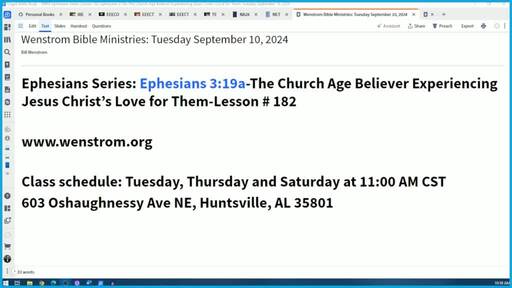
Ephesians Series: Ephesians 3:19a-The Church Age Believer Experiencing Jesus Christ’s Love for Them
Lesson # 182
Ephesians 3:14 For this reason, I make it my habit of bending my knees in the presence of the Father 15 from whom each and every family located in the heavens as well as located upon the earth is designated a name. 16 I make it a habit of occupying myself with praying that according to the wealth produced by His glory He would cause each and every one of you as a corporate unit to be given strength by means of power through the personal intermediate agency of His Spirit for the benefit of your inner being. 17 Namely that the one and only Christ’s power would dwell in your hearts through your faith …because each and every one of you are firmly rooted, yes specifically, because of all of you without exception are firmly established by means of the practice of divine-love, 18 each and every one of you as a corporate unit would cause yourselves to be able to fully comprehend with each and every one of the saints what constitutes being the breadth, length, height and depth (of Christ’s love for each and every one of you as a corporate unit). 19 Ultimately, to cause each one of you as a corporate unit to know the one and only Christ’s love for all of you without exception, which in comparison is an incomprehensible knowledge, in order to cause each one of you as a corporate unit to fulfill the purpose of experiencing the absolute fullness, namely, the one and only God’s love for all of you without exception. (Lecturer’s translation)
Ephesians 3:19 is composed of the following:
(1) complementary infinitival clause: gnōnai…tēn hyperballousan tēs gnōseōs agapēn tou Christou (γνῶναί…τὴν ὑπερβάλλουσαν τῆς γνώσεως ἀγάπην τοῦ Χριστοῦ), “to cause each one of you as a corporate unit to know the one and only Christ’s love for the benefit of all of you without exception, which in comparison is an incomprehensible knowledge.” (Author’s translation)
(2) hina (ἵνα) purpose-result clause: hina plērōthēte eis pan to plērōma tou theou (ἵνα πληρωθῆτε εἰς πᾶν τὸ πλήρωμα τοῦ θεοῦ), “in order to cause each one of you as a corporate unit to fulfill the purpose of experiencing the absolute fullness, namely, the one and only God’s love for all of you without exception.” (Author’s translation)
The complementary infinitival clause advances upon and intensifies the one which appears in Ephesians 3:18.
The latter expresses Paul’s Spirit inspired desire that the recipients of this epistle would cause themselves to be able to fully comprehend with each and every one of the saints what constitutes the breadth, length, height and depth.
The former expresses his Spirit inspired desire that they know experientially Jesus Christ’s love for them.
Therefore, the advancement and intensification is between “comprehending” and “knowing experientially” Jesus Christ’s love for the recipients of this epistle.
This interpretation is indicated by the fact that in Ephesians 3:18, the verb katalambanomai (καταλαμβάνομαι) speaks of the recipients of this epistle grasping the nature, significance or meaning of the four dimensions of Christ’s love for them.
On the other hand, as we will note, in Ephesians 3:19, the verb ginōskō (γινώσκω) speaks of the recipients of this epistle “knowing experientially” Jesus Christ’s love for them.
The latter is an advancement upon the former because it requires that the believer accept by faith Jesus Christ’s love for them, which gives them the capacity to practice the Lord’s command in John 13:34 and 15:12 to love one another as He loved the church age believer.
To “comprehend” something is to grasp it with the intellect.
However, to “experience” something is to personally encounter it.
The verb ginōskō (γινώσκω) speaks of the recipients of this epistle “knowing” the Lord Jesus Christ’s love for them “experientially” in the sense of personally encountering this love through the process of experiential sanctification (i.e., fellowship) as this love is revealed in the pages of Scripture and in prayer by God the Holy Spirit.
It also involves being affected by this encounter with the Lord’s love for them resulting in the gaining of practical spiritual wisdom and more of the character of Christ.
Like the verb katalambanomai (καταλαμβάνομαι) in Ephesians 3:18, the infinitive conjunction of this verb ginōskō (γινώσκω) here in Ephesians 3:19 functions as a complementary infinitive.
This means that like the former, the latter is also completing the thought of the second person plural aorist active subjunctive conjugation of the verb exischuō (ἐξισχύω), “each and every one of you as a corporate unit would cause yourselves to be fully able,” which also appears in Ephesians 3:18.
Thus, like the verb katalambanomai (καταλαμβάνομαι) in Ephesians 3:18, the verb ginōskō (γινώσκω) here in Ephesians 3:19 identifies for the reader what Paul wants the recipients of this epistle to be fully able to do.
Therefore, these two verbs exischuō (ἐξισχύω) in Ephesians 3:18 and the ginōskō (γινώσκω) in Ephesians 3:19 express the idea of the recipients of this epistle causing themselves to be able to fully know Jesus Christ’s love for each of them experientially.
The aorist tense of this verb ginōskō (γινώσκω) is a constative aorist, which describes in summary fashion the idea of the recipients of this epistle possessing an experiential knowledge of Jesus Christ’s love for them.
The aorist tense is not an ingressive aorist, which would express the idea of the recipients of this epistle “entering into the state of” possessing this experiential knowledge of the Lord’s love for them.
This interpretation is indicated by the fact that in Ephesians 1:15, Paul affirmed that the recipients of this letter were already practicing the command to love one another, which along with their justifying and post-justification faith, was the reason why he interceded in prayer to the Father for them on a regular basis.
Therefore, they already possessed an experiential knowledge of Jesus Christ’s love for them as manifested by the fact that they were already obeying the Lord’s command to love one another as He has loved them (cf. John 13:34; 15:12).
The active voice of this verb is a causative active, which indicates that the recipients of this letter are the ultimate cause of possessing an experiential knowledge of Jesus Christ’s love for them.
This is indicated by the fact that they must exercise faith in the Spirit inspired contents of this letter in order to appropriate the power of the Holy Spirit, which enables them to be able to fully grasp the Lord’s love for them.
Thus, the Holy Spirit is the one who enables them to know Jesus Christ’s love for them experientially.
The noun agapē (ἀγάπη), “love” does not refer to the function of human love but rather the exercise of divine-love because it originates from the character and nature of the triune God (1 John 4:8).
It is also reproduced in the church age believer by the Holy Spirit when the believer exercises faith in the Spirit inspired contents of Scripture and in context, the Ephesian epistle (Gal. 5:22-23).
This post-justification faith provides the church age believer the capacity to practice the command to love another as Christ loves them.
God’s attribute of love is experienced by the child of God and reproduced and manifested in them by God the Holy Spirit when they respond to God’s love for them by accepting by faith this love for them.
This faith is demonstrated by their obedience to the Son’s Spirit inspired command in John 13:34 to love one another as He loves and which command originates with the Father.
Obedience to this command manifests the believer’s love for God according to John 14:15 and 1 John 4:21.
Therefore, when the child of God obeys the command to love their fellow child of God, it is a love which is divine in quality and character because is resides in the character and nature of God and is reproduced in the Christian by the Spirit when they obey this Spirit inspired command.
This reproduction of the love of God in the life of the child is called “the fruit of the Spirit” by the apostle Paul in Galatians 5:22.
As was the case in Ephesians 1:9, 12, 2:6, 7, 10, 13, 3:6, 8, 11 and 17, the proper name Christos (Χριστός) here in Ephesians 3:19 refers of course to Jesus of Nazareth.
It used to describe the incarnate Son of God as well as His person and work and what He has accomplished in history through this work as well as His status in relation to creation and every creature.
Thus, it also describes His relationship to the church.
The articular construction of this word Christos (Χριστός) indicates that the referent of this word is in a class by himself and the only one deserving of the name since there were many individuals in the first century A.D. who claimed to be the Christ or were proclaimed to be the Christ.
In other words, it speaks of the incomparability of Jesus of Nazareth in that He is true Messiah and contrast to those who claim they are but are not.
The proper name Christos (Χριστός), “the one and only Christ” functions as a subjective genitive, which means that the genitive substantive functions semantically as the subject of the verbal idea implicit in the head noun, which is the noun agapē (ἀγάπη).
Therefore, this construction speaks of Jesus Christ’s love for the church age believer rather than the church age believer’s love for Him.
Constantine Campbell writes “While ἀγάπην τοῦ Χριστοῦ (“love of Christ”) could be understood as referring to believers’ love for Christ (taking τοῦ Χριστοῦ as an objective genitive), in this context it clearly refers to Christ’s love (taking τοῦ Χριστοῦ as a subjective genitive; Fowl, 122; Merkle, 108; Larkin, 64). If Paul had meant believers’ love, he would hardly pray for them to be able to comprehend or know it, and he would not describe it in such superabundant terms.”
