Handling Guilt

Notes
Transcript
Overcoming Guilt
Online Sermon:
http://www.mckeesfamily.com/?page_id=3567
The mind’s capacity to remember thoughts, emotions,
and events is a remarkable gift, but it can also be a source of
profound pain. On one hand, it is a blessing to recall the beauty
of cherished moments—walking on the beach as the sun sets,
feeling the warmth
of the breeze, or
reflecting on lifechanging milestones
like marriage, the
birth of a child, or
the day we said
"Yes" to Jesus,
becoming
new
creations in Christ.
These memories bring joy and gratitude, reminding us of God’s
goodness. But how often do we find ourselves dwelling on the
mistakes we've made, wondering if we'll ever truly be free from
the shame of our past? Not all memories are pleasant; they can
also dredge up painful reminders of our sins, mistakes, and
moments of rebellion against God, often leading to
overwhelming guilt and shame.
1
Taken from the book You are What you Think, loc. 1466.
1|Page
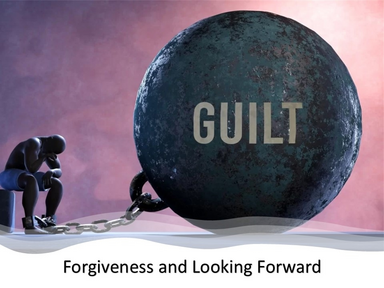
John Powell aptly describes guilt as a "small pebble
lodged in our shoe"—a constant, nagging pain that hinders us
from walking freely.1 Guilt pulls us back into the past, where
we futilely attempt to rewrite what is already done. But when
guilt arises from our sins, this reflection, as the Apostle Paul
writes, is a good thing because it can lead to "godly sorrow,"
which brings repentance and healing (2 Corinthians 7:9-10).
Even though Scripture
assures us that our sins,
once confessed, are
washed "white as snow"
(Isaiah 1:18) and
removed "as far as the
east is from the west"
(Psalm 103:12), we
often struggle to forgive
ourselves. When we
replay shameful events in our minds, it fuels anger and despair.
Have you ever felt like the weight of your past sins is
something you just can’t shake, no matter how much you’ve
confessed them to God? Today’s sermon will address this
form of false guilt, offering hope through the truth that there is
no condemnation for those in Christ Jesus. As God no longer
keeps a record of confessed sins, neither should we.
Looking Back with Regret
Throughout Scripture, even the most faithful men and
women of God wrestled with deep feelings of regret and guilt.
Let’s explore a few examples where they confronted their past
mistakes and encountered God’s grace in their brokenness. After
King David committed adultery with Bathsheba and arranged
the death of her husband, Uriah, he was confronted by the
prophet Nathan, which brought his sin into sharp focus.
Overwhelmed with
guilt,
David
penned Psalm 51,
appealing to God's
unfailing
love
(hesed) as the basis
for his forgiveness.
Through
this
prayer
of
repentance
and
brokenness, David
found assurance that God no longer despised him. Similarly,
after Peter denied Jesus three times, he wept bitterly when he
heard the rooster crow. Stricken with guilt, Peter abandoned his
calling and returned to fishing. It took three affirmations from
Jesus, the Good Shepherd, instructing him to care for His sheep,
for Peter to be restored to his divine mission (John 21). Apostle
Paul also struggled with overwhelming guilt, having been a
blasphemer and persecutor of Christians. Yet, after encountering
the risen Christ on the road to Damascus, Paul was transformed
by God’s grace and became a powerful witness, filled with joy
2|Page
and purpose (1 Timothy 1:13-14; Acts 9). Let’s now take a
moment to reflect on how these men of God overcame their guilt
and allowed His grace to redeem their lives.
Letting Go of Guilt
The first step to overcoming guilt is learning to
remember rightly. Despite the complexities of our minds, we
often recall events through the distorted lens of our own sin and
biases. Being born again does not mean the old sinful nature is
completely eradicated. As the Apostle John reminds us, "If we
claim to be without sin, we deceive ourselves and the truth is not
in us" (1 John 1:8). Though
Paul exhorts us to “count
ourselves dead to sin” and
not let it reign in our bodies
(Romans 6:9-11), we still
battle against our earthly
nature (Colossians 3:5). This
sinful lens can lead us to
either rewrite our past to
make it seem more acceptable or judge ourselves too harshly,
believing a “wretch like me” could never be forgiven, like Peter
was. To truly overcome guilt, we must put on the lens of truth.
Since we cannot hide from God's perfect discernment, we
should, like David, ask, "Search me, O God, and know my heart;
test me and know my anxious thoughts. See if there is any
offensive way in me and lead me in the way everlasting" (Psalm
139:23-24). Only through God’s eyes, the One who “knit us
together in our mother’s womb,” can we discern whether our
guilt is calling us to repentance or merely a false burden over
sins already forgiven.
The second step to overcoming guilt is confessing one's
sins. When King David sinned, his initial reaction was to hide it.
After committing adultery with Bathsheba and discovering her
pregnancy, he tried to cover it up by calling her husband, Uriah,
back from the battlefield, hoping he would sleep with her and
conceal the truth.
When this failed,
David had Uriah
killed and married
Bathsheba,
believing his secret
was safe—until the
prophet
Nathan
exposed
his
wrongdoing.
The
crushing weight of
David’s guilt as both an adulterer and a murderer could only be
lifted through confession. In Psalm 51, David poured out his
heart to God, saying, "For I know my transgressions, and my sin
is ever before me. Against You, You only, have I sinned and
done what is evil in Your sight" (verses 3-4). True freedom from
guilt comes when we acknowledge our sins before God, seek His
forgiveness, and rely on His strength to turn from them, allowing
us to be cleansed and restored.
The third step to overcoming guilt is forgiving oneself
and relying on God’s grace. Martin Luther, in his early years as
a monk, grappled with deep feelings of unworthiness before
3|Page
God, believing that no amount of confession or good works
could secure his forgiveness. His obsession with earning grace
through his own efforts led him to spend hours confessing even
trivial sins. This intense inner turmoil drove him to study
Scripture, where he ultimately discovered the doctrine of
justification by faith alone,
a revelation that became
central to the Reformation.
Similarly, the Apostle Paul,
in Romans 7, expresses his
own struggle with sin,
lamenting his inability to do
the good he desires. He
exclaims, “What a wretched
man I am! Who will rescue me from this body that is subject to
death?” (v. 24). Paul finds his answer in Christ, acknowledging
that it is through Him that he is set free from sin and death
(Romans 8:1-2). Both Luther and Paul illustrate that true
freedom from guilt comes not from self-effort, but through faith
in Christ's redemptive work.
Even after confessing our sins and accepting God’s
forgiveness, guilt can sometimes resurface, trying to steal our
peace. This recurring guilt is often a tactic of the enemy, who
wants to keep us bound in shame and self-condemnation. When
we find ourselves repeatedly haunted by past sins, we must stand
firm in the truth of God's Word, which declares, 'There is now
no condemnation for those who are in Christ Jesus' (Romans
8:1). In these moments, we should remind ourselves that God
has already forgiven us, and we can choose to reject the enemy's
lies by recalling God's promises. One practical way to overcome
recurring guilt is to speak Scripture over our lives, such as 1 John
3:20: 'If our hearts condemn us, we know that God is greater than
our hearts, and he
knows
everything.'
Through
prayer,
Scripture meditation,
and fellowship with
other believers, we can
train our minds to focus
on God's grace instead
of guilt. But while we
may learn to shift our
focus, the enemy often
tries to bring our forgiven sins back into the spotlight, causing
us to dwell on past mistakes.
sharp stone in your shoe, constantly pricking you, making it
difficult to move forward. This is why the Apostle Paul urges us
to "forget what is behind and strain toward what is ahead,"
pressing on toward the prize God has called us to in Christ Jesus
(Philippians 3:13-14). While reflecting on past sins can offer
wisdom to help avoid repeating them, we must not allow guilt
over forgiven sins to trap us in shame. God has already removed
those sins from us "as far as the east is from the west" (Psalm
103:12), freeing us to walk in His grace and press forward in
faith.
This brings us to the final step of overcoming guilt: not
allowing past sins, already confessed and forgiven, to hold us
captive any longer. Have you ever
felt that no matter how much you’ve
confessed your sin, it keeps creeping
back into your thoughts? We must
make the conscious decision to stop
replaying those moments in our
minds, because God has already
removed them from us. Have you
ever found yourself replaying a past
sin so clearly that it feels as though it
just happened, only to be
overwhelmed by the memory of
fleeting pleasure followed by crushing guilt? This can feel like a
In conclusion, overcoming guilt is a process that requires
us to align our thoughts with God’s truth, confess our sins,
embrace His grace, and release what He has forgiven.
Practically, this means daily renewing our minds by dwelling on
Scripture rather than our past mistakes (Romans 12:2). When
guilt arises, examine whether it is leading you to genuine
repentance or is simply a false burden. Confess your sins
sincerely, knowing that God is faithful to forgive (1 John 1:9).
Finally, stop revisiting sins that have already been forgiven.
Learn from them, but don’t let them chain you in shame. Instead,
focus on Christ’s sacrifice, which has set you free, and move
forward in the newness of life He has given you. Remember,
God calls us not to be trapped in guilt but to walk in the freedom
and joy of His grace, always pressing on toward the goal of our
heavenly calling.
4|Page
Conclusion
For the closing prayer, I invite you to take a moment to
reflect on any areas in your life where you may be carrying guilt
or shame. If there are sins you have not yet brought before the
Lord, confess them now and stand firmly on His promise that He
is faithful to forgive and cleanse you from all unrighteousness.
For those who have already sought forgiveness but find that the
enemy continues to use past sins to burden you with guilt, ask
the Good Shepherd to intervene. Pray that He would help you
remember rightly—that His blood has fully covered your sin,
and that there is no condemnation for those who are in Christ
Jesus. Let us take a moment of silent prayer to seek His grace
and freedom.
5|Page
