Genesis 3:1-15 The Tree of Rebellion
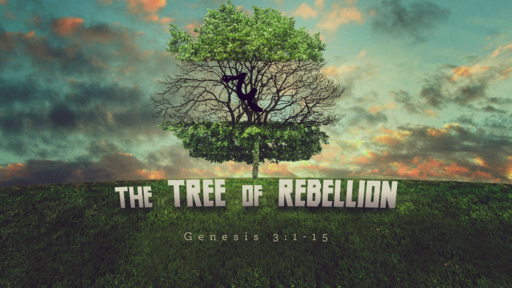

Genesis 3:1-15 (Evangelical Heritage Version)
1Now the serpent was more clever than any wild animal which the LORD God had made. He said to the woman, “Has God really said, ‘You shall not eat from any tree in the garden’?”
2The woman said to the serpent, “We may eat fruit from the trees of the garden, 3but not from the fruit of the tree that is in the middle of the garden. God has said, ‘You shall not eat from it. You shall not touch it, or else you will die.’”
4The serpent said to the woman, “You certainly will not die. 5In fact, God knows that the day you eat from it, your eyes will be opened, and you will be like God, knowing good and evil.”
6When the woman saw that the tree was good for food, and that it was appealing to the eyes, and that the tree was desirable to make one wise, she took some of its fruit and ate. She gave some also to her husband, who was with her, and he ate it. 7The eyes of both of them were opened, and they realized that they were naked. They sewed fig leaves together and made coverings for their waists. 8They heard the voice of the LORD God, who was walking around in the garden during the cooler part of the day, and the man and his wife hid themselves from the presence of the LORD God among the trees of the garden.
9The LORD God called to the man and said to him, “Where are you?”
10The man said, “I heard your voice in the garden, and I was afraid, because I was naked, so I hid myself.”
11God said, “Who told you that you were naked? Have you eaten from the tree from which I commanded you not to eat?”
12The man said, “The woman you gave to be with me—she gave me fruit from the tree, and I ate it.”
13The LORD God said to the woman, “What have you done?”
The woman said, “The serpent deceived me, and I ate.”
14The LORD God said to the serpent:
Because you have done this,
you are cursed more than all the livestock,
and more than every wild animal.
You shall crawl on your belly,
and you shall eat dust all the days of your life.
15I will put hostility between you and the woman,
and between your seed and her seed.
He will crush your head,
and you will crush his heel.
The Tree of Rebellion
Christmas Trees is the overall theme of our Midweek Advent services this year. The Christmas tree is the most widely recognized symbol of the season. Long, long ago, other religions had used evergreen branches to represent eternal life. In the 16th century the Lutherans in Germany took the next step. They brought into their homes freshly cut evergreen trees. They decorated the trees with red ornaments, symbolizing the blood of Christ, and candles, symbolizing the light of Jesus. At the top of the tree was a star or an angel, both important in the account of Jesus’ birth. The Christmas tree is an important part of our Christmas celebration. We still decorate our homes with them, and the sanctuaries of most churches, too.
Our midweek worship, however, doesn’t focus on that decorated tree over on the other side of the sanctuary. Instead, we look at some of the trees in Scripture that remind us why the birth of Jesus Christ is still so important—so worthy of celebration.
I.
Today: The Tree of Rebellion.
There it was. Right in the middle of their sanctuary. That word “sanctuary” means a few different things. I just used it to describe places like our church. Another meaning is a place of refuge or safety.
Both applied in the case of Adam and Eve. The Garden of Eden was their sanctuary. It was a place of refuge and safety—it was their home. It was also a place of worship.
It was obvious that God was good. With just a simple look around their Garden sanctuary a person could know it. Everything he had made was beautiful. At the end of the sixth day, after creating all things: “God saw everything that he had made, and indeed, it was very good” (Genesis 1:31, EHV). That means it was perfect. There was not a single flaw anywhere in creation.
In that beautiful Garden sanctuary, Adam and Eve didn’t know any evil—only good. They knew God was good; they knew he was the creator who also provided for them by giving them everything they needed in this Garden of Eden. They even had the privilege of meeting with God on a regular basis, walking with him and talking with him in the Garden.
God established an altar for them in the middle of the Garden sanctuary. It was a tree. This was where they would show their love and reverence for God. Only one command was given; one command by which they would show their total devotion and worship to their Creator God who had shown so much love to them. Don’t eat the fruit from that one tree.
What could be simpler? There was a whole Garden filled with delicious fruits hanging on all kinds of trees. Worship was simple and filled with joy.
II.
The Bible doesn’t say how long it was that Adam and Eve filled their days with worship, avoiding the fruit of that tree in the middle of the garden. Sometime between day seven, when God rested from his creating activities, and the day of our text, the angel called Satan had rebelled against God and had been thrown out of heaven. Satan experienced separation from God.
On the day of our text Adam was standing right there, but Satan, in the disguise of a snake, spoke to Eve. “Has God really said, ‘You shall not eat from any tree in the garden’?” (Genesis 3:1, EHV).
Eve replied:“We may eat fruit from the trees of the garden, 3but not from the fruit of the tree that is in the middle of the garden. God has said, ‘You shall not eat from it. You shall not touch it, or else you will die’” (Genesis 3:2-3, EHV). Eve wanted to be cautious in her worship. If she wasn’t supposed to eat it, she didn’t want to have anything to do with that fruit—she didn’t even want to touch it. It’s a good idea to stay away from temptation.
Satan moved in with his temptation using a half-truth. “You certainly will not die. 5In fact, God knows that the day you eat from it, your eyes will be opened, and you will be like God, knowing good and evil” (Genesis 3:4-5, EHV). Adam and Eve wouldn’t die—not that day, at least. Adam lived more than 900 years, long after this particular day; presumably, Eve lived hundreds of years, too. As for their knowledge, Satan stuck in another half-truth: was it really so evil to eat fruit from a tree? God knew what both evil and good were. If, suggested the snake, Adam and Eve were to eat a piece of fruit from that forbidden tree, they would be like God.
It seems odd to us, too, that God would call it evil to eat fruit from a tree. Keeping their hands off that fruit was all about trust in God. God had assured our first parents that he had given them everything they needed with the rest of the Garden of Eden.
I suppose you could look at God’s Ten Commandments, and all the peripheral things alluded to in that list, as explained by Martin Luther in his Catechism, and think some of that is odd, too. How could it be evil to express love for another human being in other sexual ways than within marriage? How could it be truly evil to steal if you are starving and just need a little food to stay alive? How could it possibly be evil to covet—to have a desire for something? Thoughts, after all, can’t totally be controlled.
III.
Those coveting Commandments were among the first ever broken. “The woman saw that the tree was good for food, and that it was appealing to the eyes, and that the tree was desirable to make one wise” (Genesis 3:6, EHV). Eve hadn’t even reached out her hand to pluck a piece of fruit from the tree before she coveted. She took a close look at that beautiful fruit and started to doubt God. She failed to trust that he had really given every good and perfect gift to herself and her husband.
“She took some of its fruit and ate. She gave some also to her husband, who was with her, and he ate it” (Genesis 3:6, EHV). Coveting is really about that failure to trust God. Adam and Eve coveted; they wanted something more than they wanted God. They wanted to be “like God.”
When God confronted the two about their sin, he approached Adam first. Why do you suppose that is? “The LORD God gave a command to the man. He said, ‘You may freely eat from every tree in the garden, 17but you shall not eat from the Tree of the Knowledge of Good and Evil, for on the day that you eat from it, you will certainly die” (Genesis 2:16-17, EHV). Adam had been given the command. Adam had been put in charge.
Beyond this, Paul reports: “It was not Adam who was deceived, but it was the woman who was deceived” (1 Timothy 2:14, EHV). If Adam wasn’t fooled by the snake—and the Bible says he wasn’t—it was his God-given duty to put a stop to the situation. Adam should have said to Eve, “Eve, snakes don’t talk. Let’s get out of here and find God; he can set everything right.” Instead, Adam went along with it.
So God goes to Adam first for an explanation. Adam points the finger of blame at Eve. When God turns to Eve, she points at the snake and blames him. Both of them were really pointing the blame at God. “You put the woman here, God.” “You put the snake here, God.” “It’s your fault, God, for even putting the tree here in the first place.”
IV.
But right there, at the Tree of Rebellion, the Tree of Knowledge of Good and Evil, the very place Adam and Eve plunged the world into sin, God gave the first promise that he would deal with their sin, and the sin of the world.
“I will put hostility between you and the woman, and between your seed and her seed. He will crush your head, and you will crush his heel” (Genesis 3:15, EHV). Word order is often important in the original languages of the Bible. The verse in Hebrew begins with “hostility” for extra emphasis.
“Hostility I will put...” says God. God promises to place hostility between mankind and Satan. What a promise that is! It isn’t just that the devil hates human beings, but humanity also hates the devil. God also promises a special Seed of the woman. While Satan would manage to crush his heel, the special Seed, Jesus, would crush Satan’s head once and for all.
Christians hear this promise in Genesis again and again. We are told that it is the first promise of the Savior to come. It sounds vague and obscure to us, but Adam and Eve recognized that God was promising to deal with Satan and his lies and empty promises. When their first child was born, they named him Cain. It’s a form of a Hebrew word meaning “to get” or “acquire.” Adam and Eve thought they had gotten the promised Savior already with Eve’s first child.
Thousands of years would go by before that promised Savior would be born. John the Baptist would point to Jesus, as today’s Gospel reminded us. Paul reminded us in the First Reading from the Letter to the Galatians: “Christ redeemed us from the curse of the law by becoming a curse for us. As it is written, ‘Cursed is everyone who hangs on a tree’” (Galatians 3:13, EHV).
The Tree of Rebellion was the beginning, but not the ending. The sin committed beneath that Tree of the Knowledge of Good and Evil points to our desperate need for Jesus to hang on the tree of the cross for us. It points out God’s first gospel promise. “I will put hostility between you and the woman, and between her seed and your seed.”
Jesus came. He crushed the serpent’s head. Our well-lit Christmas trees remind us that the Light of the World didn’t leave us to rot in a sin-filled world, but came to set us free from the curse of sin.
Give thanks this Christmas that the Tree of Rebellion wasn’t the end. God’s gift of Jesus will bring us back to the Tree of Life in heaven. Amen.
