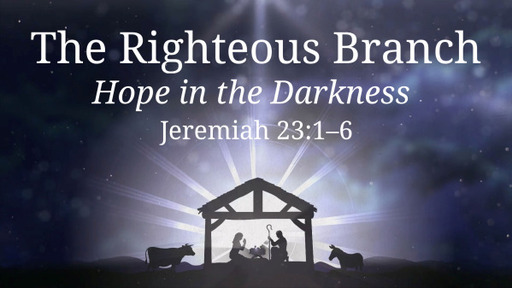
Jeremiah 23:1-6 - The Righteous Branch: Hope in the Darkness
Notes
Transcript
Handout
Introduction:
Americans today face a seemingly overwhelming wave of hopelessness. In 2022 the CDC stated that around 44% of teens in the United States reported feeling persistently sad and hopeless which was up from 37% in 2019 (1). Statistics continue to show increases in hopelessness amongst all ages of Americans - however, our young people appear to be affected at higher rates. Interestingly, times around the holiday’s such as Christmas seem to exacerbate these feelings of hopelessness and loneliness.
What should we do to resolve this hopelessness? Unfortunately, our world continues to peddle a remedy that has proven ineffective time and time again. Programs have been launched in our schools to help with self-esteem and help with emotional regulation and social interaction (2). Millions of dollars have been spent to help our young people feel less hopeless. Countless psychology experts continue to tout the need for kids to have more pride in themselves.
Yet, our nation continues to remain hopeless. In fact, as we have already seen, these so-called remedies are sending our young people into a spiral of hopelessness.
Sadly, our world continues to miss the only place where we can find true hope. True hope isn’t found in ourselves. Esteeming ourselves will only puff us up so that when we inevitably do fail at something, we only have further to fall and further depression to experience. Self-esteem is like standing on a wobbly chair and just waiting for it to tip over. Finding hope in others isn’t any better. Those around us are sinners like we are and will fail us at some point. Our ultimate hope cannot be placed in our spouse, our parents, or our friends. Yes, we should love others and value community, but we cannot expect others to give us something they cannot deliver on.
There is only one place where true hope can be found. And that is in the Righteous Branch - namely Jesus Christ.
Today we are going to see hope in the midst of the darkness. We are going to see Christ appear on the pages of the Old Testament. The promised Messiah who would bring and everlasting hope.
Join me as we get into our Scripture for today.
Read Full Scripture
“Woe to the shepherds who destroy and scatter the sheep of my pasture!” declares the Lord.
Therefore thus says the Lord, the God of Israel, concerning the shepherds who care for my people: “You have scattered my flock and have driven them away, and you have not attended to them. Behold, I will attend to you for your evil deeds, declares the Lord.
Then I will gather the remnant of my flock out of all the countries where I have driven them, and I will bring them back to their fold, and they shall be fruitful and multiply.
I will set shepherds over them who will care for them, and they shall fear no more, nor be dismayed, neither shall any be missing, declares the Lord.
“Behold, the days are coming, declares the Lord, when I will raise up for David a righteous Branch, and he shall reign as king and deal wisely, and shall execute justice and righteousness in the land.
In his days Judah will be saved, and Israel will dwell securely. And this is the name by which he will be called: ‘The Lord is our righteousness.’
Prayer
Today we will see three ways that Christ provides us hope… The first is…
I. We Can Have Hope in the Midst of Suffering (1-2)
I. We Can Have Hope in the Midst of Suffering (1-2)
Jeremiah is known as the weeping prophet. He ministered for some 5 decades in Judah and never saw a revival or a repentance as far as we know. He began serving under the good king, Josiah, around 627 BC. However, after Josiah’s death in 609 BC at the hands of Pharoah Neco of Egypt (2 Kings 23:29-30), the final four kings that served in Judah were all evil kings.
Most commentators think that Jeremiah is writing chapter 23 during the reign of the final evil king of Judah named Zedekiah.
Zedekiah was a puppet king of Judah who was placed in power by King Nebuchadnezzar of Babylon. He reigned around 11 years until the ultimate conquest and destruction of Jerusalem in 586 BC.
King Zedekiah and the other leaders of Israel continued to lead the people of Judah in rebellion against God. God clearly opposed the evil king Zedekiah as we see in 2 Kings 24:19-20:
And he did what was evil in the sight of the Lord, according to all that Jehoiakim had done. For because of the anger of the Lord it came to the point in Jerusalem and Judah that he cast them out from his presence. And Zedekiah rebelled against the king of Babylon.
God had enough of the evil in Judah. His anger led to the casting out of these evil men from His presence.
It is in this context that we come to verse 1 here.
“Woe to the shepherds who destroy and scatter the sheep of my pasture!” declares the Lord.
The shepherds, or leaders of Israel, likely refers to King Zedekiah but also to the other civil and religious leaders as well. These evil rulers are leading the people of God astray.
God starts off this statement with a woe - meaning that He is about to pronounce a judgment.
Jeremiah has already called out the greed and deceit of the priests and prophets as seen in Jeremiah 6:13. He had shown how the prophets were speaking lies and the priests were ruling by their own authority and not God’s in Jeremiah 5:31.
The religious and civil leaders had a job to do. They were to care for, teach, and feed the flock of God. Yet, they were failing to execute justice and leading the people into immorality. Instead of leading the nation in righteousness, the leaders were harming the flock.
This was a time of great suffering and injustice in Judah.
But God sees what is going on. Which brings us to verse 2…
Therefore thus says the Lord, the God of Israel, concerning the shepherds who care for my people: “You have scattered my flock and have driven them away, and you have not attended to them. Behold, I will attend to you for your evil deeds, declares the Lord.
God shows this woe of judgment clearly in verse 2. The leaders had not cared for or attended the flock of God - not just any flock - but He calls them my flock. Note God’s personal nature. He cares for His people.
Since the leaders had not attended - or cared for - or looked after His flock, God lets the leaders know that He will attend to them for their evil deeds. The leaders of Israel may have been slack in their job, but God would prove faithful in His judgment here. He would certainly punish those who led His people in rebellion.
Aren’t you thankful that God sovereignly sees everything? His watchful eyes see all that goes on in our world, and His judgment will eventually come. Though it seems like evil reigns, God will bring true justice in the end. We are told in Romans 12:19:
Beloved, never avenge yourselves, but leave it to the wrath of God, for it is written, “Vengeance is mine, I will repay, says the Lord.”
God will handle business in the end.
You might wonder how this passage points to Christ so far. It will become very clear for you in a few moments. However, hope in the midst of darkness and suffering most certainly applies to us today as well. Justice is often hard to come by in today’s world. We live in a time where there are many religious leaders, political leaders, university educators, and others in positions of authority that continually lead in unrighteousness. They call good evil and evil good. They oppress those who are defenseless. They blaspheme the name of the Lord.
But we know that we can have hope even in the midst of a crooked and depraved generation. We can have hope even in the midst of suffering. And this hope begins to be seen in our next point. We can have hope…
Scripture References: 2 Kings 23:29-30, 2 Kings 24:19-20, Jeremiah 6:13, Jeremiah 5:31, Romans 12:19
II. We Can Have Hope Because of the Good Shepherd (3-4)
II. We Can Have Hope Because of the Good Shepherd (3-4)
Then I will gather the remnant of my flock out of all the countries where I have driven them, and I will bring them back to their fold, and they shall be fruitful and multiply. I will set shepherds over them who will care for them, and they shall fear no more, nor be dismayed, neither shall any be missing, declares the Lord.
We are told that God will personally gather His remnant. The idea of a remnant is commonly seen in the book of Jeremiah. Despite the wickedness seen throughout Israel, this remnant is mentioned some nineteen times.
God shows Himself as a reliable and sovereign Shepherd. Those who are paying close attention may note the sovereignty of God shown in verse 3. We saw in verse 1 that the wicked leaders were charged with scattering the people. Yet, in verse 3 God states that He has driven the people to other countries and will bring them back. This is no contradiction. They were sent into exile because of the wickedness of the leaders by the sovereign hand of God.
But hope is here because just as God’s hand has been sovereign in the judgment of Israel, it will continue to be sovereign in the restoration of Israel.
God promises shepherds who will care for the flock when they return. He will protect them and be sure that none of the chosen remnant will be missing.
This prophecy has a two-fold fulfillment. Judah will be blessed to return from their exile. We see this return during the time of Ezra, Nehemiah, and Zerubbabel.
These godly leaders do provide righteous leadership to the remnant that returns to Jerusalem. However, this initial fulfillment is only a shadow of the fulfillment to come.
But the ultimate fulfillment of this prophecy begins in the little town of Bethlehem some 2000 years ago. Christmas is important because the coming of Christ meant the coming of the Good Shepherd.
We see throughout the Bible that time and time again the leaders of Israel continually fall into sin. Their concern is not for the flock of God but instead for their own benefit and glory.
We have seen this throughout our study through the book of Luke as well. We have seen the religious leaders continually opposing Christ at every turn out of fear that they might lose some of their power and authority.
But the Good Shepherd is completely different. This baby, born in a manger, grew up to become the greatest Shepherd that has ever walked the planet. Listen to the heart of the Good Shepherd in John 10:11-12
I am the good shepherd. The good shepherd lays down his life for the sheep. He who is a hired hand and not a shepherd, who does not own the sheep, sees the wolf coming and leaves the sheep and flees, and the wolf snatches them and scatters them.
The book of Hebrews is filled with Jesus is better statements. Jesus is better than Moses. Jesus is better than the priests. Jesus is better than the angels (Hebrews 1-5). Here we see that…
Jesus is the better shepherd.
Many of the leaders of Israel did whatever it took to keep their own power and comfort. They would compromise on matters of religion, justice, or anything else in order to maintain their grip on power, control, and wealth.
They were like the hired hand mentioned here that would flee at any sign of danger.
Unfortunately, we have some shepherds in our churches today that are not unlike these religious leaders of Israel. The word pastor actually means shepherd. Many pastors in our churches today have sacrificed truth for the applause of man, for financial gain, for pragmatic reasons such as church growth, and for personal fame and glory.
Church, we must weigh what is said by pastors by the Word of God. And we must not compromise the truth of God’s Word for selfish gain or comfort.
Jesus is not like the shepherds of Israel, and He isn’t like the weak and sometimes false shepherds seen in some of our churches today.
Jesus is the Good Shepherd Who knew all along the dangerous road to the cross that He walked. Yet, He continued on sacrificially anyway. He willingly offered Himself on the cross for the sins of the world. Which brings us to our final point…
Scripture References: John 10:11-12, Hebrews 1-5
III. We Can Have Hope Because of the Promised Savior (5-6)
III. We Can Have Hope Because of the Promised Savior (5-6)
“Behold, the days are coming, declares the Lord, when I will raise up for David a righteous Branch, and he shall reign as king and deal wisely, and shall execute justice and righteousness in the land. In his days Judah will be saved, and Israel will dwell securely. And this is the name by which he will be called: ‘The Lord is our righteousness.’
Whenever we see the word behold, there is usually something amazing and/or important that is about to be said. This is definitely an amazing announcement. In a book full of judgment, we now see a blessed hope. The Lord declares that He will raise up for David a righteous Branch.
This righteous Branch is supernatural. The tree appears to have been cut down after Zedekiah is taken into captivity. There are no further kings after him. Even to date there have been no further kings in Israel. Although they are now a nation again, there still are no kings that reign as the Old Testament kings reigned.
But God was still going to have this promise fulfilled. Although the tree had been felled, a stump remained. Another prophet of old, namely Isaiah, prophesied the following:
There shall come forth a shoot from the stump of Jesse, and a branch from his roots shall bear fruit.
Out of the darkness and despair, God would go on to provide a Messiah. Out of the stump of Jesse - from the lineage of King David - the Messiah would supernaturally arise.
This supernatural shoot or Branch points to the deity of the God-man - namely Jesus Christ. He would be born of the virgin Mary (Luke 1:27, Luke 1:34), but He would be created in Mary’s womb by the Holy Spirit. He would come as truly man through the lineage of David, but He would also come as truly God incarnate.
This is seen even further in verse 6 where we see that the Messiah will be called the ‘LORD is our righteousness.’ Notice how the word LORD is capitalized. That is because this says that He will be called “Yahweh is our righteousness.” Yahweh is God’s covenant name with Israel. This speaks of Christ being God-made-flesh.
There was so much more going on than meets the eye in that little town of Bethlehem some 2,000 years ago! The fulfillment of prophecy, the supernatural work of the Holy Spirit, and the plan of God coming to fruition were all at work in that stable. The Savior of the world was laid in a manger (Luke 2:7).
The hope of the world had arrived at last.
My friends, we can celebrate Christmas this year because we know that the hope of the world is a living hope (1 Peter 1:3). He is not dead, but He rose from the dead! He lived the sinless life that we could not live. He showed Himself as the Good Shepherd that laid His life down for us. And He now rules and reigns in heaven.
When you think of Christmas, may you consider the amazing blessing of the Savior. He is so much more than a baby in a manger. He is so much more than a baby met by shepherds and later by wise men (Luke 2:18-20, Matthew 2:1-7). Those are amazing accounts that show the beautiful humility of Christ. But may we never miss how they show the love of God Who sent His One and only Son to pay for the sins of the world, so that all who would repent and believe would be saved (John 3:16).
I pray that everyone here has repented and believed in the blessed hope of the world - namely Jesus Christ. There is no better time to do that than Christmas! Accept the free gift of eternal life from God by grace through faith (Ephesians 2:8-9).
But this is not where it ends my friends. We know that this righteous Branch has come. The hope of the world has come to earth and provided salvation. But there is even more to come. We see here that He will also make all things right one day.
One day, Christ will return and rule and reign on earth. He will take His rightful throne and He will rule as we see in verses 5-6.
Jeremiah 23:5–6 (ESV)
“Behold, the days are coming, declares the Lord, when I will raise up for David a righteous Branch, and he shall reign as king and deal wisely, and shall execute justice and righteousness in the land. In his days Judah will be saved, and Israel will dwell securely. And this is the name by which he will be called: ‘The Lord is our righteousness.’
Upon Christ’s Second Coming and Rule on Earth We See the Following:
He will rule wisely and execute judgment on the earth. He will oppose all injustice and lawlessness.
See Isaiah 11:5:
Righteousness shall be the belt of his waist, and faithfulness the belt of his loins.
2. He will save and reunite God’s people and give them peace.
Although salvation has been offered to all through Christ’s death on the cross, there will come a day where He will rule and reign in the Millennial Kingdom in which He will unite the righteous remnant of Israel with the Church. Jesus brought peace between us and God through salvation at His first coming. However, He will bring everlasting peace in the New Heaven and New Earth upon His second coming (Revelation 21:1-8).
3. He will be called, “The LORD Our Righteousness.” (See Jeremiah 33:15-16, 1 Corinthians 1:30, 2 Corinthians 5:21)
It seems that Jeremiah is showing how Christ is the better king here.
We saw earlier that Christ is the better shepherd. He is the Good Shepherd. Now see that:
Christ is the better King.
King Zedekiah’s name means ‘Yahweh is my righteousness.’ Yet, this wicked king was anything but righteous. Note the singular possessive pronoun ‘my’ there as well.
The better King - King Jesus - is called the ‘LORD or Yahweh Is our righteousness.’ King Jesus is a truly righteous King who provides righteousness to all who trust in Him.
We don’t find our righteousness in what we do or don’t do. We don’t find our righteousness in our self-esteem or our works. There is only one place where we can find righteousness - in the Person of Jesus Christ.
Romans 3 reminds us that no one is good. That is no one but God. Jesus being fully man and fully God offers us salvation through His blood poured out on the cross. By repenting of our sins and placing our faith and trust in Christ, we can be saved. Salvation involves a big concept with a long theological description.
Believers have the imputed righteousness of Christ. This means that Christ has taken all of your sin and nailed it to the cross and has given you His righteousness in its place.
This divine transaction is amazing news.
We don’t have to be hopeless. Our hope is a living hope placed in a loving, gracious, and merciful Savior.
The manger was only the beginning of this amazing living hope that we have. In the midst of a dark world, light shone forth in Bethlehem. Listen to the prophet Isaiah speak about Christ’s coming.
The people who walked in darkness have seen a great light; those who dwelt in a land of deep darkness, on them has light shone.
The Light of the World has come and continues to shine in our world even to this day. He shines through believers - His adopted children. Christ is that hope in the darkness.
If you are here today and you are feeling hopeless - maybe you are despairing of even life itself at times - look to the Light in the midst of the darkness. Nothing else in this world will bring you true joy and peace. Look to Christ because…
He is a living hope. He is a lasting hope. And He is a loving hope.
Scripture References: Isaiah 11:1, Luke 1:27, Luke 1:34, Luke 2:7, 1 Peter 1:3, Luke 2:18-20, Matthew 2:1-7, John 3:16, Ephesians 2:8-9, Isaiah 11:5, Revelation 21:1-8, Jeremiah 33:15-16, 1 Corinthians 1:30, 2 Corinthians 5:21, Romans 3, Isaiah 9:2
Conclusion:
As we come to a close today, we have seen how we can have hope even in the darkest of times. We can have hope in the darkness because we have a better Shepherd, a better Savior, and a better King.
Come and worship the newborn King of Kings, the Prince of Peace, the Light of the Word, and the Lamb of God who takes away the sins of the world.
