Do Not Love the World

Notes
Transcript
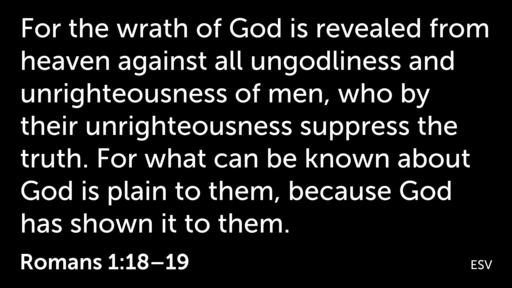
18 For the wrath of God is revealed from heaven against all ungodliness and unrighteousness of men, who by their unrighteousness suppress the truth. 19 For what can be known about God is plain to them, because God has shown it to them. 20 For his invisible attributes, namely, his eternal power and divine nature, have been clearly perceived, ever since the creation of the world, in the things that have been made. So they are without excuse. 21 For although they knew God, they did not honor him as God or give thanks to him, but they became futile in their thinking, and their foolish hearts were darkened. 22 Claiming to be wise, they became fools, 23 and exchanged the glory of the immortal God for images resembling mortal man and birds and animals and creeping things. 24 Therefore God gave them up in the lusts of their hearts to impurity, to the dishonoring of their bodies among themselves, 25 because they exchanged the truth about God for a lie and worshiped and served the creature rather than the Creator, who is blessed forever! Amen. 26 For this reason God gave them up to dishonorable passions. For their women exchanged natural relations for those that are contrary to nature; 27 and the men likewise gave up natural relations with women and were consumed with passion for one another, men committing shameless acts with men and receiving in themselves the due penalty for their error. 28 And since they did not see fit to acknowledge God, God gave them up to a debased mind to do what ought not to be done. 29 They were filled with all manner of unrighteousness, evil, covetousness, malice. They are full of envy, murder, strife, deceit, maliciousness. They are gossips, 30 slanderers, haters of God, insolent, haughty, boastful, inventors of evil, disobedient to parents, 31 foolish, faithless, heartless, ruthless. 32 Though they know God’s righteous decree that those who practice such things deserve to die, they not only do them but give approval to those who practice them.
Slide
15 Do not love the world or the things in the world. If anyone loves the world, the love of the Father is not in him. 16 For all that is in the world—the desires of the flesh and the desires of the eyes and pride of life—is not from the Father but is from the world. 17 And the world is passing away along with its desires, but whoever does the will of God abides forever.
Introduction
John is expressing his concern that true believers live as believers and not as those of the world.
What is the world?
“World” in the NT is usually the Greek word kosmos. It is related to a verb which means “to set in order,” or “to adorn, decorate.” Greek lexicographers give five meanings for “world” (kosmos) in NT usage:
1. The universe created by God with design and order (e.g., Mt 13:35; Jn 17:24; Acts 17:24).
2. The planet earth (e.g., Jn 11:9). This includes the idea of earth as the dwelling place of human beings (16:21) and of earth as contrasted with heaven (6:14; 12:46).
3. The total of mankind (Mt 5:14; Jn 3:16; 1 Cor 4:13).
4. The total of human existence in this present life, with all of its experience, possessions, and emotions (Mt 16:26; 1 Cor 7:33).
5. The world order which is alienated from God, in rebellion against him, and condemned by nature and by godless deeds.
Slide
1. Do Not Love the World v15
1. Do Not Love the World v15
Slide
15 Do not love the world or the things in the world. If anyone loves the world, the love of the Father is not in him.
Slide
a. Love for the World v15
a. Love for the World v15
1 John 2:15 (ESV)
15 Do not love the world or the things in the world. If anyone loves the world, the love of the Father is not in him.
John directs his warning to those people who already have switched allegiance and are now giving their undivided attention to the affairs of the world. He tells them to stop loving the world and to desist from pursuing their worldly interests. He is not talking about a single incident but about a lifestyle. Kistemaker, S. J., & Hendriksen, W.
Slide
b. Love God v15
b. Love God v15
1 John 2:15 (ESV)
15 Do not love the world or the things in the world. If anyone loves the world, the love of the Father is not in him.
John directs his warning to those people who already have switched allegiance and are now giving their undivided attention to the affairs of the world. He tells them to stop loving the world and to desist from pursuing their worldly interests. He is not talking about a single incident but about a lifestyle. Kistemaker, S. J., & Hendriksen, W.
“There are so many people who can be described as spiritual worldlings. If you talk to them about salvation they have the correct view; but if you talk to them about life in general they are worldlings. If you listen to their ordinary conversation about life in this world you will discover a heathen philosophy. They are worried about food and drink; they are always talking about wealth and position and their various possessions. These things really control them. That is to be like the heathen, says Christ; for the Christian should not be controlled by these things.” – Dr. Martyn Lloyd-Jones;
‘Studies in the Sermon on the Mount’; pages 407-8
Slide
24 “No one can serve two masters, for either he will hate the one and love the other, or he will be devoted to the one and despise the other. You cannot serve God and money.
The world means everything connected with the present life, apart from the kingdom of God and the hope of eternal life. So he includes in it corruptions of every kind and the abyss of all evils. In the world are pleasures, delights, and all those attractions by which people are so captivated that they withdraw from God. John Calvin
Slide
2. Do the Will of God v16
2. Do the Will of God v16
Slide
16 For all that is in the world—the desires of the flesh and the desires of the eyes and pride of life—is not from the Father but is from the world.
Slide
13 Who is wise and understanding among you? By his good conduct let him show his works in the meekness of wisdom. 14 But if you have bitter jealousy and selfish ambition in your hearts, do not boast and be false to the truth. 15 This is not the wisdom that comes down from above, but is earthly, unspiritual, demonic. 16 For where jealousy and selfish ambition exist, there will be disorder and every vile practice. 17 But the wisdom from above is first pure, then peaceable, gentle, open to reason, full of mercy and good fruits, impartial and sincere. 18 And a harvest of righteousness is sown in peace by those who make peace.
What are the so-called things of the world? John spells them out in three categories: cravings of sinful man, lust of man’s eyes, and boasting of what a person has or does. Of course, this list of tendencies is comprehensive in scope, but not necessarily exhaustive. Kistemaker, S. J., & Hendriksen, W.
The first two categories (cravings and lust) are sinful desires; the last (boasting) is sinful behaviour. The first two are internal and hidden sins; the last is an external and revealed sin.
Slide
a. Cravings
a. Cravings
1 John 2:16 (ESV)
16 For all that is in the world—the desires of the flesh and the desires of the eyes and pride of life—is not from the Father but is from the world.
Slide
17 “You shall not covet your neighbor’s house; you shall not covet your neighbor’s wife, or his male servant, or his female servant, or his ox, or his donkey, or anything that is your neighbor’s.”
14 But each person is tempted when he is lured and enticed by his own desire. 15 Then desire when it has conceived gives birth to sin, and sin when it is fully grown brings forth death.
Slide
16 But I say, walk by the Spirit, and you will not gratify the desires of the flesh. 17 For the desires of the flesh are against the Spirit, and the desires of the Spirit are against the flesh, for these are opposed to each other, to keep you from doing the things you want to do.
b. Lust
b. Lust
1 John 2:16 (ESV)
16 For all that is in the world—the desires of the flesh and the desires of the eyes and pride of life—is not from the Father but is from the world.
John describes this desire as “the lust of [the] eyes.” The eyes are the channels to man’s soul. When man is enticed by lust, his eyes serve as instruments that cause him to transgress and sin. Kistemaker, S. J., & Hendriksen, W.
Slide
28 But I say to you that everyone who looks at a woman with lustful intent has already committed adultery with her in his heart.
Slide
4 But the serpent said to the woman, “You will not surely die. 5 For God knows that when you eat of it your eyes will be opened, and you will be like God, knowing good and evil.” 6 So when the woman saw that the tree was good for food, and that it was a delight to the eyes, and that the tree was to be desired to make one wise, she took of its fruit and ate, and she also gave some to her husband who was with her, and he ate. 7 Then the eyes of both were opened, and they knew that they were naked. And they sewed fig leaves together and made themselves loincloths.
Slide
c. Boastings
c. Boastings
1 John 2:16 (ESV)
16 For all that is in the world—the desires of the flesh and the desires of the eyes and pride of life—is not from the Father but is from the world.
John lists the third tendency in words that cannot be translated easily. Translators provide a number of equally valid versions. Here are some representatives:
“The pride of life” (KJV, NKJV, RSV)
“The boastful pride of life” (NASB)
“All the glamour of its life” (NEB)
“The life of empty show” (NAB)
“Pride in possessions” (JB)
“The boasting of what [man] has and does” (NIV)
The reason for these numerous variations lies in two Greek words: “boast” and “life.” The first word means the boasting of a braggart or impostor (compare James 4:16). This boasting may even approach the point of arrogant violence. The second denotes life with respect to actions and possessions. The person who brags about his deeds and goods expresses “lust for advantage and status.” Kistemaker, S. J., & Hendriksen, W.
Slide
13 Come now, you who say, “Today or tomorrow we will go into such and such a town and spend a year there and trade and make a profit”— 14 yet you do not know what tomorrow will bring. What is your life? For you are a mist that appears for a little time and then vanishes. 15 Instead you ought to say, “If the Lord wills, we will live and do this or that.” 16 As it is, you boast in your arrogance. All such boasting is evil. 17 So whoever knows the right thing to do and fails to do it, for him it is sin.
Slide
3. Eternal Life v17
3. Eternal Life v17
17 And the world is passing away along with its desires, but whoever does the will of God abides forever.
Man needs to look at the fleeting existence of worldly people, pleasures, and desires. If he places his interest in that which is here today and gone tomorrow, he reaps a harvest of instability, stumbles in the darkness of sin and, because he has cast his lot with the world, faces a similar end. “For this world in its present form is passing away” (1 Cor. 7:31). Kistemaker, S. J., & Hendriksen, W.
However, the child of God is secure, for he possesses eternal life. What a contrast! The person who loves the world soon passes away, “but the man who does the will of God lives forever.” Kistemaker, S. J., & Hendriksen, W.
Slide
1 Since therefore Christ suffered in the flesh, arm yourselves with the same way of thinking, for whoever has suffered in the flesh has ceased from sin, 2 so as to live for the rest of the time in the flesh no longer for human passions but for the will of God.
Conclusion
“The true happiness that God offers to his children is eternal; it is then a shameful thing for us to be entangled with the world, which with all its benefits will soon vanish away.” John Calvin
It is “this world” (Jn 8:23; 12:25; 1 Cor 3:19) as opposed to “that which is to come”; “this world” in contrast with “the other, or heavenly world.” The ruler of this world is the devil (Jn 12:31; 14:30; 16:11; 1 Cor 5:10). “The whole world is under the control of the evil one” (1 Jn 5:19). On the other hand, the Christian is not of this world (Jn 15:19; 17:16), even though he is in the world and a participant in its activities (Jn 17:11). The believer is regarded as dead to the world (Gal 6:14; cf. Col 3:2, 3). The Christian is to be separated from the world (Jas 1:27). Friendship with the world is enmity toward God (Jas 4:4). Relationship with the world is an indicator of relationship with God: “If anyone loves the world, love for the Father is not in him” (1 Jn 2:15). The Scripture points out that “all that is in the world, the lust of the flesh and the lust of the eyes and the pride of life, is not of the Father but is of the world” (1 Jn 2:16). The world and its desires or lusts are transient, passing away, but the doer of God’s word abides forever (1 Jn 2:17; cf. 2 Cor 4:18).
Elwell, W. A., & Beitzel, B. J. (1988). World. In Baker encyclopedia of the Bible (Vol. 2, p. 2163). Baker Book House.
