John 2:1-11 What Do You Want?
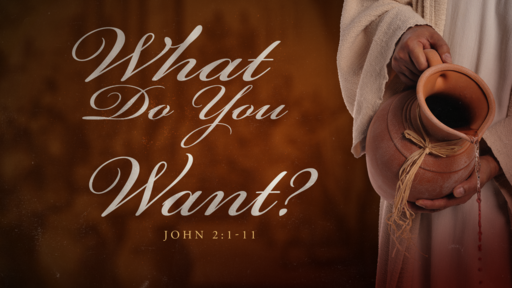

John 2:1-11 (Evangelical Heritage Version)
Three days later, there was a wedding in Cana of Galilee. Jesus’ mother was there. 2Jesus and his disciples were also invited to the wedding.
3When the wine was gone, Jesus’ mother said to him, “They have no wine.”
4Jesus said to her, “Woman, what does that have to do with you and me? My time has not come yet.”
5His mother said to the servants, “Do whatever he tells you.”
6Six stone water jars, which the Jews used for ceremonial cleansing, were standing there, each holding twenty or thirty gallons. 7Jesus told them, “Fill the jars with water.” So they filled them to the brim. 8Then he said to them, “Now draw some out and take it to the master of the banquet.” And they did.
9When the master of the banquet tasted the water that had now become wine, he did not know where it came from (though the servants who had drawn the water knew). The master of the banquet called the bridegroom 10and said to him, “Everyone serves the good wine first, and when the guests have had plenty to drink, then the cheaper wine. You saved the good wine until now!”
11This, the beginning of his miraculous signs, Jesus performed in Cana of Galilee. He revealed his glory, and his disciples believed in him.
What Do You Want?
I.
The veil was a complete giveaway. Not a veil at a wedding day, but a veil worn out in the marketplace as the young lady went about her daily business. The veil was a sign to everyone that she was spoken for—she was engaged.
As soon as the engagement happened, she went about the business of preparing for her wedding. What bride wouldn’t do that? She would look for just the right dress and talk to her best friends about being bridesmaids when the time came. People might ask her: “When is the big day?” “I don’t know,” would come her answer.
That might be an answer these days, too. The couple might not have had a chance to choose a date. They might need to make sure their closest friends and family are available at the chosen time.
When it comes to weddings, what do you want? You want everything to be just right.
Back in the wedding at Cana days, however, choosing the date didn’t work that way. In reality, the bride and groom weren’t the ones to set the date at all. Neither one would know the date for the wedding.
The deal was that after the engagement contract was accepted by the young lady, the groom had to prepare a house for her before the wedding could take place. The typical man would slap something together just so he could go and get the girl, but that wasn’t allowed. The father of the groom had to give his stamp of approval on the home. Then the groom could go get the girl.
As the house was being built, the rest of the preparations had to also be made. You know the things that had to be done. The festive decorations for the hall had to be completed. The caterer was selected, along with the menu. Guests had to be summoned. Someone had to decide how much of everything was needed for the celebration.
The list of things needing to be done is long and complicated. These days, all those making decisions might have a shared document in the cloud they can consult. When I got married, there was a wall plastered with post-it notes arranged by date so nothing would be left undone. No matter the system, everything has to be accomplished at the appropriate time to make sure the event comes off just as everyone wants it to.
II.
Despite what everyone wants for that special event, disaster had struck at the Cana wedding. They had run out of wine. It’s one thing to plan for a cash bar and the appropriate amounts of drinks for your wedding banquet that takes place on the day of your wedding ceremony. It’s another thing to plan a 7-day event. That’s how long a Jewish wedding feast usually lasted in those days.
When did this potentially-disastrous wedding take place? John skips over Jesus’ baptism; others had already written about that. The other writers had also covered Jesus going off into the wilderness immediately after his baptism to be tempted by Satan for 40 days.
John picks up the narrative about Jesus’ life after those events. John the Baptist identified Jesus as the Lamb of God. Then Jesus chose several men to be his disciples. Today’s Gospel picks up after that: “Three days later, there was a wedding in Cana of Galilee. Jesus’ mother was there. 2Jesus and his disciples were also invited to the wedding” (John 2:1-2, EHV).
If you have been invited to a wedding, you are important in some way to the bride and groom. They specifically want you to share their joy. Mary and Jesus had been invited, and Jesus’ new entourage had accompanied him. He was just relaxing, minding his own business and enjoying the feast. Mary approached his table, leans over, and quietly tells him about the wine disaster.
What did she want? Mary didn’t ask him to do anything about the disaster. Was telling Jesus about the disaster some passive aggressive act, trying to apply pressure to him to take action?
“Jesus said to her, ‘Woman, what does that have to do with you and me? My time has not come yet’” (John 2:4, EHV). Jesus was no longer just the child in the temple, learning from the rabbis. At his baptism he had been anointed to begin the Father’s work in earnest. While Mary was still his mother, she was actually one of the many he had come to save. She didn’t have authority over the work he was to do at the Heavenly Father’s direction.
He had no watch. Maybe Jesus glanced over at the sundial before he announced, “It’s not time, yet.” John uses this as a theme again and again in his gospel. Jesus’ time had not yet come, he would say.
Perhaps the servants were standing nearby and overheard the whispered conversation between Mary and Jesus. If so, what might they have wanted? They knew of the lack of wine. They were going to be forced to tell people over and over: “I’m sorry, there isn’t any wine left.”
The disciples were nearby, too, and might have overheard Mary. Being with Jesus was brand new to them. It would seem that at most there would have been six: Peter and Andrew, James and John, and Philip and Nathaniel. They had all left their livelihoods and everything else behind when they followed Jesus. He had told them: “You will see greater things than that!” (John 1:50, EHV). They might have wanted to see an example of the greater things. As Mary leaned over Jesus’ shoulder as he reclined at the table, perhaps they began to get their hopes up.
What would you want? Maybe it wasn’t at a wedding, but have you ever prayed to God to remedy some specific disaster in your life? Maybe, like Mary, you just whisper in God’s ear about something that’s going on; your suggestions to God may even sound a little passive aggressive.
How do you like it when God’s answer isn’t immediately forthcoming? We are Americans. We tend to expect what we want, when we want it, and lots of it. We aren’t always very patient when God’s answer seems to be “maybe later,” or “it’s not time, yet.”
We aren’t told exactly what Mary might have wanted. Whatever it might have been, she accepts Jesus’ answer just as it is. She doesn’t whine or beg or plead. No promise had been made by Jesus. In fact, it seems quite the opposite; Jesus seemed to have implied that he wouldn’t do anything about the situation.
Nonetheless, Mary says to the servants hovering nearby: “Do whatever he tells you” (John 2:5, EHV). What did she expect Jesus would do? Anything? Would it be now or in the future? Mary didn’t bother to create a flowchart of possibilities, just told the servants to do whatever Jesus might tell them.
III.
What did the servants want now? Some instructions, perhaps. They were probably not sure what might happen next. Would Jesus send them on an errand to the local vintner to see if a few skins of wine could be procured? Maybe he would go, bringing some of them with him to help with the carrying.
“Six stone water jars, which the Jews used for ceremonial cleansing, were standing there, each holding twenty or thirty gallons. 7Jesus told them, ‘Fill the jars with water’” (John 2:6-7, EHV). You can almost see some raised eyebrows or quizzical looks on the part of the servants. Of all the scenarios they had considered, this wasn’t one of them. Jesus’ instruction seemed rather odd, even illogical.
Ceremonial cleansing would have been very important to the Jews attending the wedding feast so, no doubt, the jars had been at least partially emptied. Mary had told them to do whatever Jesus asked. Despite any raised eyebrows: “They filled them to the brim” (John 2:7, EHV).
John finds this to be an important detail. Most people wouldn’t have any clue what had happened later, but the disciples and the servants would know. Once the jars had been completely topped off, it couldn’t be said that some strong wine had been mixed in. There was nothing in those jars but water—all the way to the very top.
The instructions continued. The servants dipped some liquid out of the top of the jars. It was immediately plain to see that it wasn’t water any more. As directed, they poured some out for the master of the banquet—the one who would have the most refined palate at the feast.
“When the master of the banquet tasted the water that had now become wine, he did not know where it came from (though the servants who had drawn the water knew). The master of the banquet called the bridegroom 10and said to him, ‘Everyone serves the good wine first, and when the guests have had plenty to drink, then the cheaper wine. You saved the good wine until now!’” (John 2:9-10, EHV).
Had the bridegroom even been aware of the impending disaster? He might have been much too busy enjoying the company of his new bride. Whether he understood what happened or not, the servants did. They had served the wine; they knew where it came from.
Remember the size of the water jars? 20-30 gallons. 6 jars. Jesus, with no magic formulas, no incantations, no theatrical waving of a wand, not even moving from his comfortable chair, had turned between 120 and 180 gallons of water into the finest of wines.
IV.
“This, the beginning of his miraculous signs, Jesus performed in Cana of Galilee. He revealed his glory, and his disciples believed in him” (John 2:11, EHV).
Whatever Mary wanted, Jesus’ miracle far exceeded her expectations. The disciples had wanted to know they were following the right man. They still would have moments of wavering; there would be misunderstandings about his purpose; they wouldn’t always understand. But they would keep following and learning.
What do you want? Jesus told his mother: “My time has not yet come.” John will repeat that theme again and again in his gospel account of Jesus and his ministry. When he starts reporting the events of Holy Week, the phrase will shift. “My time has come,” Jesus will say again and again as he completes the Heavenly Father’s plan.
Remember that in your prayers. Everything happens in the time God has planned. Jesus has paid for the sins of the world, all in his good time. He has given you the faith you have in his saving work, all in his good time. He will supply what you need and answer your prayers, in his good time and in his perfect judgment. He will take you to your final home, when he determines it is time. Amen.
