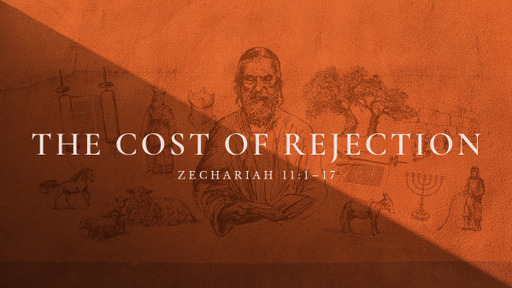
The Cost of Rejection

Notes
Transcript
Bible Passage: Zechariah 11:1-17
Bible Passage: Zechariah 11:1-17
Summary: Zechariah 11 reveals a poignant picture of God as the ultimate Shepherd facing rejection and abandonment by His flock, illustrating the painful consequences of disobedience and the inadequacy of worldly leadership. It serves as a prophetic critique of the leaders of Israel who have led the people away from God’s intended path, foreshadowing the betrayal of Christ.
Big Idea: Rejecting God's shepherding leads to spiritual desolation, but embracing Christ brings restoration and true life.
1. Opening Our Eyes To Devastation, 1-3.
1. Opening Our Eyes To Devastation, 1-3.
Zechariah 11:1-3
These verses describe the invasion of the Holy Land by the Romans, including the destruction of Jerusalem and the Second Temple.
Verses 1-2 — It is best to see this as the the physical desolation of the land which would also involve the people dwelling. This then pictures the storm of judgment sweeping from the highlands to the lowlands. All the land is affected, Lebanon, Bashan, and Jordan representing the Holy Land (cf. Zech. 10:10). As the destruction comes, the wail, the howling of distress is heard; it is the involuntary response to a great loss or terror.
Verse 3 — The shepherd wail because their pasture lands have been destroyed. Cf. Jeremiah 25:34
“Wail, you shepherds, and cry; And wallow in ashes, you masters of the flock; For the days of your slaughter and your dispersions have come, And you will fall like a choice vessel.
“Hear the sound of the cry of the shepherds, And the wailing of the masters of the flock! For the Lord is destroying their pasture,
They have had their “glory” ruined. The word “glory” can be translated as ‘cloak; coat; garment’ and is used in Jonah 3:16 fro the regal raiment of the king, signifying the dignity and power of the office. Jonah 3:6
When the word reached the king of Nineveh, he arose from his throne, laid aside his robe from him, covered himself with sackcloth and sat on the ashes.
The term shepherds is many times also used to denote rulers who are responsible for the people. This would picture shepherds unable or unwilling to fulfill their responsibilities to the people. Accountable to God, they have failed and God brings judgment upon them.
Even the Jordan River valley, ‘the pride of the Jordan,’ hears the wail of young lions as they see the devastation coming toward them. The misery of the land, and its people, is complete.
This is a reminder that human leaders fall short. If we place our faith and trust solely in a person, we will be disappointed.
We need a greater shepherd, one not tainted with sin and selfishness with no shortcomings. We need a shepherd like the Lord Jesus.
I believe the description here has reference in very general terms of the judgment of God upon Israel in the time of the Second Temple under the hand of the Romans. Why has this come about?
2. Observing Our Rebellion's Outcome, 4-6.
2. Observing Our Rebellion's Outcome, 4-6.
Zechariah 11:4-6
The LORD commands Zechariah to become a living picture of the LORD Jesus, the wise but forsaken Shepherd, in his prophetic capacity. He was to feed the flock of slaughter, their condition being already precarious, as sheep without a shepherd (Zech 10:2),
For the teraphim speak iniquity, And the diviners see lying visions And tell false dreams; They comfort in vain. Therefore the people wander like sheep, They are afflicted, because there is no shepherd.
Yet when this prophecy is realized , they will be in an even worse condition, similar to the description of Psalm 44:22
But for Your sake we are killed all day long; We are considered as sheep to be slaughtered.
The implication comes from the vivid explanation found in
Verses 5-6 — “Those who buy” are the foreign oppressors of Israel. Hardened in their ways, they are depicted as congratulating themselves for their successes, blasphemously blessing God for the results of their transactions. They account themselves not guilty in the matter, Jeremiah 50:6-7
“My people have become lost sheep; Their shepherds have led them astray. They have made them turn aside on the mountains; They have gone along from mountain to hill And have forgotten their resting place.
“All who came upon them have devoured them; And their adversaries have said, ‘We are not guilty, Inasmuch as they have sinned against the Lord who is the habitation of righteousness, Even the Lord, the hope of their fathers.’
The foreign rulers, in their oppression of Israel, are culpable and they will pay the full penalty for their abusive treatment of them.
Israel’s own shepherds are all the more blameworthy; they had no compassion/pity for them. The people were left with no human defender from within the nation or from outside of it.
The LORD declares, in light of this, that He is displeased. with Israel. He will have no pity on them. That is the ultimate reason for Israel’s misery. In rejecting the LORD, they instead would become dependent on the power of another kingdom and on another king, who would strike the land and its people, and the LORD would not deliver His people from him/them. The king in view is Caesar and the striking took place in the destruction of Jerusalem and the Second Temple in 70 AD.
This makes verses 5 and 6 like a parenthesis. This demonstrates the results of the ministry of the True Shepherd, confirmed by history that these conditions did take place after Israel’s rejection of their Messiah.
3. Overcoming God's Withdrawal, 7-11.
3. Overcoming God's Withdrawal, 7-11.
Zechariah 11:7-11
Verse 7 -- Zechariah obeyed the LORD, pastured the flock and
taking for himself two staffs. The staff was used to guide the sheep, to correct the sheep, and to rescue the sheep. Each staff gets a symbolic name:
‘Favor’ refers to God's blessing, joy, and His promise to His people.
‘Union’ refers to that which is between God and His people, and between each other together as one flock, both Judah and Israel.
Verse 8 — This verse sounds harsh one month represents a short period of time, but the three shepherds may be best taken as the three classes of leaders that God gave to Israel.
The first class: the king, yet those turned away from the
living God and started following idols.
The second class: Priests, yet they stopped being the holy
man of God and started abusing the people.
The third class: Prophets, yet many stopped being God's
spokesmen and started saying things just to please the people and the king.
This is why the Lord's soul became impatient with them. These shepherds’ actions showed that they were weary of God’s True shepherd, represented by Zechariah. The action of annihilation expresses the idea of removing the inadequate shepherds, replacing them with the wise and true Shepherd. Yet we find the flock rejected Messiah Jesus. Why do people reject Him? Many reasons:
They do not want to admit He is God.
They refused to give up control of their lives to Him.
They believe they know all about Him and think He is outdated.
They are embarrassed by Him in culture that mocks and ridicules His name.
They do not want to mess up their religious practices and the pride they have in them.
When Jesus was here at his first coming, the people used all
these reasons to reject him.
verse 9 – However, the Lord's Shepherd is no pushover.
Zechariah resigns from being a good shepherd: Jesus as the Good Shepherd was forsaken,
John 1:11
He came to His own, and those who were His own did not receive Him.
The people choose to reject their true Shepherd; therefore, the Lord allows judgment upon his people. The remainder of verse nine is a prophetic description of events that happened in the destruction of Jerusalem and the temple as it relates to the people.
Verse 10 tells us what Zechariah did with the staff named “Favor.” He cut it into pieces as a picture of The LORD’s removal of His blessing from the people. It was because they had rejected Him, the LORD will reject them.
Verse 11 informs us that the day Zechariah broke that staff,
the poor of the flock who observed him recognize that this was the word of the Lord. God had spoken through Zechariah’s words and actions.
4. Offering Reflection On Betrayal, 12-13.
4. Offering Reflection On Betrayal, 12-13.
Zechariah 11:12-13
Verse 12 – Zechariah, as the Good Shepherd, asked for his
wages. A shepherd in those days didn't just take care of his own sheep, sometimes he took care of the sheep of others. Now he is asking for what he has earned based on their evaluation of his work. The wise Shepherd, though rejected and forsaken, left them without a good and wise shepherd to replace him.
They determined and weighed out thirty shekels of silver.
That was the price of an injured slave no longer able to work, whereas an able-bodied slave was worth 60 shekels of silver. Exodus 21: 32
“If the ox gores a male or female slave, the owner shall give his or her master thirty shekels of silver, and the ox shall be stoned.
Prophetically, Judas Iscariot betrayed Jesus for the same amount, 30 shekels. Thus, the evaluation the people would give of the Good Shepherd was that He was only worth the price of damaged goods; they did not value Him as they should.
Verse 13 -- The Lord said to Zechariah to throw his wages to
the potter, sarcastically “that magnificent price in which I was valued by them.”
Zachariah did what the Lord said, throwing the silver to the potter in the house of the Lord. This potter is likely tasked with making special vessels used in the service of the temple.
5. Ousting False Leadership, 14-17.
5. Ousting False Leadership, 14-17.
Zechariah 11:14-17
Verse 14 -- Then Zechariah reveals that he cut in pieces the
staff “Union,” illustrating the break between the LORD and His people because they rejected the Good Shepherd and the brotherhood between Judah and Israel. This later occurred during the siege and destruction of Jerusalem and the second temple when many factions arose among the people, and brother strove against brother.
We must not reject Jesus because He is the Shepherd we need
the most. If we reject Jesus, He will reject us. Matthew 23: 37-38
“Jerusalem, Jerusalem, who kills the prophets and stones those who are sent to her! How often I wanted to gather your children together, the way a hen gathers her chicks under her wings, and you were unwilling.
“Behold, your house is being left to you desolate!
To reject the Good and Wise Shepherd is to follow shepherds who will hurt us.
Verse 15-16 -- Now Zechariah is commanded to portray a
foolish shepherd. The word “foolish” has the idea of one morally deficient and corrupt, even evil.
Then the Lord promises to raise up another shepherd in the
land, but this shepherd will not care for the perishing, seek the scattered, heal the broken, or sustain the one standing. All this shepherd cares about is to devour and to totally destroy the sheep.
They had God's good and true shepherd, Jesus. Israel rejected
Him and will turn to false shepherds. John 5: 43
“I have come in My Father’s name, and you do not receive Me; if another comes in his own name, you will receive him.
False shepherds would come to abuse the people of Israel to
take advantage and to harm them mercilessly. The ultimate expression of the false/foolish/worthless shepherd in the last days is the one called Antichrist. He will deceive and abuse not only Israel but the entire world, Revelation 13:7
It was also given to him to make war with the saints and to overcome them, and authority over every tribe and people and tongue and nation was given to him.
Verse 17 tells us what this worthless shepherd will experience and that is condemnation. The arm represents his strength, which will wither. The right eye represents his intelligence, which is useless when He comes before the Good Shepherd
God has ordained that the wise and true Shepherd will
triumph over the false shepherd, Revelation 19:19- 20
And I saw the beast and the kings of the earth and their armies assembled to make war against Him who sat on the horse and against His army.
And the beast was seized, and with him the false prophet who performed the signs in his presence, by which he deceived those who had received the mark of the beast and those who worshiped his image; these two were thrown alive into the lake of fire which burns with brimstone.
