Seed the Clouds

Notes
Transcript
Seed the Clouds
Online Sermon:
http://www.mckeesfamily.com/sermons/
On November 13, 1946, a small aircraft took off from
Schenectady County Airport carrying an unusual payload—six
pounds of dry ice. Aboard was chemist Vincent Schaefer, a
researcher at the General Electric Research Laboratory, who had
been
conducting
groundbreaking
experiments
on
cloud seeding. He
discovered
that
introducing
solidified
carbon
dioxide into a cloud
could rapidly cool
water
droplets,
triggering
the
formation of snow crystals. Determined to test his theory in real
conditions, Schaefer flew his single-propeller plane into a
towering cumulus cloud and released the dry ice. The results
were astonishing—not only did snow crystals form instantly, but
the resulting snowfall extended up to forty miles away. This
experiment marked the first successful attempt at artificial
weather modification and laid the foundation for modern
weather control techniques.
1|Page
While cloud seeding is an impressive scientific
breakthrough, the Bible reveals an even greater way to bring
rain—not through human ingenuity, but through the power of
prayer. After Elijah’s dramatic showdown with the prophets of
Baal on Mount Carmel, he did something that defied human
reasoning—he “bent down to the ground and put his face
between
his
knees” (1 Kings
18:42) and prayed
for rain. For three
and a half years,
the
land
had
suffered under a
relentless drought,
yet Elijah trusted
in the faithfulness
of God. Though no
sign of change was
visible at first, he persisted in prayer, sending his servant to
check the horizon. On the seventh time, a tiny cloud appeared,
and soon, the sky darkened, the wind howled, and torrents of rain
poured upon the parched land (1 Kings 18:45). Elijah didn’t need
an aircraft or a scientific formula—he simply seeded the sky
with persistent prayer, and God opened the heavens. What kind
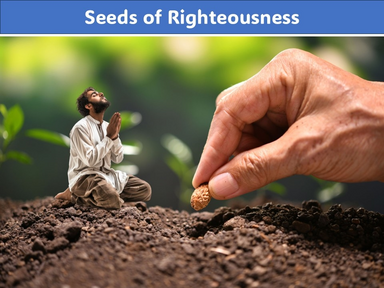
of seeds are we planting today? The harvest we reap depends on
the faith we sow.
Just as Elijah sowed faith through prayer, we are called
to plant seeds of obedience, humility, and generosity in the name
of Jesus. As Mark Batterson reminds us, humility invites God’s
favor, generosity activates divine reciprocity, and faithful
obedience today lays the foundation for tomorrow’s
breakthroughs.1 The seeds we plant—through prayer, faith, and
righteous living—will determine the harvest we reap in the
future. If we want to see God move powerfully in our lives, we
must first be faithful in sowing the right seeds today.
In today’s sermon, we will explore how believers can
intentionally plant seeds of righteousness within God’s
kingdom. Rather than drifting through life, we are called to
actively pursue a life that reflects the worthiness of the Gospel.
This requires a daily commitment to submitting to God’s Word,
seeking His guidance, and walking boldly into the future He has
prepared for us. The seeds we sow today determine the harvest we
reap tomorrow—so let’s plant them in faith and trust in the God who
brings the rain.
Seeding the Clouds by Taking Leaps of Faith
If we are to plant seeds of righteousness in God’s
kingdom and accomplish more than we can ask or imagine, we
must be willing to take leaps of faith. The story of Esther
beautifully illustrates how God uses the ordinary and overlooked
to fulfill His divine purposes. Exiled from Jerusalem by the king
of Babylon (Esther 2:6) and orphaned at a young age, Esther was
adopted by her cousin, Mordecai (2:7). Knowing that revealing
her Jewish heritage could put her life in danger, Mordecai
advised her to keep it a secret (2:10). But Esther’s life took an
unexpected turn when King Xerxes removed Queen Vashti
1
Ibid., Location 3069.
2|Page
(1:19) and ordered a search for a new queen (2:2). Esther, a
humble Jewish girl, was brought before the king, found favor in
his eyes, and was
crowned queen (2:17).
Just when it seemed her
story had turned from
tragedy to triumph, a
crisis arose—Haman, a
proud and wicked
Agagite, was elevated
to a position of honor
(3:1),
and
when
Mordecai refused to bow to him, Haman plotted to annihilate all
the Jews (3:5-6).
Mordecai urged Esther to take a bold risk and approach
the king, reminding her, “And who knows but that you have c
ome to your royal position for such a
time as this?” (4:14). Before stepping
out in faith, Esther called for three days
of fasting and prayer (4:16), seeding the
clouds of God’s favor before making her
courageous move. Because of her faith,
she approached the king, exposed
Haman’s wicked plot, and ultimately
saved her people. Esther’s story reminds
us that faith often requires risk. The
greatest breakthroughs come when we
pray, trust, and step forward in obedience. How many divine
opportunities have we missed because we lacked the faith to take
a risk and do what God has called us to do?
This is exactly how God chooses to work in and through
our lives. He prepares us in advance for great works (Ephesians
2:10), and these works are “seeded” through prayer and fasting.
Mark Batterson rightly states, “Prayer without planning is a
waste of time, while planning without prayer is a waste of
energy. Seeding the clouds is exercising our faith by identifying
God-honoring, God-sized goals, then reverse-engineering them
into habits.” 2 True faith requires both prayerful dependence on
God and intentional action.
While we are not responsible for the outcomes, we are
responsible for what we do with the opportunities God places
before us (2 Corinthians 5:10). If we choose to align ourselves
with the ways of
the
world—
chasing the lust of
ill ow what
esponsi le
the eyes, the lust of
ou eap
or
the flesh, and the
ut omes
pride of life—we
nmit
ainst
God
show
enmity
pportuni es
i ht in
against God (James
God s i ht
4:4; 1 John 2:16).
Since we reap what
we sow, why not
begin with the end in mind? Why not seek first the kingdom of
God and, like Queen Esther, develop the faith and wisdom to
walk boldly in His ways for His honor and glory? It may be
2
Ibid., Location 3106
3|Page
easier—and certainly more tempting—to avoid God-sized goals
and settle for comfort, but as in farming, so it is in our spiritual
journey: doing nothing allows weeds of complacency to take
root. To neglect our calling is not just a missed opportunity; it is
a sin against God who has prepared us to accomplish great things
in His name.
What are some of the God-sized goals in your life, and are you
passionately pursuing them for His honor and glory?
There is no Time Like the Present
To faithfully serve in God’s kingdom, we must recognize
that every moment presents an opportunity—an opportunity to
cast aside the shackles
of complacency, step
out in faith, and boldly
pursue the calling God
has placed before us.
Too often, we live as
though
we
have
unlimited time, putting
off God’s work for another day, another season, another stage of
life. But what if we lived with a greater sense of urgency and
purpose, treating each day as a divine appointment?
On May 29, 1832, a twenty-year-old French
mathematician, Évariste Galois, sat down and wrote a sixty-page
mathematical masterpiece. His work not only solved a 350-yearold mathematical mystery but also
laid the foundation for modern
computer science, coding theory, and
cryptography.3 How was Évariste
able to accomplish such an incredible
feat in a single night? It was as if he
was living May 29 as though it was
his last day on earth—because, in his
mind, it was. Challenged to a duel by
his rival, Perscheux d’Herbinville,
Évariste believed he would not
survive the next morning. And so, knowing his time was short,
he poured out everything he had, leaving behind a legacy that
would shape the world for generations to come.
If we are to seed clouds in God’s kingdom, we must do
so not with stress, anxiety, or an endless chase after worldly
success, but with the clarity and passion of someone who
understands the brevity of life. Like Évariste, we must cease the
moment, treating each day as a precious gift from God and living
as though it may be our last. Not out of fear, but out of a holy
urgency—an urgency to pray more fervently, serve more
faithfully, love more deeply, and step forward in faith without
hesitation.
Making the most of our time often requires us to slow
down and listen to the still, small voice of the One who directs
our paths. In a world that glorifies busyness and instant results,
it is easy to rush decisions without seeking God’s wisdom. Yet,
Scripture reminds us that “haste leads to poverty” (Proverbs
21:5) and that “the way of fools seems right to them, but the wise
listen to advice”
(Proverbs 12:15).
People tend to
e ision a ue
make poor choices
when
acting
impulsively, and
this truth is even
confirmed
by
science. A study
by the National
Academy
of
Sciences
examined 1,112 rulings by an Israeli parole board and found a
staggering pattern—70% of cases reviewed in the morning were
granted parole, while only 10% were granted later in the day.
This sharp decline was not due to worse cases being reviewed
last, but rather due to “decision fatigue”—the mental exhaustion
that comes after making too many choices.4 When we are worn
down, overwhelmed, or distracted, we lose the motivation and
clarity needed to choose wisely.
We see biblical examples of poor decisions made in
moments of stress as well. On the night of Jesus' betrayal, Peter,
3
Ibid., Location 3144.
4|Page
4
Ibid., Location 3161.
in a moment of panic, impulsively cut off the right ear of the
high priest’s servant (John 18:10). Later that same night, driven
by fear, he denied Jesus three times (Matthew 26:69-75). In the
same chaotic scene, a young man following Jesus was so
desperate to escape that he ran off naked (Mark 14:51-52)!
These moments of fear, fatigue, and haste serve as warnings:
without a spirit attuned to God, we are prone to make rash
decisions that we later regret.
If we desire to live worthy of the Gospel, then we must
learn to take the time to be holy. Throughout the book of Psalms,
the word “Selah” appears seventy-one times—a word believed
to signify a pause, a
moment of reflection
and stillness before
God. In music, it
signifies taking an
eighth
rest—a
deliberate break in
the sound. Is it not in
fasting and prayer
that we hear the
voice of the Master
most clearly, because we have intentionally set aside the noise
of life? The theologian Jeremy Taylor once wrote, "Some
neglect God and His angels for the noise of a fly."5 How true this
is! In a world filled with constant distractions, notifications, and
digital noise, it becomes easy to fixate on the fleeting rather than
the eternal.
5
Ibid.
5|Page
If we are to seed the clouds of righteousness, we must be
intentional about creating sacred space with God. This means
putting our phones on ‘Do Not Disturb,’ turning off social
media, and stepping into a quiet
place where it is just us and the Lord.
James 4:8 reminds us that when we
draw near to God, He will draw near
to us. In the stillness, God molds our
hearts, shapes our present and future,
and aligns our steps with His divine
will. With one eye fixed on eternity
and the other on daily obedience, we can redeem the minutes,
hours, and days—transforming ordinary moments into
extraordinary encounters with our Sovereign Lord.
Ways to Seed the Clouds
So, what are some practical ways we can seed the clouds
of righteousness?
1.
Take Time to be Holy. Do not merely drift through life
passively, nor become so caught up in endless activity that
you neglect time to be holy. A sincere love for God requires
more than just words—it demands that we learn to hate evil
and cling to what is good (Romans 12:9). Yet, putting off the
sin that so easily entangles us is no simple task! Aligning our
hearts with God’s will requires more than just hearing His
Word—it requires delighting in it (Psalms 1:2) and allowing
it to transform us (James 1:22). Like clay in the hands of the
Master Potter, we must allow God to shape and mold us for
His purpose (Isaiah 64:8).
2.
Trust God’s Plan Over Your Own. Believe that God’s
plan for your life is greater than the one you have designed
for yourself! Too often, we hold tightly to our own dreams
and understanding, forgetting that God’s ways are higher
than ours (Isaiah 55:8-9). In our own eyes—and even in the
eyes of others—we may appear wise and self-sufficient, but
true fruitfulness only comes from abiding in Christ, the true
vine (John 15:1-8). If we seek to live a life that bears lasting,
eternal fruit, then we must submit our will to His and trust in
His divine purpose.
3.
Step out in Faith. Always be ready—not only to give the
reason for the hope you have (1 Peter 3:15) but also to take
bold leaps of faith when God calls you. Faith is not just about
believing; it’s about acting in trust, saying "YES" to the One
who enables you to do far more than you can ask or imagine
(Ephesians 3:20-21). Seeding the clouds of righteousness is
not accomplished through passive waiting—it requires
effort, surrender, and allegiance to the One who bought you
at the price of His very life. So serve wholeheartedly (1
Corinthians 6:19-20), take courageous steps of faith, and
watch as the rain of God’s blessings falls—not just on your
life, but on those around you.
6|Page
Conclusion
Throughout history, God has used ordinary people with
extraordinary faith to seed the clouds of righteousness. Elijah
prayed persistently, and God sent the rain. Esther took a bold
risk, and God saved a nation. In the same way, God has called
each of us to plant seeds of faith, obedience, and trust, believing
that He will bring the harvest in His perfect timing. The question
is—what seeds are you planting today? Are you seeding the
clouds with prayer, faith, and obedience, or are you allowing
fear, distraction, and complacency to hold you back? God has
already prepared the work for you to do (Ephesians 2:10). But
will you step out in faith? Will you pray persistently like Elijah,
act boldly like Esther, and trust completely in the One who is
able to do immeasurably more than all you ask or imagine
(Ephesians 3:20)? Now is the time. Don’t wait for the perfect
moment, the perfect conditions, or the perfect level of certainty.
Step forward in faith today. Pray, obey, take the leap, and seed
the clouds—because in due time, God will bring the rain.
