Genesis 45:3-15 Forgiveness
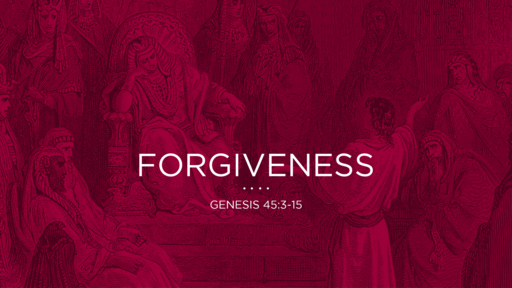

Genesis 45:3-15 (Evangelical Heritage Version)
3Joseph said to his brothers, “I am Joseph! Is my father still alive?”
His brothers could not answer him, because they were terrified by his presence. 4Joseph said to his brothers, “Come closer to me, please.”
They came closer. He said, “I am Joseph, your brother, whom you sold into Egypt. 5Now do not be upset or angry with yourselves for selling me to this place, since God sent me ahead of you to preserve life. 6For two years now the famine has been in the land, and there are still five more years in which there will be neither plowing nor harvest. 7God sent me ahead of you to preserve you as survivors on the earth, and to keep you alive by a great act of deliverance. 8So it was not you who sent me here, but God, and he has made me a father to Pharaoh, lord over his entire household, and ruler over the whole land of Egypt. 9Hurry, go up to my father and tell him, ‘This is what your son Joseph says: “God has made me lord of all Egypt. Come down to me. Do not delay. 10You shall live in the land of Goshen, where you will be close to me—you, your children, your grandchildren, your flocks, your herds, and all that you have. 11I will take care of you here, for there are still five years of famine. Otherwise you will come to ruin, you, and your household, and all that you have.” ’ 12Pay attention. Your eyes and the eyes of my brother Benjamin see that it is my mouth that speaks to you. 13You shall tell my father all about my position of honor in Egypt and about everything that you have seen. Hurry and bring my father down here.”
14He threw his arms around his brother Benjamin’s neck and wept, and Benjamin wept on his shoulder. 15He kissed all his brothers and wept over them. After that his brothers talked with him.
Forgiveness
I.
The group of brothers had stood before this powerful ruler several times before. It all started a couple of years earlier, when a famine afflicted every land around them. At least they had thought it all started with the famine. No crops had grown. Their animals were thin and nearing starvation as they had no choice but to lead them to spindly vegetation with the ongoing drought.
There had been no choice but to make the journey to the land of Egypt. There, somehow, there was food. Someone had been storing up grain and supplies for years in anticipation of a disaster no one thought would come. Like so many from lands near and far, they had gone to buy food.
The transactions with the Egyptians had started out much the same as anyone else’s. There couldn’t be much bartering—the leverage was all on the side of Egypt. They paid the asking price and started on their way.
It was then that the interactions changed significantly from any of the other buyers coming to Egypt. They were grilled, interrogated extensively by the man in charge. He asked them all kinds of questions about their family. Finally, one of the brothers was held hostage while the others returned to their father with instructions to bring back the youngest brother the next time they came in search of food. After their first night of travel, each remaining brother found that the payment they had made for their supplies had been returned. None-the-less, they carried on. What choice did they have, really?
Eventually there was no choice but to go back to Egypt. Reluctantly, their father Jacob sent the youngest brother along.
Standing before that powerful Egyptian ruler the second time started the roller coaster of emotions. The ruler invited—an invitation that could not be refused—them to a feast. They wondered if it were just a pretext to accuse them of theft, since they had all found their initial payment in the food bags. To head off any accusation of theft, they approached the ruler’s manager and informed them they had found their money from the last trip. They had brought it, and more money for the next purchase, with them on this trip.
The manager told them: “There is no problem. Do not be afraid. Your God, the God of your father, has given you treasure in your bags. I received your money” (Genesis 43:23, EHV). They were not young men anymore, but somehow they were seated by age at the feast the ruler was hosting. That, too, made them wonder.
Soon, the feast was over and the brothers—all of them—were sent on their way. What a joy for the brothers. It wasn’t long and the ruler’s manager caught up with them and accused them of theft. Only the perpetrator would be detained; the rest could continue on their way. The youngest brother was found to be in possession of the stolen property.
The youngest was their father’s favorite. He had become the favorite when the other favorite disappeared. The others now were reliving a nightmare. They had been the ones who caused the disappearance. They had sold their brother into slavery. The only way they could see to keep the current situation from becoming total disaster was to make sure their youngest brother returned home safely.
All returned to stand before the ruler.
They faced the accusations as a team. Make all of us your captives, not just the youngest. When that offer was refused, Judah offered to be the slave in place of the youngest, Benjamin.
It was then that the ruler identified himself as their long-lost brother. “Joseph said to his brothers, ‘I am Joseph! Is my father still alive?’ His brothers could not answer him, because they were terrified by his presence” (Genesis 45:3, EHV).
Rather than being relieved, their nightmare reached a fevered pitch. What they had done was coming back to bite them with a vengeance. The only thing that could be worse than a powerful ruler of a foreign land who desired retribution was that the ruler would turn out to be the very brother they had wronged so deeply. What could they possibly expect from him? Only the worst.
One thing was sure—they had no recourse. Whatever Joseph would decide would be final. Their fate was in his hands. They came to Egypt in a desperate search for food. What they found was guilt—and the end of a story they didn’t realize was still being written.
On the other side of the dais stood Joseph, the de facto ruler of Egypt. He was one of the most powerful people in the whole world. The fate of his brothers was in his hands. He had the power to give life, or take it away.
There he stood, wearing the finest clothing the world had to offer. Unlike his brothers, his hands weren’t filled with callouses from hard work, but heavy with jewelry. A gold signet ring was on one finger—a ring that meant he could make whatever decision he chose in Pharaoh’s name.
II.
With whom do you identify? Joseph, or his brothers?
Maybe sometimes you crave the kind of wealth that would mean you never have to want for anything; that anything you could imagine could be yours with just a word. Perhaps you crave the power of Joseph. Power that could eviscerate anyone who stood in your way, or grant them clemency if you so chose.
Other times, perhaps, you see yourself more like the brothers. You are just doing your best to get by in a life filled with pain and disaster. When confronted by some of your own choices in life, your mistakes come back to haunt you. You wish things could be different, but the choices you made in the past came with certain consequences, and you find yourself in this present moment. Trembling, perhaps. Afraid of what the future might hold, maybe. All you can do is wait and see.
III.
Maybe you missed something about Joseph. His brothers missed it, too. They stood there, looking at his face, wondering if his expression would contain any clues about what would happen next.
To be sure, Joseph stood in a position of total power. As he stood there, he must have looked back over his life. There were some less-than-admirable moments in his own past, too. He had shown an attitude of self-importance before his brothers. He had flaunted his position in the family in their faces.
There were some hopeless and helpless moments, too. He had been at the total mercy of the band of Ishmaelites, to whom he had been sold. Once in Egypt, he seemed to finally be pulling ahead in life, only to be falsely accused and imprisoned. Maybe he scratched lines in the walls for each day he was there. He made friends, but one forgot him when he was released—at least, for a time.
Joseph could have claimed victimhood. Many times over. So many experiences had beaten him down. Instead of being a victim, Joseph chose to wait patiently for God’s victory to be revealed to him.
As he considered all the long days and years of his life, Joseph could now clearly see God’s guiding and protecting hand in everything. Not only that, an honest look back at his own life showed that God had always had a plan.
Perhaps he had been thinking about all this for some time. Joseph says: “Now do not be upset or angry with yourselves for selling me to this place... 7God sent me ahead of you to preserve you as survivors on the earth, and to keep you alive by a great act of deliverance. 8So it was not you who sent me here, but God” (Genesis 45:5, 7-8, EHV).
God’s plan was much larger than just one man. God’s plan was to put Joseph in a position to keep his whole family alive. Joseph probably knew from his father about God’s promise that a Savior was to come through Abraham, Isaac, and Jacob’s line. God preserving Joseph’s family alive meant that God was preserving the Savior’s family, too.
When Jesus finally arrived, it was not to fanfare and total acceptance by his countrymen. Isaiah prophesied: “He was despised and rejected by men, a man who knew grief, who was well acquainted with suffering. Like someone whom people cannot bear to look at, he was despised, and we thought nothing of him” (Isaiah 53:3, EHV).
God’s plan, already when Joseph was spending time in prison, and when he stood in front of his brothers inviting them to Egypt, was a plan for the whole world. Joseph forgave his brothers and the family was preserved.
Because Joseph forgave his brothers, the line of the Savior was preserved, all according to God’s plan. The Savior came and did his work, so that we might be forgiven, just like Joseph, just like Joseph also forgave his brothers.
IV.
It’s hard for us sometimes to look at our own lives as Joseph did as he stood there in front of his brothers. It’s easy to get wrapped up in this moment. It’s easy to see only the trials and tribulations of today, and totally ignore the blessings God has given throughout your life. It’s easy to miss all the good God has done through every challenge you have faced.
It’s hard for us to look at our own lives as the brothers must have done as they stood there listening to Joseph. They had considered the consequences of their prior actions, and had been prepared to deal with them as they must. Instead, they had been led to see that even their evil actions had been used by God for good—even in their own lives. As you look back in your own life try to see how God has blessed you even through your own mistakes and misdeeds.
Most importantly, as you look back, reflect on the forgiveness God has given to you in Jesus. Every mistake and every outright evil thing you have done has been paid in full by your Lord Jesus.
Perhaps a time will come when you are put in a position like Joseph. Be prepared to be that one through whom God announces forgiveness to others. God grant you the strength to forgive as you have been forgiven. Amen.
