Hang Up | Disconnecting to Reconnect
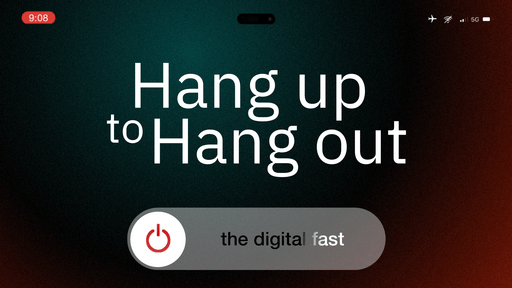

Hang Up & Hang Out: Fasting to Find God • Sermon • Submitted • Presented • 44:28
0 ratings
· 85 viewsFasting - whether from food or digital technology - is a way to recalibrate our hearts, remove distractions, and reconnect deeply with God and others.
Files
Notes
Transcript
Show of hands—how many of you have ever given up something for Lent?
Yeah, it’s a pretty common practice among Christians—maybe less so today—but throughout church history, fasting has been a foundational part of the Christian life. Unfortunately, in America and much of Western society, fasting has been watered down to little more than a dieting trend—if it’s even talked about or practiced at all.
I’ve actually got a little joke about this, and I know, it’s not that funny so lower your expectations—some of you might’ve heard me use it if you’ve ever asked me about fasting. It goes like this: someone asks, “What’s the point of fasting? What does it actually accomplish?” And my answer? “At the end of every fast, I’ve discovered one consistent result—I’m hungry.”
Yeah, I know—dry dad humor at its finest. But there’s some truth in that simplicity. When I fast from food, I definitely get physically hungry. But that’s not really the point, is it?
Because here’s the thing: while fasting from food can have some physical benefits, right secular cultural has realized this and if fasting gets talked about much today it’s kind of just been watered down to a dieting trend, while fasting from food can have some physical benefits, biblical fasting isn’t about physical hunger—it’s about stirring up a deeper spiritual hunger for God. It’s about creating space in our lives to focus on Him, to recognize our need for His presence, and to draw closer in dependence and trust.
Fasting is meant to serve as a powerful reminder that we don’t live on bread alone but by every word that comes from the mouth of God (Matthew 4:4). Yet, almost everything in our modern world is screaming the opposite message.
Food, technology, and the constant noise of life bombard us with lies that say, “You don’t need anyone else—not even God—to live the good life.” Instead, we’re told to chase our self-focused desires, whatever they may be. The mantra of our culture is clear: “Live your truth.” “You be you.” “Don’t let anyone tell you who you are or how to live!”
It goes even deeper—“You decide your gender, who you can marry, what makes you happy—and do whatever it takes to make it happen.”
We’re endlessly distracted by the declaration that you don’t need anyone else—not even God—to make a life worth living. The message is loud and clear: You can be anything you want, and you can do it on your own.
And this is where fasting becomes incredibly helpful—maybe even necessary.
But let’s be clear:
Fasting isn’t a tool to manipulate God into doing something for us.
It doesn’t make you a better Christian, and not fasting doesn’t make you less of one.
It’s not about convincing God to love you more or punishing your flesh.
(By the way, if you’re curious about diving deeper, Got Questions has a great article on fasting you might want to check out.)
Fasting—whether from food or digital distractions—is about recalibrating our hearts, removing what distracts us, and reconnecting deeply with God and others.
And that’s what I want to show you from Scripture today—not just what fasting is but why I believe a digital fast is something deeply needed for me personally, and for us as a church community.
We’re going to look at a few key passages together and unpack these 3 points:
The Heart of fasting (Matthew 4:1-4)
Technology: A Trap of distraction or Tool for Good? (Genesis 3:4; Leviticus 23:3; John 10:10; 2 Corinthians 2:11)
Join us in a church-wide digital fast.
So, let’s dive in and start by looking at what fasting really is—and what it’s supposed to do.
1. The Heart of Fasting (Matthew 4:1-4)
1. The Heart of Fasting (Matthew 4:1-4)
You can go ahead and turn to Matthew 4, but before we dive into how Jesus models fasting for us, I want you to see that fasting isn’t just something Jesus did—it’s been practiced throughout the Bible and church history.
Early Christians often fasted twice a week, recognizing its power to quiet distractions and draw near to God. And when you look through Scripture, you’ll see fasting woven into the lives of God’s people for all sorts of reasons. Here are just a few:
To draw near to God in grief (Psalm 35:13)
To strengthen and bolster prayer (Ezra 8:21; Daniel 9:3; Matthew 6:16-18)
To seek guidance and wisdom (Acts 13:2-4; Acts 14:23)
To express repentance and mourning (1 Samuel 7:6; Joel 2:12)
To overcome temptation and spiritual battles (Matthew 4:1-2)
From cover to cover, fasting is a spiritual discipline deeply rooted in Scripture and practiced by believers throughout history. It’s not about checking a religious box or following a set of rigid rules—it’s about intentionally disconnecting from worldly distractions so we can reconnect with God. It’s about hanging up to hang out with God and his people!
And here’s the key: Fasting isn’t about earning God’s favor—it’s about positioning our hearts to receive from Him. It’s an act of humility, done with joy, that helps recalibrate our hearts and reminds us of where our true help comes from.
This is exactly what Jesus models for us as He steps into His public ministry. After 30 years of living in relative obscurity—working as a carpenter alongside His earthly father, Joseph—Jesus begins His ministry by fasting.
Now, with that in mind, let’s take a closer look at how Jesus demonstrates the power and purpose of fasting here in our text.
1 Then Jesus was led by the Spirit into the wilderness to be tempted there by the devil. 2 For forty days and forty nights he fasted and became very hungry. 3 During that time the devil came and said to him, “If you are the Son of God, tell these stones to become loaves of bread.” 4 But Jesus told him, “No! The Scriptures say, ‘People do not live by bread alone, but by every word that comes from the mouth of God.’”
Now, this story continues—and I encourage you to read the rest later because there’s so much more to unpack—but for this morning, I want you to notice something crucial.
Yes, Jesus fasted, and after forty days, He was hungry—any of us would be. But this moment is about so much more than physical hunger.
As I mentioned earlier, Jesus was about to launch His earthly ministry—a mission that would turn the world upside down. Before stepping into that calling, He needed clarity and deep connection with the Father. Fasting gave Him space to retreat from the noise and pressures around Him and focus entirely on hearing God’s voice and preparing for the mission ahead.
But this wasn’t just about Jesus taking a break to gather His thoughts. This is one of those moments where Scripture pulls back the curtain and gives us a glimpse into the spiritual battle happening behind the scenes.
Friends, like Jesus, we too are living in a love story set in a world at war.
There’s a cosmic battle raging—one that didn’t start with us but certainly involves us. And our enemy? Well, he’s crafty, but his tactics haven’t changed much since the very beginning.
As Jesus fasts to draw near to the Father, Satan shows up—trying to distract, discourage, and derail Him from His God-given mission.
The first temptation—and every temptation that followed here in Matthew 4—had one goal: convincing Jesus to step outside of God’s boundaries.
"Hey Jesus, I see you're hungry. If you're really the Son of God, why not use your power to satisfy your desires?"
But Jesus, clear headed and refocused by His fast, responds with Scripture—a truth likely impressed upon His heart during those 40 days:
"Man shall not live on bread alone, but on every word that comes from the mouth of God" (Deuteronomy 8:3).
You see, this fast wasn’t about food—it was about dependence on God. It was about aligning His heart with the Father’s will.
And just like in the garden of Eden back in Genesis with Adam and Eve, Satan shows up to whisper the same old lies:
“God’s limits are holding you back.”
“You could have more than what God has given you.”
“You don’t need God—take control yourself.”
And Church, here’s the warning for us today: Those same lies are still being whispered into our lives—but now, they’re amplified through technology.
Before we dive deeper into that, let’s pause and remember what Paul warned the Corinthians in 2 Corinthians 2:11
11 in order that Satan might not outwit us. For we are not unaware of his schemes.
Friends, have you allowed yourself to become unaware of Satan’s schemes? We need to wise up. Satan’s strategies haven’t changed—they’ve just been repackaged for modern life.
We just saw how Satan tempted Jesus to bend God’s boundaries. “If you’re really the Son of God, turn these stones into bread.” It’s the same message: “Why stay within God’s limits? Why not satisfy yourself?”
But here’s the thing—this lie is as old as humanity itself. It’s the very first lie ever told.
Let’s go back to where it all started:
1 Now the serpent was more crafty than any of the wild animals the Lord God had made. He said to the woman, “Did God really say, ‘You must not eat from any tree in the garden’?” 2 The woman said to the serpent, “We may eat fruit from the trees in the garden, 3 but God did say, ‘You must not eat fruit from the tree that is in the middle of the garden, and you must not touch it, or you will die.’ ” 4 “You will not certainly die,” the serpent said to the woman. 5 “For God knows that when you eat from it your eyes will be opened, and you will be like God, knowing good and evil.”
It’s the same tactic, over and over again:
“God’s limits are holding you back.”
“You deserve more.”
“You don’t need God—take control for yourself.”
Just like Satan tempted Adam and Eve to step outside God’s boundaries, he used the same strategy with Jesus—and he’s still using it on us today. The packaging may look different, but the scheme is exactly the same.
The enemy’s goal has always been to convince us that:
God’s boundaries are restrictions, not protection.
You’re missing out on something better.
You can live without God—just take control yourself.
And here’s where it hits home:
In today’s world, technology has become one of Satan’s most effective tools to keep us distracted, dissatisfied, and disconnected from God.
Which brings us to our next point:
2. Technology Has Become More of a Trap to distract Than a Tool for God’s Good designs.
2. Technology Has Become More of a Trap to distract Than a Tool for God’s Good designs.
Now, hear me! Technology itself isn’t evil. It’s a tool—plain and simple.
Think of it like a gun. In the right hands, it can be used to hunt game, to provide, to feed a family. But in the wrong hands—driven by violent anger—it can kill and destroy.
Digital Tech is no different. It can be used for good or for evil, and just like a gun, when we are unintentional with digital tech, as I think most of us are, it becomes a weapon in the hands of the dominion of darkness. It becomes a tool of distraction and destruction, used against us far more than we’re using it for the good designs of God.
And I believe a fast from technology might be just what the Great Physician ordered—a chance to reorient our hearts and minds toward Him.
Now, don’t get me wrong—I’m not saying we need to go full Amish! I’m not calling for a total rejection of technology. I love technology!
What I am saying is this: a break, a fast, gives us space to detox—to step back, reset, and re-engage with intentionality.
It’s about ensuring that we are using technology as a helpful tool—not falling prey to its traps, traps so often set by the accuser, the enemy of our souls.
Traps that again, are as old as humanity itself.
The temptation Jesus faced in the wilderness—and the temptation Adam and Eve faced in the garden—is the same temptation that digital technology dangles before our eyes every single day.
Instead of drawing us nearer to God, it often pulls us away—away from Him, away from one another—and it whispers that same ancient lie: “Push God’s limits. Bend the boundaries He’s set for your good and your protection.”
Look again at
5 “For God knows that when you eat from it your eyes will be opened, and you will be like God, knowing good and evil.”
You will be like God.
Is this not the promise of digital technology?
For goodness’ sake, the AI revolution alone is staggering. The claims being made right now are astonishing.
Just this past Thursday, I listened to a podcaster out of Silicon Valley—someone deeply immersed in the tech world—who admitted that he used to roll his eyes when people compared AI to a new species. But now? With what AI is capable of today, he said—and I quote—“I’ve had to rethink this.”
And if you’ve followed any of the chaos surrounding OpenAI—the company behind ChatGPT—you might’ve heard about the drama with their CEO getting fired and then rehired. But here’s the wildest part: Some employees were reportedly trying to start a new religion with an Artificial Intelligence machine as its deity.
I am not making this up, Church!
What AI is enabling right now is astonishing. The constant connectivity, the vast ocean of knowledge at our fingertips—it’s overwhelming. And the claims being made about its potential? Almost god-like in what technology promises to enable.
Now don’t twist my words—technology is not God, and it should never be worshiped as such.
And yet—many do.
And why should any of this surprise us! This desire to be limitless, like God — All knowing, All present, all powerful — this is a desire lurking in all of our hearts, and technology left unchecked only serves to amplify it!
Through our never ending use of the smart phone, we are easily lured into thinking we can be limitless — always online, always available, always consuming!
Did you know that the average adult spends 5-6 hours on screen. And our teens are worse, for them it’s more like 7-9 hours a day!
And this constant engagement makes finding moments of quiet difficult. At best, in our quest to push our limits for productivity’s sake we’ve become distracted from the good life in God. At worst we’ve been completely derailed and are reaping death and destruction!
Folks, we created to live within limits! And yet our smartphones invite us daily to push past them!
A friend recently sent me a devotional from Paul David Tripp on Leviticus 23:3. It hit home—because I struggle with pushing past the limits God has set for me and the struggle is amplified by my smartphone and being constantly connected!
Tripp writes:
It is tempting to live beyond your limits. It is tempting to work harder and longer than God has designed you to. It is tempting to evaluate your life by how much you have experienced or achieved. It is tempting to exhaust yourself by working to acquire, and then working to maintain what you have acquired. But there is no limitless human being. God has created all of us with limits of time, energy, wisdom, and righteousness.
Think about time—you can’t stretch it. We don’t get 30 hours in a day. And when we push those limits, something always pays the price—our families, our health, our relationship with God.
God created us with limits. He knows them well, which is why He commanded rest.
3 “ ‘There are six days when you may work, but the seventh day is a day of sabbath rest, a day of sacred assembly. You are not to do any work; wherever you live, it is a sabbath to the Lord.
But here’s the harsh truth: our ever-connected world makes honoring those limits harder than ever. And the dominion of darkness, the World, Our Sinful Flesh and the Devil? It knows this.
We now have over a decade of hard data from the social sciences—and the verdict is clear:
Satan Is Using Technology to Steal, Kill, and Destroy (John 10:10, 2 Cor. 2:11)
Satan Is Using Technology to Steal, Kill, and Destroy (John 10:10, 2 Cor. 2:11)
Remember we must not be naive or ignorant to the schemes of the enemy lets he outwit us!
John 10:10 warns us
10 The thief comes only to steal and kill and destroy; I have come that they may have life, and have it to the full.
In Greco-Roman culture, the word “steal” used here carries with is the idea of a clever thief—someone so strategic, so shrewd, that you didn’t even realize something had been taken.
Satan steals subtly from us, Church and he’s using our smartphones to do it!
Darren Whitehead paints a scene everyone of us can relate to:
How many times has someone sent you a text message. You respond. Then look at the weather. Then without even thinking you mindlessly pop over to Instagram – what’s happening on the gram? You see a suggested reel of a mountain biker on a hill top, then a hang glider, then a science experiment with mentos & a coke bottle, then a quote from Dr Phil, then a guitar solo, then a magic trick with an egg, then a scene from Seinfeld, then the best pickleball point you’ve ever seen, then a quote from Elon Musk, then an audition from America’s Got Talent… on and on and on… Can anyone relate to this? We look up & 36 minutes have evaporated!
Or what about CLICKBAIT? CLICKBAIT is a sensational, ridiculous, and misleading headline that tricks you into opening an image, video, or article link.
You ever seen the headline. Guess who’s now waiting tables in Hollywood? Picture of Screech from Saved by the Bell… click on it – But where’s Screech?
We get sucked down a worm hole of worthless, mindless trivia…
Friends, this isn’t just wasted time. It’s stolen time. Technology, left unchecked, used unintentionally becomes a trap—stealing our focus and killing our relationships.
You’ve probably heard this one, maybe you like me live it daily!
The average American’s attention span has dropped to 8 seconds. 8 seconds, friends that is less than that of a goldfish and the data shows that it’s our unchecked use of our smartphones that are doing this to us!
And how many of us have been out and about, in a restaurant, at a ball game, at a family holiday, where we’re all there together but we’re alone together.. on our phones. I’ve seen so many couples and families at a restaurant and all of them are on a device. Listen I’m not shaming anyone, honestly I’ve been that family before… but folks, we are allowing this tool to steal precious moments from our families!
It’s secretly stealing our time and attention.
It’s also killing us—mentally, emotionally, sexually, physically, and spiritually.
Again we have 10 years of data to back up the truth!
The Surgeon General even has recommended warning labels on social media—like those on cigarettes—because of the proven mental health damage, especially to teens.
We’re seeing staggering rises in depression, anxiety, suicidal thoughts, and sexual abuse tied directly to the rise of smartphones and social media.
Unchecked digital technology isn’t just distracting us—it’s destroying us Church!
The Greek word for destroy in John 10:10 carries the weight of taking away life. And when you hold that against what Christ offers—life to the full—the contrast is striking.
Satan’s goal? To destroy our flourishing life in God.
And I know this is heavy stuff, but I have to share one more piece of data with you all because it’s fascinating and reveals the schemes of the enemy clearly! It has to do with how the dominion if darkness is destroying people’s joy!
One of the things Jesus died to give you and I in unending supply is joy Church. Joy is the knowledge that someone is glad to see me! Jesus died to take our sin so that we could know that God is always glad to see us and we would be able to enjoy God forever as children who are pure and clean before Him!
Our tech, left unchecked is stealing and destroying our ability to feel joy!
Tristan Harris, a former product philosopher at Google, said, “The tech industry is in an arms race for people’s attention.” Why? Because distraction and addiction drive profits—it’s called the attention economy.
And they’re exploiting our brain chemistry to do it.
Seth Godin, an author and cultural thinker, points out that big tech understands something crucial about human nature: the value of our excitement, anger, lust—every raw emotion we experience. And they don’t just understand it—they exploit it. They design products and algorithms that tap into the brain’s reward system, creating patterns of digital addiction through what’s known as the dopamine cycle.
But let’s break that down—What is dopamine?
Dopamine is a neurotransmitter—a chemical messenger in the brain—that plays a major role in how we feel pleasure, motivation, and reward. It’s often called the “feel-good” chemical because it reinforces behaviors that bring us joy or satisfaction. God designed it as a good and necessary part of how we experience reward and motivation—whether it’s enjoying a good meal, celebrating a win, or sharing a moment with someone you love.
But here’s where technology hijacks this God-given system.
The Digital Addiction Cycle: How It Works
The Digital Addiction Cycle: How It Works
The Slot Machine Effect:
Social media and apps are intentionally designed to function like slot machines. Every time you scroll, click, or refresh, you’re met with unpredictable content—a funny video, a message, a “like.” That unpredictability triggers your brain to release dopamine, drawing you back in for more.
The Dopamine Loop:
Every like, notification, or new comment gives you a small dopamine rush. Your brain starts to crave that next hit, forming a habit loop. This is why so many of us feel the urge to check our phones constantly—even when there’s no real reason
Dopamine Overload:
Over time, constant engagement overstimulates your brain’s dopamine receptors. When that happens, those receptors begin to dull and stop functioning properly. The result? You need more stimulation just to feel anything. What once brought joy now leaves you feeling numb.
The Numbness of Over stimulation:
This is where it gets dangerous. When your dopamine system is overloaded, real joy becomes harder to experience. Moments with family, time in nature, or even worship can feel dull because your brain has been rewired to crave constant, high-intensity stimulation.
Resetting for Real Joy:
The good news? Your brain can reset. It takes about three weeks of stepping back from over stimulation—whether that’s social media, video games, or constant scrolling—for your dopamine receptors to heal and reset. Only then can you begin to experience real joy again, the way God intended.
Which is why we’re doing a digital fast together as a Church!
3. The Invitation to Disconnect from the Digital World to Reconnect with God and His People
3. The Invitation to Disconnect from the Digital World to Reconnect with God and His People
Here’s the invitation:
For Lent, our church is committing to 40 days of a digital fast—a corporate step toward hanging up to hangout with God and each other! A time to intentionally break free from the constant distractions of technology so that we can reawaken our hunger for God.
If you haven’t picked up the book from Darren Whitehead. I’d encourage you to do so. It has a lot of the information and more that I shared with you today in the front half and then in provides 40 days of devotional content to help guide your fast moving through 4 key phases: Detach, Discover, Delight and Determine.
Again we’re not totally throwing out or technology. We’re disengaging for a set time, to detox and detach to discover how the enemy has stolen, killed and destroyed through the unchecked trap of technology, and hopefully rediscover how to delight in community and God and then determine to re-engage with our tech in a way to avoid it’s traps and use it as a tool for God’s good designs moving forward!
In his book, Darren recognizes that
“Everyone is different, and the necessity for access to digital technology and devices varies.
With that in mind, he gives us two options for our digital fast, which I’ll put on the screen and make available on our website as well:
1) a full digital fast and
2) a modified digital fast.
Regardless of which you choose, taking a break from plugging in to reconnect with others and life will benefit you.
I realize, some of you may want more help in thinking this through and so here’s what we’re going to do. Wes is going to teach an equip class over the next 2 weeks Sunday Mornings from 8:30-9:30 for anyone who wants more help talking through the practicality of putting this fast together for themselves and their families. We’ll take it to a 3rd week if the interest requires.
Also, I made a page on our website under the “Freedom” tab with tons of books, podcasts and resources to help you plan, prepare and participate in the fast here at CR.
Final Challenge: Will You Join Us?
Final Challenge: Will You Join Us?
Church, Jesus fasted because He knew true life is found in God, not in temporary satisfaction.
Are we willing to do the same?
Fasting—whether from food or digital distractions—is a way to remove distractions, recalibrate our hearts, and reconnect deeply with God and others.
Are we willing to break free from distractions and reawaken our hunger for God?
I truly believe stepping away from digital distractions will open the door for God’s power to move in profound ways.
So what do you say? Will you join us? Will you Hang Up to Hang Out?
Pray.
