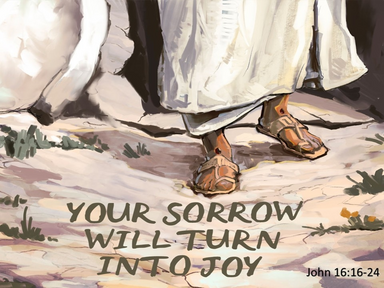
Turn Sorrow to Joy

Notes
Transcript
My Sorrow Turned into Joy
John 16:16-24
Online Sermon:
http://www.mckeesfamily.com/?page_id=3567
Imagine being one of Jesus’ disciples and hearing Him
say that He would only be with you a little while longer.
You can still recall the first time you met Him—the
moment He searched your heart and knew you completely. Like
Nathanael, you marveled at how He saw you before you even
knew Him (John 1:4851). He spoke with an
authority unlike any
other, revealing truths
about God’s kingdom
that had remained hidden
for generations. And
though
you
were
fearfully and wonderfully
made (Psalm 139:13-14), you also knew you were deeply flawed
by sin.
Yet when Jesus called, “Follow Me, and I will make you
fishers of men,” you didn’t hesitate (Mark 1:17). You left
everything behind—your family, your trade, your security—to
walk in His footsteps. You listened intently as He taught in
parables, witnessed miracles beyond imagination, and even took
1|Page
part in His ministry, healing the sick and casting out demons in
His name (Matthew 10:1).
But now, He speaks of leaving. Mary had been told that
Jesus would be called the Son of the Most High, and that His
kingdom would have no end (Luke 1:32-33). Now, Jesus speaks
of something unthinkable—His death. At first, His words
seemed mysterious:
“Destroy this temple, and in three days I will raise it
up” (John 2:19).
“As Moses lifted up the serpent in the wilderness, so
must the Son of Man be lifted up” (John 3:14-15).
But as time went on, His meaning became painfully clear.
“I am the Good Shepherd. The Good Shepherd lays
down His life for the sheep.”
“No one takes it from Me, but I lay it down of My own
accord” (John 10:11-18).
And then, the most troubling words of all: “I am going to the
Father… where I am going, you cannot come” (John 13:33,
14:2).
Can you imagine the weight of those words? You had
given up everything to follow Him, and now He was saying He
would be taken away, crucified, and leaving you behind. Had
everything been for nothing? Without its King, how could God’s
kingdom ever spread?
It must have felt like the end of everything.
But what if this wasn’t the end at all?
What if His departure wasn’t the end of joy—but the beginning of
something far greater than you ever imagined?
Preparing them for Sorrow
As the Gospel story unfolds and the shadow of Christ’s
arrest and crucifixion looms closer, one can’t help but wonder—
how would our Good Shepherd prepare His disciples for the
crushing sorrow that was about to consume them?
How would they endure the news that their beloved
Master had been brutalized by His captors—beaten and mocked
by the men guarding Him
(Luke 22:63-65), spat
upon and struck in the
face by His accusers
(Matthew
26:67-68)?
Imagine their anguish
upon hearing that Pilate
had ordered Jesus to be
flogged (John 19:1-3) and
that the governor’s soldiers had stripped Him, draped Him in a
scarlet robe, pressed a crown of thorns into His head, and
1
Matt Carter and Josh Wredberg, Exalting Jesus in John (Nashville,
TN: Holman Reference, 2017), 329.
2|Page
mercilessly mocked Him as a false king (Matthew 27:27-31).
And how would Jesus prepare John, the disciple He loved, for
the heartbreak of watching His Master collapse under the weight
of the cross, forcing Simon of Cyrene to carry it in His place
(Matthew 27:32)? How would John bear the agony of standing
at the foot of the cross, witnessing Jesus’ final moments as He
cried out in a loud voice and breathed His last (Mark 15:37)?
When His bruised and lifeless body was taken down,
wrapped in burial cloths, and placed in a sealed tomb under
Roman guard, it must have seemed as if all hope was lost. Their
world had shattered. And if their grief weren’t heavy enough,
while the disciples wept and mourned the loss of their Lord, the
world rejoiced in His death.1 The religious leaders, the soldiers,
and even the crowds celebrated their perceived victory over the
one who had claimed to be the Son of God. At this point in the
story, one question lingers: how could anyone survive such
unbearable sorrow? How could Jesus' followers possibly be
prepared for the depths of despair that awaited them?
The Necessity of the Cross
Though the disciples would experience overwhelming
sorrow, there was simply no other way for humanity to be saved
from sin. Satan had tempted Jesus with the kingdoms of the
world and their splendor, but they were never his to give, for
there is only one true Lord and God (Matthew 4:8-10). The only
path to redemption was through the agony of the cross.
In the Garden of Gethsemane, Jesus fell to the ground,
His face pressed into the earth (Matthew 26:39), His body
trembling under the weight of what was to come. In anguish so
deep that His sweat was
like drops of blood
(Luke 22:44), He cried
out to the Father,
knowing that there was
no other way—only His
sacrificial death could
atone for the sins of the
world. What the law was
powerless to accomplish
because of human sinfulness, Christ fulfilled by offering
Himself as the sinless Lamb of God, a ransom for many (Mark
10:45).
Peter, out of genuine love and passion, tried to stop Jesus
from going to the cross, but even the gates of Hell could not
prevent God's plan of redemption (Matthew 16:21-23). Not even
Satan, the so-called
prince of this world,
could prevent the
Lamb who was slain
before the foundation of the world from fulfilling His mission
(Revelation 13:8). Jesus’ sacrifice was an unstoppable
expression of divine love—not just for His disciples, friends, and
family, but especially for His enemies (Romans 5:10).
3|Page
Without the cross, there would be no resurrection joy, no
eternal victory, and no sealing of the redeemed by the Holy
Spirit (2 Corinthians 1:21-22). But because of the cross, sorrow
would be turned into joy, despair into hope, and sinners into
saints, forever secured in Christ.
It would be easy for us to judge the apostles from this
side of the cross and wonder how they could have doubted. Had
they not heard the prophecies? Had Jesus Himself not told them
He would rise again?
Yet, if we are truly
honest with ourselves,
we must humbly admit
that we, too, struggle
with faith amid trials.
Despite the countless
Witnesses
blessings
God
has
f oy
promised us, when pain
and suffering come, we
often cannot see beyond the walls of our anguish. We cry out in
desperation, feeling as though God has somehow forsaken us—
just as the disciples must have felt in their darkest hour.
But here’s what we learn from them: even in the bleakest
moments, the Good Shepherd is at work. His plan is never to
harm us, but to shape us, refine us, and allow us to flourish. Can
we not look to the cloud of witnesses in Scripture and to our own
testimonies of deliverance? Do we not have countless reminders
of God’s faithfulness that assure us He will never leave us nor
forsake us? It is precisely because we have walked through the
crucible of affliction—carried on the shoulders of our Lord—
that we learn to rejoice. We rejoice not only because He delivers
us from suffering, but because He strengthens our faith through
it.
So, I pray, Lord, teach us to find joy amid mourning.
Until we learn to do so, we will never be fully grateful or
satisfied, for the crumbs of our afflictions will blind us to the
feast of spiritual blessings You have prepared for us. Without
the cross, there would be no resurrection joy, no eternal victory,
and no sealing of the redeemed by the Holy Spirit. But through
the cross, death itself would be defeated, and a new dawn of
redemption would rise (2 Corinthians 1:21-22). Lord, teach us
to find joy amid mourning.
Joy that Cannot be Taken Away
But just as sorrow filled the hearts of the disciples at the
cross, Jesus had already promised that their grief would not last
forever. To help them grasp the emotional turmoil they were
about to endure, He compared it to childbirth—a process filled
with pain, struggle, and anticipation, yet ending in
overwhelming joy.
Pregnancy is no easy task. What mother could forget the
morning sickness, exhaustion, swollen ankles, aching back,
constant trips to the bathroom, and digestive struggles that seem
2
Matt Carter and Josh Wredberg, Exalting Jesus in John (Nashville,
TN: Holman Reference, 2017), 330.
4|Page
endless? If that weren’t enough, the emotional toll of mood
swings, fear of the unknown, and restless nights only add to the
burden. And in ancient
times, labor itself was
even more grueling—
most women delivered
squatting or kneeling,
without
modern
medicine, relying only
on herbs, warm water,
and massage for relief.
Truly, as Genesis 3:16
declares, "I will make your pains in childbearing very severe"—
a promise every mother can attest to!
And yet, something miraculous happens. The moment a
mother holds her child, the pain that once seemed unbearable
fades in the overwhelming joy of new life in her arms. Jesus
assured His disciples that their sorrow, too, would not be the
final chapter. Just as labor pains give way to unspeakable joy,
their grief would be swallowed up in a joy that no one could ever
take away (John 16:20-22).
What else in life carries such a guarantee? Wealth can
vanish in an instant—stolen by thieves or lost in a stock market
crash. Good health can be taken by disease. Reputations can be
tarnished by gossip, cruelty, and slander.2 But there is one thing
that no power on earth or in hell can ever take away—the love
that Christ demonstrated on the cross! As Paul declares:
“For I am convinced that neither death nor life, neither angels
nor demons, neither the present nor the future, nor any powers,
neither height nor depth, nor anything else in all creation, will
be able to separate us from the love of God that is in Christ Jesus
our Lord” (Romans 8:38-39).
Even death itself has no sting for those who are in Christ! Why?
Because “The sting of death is sin, and the power of sin is the
law. But thanks be to God! He gives us the victory through our
Lord Jesus Christ” (1 Corinthians 15:56-57).
Yet so often, we place our joy in things that can be taken
from
us—relationships,
careers, financial security,
health, fame, and power. But
doing so is like storing all your
life’s savings in a piggy bank
and leaving it in a high-crime
neighborhood, expecting it to
remain
untouched.
Jesus
warned His disciples:
You will feel the excruciating pain of watching Me
crucified. You will be deeply troubled, lost in grief for three
days, wondering if all your hopes in the kingdom of God have
been in vain. But on that glorious resurrection morning, when
the tomb stands empty and the Holy Spirit fills your hearts, you
will know that death has lost, and joy has won!
5|Page
Like the disciples, we are called not just to endure
hardship, but to endure it with hope—knowing that joy is
coming. While we cannot
avoid the pain of trials
and tribulations, we can
see them for what they
truly
are—momentary
afflictions that cannot
compare to the eternal joy
awaiting us. As Paul
reminds us:
“I consider that our present sufferings are not worth
comparing with the glory that will be revealed in us” (Romans
8:18).
Just as a mother forgets her labor pains in the presence of her
newborn, so too will all suffering pale in comparison to the
resurrection joy we will experience when we stand before the
pioneer and perfecter of our faith, Jesus Christ (Hebrews 12:12). Earthly joy is fleeting, but the joy found in Christ is eternal.
While everything else fades, His love, His promises, and our
inheritance in Him remain forever!
Let our Joy be Refreshed in Prayer
But even as we cling to the unshakable joy found in
Christ, we must remember that joy is not a fleeting emotion nor
a one-time experience—it is a wellspring that must be nurtured,
renewed, and refreshed daily. Just as a weary traveler finds relief
in a cool stream, we must continually return to the presence of
God to sustain our joy. Through prayer, we are anchored in His
promises, strengthened by His Spirit, and refilled with the peace
that surpasses all understanding.
Like the disciples, we do not fear, for though we are sent
out like sheep among wolves, we go not with mere words of
wisdom or persuasion, but in the demonstration of the Spirit’s
power
(1
Corinthians 2:4-5).
Jesus assures us
that whatever we
ask in His name,
He will do—not as
a genie who grants
wishes, but as our
sovereign
Lord
who aligns our
hearts with His
perfect and pleasing will (Romans 12:1-2). It is through prayer
that we discern His will, receive His strength, and are
empowered to live lives worthy of the Gospel (Philippians 1:27).
We are called to holiness, generosity, boldness, gratitude,
repentance, and selflessness—but we cannot do this on our own.
It is only as we humble ourselves before God, pleading for His
work in us, that we are transformed.
A prayerless life is a powerless life. And a powerless life
is one that lacks true, lasting joy. May we never neglect the
privilege and power of prayer—for in His presence, our joy is
renewed, our faith is strengthened, and our purpose is made
clear.
6|Page
Conclusion
As we stand at the end of this journey—from the sorrow
of the cross to the unshakable joy of the resurrection—we are
reminded of a truth that transforms everything: our pain is
temporary, but our joy in Christ is eternal. Just as the disciples
faced crushing sorrow, only to be overwhelmed with
resurrection joy, so too must we remember that our trials are not
the end of the story. We do not grieve as those without hope. We
do not endure suffering without purpose. We do not walk
through life without the presence of our risen Savior. Our joy is
not in circumstances, not in temporary pleasures, not in the
fleeting things of this world. Our joy is in Christ alone—the One
who conquered death, the One who defeated sin, the One who
has sealed us with His Spirit and secured for us an eternal
inheritance that can never fade!
So, no matter what trials we face, no matter what burdens
we carry, we cling to the truth that nothing—absolutely
nothing—can separate us from the love of God that is in Christ
Jesus our Lord (Romans 8:38-39).
And how do we keep this joy alive?
Through prayer.
Through abiding in His presence.
Through fixing our eyes on Jesus, the pioneer and perfecter of
our faith (Hebrews 12:2).
Let us, then, walk in the power of His Spirit, live lives worthy of
the Gospel, and hold fast to the unshakable joy that no trial, no
hardship, and no force of darkness can take away.
For the tomb is still empty.
The victory is still won.
And the joy of the Lord is still our strength—forever!
7|Page
