Many Called, Few Chosen
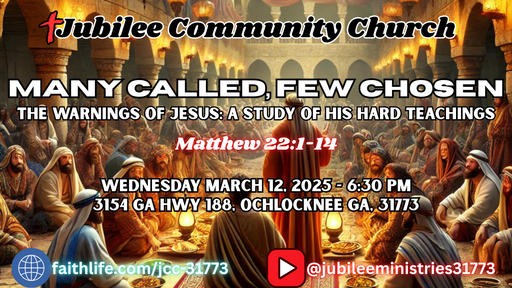
The Warnings of Jesus: A Study of His Hard Teachings • Sermon • Submitted • Presented • 54:13
0 ratings
· 114 viewsFiles
Notes
Transcript
Many Called, Few Chosen
Many Called, Few Chosen
Wednesday Night Bible Study – Session 1
Series: The Warnings of Jesus: A Study of His Hard Teachings
Date: March 12, 2025
Introduction
Introduction
1. Welcome
• Welcome: Tonight, we begin a study on the warnings of Jesus, focusing on the Parable of the Wedding Feast and its profound message: Many are called, but few are chosen.
2. Why This Study Matters
• Jesus’ warnings were given to ensure we have genuine faith, not just religious association.
• Many assume they are part of God’s Kingdom, but Jesus teaches that not all who are invited will enter.
• This session will answer:
• What does it mean to be called but not chosen?
• What does the wedding garment symbolize?
• How does this connect to other warnings in Scripture?
3. Key Passage: Matthew 22:1-14
• The Parable of the Wedding Feast is a kingdom parable, teaching who will enter and who will be cast out.
• Jesus used wedding imagery throughout Scripture to describe salvation and judgment.
Part I: The Parable of the Wedding Feast (Matthew 22:1-14)
Part I: The Parable of the Wedding Feast (Matthew 22:1-14)
1. The Kingdom of Heaven is Like a Wedding Feast (Verses 1-2)
2 The kingdom of heaven is like unto a certain king, which made a marriage for his son,
• Symbolism in the parable:
• The King = God the Father
• The Son = Jesus Christ
• The Wedding Feast = The Kingdom of God / Eternal Life
• The First Invited Guests = Israel (God’s chosen people)
• The Other Guests (Good and Bad) = The Gentiles (All nations invited)
• Isaiah 25:6-9 – God prepares a great feast, removing reproach from His people.
• Revelation 19:7-9 – The Marriage Supper of the Lamb, where the redeemed join Christ.
Main Takeaway: Jesus shows that not everyone invited will accept the invitation or be found worthy.
2. The Rejection of the Invitation (Verses 3-7)
3 And sent forth his servants to call them that were bidden to the wedding: and they would not come.
• God first invited Israel to receive salvation through the Messiah (Romans 1:16).
• But many ignored the invitation, just as Israel rejected Jesus.
• Some guests even killed the messengers (symbolizing the prophets and apostles).
7 But when the king heard thereof, he was wroth: and he sent forth his armies, and destroyed those murderers, and burned up their city.
• Jeremiah 7:25-26 – Israel rejected God’s prophets, leading to judgment.
• Luke 13:34-35 – Jesus weeps over Jerusalem’s rejection and destruction.
• Acts 7:51-52 – Stephen accuses Israel of killing the prophets and resisting God.
Lesson: Rejecting God’s call brings judgment.
Application: Are we ignoring God’s voice? Have we treated His invitation as unimportant?
3. The Invitation is Given to Others (Verses 8-10)
9 Go ye therefore into the highways, and as many as ye shall find, bid to the marriage.
• Since Israel rejected the call, God opened the door to the Gentiles (all nations).
• The King invites both good and bad, showing that salvation is freely offered to all.
• However, not everyone who enters the banquet is truly chosen.
• Isaiah 55:1-3 – God invites all to come and partake freely.
• Romans 11:11 – Salvation is extended to the Gentiles due to Israel’s unbelief.
Application: God’s invitation is wide open, but simply being invited is not enough—we must be clothed in righteousness.
Part II: The Man Without a Wedding Garment (Matthew 22:11-13)
Part II: The Man Without a Wedding Garment (Matthew 22:11-13)
11 And when the king came in to see the guests, he saw there a man which had not on a wedding garment:
1. The Wedding Garment Represents Righteousness
• In biblical times, wedding garments were provided by the host for guests.
• The man who came without a wedding garment refused to wear what was given.
8 And to her was granted that she should be arrayed in fine linen, clean and white: for the fine linen is the righteousness of saints.
• Isaiah 61:10 – Salvation is like being clothed in garments of righteousness.
• Galatians 3:27 – We must “put on Christ” through faith.
2. The Man is Cast into Outer Darkness (Verses 12-13)
13 Then said the king to the servants, Bind him hand and foot, and take him away, and cast him into outer darkness; there shall be weeping and gnashing of teeth.
• This represents eternal separation from God (Hell).
• The man thought he could enter the Kingdom without being clothed in Christ.
• Matthew 8:12 – The children of the kingdom cast into outer darkness.
• 2 Corinthians 5:21 – We must be clothed in Christ’s righteousness.
Lesson: Many will try to enter the Kingdom on their own terms, but only those covered by Christ will be accepted.
Application: Are we clothed in our own righteousness, or in Christ’s righteousness?
Part III: Many Are Called, Few Are Chosen (Matthew 22:14)
Part III: Many Are Called, Few Are Chosen (Matthew 22:14)
14 For many are called, but few are chosen.
1. What Does This Mean?
• Many hear the Gospel, but few respond in true faith.
• The chosen are those who respond in faith and obedience.
• Matthew 7:13-14 – Few find the narrow way.
• Luke 13:24 – Many will seek to enter, but will not be able.
• Matthew 10:22 – Only those who endure to the end will be saved.
Part IV: How Do We Ensure We Are Among the Chosen?
Part IV: How Do We Ensure We Are Among the Chosen?
1. Repent and Believe in Christ Alone (Acts 2:38, John 14:6)
2. Walk in Holiness and Obedience (1 Peter 1:15-16, Hebrews 12:14)
3. Be Clothed in Christ’s Righteousness (Galatians 3:27, Revelation 19:8)
4. Endure Until the End (Matthew 24:13)
Conclusion
Conclusion
1. Summary of Key Truths
• God’s invitation is open to all, but not all will enter.
• Many will try to enter without true faith and obedience.
• Only those clothed in Christ’s righteousness will be accepted.
2. Final Call to Self-Examination
• Are we truly surrendered to Christ?
• Have we put on the wedding garment of righteousness?
Next Session: “Depart from Me, I Never Knew You”
Next Session: “Depart from Me, I Never Knew You”
• What does it mean when Jesus says, “I never knew you” (Matthew 7:21-23)?
• How can we ensure that we truly know Christ and are not deceived?
