Clothing of Christ

Notes
Transcript
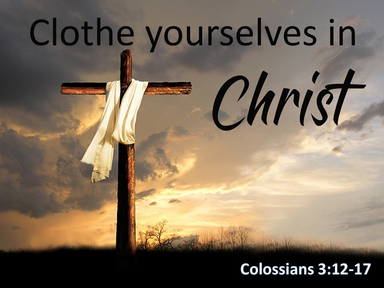
Putting on Christ’s Clothes
Colossians 3:12-17
Online Sermon:
http://www.mckeesfamily.com/?page_id=3567
Can you remember the moment your life changed
forever? The moment Christ stepped into your heart and
everything was made new? That life-changing moment when
God’s grace swept
over you, bringing a
transformation
so
profound that words
could hardly capture
it? How does one
describe
the
experience
of
receiving a brandnew heart and spirit,
as promised in
Ezekiel 36:26-27? In that instant, the self—the god we once
worshiped—was crucified with Christ. Like Apostle Paul, we
can now declare with joy, "It is no longer I who live, but Christ
who lives in me" (Galatians 2:20). With deep humility and
1
Everett F. Harrison, “Romans,” in The Expositor’s Bible
Commentary: Romans through Galatians, ed. Frank E. Gaebelein,
vol. 10 (Grand Rapids, MI: Zondervan Publishing House, 1976), 68.
1|Page
gratitude, we recognize that salvation was not something we
earned through our own righteousness, which is like filthy rags
before God (Isaiah 64:6). Instead, we were saved "by His mercy,
through the washing of regeneration and renewal by the Holy
Spirit" (Titus 3:5). In that moment, we were not just forgiven—
we were adopted into God’s family as His children and heirs
(John 1:12-13). Who could ever forget such a day?
But salvation didn’t just change our identity—it changed
our relationship with sin. Sin lost its mastery over us! Do you
remember your baptism? Paul writes in Romans 6:4-6:
"We were therefore buried with Him through baptism into death
in order that, just as Christ was raised from the dead by the glory
of the Father, we too may
live a new life."
Baptism itself does not
save us, but it is a
powerful symbol of the
transformation brought by
the Holy Spirit. Once, sin
entangled and enslaved
us. But in that moment,
Christ broke its dominion over us.1 What the law was powerless
to do because of our sinful nature (Romans 8:3), Christ
accomplished on our behalf. In baptism, we are united with
Christ in His death—so that we die to sin—and in His
resurrection, so that we walk in newness of life, filled with His
holiness and righteousness.2 This doesn’t mean that we become
incapable of sin after salvation, but it does mean that we are no
longer bound by it. Through the Holy Spirit, we now have the
power to say NO to sin and YES to holy living.
As God’s chosen people, called "out of darkness into His
wonderful light" (1 Peter 2:9), we are urged to fix our hearts "on
things above, where Christ is, seated at the right hand of God"
(Colossians 3:1). This means we must put to death the remnants
of our earthly nature—
“sexual
immorality,
impurity, lust, evil
desires, and greed,
which is idolatry”
(Colossians 3:5). We
once walked in these
R mo n
ways—anger,
rage,
malice, slander, and
o n
filthy
language
(Colossians 3:8)—but now, as God’s redeemed masterpieces,
salvation is not just a one-time transformation. It is an ongoing,
glorious invitation to sit at the feet of the Master, allowing the
Potter to continually shape us into His righteousness and
holiness. But how do we live this new life daily? How do we
practically walk in holiness?
2
Douglas J. Moo, Romans, The NIV Application Commentary (Grand
Rapids, MI: Zondervan Publishing House, 2000), 197.
2|Page
Today's Focus: Clothing Ourselves with Christ
In today’s message, we will dive into how to clothe
ourselves with the characteristics of Christ—compassion,
kindness, humility, gentleness, and patience. These virtues are
not just personal attributes but essential for protecting unity
within the body of Christ and living as those who have been
made alive in Him. Let us press forward, not merely as those
who have been saved, but as those who daily surrender to the
Master’s refining work—so that Christ may be seen in us, and
through us, for His glory.
Committing to Christ-like Character
Now that we have been born again of water and the
Spirit, we are no longer who we once were—we are new
creations,
shaped,
sustained, and
sanctified by
Christ
Himself. This
transformation
is not merely
personal; it marks our entrance into something far greater—a
holy community, the people of God. As His chosen, holy, and
dearly loved (Colossians 3:12), we are set apart, not because of
anything we have done, but by His sovereign grace. Just as God
chose Israel, so He has chosen us: “Out of all the peoples on the
face of the earth, to be His treasured possession” (Deuteronomy
7:6-7; 1 Peter 2:9-10).
Since no one earns their place in God’s kingdom, there
is no room for boasting—only humble, joyful gratitude for His
grace. As Paul reminds us, “He has called not only from among
the Jews but also from
the Gentiles” (Romans
9:24-25), making us
partakers
in
His
glorious
inheritance
(Ephesians
1:11-12).
We now belong to a
kingdom
that
is
unshakable, a family
that is eternal. Our
past—our sins, failures, and former identities—no longer define
us. Instead, we bear the mark of divine adoption, sealed by the
Spirit.
This new identity transcends religious background,
ethnicity, and social status;3 we are one body in Christ, bound
together by His love (Galatians 3:28). And as God’s beloved,
our calling is clear: to reflect His character, to live out His
3
Douglas J. Moo, The Letters to the Colossians and to Philemon, The
Pillar New Testament Commentary (Grand Rapids, MI: William B.
Eerdmans Pub. Co., 2008), 275.
3|Page
righteousness, and to walk in the light of His holiness. But what
does this look like in our daily lives? How do we embody the
identity Christ has bestowed upon us?
Just as Israel was called to be a light to the nations, we
too are called to shine in the darkness by clothing ourselves with
Christ’s character, so that others may “see your good deeds and
glorify your Father in heaven” (Matthew 5:16). Paul, in a
passage reminiscent of the fruit of the Spirit (Galatians 5:22-23),
outlines six key virtues that we, as followers of Christ, must wear
daily. To offer our
om ass on
bodies as living
n no
s
n n oo
s a
sacrifices (Romans
ms
on
s
12:1), we must first
a s
s
a
remove the tattered
o o
garments of our old
n n ss
sinful nature—the
o s o as ona
pride,
selfish
oo
a s
o
ambition,
and
n os
hardened hearts that
once defined us. The
world chases status and recognition, but Christ calls us to a life
of humility, service, and love. Rather than seeking personal
gain, we must clothe ourselves with compassion—a mercy that
flows not from obligation, but from a heart transformed by
Christ (Colossians 3:12). As God’s chosen people, we are also
called to kindness, not just as an occasional gesture of goodwill
but as a lifestyle of generosity. To give our time, our resources,
and our love to those in need is to give to Christ Himself
(Matthew 25:40). True kindness goes beyond politeness—it is a
reflection of Christ’s love, seeking the good of others before
ourselves.
In reflecting the One who gave His life as a ransom for
many (Mark 10:45), we must throw off the world’s pursuit of
honor—the outward displays of egotism and arrogance that
crave recognition4—and instead, put on the garment of
humility. True humility is not weakness—it is strength under
God’s control. It
does not strip us
o no os on,
om
m
of our worth but
a
om n a
s an
aligns us with
a
Christ,
who,
though He was
fully
God,
a n o
s, s
n
humbled Himself
n
ss s
ans
to serve others
(Philippians 2:34). Walking in
humility means putting others before ourselves, seeking their
well-being first, and trusting that in due time, God will lift us up
(James 4:10). Instead of prideful self-assertiveness, we bear with
one another in love (Colossians 3:13), considering the rights and
feelings of others, exercising patience in disagreements, and
4
David E. Garland, Colossians and Philemon, The NIV Application
Commentary (Grand Rapids, MI: Zondervan Publishing House,
1998), 210–211.
4|Page
choosing words that build up rather than tear down. Even when
correction is necessary, it should be given not in condemnation
but in grace, with the goal of restoring rather than wounding.
Above all, as God’s own, we are clothed with patience and
forgiveness, extending mercy even to our enemies. Jesus
commanded, “Love your enemies, do good to those who hate
you, bless those who curse you, pray for those who mistreat you”
(Luke 6:27-28). This is not a passive endurance but an active,
Christ-like love that refuses to be overcome by evil and instead
overcomes evil with good (Romans 12:21). When we wear these
virtues, we do not merely reflect Christ—we reveal Him to a
world in desperate need of His light.
Cultivating the Bonds of Love
Paul reminds us that simply putting on Christ’s virtues—
compassion, kindness, humility, gentleness, patience, and
forgiveness—is not enough unless they are bound together by
love, which holds them in perfect unity (Colossians 3:14).
Without love, even the most righteous actions are incomplete.
This truth naturally leads us to reflect on the infamous “love
chapter” in Scripture:
“If I speak in the tongues of men or of angels, but do not have
love, I am only a resounding gong or a clanging cymbal. If I have
the gift of prophecy and can fathom all mysteries and all
knowledge, and if I have faith that can move mountains, but do
not have love, I am nothing” (1 Corinthians 13:1-2).
Paul describes love as patient and kind—never envious,
boastful, or proud. It does not dishonor others, nor is it selfseeking
or
easily angered.
Above all, love
keeps no record
of wrongs (1
Corinthians
13:4-5). Love
rejoices in the
truth, always
trusts, always hopes, and always perseveres (1 Corinthians
13:7). Without love, our faith lacks its most essential quality, for
as Apostle John declares:
“Everyone who loves has been born of God and knows God.
Whoever does not love does not know God, because God is
love” (1 John 4:7-8).
Our light cannot truly reflect the glory of the Father until His
love is alive in us. So, the question remains: Do you love those
whom God has placed in your life? Do you see His image in
them, or do you struggle to love as He has loved you?
5
Curtis Vaughan, “ o oss ans,” in The Expositor’s Bible Commentary:
Ephesians through Philemon, ed. Frank E. Gaebelein, vol. 11 (Grand
Rapids, MI: Zondervan Publishing House, 1981), 215.
5|Page
Cherishing Christ’s Peace
Those who have clothed themselves with Christ’s virtues
will, in every circumstance, strive to preserve the bonds of peace
(Colossians 3:15). However, being born again does not mean we
will never experience adversity, inner turmoil, or moments of
remorse over sin. There will be times when our peace is ruffled
by trials, overcast by sin, or shaken by a troubled conscience.5
Yet, for peace to rule in our hearts, we must see the image of
God in others—even in those with whom we differ.
As members of one body, we come from varied
backgrounds—economically, demographically, and culturally.
These differences,
however, are not
meant to divide us
but
to
be
celebrated in unity
as we follow
Christ, the Head of
the body. True
peace is not just an
individual sense of
a n
s
calm; it is a
communal bond that governs our relationships, fostering
reconciliation, harmony, and unity in the face of conflict. John
MacArthur wisely observes, “Too many churches today have
forgotten that their main purpose is one. As the church of the
living God, they are to be the pillar of support and truth.” When
believers allow Christ’s peace to rule their hearts, even tense and
uncomfortable moments become opportunities to demonstrate
our allegiance to Christ—the Vine to whom we are grafted at the
cost of His very life. It is only when we are at peace with God—
in prayer, submission, and trust in His sovereign rule over our
lives—that we can truly love as Christ first loved us (1 John
4:10).
Celebrating the Word of Christ
With Christ’s virtues and peace firmly rooted in our
lives, Paul urges us to celebrate the words of Christ—both
through teaching and singing. John Calvin wisely reminds us,
“Unless God’s Word illumine the way, the whole life of men is
wrapped in darkness and mist, so that they cannot but miserably
stray.”6 The Christ-centered life is not shallow or superficial,
but one deeply anchored in the transformative power of the
Gospel. This calls us to not only affirm and encourage one
another but also to admonish in wisdom, reflecting Christ’s
teaching and example in all we do. God’s Word is our guide:
“Your word is a lamp for my feet, a light on my path” (Psalm
119:105).
6
John Calvin, The Complete Gathered Gold: A Treasury of Quotation of
Christians.
6|Page
“All Scripture is God-breathed and is useful for teaching,
rebuking, correcting and training in righteousness, so that the
servant of God may be thoroughly equipped for every good
work” (2 Timothy 3:16-17).
But our response to God’s Word should not be mere
intellectual acceptance—it should overflow into praise. Paul
encourages us to worship the Lord “through psalms, hymns, and
songs from the Spirit” (Colossians 3:16). While preferences in
music may vary, Paul reminds us that style is not what matters
most. Rather, what pleases God is a heart that sings from a
wellspring of gratitude. Thus, Paul concludes with this powerful
charge:
“Whatever you do, whether in word or deed, do it all in the name
of the Lord Jesus, giving thanks to God the Father through Him”
(Colossians 3:17).
May we live, teach, and sing in a way that reflects the glory of
Christ, exalting His name in all that we do!
Conclusion
As we come to the end of this message, we are reminded
that salvation is not just a moment—it is a transformation that
continues daily. The day Christ entered our hearts was the day
everything changed. We were washed, renewed, and adopted
into God’s family. But this was only the beginning. Our new
identity in Christ calls us to live differently—to put off the old
self, to clothe ourselves in His righteousness, and to reflect His
character in all we do.
Paul challenges us to fix our hearts on things above, to
live in the reality of our heavenly calling, and to walk in holiness,
love, peace, and gratitude. This transformation is not just for our
personal growth—it is a testimony to the world. When we love
as Christ loved, when we forgive as He forgave, and when we
worship with sincere hearts, we do not just reflect Christ—we
reveal Him to a world desperate for hope.
So, as we go forward:
Let us be people of love, bearing with one another in patience
and kindness.
Let us be peacemakers, striving for unity in the body of Christ.
Let us be doers of the Word, not merely hearers, allowing
Scripture to shape our every decision.
Let us worship with hearts overflowing in gratitude, not
caught up in style or preference, but in genuine praise to our
Savior.
And above all, let us live every moment for the glory of Christ,
for as Paul reminds us:
“Whatever you do, whether in word or deed, do it all in the name
of the Lord Jesus, giving thanks to God the Father through Him”
(Colossians 3:17).
May we leave here today not just inspired but transformed—
fully surrendered to Christ, fully clothed in His righteousness,
7|Page
and fully committed to living, loving, and serving in His name,
for His glory, until the day He returns.
