Luke 13:1-9 How Long?
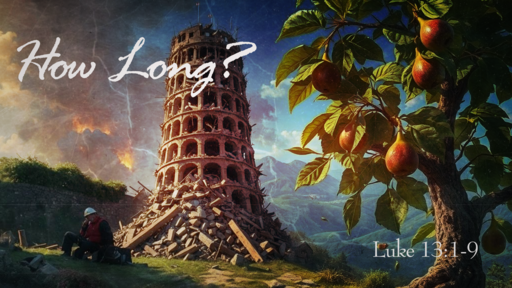

Luke 13:1-9 (Evangelical Heritage Version)
At that time there were some present who told Jesus about the Galileans whose blood Pilate had mixed with their sacrifices. 2He answered them, “Do you think that these Galileans were worse sinners than all the other Galileans because they suffered these things? 3I tell you, no. But unless you repent, you will all perish too. 4Or those eighteen who were killed when the tower in Siloam fell on them—do you think that they were worse sinners than all the people living in Jerusalem? 5I tell you, no. But unless you repent, you will all perish too.”
6He told them this parable: “A man had a fig tree planted in his vineyard. He came looking for fruit on it, but he did not find any. 7So he said to the gardener, ‘Look, for three years now I have come looking for fruit on this fig tree, and I have found none. Cut it down. Why even let it use up the soil?’ 8But the gardener replied to him, ‘Sir, leave it alone this year also, until I dig around it and put fertilizer on it. 9If it produces fruit next year, fine. But if not, then cut it down.’”
How Long?
I.
Bad news always seems to travel fast, even in the days before 24-hour news cycles on TV, or instant posts on social media platforms by citizen journalists. Recent news events had been unbelievably bad. As bad as it was, one had to believe it, because it was true.
Roman soldiers had desecrated the temple. There had been people inside the temple in Jerusalem and, apparently at the orders of Pilate, they had been killed right where they worshiped.
Imagine the shock you would experience on hearing the news. Gentle, God-fearing people can’t imagine such a thing. Shock would quickly give way to outrage. How could anyone be that evil? But evil does exist in the world—you know that. You might begin to wonder if such evil might happen to others, too.
When bad things happen these days—even when outright evil things happen—the question that seems to come is “Why do bad things happen to good people?” One time, as they were walking along, Jesus’ disciples had asked him: “Who sinned, this man or his parents, that he was born blind?” (John 9:2, EHV). Their question indicates that rather than wondering why bad things happened to good people, it was necessary to assume that if something bad happened, it simply had to be a punishment from God in some way. Bad things simply didn’t happen to good people, they assumed.
That’s the context under which today’s Gospel begins. “At that time there were some present who told Jesus about the Galileans whose blood Pilate had mixed with their sacrifices” (Luke 13:1, EHV).
Perhaps there were ulterior motives in bringing this breaking news to Jesus. Did they want Jesus to condemn the Romans for their atrocities? Were they hoping Jesus might give a little sermon about making sure you perform your religious duties at the temple with the proper reverence and motives? Maybe they were expecting Jesus to confirm that these were bad people, receiving their just punishment from God for their specific sins—whatever those sins might have been.
I don’t think they expected the response they got. “He answered them, ‘Do you think that these Galileans were worse sinners than all the other Galileans because they suffered these things? 3I tell you, no’” (Luke 13:2-3, EHV). Our modern ears find it strange that Jesus had to tell them that being brutalized while they were at worship did not prove that these believers were notorious sinners deserving of God’s special wrath.
Jesus pulled up another news story. “Or those eighteen who were killed when the tower in Siloam fell on them—do you think that they were worse sinners than all the people living in Jerusalem? 5I tell you, no” (Luke 13:4-5, EHV). Being at the wrong place at the wrong time was not proof of unusual guilt before God, either.
The prevailing attitude was wrong, Jesus told them.
These days things are twisted around just a little bit. Only a few really bad people need to do any repenting. You know the type: murders, gang members, thieves, rapists, drug kingpins, and even the local drug dealers on the street. Those kinds of people need to repent.
II.
Jesus’ commentary on the news stories of his day gets right to the heart of today’s attitudes, too. “But unless you repent, you will all perish too” (Luke 13:3 & 5, EHV). Bad things don’t just happen to so-called “bad” people, they can happen to anyone. Jesus wants them all to know that bad things happen, no matter who you are. But really, his message is even more profound.
It’s not just that bad things might happen to good people, what he is really saying is that there are no good people. “Unless you repent, you will all perish too.” Even the Galileans who weren’t murdered in the temple were sinners. Even the people in Jerusalem who escaped the falling stones and other debris from the tower of Siloam were sinners. Even the people today who aren’t hardened criminals are sinners.
The fact is, God doesn’t distinguish between big sins and little sins. In his eyes, every sin is a big sin. Every sin deserves punishment in hell for eternity. Back when our first parents fell from their state of perfection into sin, God told them there would be consequences for sin. The world would be filled with difficulty. Bad things would happen. Rather than a perfect world with no problems, they would have to face sickness and sorrow; there would be pain; work would no longer be a pure joy, but filled with difficulties.
Worst of all, every human being would eventually have to come face to face with death. “Unless you repent, you will all perish too.” It isn’t just death faced by evil people in the world, or accidental death, or even natural death at the end of life that is the problem. Unless you repent, you will face eternal death—that is, separation from God forever in hell.
What is repent? The word translated “repent” means to have a change of mind; to change one’s way of life as the result of a complete change of thought and attitude with regard to sin and righteousness. In other words, when Jesus says “repent,” he is describing conversion. Repent means a change in the people’s attitude toward God.
III.
“I tell you, no. But unless you repent, you will all perish too” (Luke 13:3 & 5, EHV). There is a tension between “No!” and “Unless you repent.” Jesus tells a parable to help understand and to think about their own relationship with God.
Did you notice some unusual things about the parable? Often Jesus explains his parables to his disciples—if not immediately, then later. This time, there is no explanation. The owner of the vineyard isn’t identified; neither is the gardener. Since the property is described as a vineyard, it would seem grapes would be the predominant crop. The owner might have put in a fig tree just to have a little something for himself, in addition to a saleable crop. He kept looking for fruit, but there was nothing—not even a few small ones.
“He said to the gardener, ‘Look, for three years now I have come looking for fruit on this fig tree, and I have found none. Cut it down. Why even let it use up the soil?’” (Luke 13:7, EHV). Three years he had been waiting! This wasn’t some spur of the moment, hasty decision. He had been patient. He had been waiting for results—any results—for a long time. Nothing.
Even though Jesus doesn’t give an explanation, it seems quite clear that the owner of the vineyard is God. While he is a holy and just God, perfect and demanding perfection from his people, God is also patient. He does not take the first opportunity to bring punishment on the wrongdoer.
The gardener steps in. “Sir, leave it alone this year also, until I dig around it and put fertilizer on it. 9If it produces fruit next year, fine. But if not, then cut it down” (Luke 13:8-9, EHV). Again, there is no explanation about who the gardener is, but we can see Jesus there, pleading for his people. Just a little longer for this one’s time of grace. I will carefully nurture this vulnerable soul; I will do all I can to bring about the repentance I urged earlier.
IV.
You can almost see the expectant looks on the faces standing there listening to Jesus. We want the rest of the story. We want to know the end. You can see their minds spinning with questions.
The gardener made his plea, but then what? Did the owner agree? How about the tree? Did it produce fruit the following year? If so, how much; only a few pieces, or lots of figs? If the owner did agree, what was his demeanor while waiting to see the results? Was he carefully sharpening his ax in anticipation of a mighty swing, or was he hopeful of the same results the gardener hoped for?
Jesus leaves the parable without a conclusion. The ending is not satisfying at all, it just leaves you hanging, as if there is supposed to be a sequel, and you’ll have to tune in next time to see what happens.
But there is no next time. The parable has ended.
The end of the parable is that you are still here. It’s not too late—yet.
“Unless you repent, you will all perish too,” Jesus said. Remember that repent doesn’t just mean to feel regret about your sins. It means to have a change in attitude toward God. Repent, as Jesus uses is, is a synonym for conversion. It is as Luther says in his Meaning of Baptism for Our Daily Life: “Baptism means that the old Adam in us should be drowned by daily contrition and repentance, and that all its evil deeds and desires be put to death. It also means that a new person should daily arise to live before God in righteousness and purity forever.”
Lent is a time for self-examination—a time for daily contrition and repentance. There are constantly stories in the news that are tragic or horrific, just like the news reports used by Jesus. Don’t try to judge others with today’s news, but evaluate your own life.
You can’t change yourself from a fig-less tree to a productive tree, but God can. Jesus always wants another chance to rejuvenate you. His love is continual and constant. Through his death and resurrection, Jesus digs into your life and gives you a source of spiritual energy.
Every day drown the old Adam inside and bring out the new person that bears abundant fruit. Every day trust in Jesus, who paid for your sins and gives you the strength to carry on in newness of life. Do it every day, because you don’t know how long. Amen.
