From Golgotha to the Grave (3)
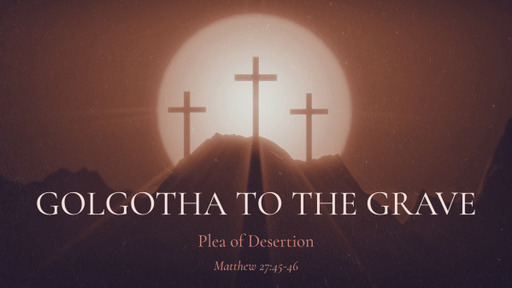
From Golgotha to the Grave  •  Sermon  •  Submitted   •  Presented   •  42:38
0 ratings
· 46 views
Files
Notes
Transcript
Matthew 27:45–46 KJV 1900
Now from the sixth hour there was darkness over all the land unto the ninth hour. And about the ninth hour Jesus cried with a loud voice, saying, Eli, Eli, lama sabachthani? that is to say, My God, my God, why hast thou forsaken me?
Darkness is a sign of divine Judgement
Jesus Christ: His Crucifixion 1. The Moment of the Saying

“From the sixth hour [12:00 noon] there was darkness over all the land unto the ninth hour [3:00 p.m.]” (

Jesus Christ: His Crucifixion 1. The Moment of the Saying

This darkness spoke of the Divine judgment upon sin and sinners.

It represented the absence of God which is part of the damnation of sinners.

Since Christ was experiencing this judgment on behalf of sinners, His fourth utterance from the cross reflected the judgment He was experiencing.

The darkness was more than a physical darkness, for it represented the darkness of the lost soul that is separated from God.

This separation is the most agonizing experience a soul can have.

Thus the cry of anguish from the Savior is a great warning to lost sinners to repent from their sin and turn to Christ for salvation lest they, too, cry out in great agony in the darkness of damnation for the presence of God.

Yes indeed Jesus was forsaken.
He was not only forsaken by the crowd who on Palm Sunday shouted, “HOSANNA, HOSANNA, BLESSED BE THE LORD.” and then only three days later they cried out, “CRUCIFY HIM, CRUCIFY HIM.”
He was forsaken by the religious leaders. They stirred up the people and had Jesus arrested and condemned.
He was also forsaken by His disciples, when He needed them the most they were no where to be found.
But all of this was as nothing compared to what He experienced when, hanging on a cross, he was forsaken by God.
“The most gut-wrenching cry of abandonment and loneliness in history came not from a prisoner or a widow or from a dying patient.
No it came from skull hill from the Messiah.“MY GOD, MY GOD, WHY HAVE YOU forsaken ME?’”
Why did God leave him alone on the cross?
I pray, that by the end of the messege this morning, we can answer that question.
But to start this morning we first must look at the…..

I. The Perplexity of the Plea

Throughout His ministry, Jesus had always been in fellowship with the Father.
Every time Jesus spoke he always said Father
But now, for the first time, He experienced what it meant to be forsaken. and He cries out My God My God.
Jesus had taken upon himself the sin of the world and because of The holiness of God, God the Father could not look upon sin, and Jesus, as the sacrificial Lamb, felt the unbearable distance from His Father.
What a perplexing thought.
Martin Luther sat contemplating these words, “My God, my God, why have you forsaken me?” For a long time, without food or water, he sat in deep meditation reflecting on this saying of Christ. After a long time he rose from his chair and exclaimed in utter amazement, "God forsaken of God! Who can understand that?"
It certainly is a perplexing plea!

II. The Agony of the Plea

Jesus had endured unimaginable torment—mocked, beaten, and nailed to the cross.
But in this moment, the pain was not just physical; it was spiritual.
The One who had perfect communion with the Father now felt utterly abandoned.
My God, my God, why hast thou forsaken me.”
This was indeed a most agonizing cry.
These words mark the climax of His suffering
He had been beaten and mocked
nailed and whipped
without one cry of suffering
all he had uttered up to this point was Father forgive them
Now the real agony set in
He was forsaken of His own father
This cry underscores the fact that the suffering from the loss of the presence of God was His greatest suffering.
This explains the great agony of the prayer in Gethsemane.
There Christ was not cowering before physical suffering.
That was minor compared to the spiritual suffering of the loss of God’s presence.
That was the cup that Christ dreaded drinking.
It will be hard for mankind to comprehend the awfulness of the loss of the presence of God, for men often do not want God around.
In our land, laws are being made and reinforced to prevent the mention of God in many places
This in no way reflects an agony of a lack of God’s presence.
Because most could care less about God’s presence
But just because lost sinners are hardened to the coming consequences of sin does not mean the consequences will be lessened.
Once the sinner dies and enters the darkness of damnation, he will realize that his greatest loss is the loss of the presence of God.
Covet the presence of God as you have coveted nothing else. (Butler)
No suffering is so great as to be without it.
It was a perplexing plea
It was a Agonizing plea

III. The Reality of the Plea

His plea was certainly perplexing and to be forsaken by God would diffenetly be pure agony,
But what I really wanted to convey to us this morning is “why God turned his back on His Son” that afternoon.
So we see the reality of the plea.
What reality do we see here this morning?
a. The Reality of Sin
At this moment, Jesus bore the full burden of the world’s sin, and in doing so, experienced the separation that sin creates between man and God.
There is no one here this morning that does not have blood on their hands when it comes to the death of Christ.
You werent there physically, but you were there in thought.
Just as Christ cried out for forgiveness of all man kind and Christ cries out as man being forsaken of God.
The Bible tells us: for all have sinned and come short of the glory of God.
Psalm 14:2–3 “The Lord looked down from heaven upon the children of men, To see if there were any that did understand, and seek God. They are all gone aside, they are all together become filthy: There is none that doeth good, no, not one.”
No man on earth and no sinner in hell can ever understand the depth of meaning of these words of Jesus.
You understand this morning, Christ was perfect and all of us and all those that have come before us are not       
We do not fully comprehend these words because we don't fully understand the holiness of God.
The Hebrew prophet Habakkuk understood this when he exclaimed,
Habakkuk 1:13 KJV 1900
Thou art of purer eyes than to behold evil, And canst not look on iniquity: Wherefore lookest thou upon them that deal treacherously, And holdest thy tongue when the wicked devoureth the man that is more righteous than he?
Finite depraved sinners do not understand how sin appears to an infinite, holy and righteous God.
God’s attitude toward sin caused Him to turn His back on His Son and forsake Him.
Sin is serious business with God.
Christ revealed the horror of sin when we died on the cross.
We treat sin lightly.
God takes it seriously.
God cannot and will not tolerate sin in His presence because He is a holy God.
The Bible says: "The soul that sins will surely die." "The wages of sin is death."
God’s attitude toward sin caused Him to pour out His wrath on His own Son.
What a startling contrast these words are to those occasions when God the Father broke through glory and said, “This is My beloved Son in whom I am well pleased.”
Sin is so serious that there is only one way God can deal with it.
By the shedding of blood.
The writer of Hebrews said, Hebrews 9:22 “And almost all things are by the law purged with blood; and without shedding of blood is no remission.”
These words from the cross reveal the reality of sin and holiness.
They also reveal the reality for the sacrifice.
a. The Reality of Sin:
b. The Reality of Sacrifice
Jesus was fulfilling the great messianic Psalm 22.
This great Psalm runs through out the whole crucifixion narrative.
It is interwoven through out the crucifixion story because it foretells the crucial events in the crucifixion of Jesus.
Jesus was not a Jewish martyr.
He was the Suffering Servant of Yahweh who laid down His life freely.
The reality of the sacrifice is that it is Substitutionary
b. The Reality of Sacrifice
He Took Our Place:
Isaiah 53:4-5 says, "Surely he hath borne our griefs, and carried our sorrows... He was wounded for our transgressions."
Jesus was forsaken so that we would never have to be.
He endured the punishment that was rightfully ours.
The cross was not just about physical death; it was about spiritual redemption.
By taking on our sin, Jesus made a way for us to be reconciled to God.
His moment of desertion secured our eternal security.
This truth becomes clear when we consider the Levitical ceremony of laying hands on head of the innocent scapegoat and confessing the sins of the people.
(the goat was sent away from everything. It was abandoned and left alone.)
Jesus is our scapegoat, dying in our place, taking the punishment for our sins upon Himself (2 Cor. 5:21).
He was abandoned on the cross
He was left alone
so that we would not have to experience it.
Galatians 3:13 tells us Christ became a curse for us, "for it is written, Cursed is everyone who hangs on a tree."
Jesus was made the representative of sin.
On Jesus Christ, representatively, fell the collective consequences of sin.
He bore the penalty of our sins for us.
He suffered on our behalf.
This is a revelation of what hell is like.
Total darkness
complete separation from God
Christ was not having a good time
and you wont either
It is also a revelation of the penalty of our sin.
The whole weight of every sin ever committed and that ever would be committed fell on Jesus. 
The penalty He bore for us was the inevitable separation from God which sin brings and belongs to us.
Think of gathering all the sin of humanity into one pile.
What a seething mountain of wickedness!
Yet, Jesus came down to be a representative for us so that God might blot it out in one sufficient comprehensive condemnation!
And let it never be forgotten that it was not His, but it was for yours and my wicked depravity that He identified Himself with and suffered.
In becoming sin for us the Father had to turn judicially from His Son.
The apostle Paul wrote:
Romans 3:25–26 KJV 1900
Whom God hath set forth to be a propitiation through faith in his blood, to declare his righteousness for the remission of sins that are past, through the forbearance of God; To declare, I say, at this time his righteousness: that he might be just, and the justifier of him which believeth in Jesus.
The wonder of it all is that He did it only because of His love for us!
b. The Reality of Sacrifice
He Took Our Place
He Loved Us Beyond Understanding
This cry of desertion is also a cry of love.
Jesus willingly suffered in our place, revealing the depth of God’s love for us.
As John 3:16 says, "For God so loved the world, that he gave his only begotten Son."
God continues to demonstrate His own love for us, in that while we were yet sinners, Christ died for us.
1 John 4:10 “Herein is love, not that we loved God, but that he loved us, and sent his Son to be the propitiation for our sins.”
It was not the nails, but His wondrous love for me that kept Jesus on the cross.
Revelation 1:5, "To Him who loves us and washed us from our sins by His own blood . . ."
Ephesians 5:2 “And walk in love, as Christ also hath loved us, and hath given himself for us an offering and a sacrifice to God for a sweetsmelling savour.”
Christ’s death was an offering to God “in our behalf.”
These words from the cross reveal to us the reality of our sin and the reality of His sacrifice

Conclusion:

Jesus cried out, “My God, my God, why hast thou forsaken me?” so that we would never have to cry out in eternal separation from God.
His pain secured our peace.
His sacrifice made our salvation possible.
His seperation made our fellowship possible
His resurrection gives us victory!
If you have not yet placed your faith in Jesus Christ, today is the day of salvation (2 Corinthians 6:2).
Come to Him, repent of your sins, and receive the gift of eternal life!
Related Media
See more
Related Sermons
See more
Earn an accredited degree from Redemption Seminary with Logos.