James Part 8

Notes
Transcript
James, Part 8 – James 2:14-26
Introduction:
Some have called this passage in James “the most theologically significant, as well as the most controversial, in the letter of James. It deals with the question of whether belief in Jesus can save you if it’s not accompanied by works. In other words, what is the relationship between faith and works? That’s also where the controversy lies: Paul seems to have one view while James takes a different perspective. Who is right?
It’s important that we unpack this and see this passage rightly.
James has already told us a few times now that there are things we are to do: control the tongue, take care of widows and orphans, treat everyone justly, etc. Now he changes his angle a bit, puts it all out there, and asks a direct rhetorical question:
James 2:14 What good is it, my brothers and sisters, if someone claims to have faith but does not have works? Can such faith save him?
14 What good is it, my brothers and sisters, if someone claims to have faith but does not have works? Can such faith save him?
What use it? What difference does it make?
And James is going to argue that it doesn’t help anybody -- in this life, and eternally.
For example:
James 2:15 If a brother or sister is without clothes and lacks daily food 16 and one of you says to them, “Go in peace, stay warm, and be well fed,” but you don’t give them what the body needs, what good is it?
15 If a brother or sister is without clothes and lacks daily food
17 In the same way faith, if it does not have works, is dead by itself.
So, James’ answer to the question in 14 is NO in 17, and he uses a practical illustration to make a universal statement: if faith isn’t accompanied by good works, it’s completely dead – unable to help others, and counterfeit or illegitimate for the one who claims he’s a follower of Jesus.
How does that land on you? That’s pretty heavy, isn’t it? It makes you start doing a mental inventory of your actions over the last year, or so – and maybe that’s what James wants, not wanting anyone to fool themselves into thinking they have something they don’t or that their faith is more than it is.
Some of us might defend our lack of action by saying, “That’s just not my gift. I have the gift of encouragement – not really the gift of helps.”
That’s exactly what the people in his illustration would have said. James point is that’s completely wrong thinking:
Objection to that answer (using a Diatribe):
Objector: James 2:18 But someone will say, “You have faith, and I have works.”[d]
18 But someone will say, “You have faith, and I have works.” Show me your faith without works, and I will show you faith by my works.
James: “Show me your faith without works, and I will show you faith by my works.”
This imaginary opponent is viewing faith and works more like gifts (You have the gift of works and I have the gift of faith – works isn’t my gift). James says it doesn’t work like that. It’s a false-dichotomy -- It’s foolish thinking.
ILLUS: Like two husbands talking about how they convince their wives of their love, one through words and the other through actions. How are the wives going to respond?
James’ response: You don’t know that you have saving faith if there is no evidence of it – it’s theoretical:
So, he turns to what they believe that gives them their confidence:
James 2:19 You believe that God is one. Good! Even the demons believe—and they shudder.
19 You believe that God is one. Good! Even the demons believe—and they shudder.
You’re satisfied sitting around talking about theology that never makes a difference in anyone’s life.
James is saying you can believe all the right things and still be wrong. Again, merely saying you have faith is no indicator and certainty that you have a living faith. There must be something more!
Believing in God is one is great – It is the first great command found in Deuteronomy 6:4, the bedrock upon which all other things are built.
But this lacks the heart of the command that demonstrates your true belief in the first. It’s what Jesus said when asked which was the greatest command. He said (Matthew 22:37-40)
37 He said to him, “Love the Lord your God with all your heart, with all your soul, and with all your mind. 38 This is the greatest and most important command. 39 The second is like it: Love your neighbor as yourself. 40 All the Law and the Prophets depend on these two commands.”
“Love the Lord your God with all your heart, with all your soul, and with all your mind.[l] 38 This is the greatest and most important[m]command. 39 The second is like it: Love your neighbor as yourself.[n] 40 All the Law and the Prophets depend[o] on these two commands.” The first is dependent on the second. You can’t say you love God and not demonstrate love to your neighbor.
If Jesus’ priority was demonstrating the love of God to people, how can we say that we are followers of Jesus if we’re not doing the same thing?
Loving our neighbor as Jesus does demonstrates that we love Him and keep his commandments because Jesus came not to be served but to serve.
John 15:12 - “This is my command: Love one another as I have loved you. 13 No one has greater love than this: to lay down his life for his friends. 14 You are my friends if you do what I command you.
12 “This is my command: Love one another as I have loved you.
16 This is how we have come to know love: He laid down his life for us. We should also lay down our lives for our brothers and sisters. 17 If anyone has this world’s goods and sees a fellow believer in need but withholds compassion from him—how does God’s love reside in him? 18 Little children, let us not love in word or speech, but in action and in truth.
This is how we have come to know love: He laid down his life for us. We should also lay down our lives for our brothers and sisters.17 If anyone has this world’s goods and sees a fellow believer[i] in need but withholds compassion from him—how does God’s love reside in him? 18 Little children, let us not love in word or speech, but in action and in truth.
“I love you” is only as meaningful as the actions that back it up. This is why James said that faith is dead/useless if we simply speak a blessing without beinga blessing.
James 2:20 Senseless person! Are you willing to learn that faith without works is useless?
20 Senseless person! Are you willing to learn that faith without works is useless?
This is a foolish position to take because you are depending on a version of faith that is lifeless.
Expressions of love without action, and good theology without application are empty.
James now tries to reason with the foolish one by turning to an example they would be familiar with.
He’s speaking to Jews who had the highest regard for Abraham, the father of the Jews, so he points to him in (21):
James 2:21-24 Wasn’t Abraham our father justified by works in offering Isaac his son on the altar?
21 Wasn’t Abraham our father justified by works in offering Isaac his son on the altar? 22 You see that faith was active together with his works, and by works, faith was made complete, 23 and the Scripture was fulfilled that says, Abraham believed God, and it was credited to him as righteousness, and he was called God’s friend. 24 You see that a person is justified by works and not by faith alone.
22 You see that faith was active together with his works, and by works, faith was made complete, 23 and the Scripture was fulfilled that says, Abraham believed God, and it was credited to him as righteousness,[e] and he was called God’s friend.
24 You see that a person is justified by works and not by faith alone.
Whoah! Twice he said Abraham was justified by works.
He says it again in (25-26) and he seems to drive the point home making clear that a prostitute (not just a patriarch) was justified by what she did:
James 2:25-26 25 In the same way, wasn’t Rahab the prostitute also justified by works in receiving the messengers and sending them out by a different route? 26 For just as the body without the spirit is dead, so also faith without works is dead.
25 In the same way, wasn’t Rahab the prostitute also justified by works in receiving the messengers and sending them out by a different route? 26 For just as the body without the spirit is dead, so also faith without works is dead.
Justified = the heart of the gospel. It is being brought into right relationship with God. This seems to fly in the face of what we understand as the work of justification.
Here is where the controversy begins, because Paul uses this exact word, “justified” very differently. Let’s compare the two:
James 2:24: You see that a person is justified by works and not by faith alone.
Romans 3:8: For we conclude that a person is justified by faith apart from the works of the law.
What do we do with this since they are contradictory on their face?
Gets even trickier because both of them appeal to Abraham as proof of their conclusions:
We already read what James said here in (21-23)
Then, in Romans 4, right after Paul makes the conclusion in 3:8, says:
(Romans 4:1-3) - What then will we say that Abraham, our forefather according to the flesh, has found?[a] 2 If Abraham was justified[b] by works, he has something to boast about—but not before God. 3 For what does the Scripture say? Abraham believed God, and it was credited to him for righteousness.
1 What then will we say that Abraham, our forefather according to the flesh, has found? 2 If Abraham was justified by works, he has something to boast about—but not before God. 3 For what does the Scripture say? Abraham believed God, and it was credited to him for righteousness.
Both men say, “Abraham believed God, and it was credited to him for righteousness,” but draw opposite conclusions!
Or do they? I don’t think they do.
For us to understand this, we have to know who they were writing to, why, and what they mean when they use the words “works” and “faith”
Who and why:
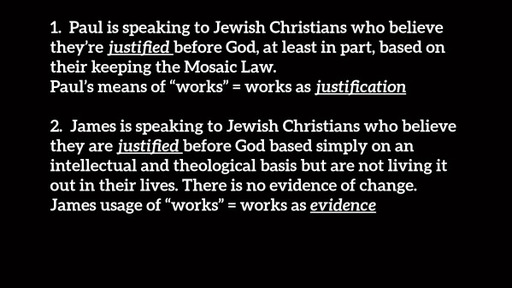
1. Paul is speaking to Jewish Christians who believe they’re justified before God, at least in part, based on their keeping the Mosaic Law (specifically circumcision). This is what Paul means by “works” (works as justification)
Them: “justification” = “Faith plus works”
Paul: “justification” = Faith plus nothing. (eg Ephesians 2:8-9)
2. James is speaking to Jewish Christians who believe they are justified before God based simply on an intellectual and theological basis but are not living it out in their lives. There is no evidence of change/transformation. This is what James means when he uses the word “works” (works as evidence)
Them: “justification” = Faith, then nothing.
James: “justification” = Faith, then works.
One “justified” by works. One “justified” by words.
So, when we put it together, we can see how both were speaking of different aspects of the same gospel and that both believed the same thing:
Paul says that Abraham was justified by faith apart from works because, in Genesis 15:6, “Abraham believed God and it was credited to him as righteousness” before he offered Isaac on the altar in Genesis 22!
James believes the same thing:
· James 1:18
18 By his own choice, he gave us birth by the word of truth so that we would be a kind of firstfruits of his creatures.
By his own choice, he gave us birth by the word of truth so that we would be a kind of first fruits of his creatures.
· James 1:21
21 Therefore, ridding yourselves of all moral filth and the evil that is so prevalent, humbly receive the implanted word, which is able to save your souls.
Therefore, ridding yourselves of all moral filth and the evil that is so prevalent,[e] humbly receive the implanted word, which is able to save your souls.
· James 2:5
5 Listen, my dear brothers and sisters: Didn’t God choose the poor in this world to be rich in faith and heirs of the kingdom that he has promised to those who love him?
Listen, my dear brothers and sisters: Didn’t God choose the poor in this world to be rich in faith and heirs of the kingdom that he has promised to those who love him?
James agrees with Paul that Abraham’s belief was credited as righteousness in Genesis 15, but simply makes the important point to those who think that “simply believing right things about Jesus” is enough, and that Abraham’s faith was proved to be a living, active faith when he obeyed God.
Douglas Moo: “James is not arguing that works must be added to faith. His point, rather, is that genuine biblical faith will inevitably be characterized by works. ‘it is not that faith is supplemented, but the essence of faith is defined as a stance that includes one’s life as a whole.”
In other words, James is not simply calling people to “work more.” It may be a wake-up call to engage the things God has called you to do that you’ve resisted, but it serves more as a test of the faith you say you have.
It’s a call to look in the mirror to see where our relationship is with the Lord and to deal with that honestly as the Holy Spirit guides and convicts.
Let’s flip over to Paul:
Paul believes what James is saying, as well:
· 1 Thessalonians 1:2-3
2 We always thank God for all of you, making mention of you constantly in our prayers. 3 We recall, in the presence of our God and Father, your work produced by faith, your labor motivated by love, and your endurance inspired by hope in our Lord Jesus Christ.
We always thank God for all of you, making mention of you constantly in our prayers. 3 We recall, in the presence of our God and Father, your work produced by faith, your labor motivated by love, and your endurance inspired by hope in our Lord Jesus Christ.
· 2 Thessalonians 1:11-12
11 In view of this, we always pray for you that our God will make you worthy of his calling, and by his power fulfill your every desire to do good and your work produced by faith, 12 so that the name of our Lord Jesus will be glorified by you, and you by him, according to the grace of our God and the Lord Jesus Christ.
In view of this, we always pray for you that our God will make you worthy of his calling, and by his power fulfill your every desire to do good[b] and your work produced by faith, 12 so that the name of our Lord Jesus will be glorified by you, and you by him, according to the grace of our God and the Lord Jesus Christ.
· Ephesians 2:8-10
8 For you are saved by grace through faith, and this is not from yourselves; it is God’s gift—9 not from works, so that no one can boast. 10 For we are his workmanship, created in Christ Jesus for good works, which God prepared ahead of time for us to do.
For you are saved by grace through faith, and this is not from yourselves; it is God’s gift— 9 not from works, so that no one can boast. 10 For we are his workmanship, created in Christ Jesus for good works, which God prepared ahead of time for us to do.
To summarize:
Faith produces works (1 & 2 Thessalonians), and works (James 2:22) completes faith.
Both would agree that works are NOT the rootof justification and faith the fruit.
Instead, both would agree that faith is the rootof salvation and works are the fruit.
15 “Be on your guard against false prophets who come to you in sheep’s clothing but inwardly are ravaging wolves. 16 You’ll recognize them by their fruit. Are grapes gathered from thornbushes or figs from thistles? 17 In the same way, every good tree produces good fruit, but a bad tree produces bad fruit. 18 A good tree can’t produce bad fruit; neither can a bad tree produce good fruit. 19 Every tree that doesn’t produce good fruit is cut down and thrown into the fire. 20 So you’ll recognize them by their fruit.
21 “Not everyone who says to me, ‘Lord, Lord,’ will enter the kingdom of heaven, but only the one who does the will of my Father in heaven.
15 “Be on your guard against false prophets who come to you in sheep’s clothing but inwardly are ravaging wolves. 16 You’ll recognize them by their fruit. Are grapes gathered from thornbushes or figs from thistles? 17 In the same way, every good tree produces good fruit, but a bad tree produces bad fruit. 18 A good tree can’t produce bad fruit; neither can a bad tree produce good fruit. 19 Every tree that doesn’t produce good fruit is cut down and thrown into the fire. 20 So you’ll recognize them by their fruit.
21 “Not everyone who says to me, ‘Lord, Lord,’ will enter the kingdom of heaven, but only the one who does the will of my Father in heaven.
Conclusion:
It doesn’t matter who you are, whether Abraham or Rahab, or how great your works are, good works that result from true faith are pleasing and useful to God, and result in God’s will being accomplished through you. Rahab, the prostitute was just as important to the coming of Jesus as Abraham: both were ancestors in the lineage of Jesus.
What do we do with this? Takeaways:
1. We look in the mirror. What is the condition of our faith – deal with it before the Lord.
2. We seek Him every day. As we rejoice in Him and sit in His presence (Word and prayer), He’ll make us sensitive to the “good works” He wants us to do as an expression of the Word He has implanted in us.
3. We eliminate every excuse that brings us back to self-centeredness and we pour our lives into the good works, prepared for us from the foundation of the world.
(John 14:12- 21) - “Truly I tell you, the one who believes in me will also do the works that I do. And he will do even greater works than these, because I am going to the Father. 13 Whatever you ask in my name, I will do it so that the Father may be glorified in the Son. 14 If you ask me[e] anything in my name, I will do it. 15 “If you love me, you will keep[g] my commands….21The one who has my commands and keeps them is the one who loves me. And the one who loves me will be loved by my Father. I also will love him and will reveal myself to him.”
12 “Truly I tell you, the one who believes in me will also do the works that I do. And he will do even greater works than these, because I am going to the Father. 13 Whatever you ask in my name, I will do it so that the Father may be glorified in the Son. 14 If you ask me anything in my name, I will do it. 15 “If you love me, you will keep my commands….21 The one who has my commands and keeps them is the one who loves me. And the one who loves me will be loved by my Father. I also will love him and will reveal myself to him.”
