The Resurrection of Jesus Christ Was His Coronation as King and Affirmed His Sonship and Deity (Doctrinal Bible Church in Huntsville, Alabama)

Doctrinal Bible Church
Pastor-Teacher Bill Wenstrom
Sunday April 20, 2025
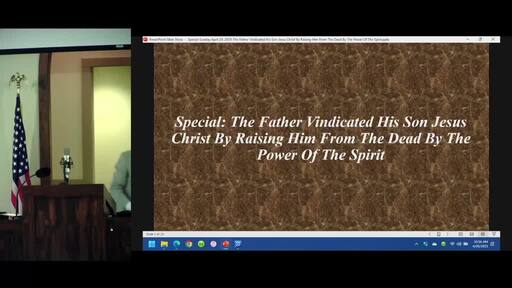
Special: The Resurrection of Jesus Christ Was His Coronation as King and Affirmed His Sonship and Deity
Acts 13:13 From Paphos, Paul and his companions sailed to Perga in Pamphylia, where John left them to return to Jerusalem. 14 From Perga they went on to Pisidian Antioch. On the Sabbath they entered the synagogue and sat down. 15 After the reading from the Law and the Prophets, the synagogue rulers sent word to them, saying, “Brothers, if you have a message of encouragement for the people, please speak.” 16 Standing up, Paul motioned with his hand and said: “Men of Israel and you Gentiles who worship God, listen to me! 17 The God of the people of Israel chose our fathers; he made the people prosper during their stay in Egypt, with mighty power he led them out of that country, 18 he endured their conduct for about forty years in the desert, 19 he overthrew seven nations in Canaan and gave their land to his people as their inheritance. 20 All this took about 450 years. “After this, God gave them judges until the time of Samuel the prophet. 21 Then the people asked for a king, and he gave them Saul son of Kish, of the tribe of Benjamin, who ruled forty years. 22 After removing Saul, he made David their king. He testified concerning him: ‘I have found David son of Jesse a man after my own heart; he will do everything I want him to do.’ 23 “From this man’s descendants God has brought to Israel the Savior Jesus, as he promised. 24 Before the coming of Jesus, John preached repentance and baptism to all the people of Israel. 25 As John was completing his work, he said: ‘Who do you think I am? I am not that one. No, but he is coming after me, whose sandals I am not worthy to untie.’ 26 “Brothers, children of Abraham, and you God-fearing Gentiles, it is to us that this message of salvation has been sent. 27 The people of Jerusalem and their rulers did not recognize Jesus, yet in condemning him they fulfilled the words of the prophets that are read every Sabbath. 28 Though they found no proper ground for a death sentence, they asked Pilate to have him executed. 29 When they had carried out all that was written about him, they took him down from the tree and laid him in a tomb. 30 But God raised him from the dead, 31 and for many days he was seen by those who had traveled with him from Galilee to Jerusalem. They are now his witnesses to our people. 32 “We tell you the good news: What God promised our fathers 33 he has fulfilled for us, their children, by raising up Jesus. As it is written in the second Psalm: “ ‘You are my Son;
today I have become your Father.’ 34 The fact that God raised him from the dead, never to decay, is stated in these words: “ ‘I will give you the holy and sure blessings promised to David.’35 So it is stated elsewhere: “ ‘You will not let your Holy One see decay.’ 36 “For when David had served God’s purpose in his own generation, he fell asleep; he was buried with his fathers and his body decayed. 37 But the one whom God raised from the dead did not see decay. 38 “Therefore, my brothers, I want you to know that through Jesus the forgiveness of sins is proclaimed to you. 39 Through him everyone who believes is justified from everything you could not be justified from by the law of Moses. 40 Take care that what the prophets have said does not happen to you: 41 “ ‘Look, you scoffers, wonder and perish, for I am going to do something in your days that you would never believe, even if someone told you.’” (NIV84)
In Acts 13:33, the apostle Paul uses Psalm 2:7 to teach the Jews that the resurrection of Jesus Christ was a fulfillment of Old Testament prophecy and specifically, he quotes a certain portion of Psalm 2:7, namely “You are my Son; today I have become your Father.”
By employing this portion of Psalm 2:7, he is teaching that the resurrection of Jesus Christ was His coronation as the King of Israel and a fulfillment of the Davidic covenant as well as affirming His Sonship and deity.
Psalm 2:7 is also applied to Jesus’ resurrection in Hebrews 1:5; 5:5.
In contemporary Judaism, this Psalm was applied to the Messiah and was itself based on the Nathan prophecy of 2 Samuel 7 and specifically 2 Samuel 7:16, thus it refers to the Davidic covenant.
The “Davidic” covenant deals with the dynasty that will rule the nation of Israel as indicated in 2 Samuel 7:16 where God promised David that a descendant of his would sit on his throne forever.
The Davidic covenant is also confirmed in the following passages: Isa. 9:6-7; Jer. 23:5-6; 30:8-9; 33:14-17, 20-21; Ezek. 37:24-25; Dan. 7:13-14; Hos. 3:4-5; Amos 9:11; Zech. 14:4, 9.
The Davidic covenant contains four promises: (1) A Davidic House: Posterity of David will never be destroyed. (2) A Davidic Throne: Kingdom of David shall never be destroyed. (3) A Davidic Kingdom: David’s Son (Christ) will have an earthly sphere of rule. (4) It Shall Be Unending. The “sign” of the Davidic Covenant is a Son (Lord Jesus Christ).
Provisions of the Davidic covenant: (1) David is to have a child, yet to be born, who will succeed him and establish his kingdom (2) This son (Solomon), instead of David, will build the temple. (3) The throne of his kingdom will be established forever. (4) The throne will not be taken away from him (Solomon) even though his sins justify God’s discipline. (5) David’s house, throne and kingdom will be established forever.
The essential features of the Davidic covenant are found in three words in 2 Samuel 7:16: (1) House (physical descendants): A line stemming from David would continue indefinitely and would be the divinely recognized royal line. (2) Kingdom (political body): the political body that David would rule and over which David’s descendants would successively reign. (3) Throne (right to rule): refers to the authority as king vested in him.
One of the royal titles that the Lord Jesus Christ possesses is that of the “Son of David,” which denotes His rulership over the nation of Israel (Matt. 1:1; 20:30; Mark 10:47-48; Luke 1:32; 2 Tim. 2:8; Rev. 3:7; 5:5; 22:16).
The Bible anticipates a future literal fulfillment of the Davidic covenant.
The Lord Jesus Christ, the Son of David, will literally fulfill this covenant during His millennial reign.
The prophetic implications of the Davidic covenant: (1) Israel must be preserved as a nation. (2) Israel must have a national existence and be brought back into the land of her inheritance. (3) David’s descendant, the Lord Jesus Christ, must return to the earth, bodily and literally, in order to reign over David’s covenanted kingdom. (4) A literal earthly kingdom must exist over which the returned Messiah will reign. (5) This kingdom must become an eternal kingdom.
“YOU ARE MY SON” affirms the Sonship of Jesus Christ and thus His deity since the word for “SON” is the noun huios (υἱός), which expresses three fundamental concepts regarding Jesus Christ: (1) His eternal relationship with the Father. (2) His appointment to the office of Savior and Messiah. (3) His divine essence.
This word expresses the Lord Jesus Christ’s equality with the Father and His eternality. He is infinite and eternal God (John 1:1-2, 14; John 8:58; 10:30a; Col. 2:9a; Rev. 1:8) and is therefore, equal with the Father (Matthew 17:1-5; John 10:30, 37-38; 14:9; 17:5, 24-25; 20:30-31; Romans 1:1-4; Philippians 2:5-8; Hebrews 1:3).
“SON” in Psalm 2:7 is to be understood as a royal and messianic title and so when the Davidic king is installed in Jerusalem, the Father recognizes Him as His own Son.
When applied to Jesus of Nazareth and His resurrection from the dead, this Psalm indicates that His resurrection brings Him to the full experience of His Messianic destiny as the King over Israel and all the creation.
“TODAY” refers to the day of the resurrection of Jesus Christ and “I HAVE BEGOTTEN YOU” emphasizes God the Father’s role in the resurrection of Jesus Christ.
“Today I have become your Father” refers to the Father placing His Son Jesus Christ on the throne as King of Israel indicating that the day of Jesus Christ’s resurrection was in fact His coronation as the King over Israel and all the earth.
Psalm 2 does not discuss God giving birth to Jesus Christ as His Son like humans but rather, the language describes the royal court and inauguration.
In Psalm 2:7, God figuratively adopted the kings of David’s line while “today” is referring to their accession day and the beginning of the relationship.
However, when used of Jesus at his resurrection (Acts 13:32–37) the meaning rather is that God has made publicly plain what had always been the case, namely that Jesus of Nazareth was His Son and thus God and the rightful King of Israel and the fulfillment of the Davidic covenant.
The term “son” refers to the promises of the Davidic covenant; specifically, to the descendant of David who will fulfill the role of the royal dynasty.
Thus, God “fathered a son” in the sense that Jesus now officially holds the status of the ultimate Davidic king.
This phrase does not mean that Jesus Christ became God’s Son at His resurrection because Jesus was indeed the Son of God from all eternity and recognized as such throughout his earthly life (Luke 1:35; 3:22; 9:35).
However, it was through the resurrection that he was exalted to God’s right hand, enthroned as Son of God, and recognized as such by believing humans.
The resurrection of Christ demonstrated to all that He was indeed who He claimed to be, namely, the incarnate Son of God (Rm. 1:1-4).
So the resurrection of Jesus Christ simply served as a confirmation to all creation that Jesus Christ was who He claimed to be all along, namely the Son of God who was the fulfillment of the Davidic covenant and thus the promised Messiah and King of Israel.
