Love in Deed and Truth

Notes
Transcript
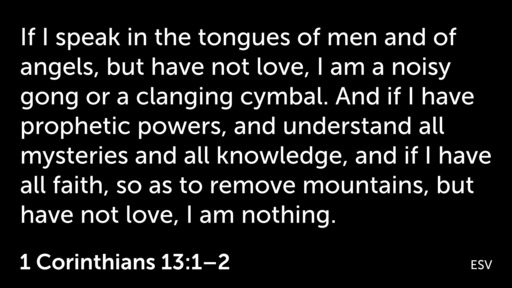
1 If I speak in the tongues of men and of angels, but have not love, I am a noisy gong or a clanging cymbal. 2 And if I have prophetic powers, and understand all mysteries and all knowledge, and if I have all faith, so as to remove mountains, but have not love, I am nothing. 3 If I give away all I have, and if I deliver up my body to be burned, but have not love, I gain nothing. 4 Love is patient and kind; love does not envy or boast; it is not arrogant 5 or rude. It does not insist on its own way; it is not irritable or resentful; 6 it does not rejoice at wrongdoing, but rejoices with the truth. 7 Love bears all things, believes all things, hopes all things, endures all things. 8 Love never ends. As for prophecies, they will pass away; as for tongues, they will cease; as for knowledge, it will pass away. 9 For we know in part and we prophesy in part, 10 but when the perfect comes, the partial will pass away. 11 When I was a child, I spoke like a child, I thought like a child, I reasoned like a child. When I became a man, I gave up childish ways. 12 For now we see in a mirror dimly, but then face to face. Now I know in part; then I shall know fully, even as I have been fully known. 13 So now faith, hope, and love abide, these three; but the greatest of these is love.
Introduction
John is stressing the vital truth that as believers we must love one another. That love is the evidence of our being true believers. It is a love that must be clearly seen in our lives. It is a love that comes from God alone. It is a love that is active and real. It is this love of which John now speaks.
Slide
16 By this we know love, that he laid down his life for us, and we ought to lay down our lives for the brothers. 17 But if anyone has the world’s goods and sees his brother in need, yet closes his heart against him, how does God’s love abide in him? 18 Little children, let us not love in word or talk but in deed and in truth.
Slide
1. Knowing Love v16
1. Knowing Love v16
16 By this we know love, that he laid down his life for us, and we ought to lay down our lives for the brothers.
Slide
4 Love is patient and kind; love does not envy or boast; it is not arrogant 5 or rude. It does not insist on its own way; it is not irritable or resentful; 6 it does not rejoice at wrongdoing, but rejoices with the truth. 7 Love bears all things, believes all things, hopes all things, endures all things.
Slide
a. The Love of Christ
a. The Love of Christ
16 By this we know love, that he laid down his life for us, and we ought to lay down our lives for the brothers.
Slide
We know what love is. John calls attention not to illustrations of love taken from daily life, but to the supreme example of love, namely, to “Jesus Christ [who] laid down his life for us.” In short, we know what love is, because we have heard the gospel message. Kistemaker, S. J., & Hendriksen, W.
13 Greater love has no one than this, that someone lay down his life for his friends.
12 He who is a hired hand and not a shepherd, who does not own the sheep, sees the wolf coming and leaves the sheep and flees, and the wolf snatches them and scatters them.
17 For this reason the Father loves me, because I lay down my life that I may take it up again. 18 No one takes it from me, but I lay it down of my own accord. I have authority to lay it down, and I have authority to take it up again. This charge I have received from my Father.”
37 And he said to him, “You shall love the Lord your God with all your heart and with all your soul and with all your mind. 38 This is the great and first commandment. 39 And a second is like it: You shall love your neighbor as yourself. 40 On these two commandments depend all the Law and the Prophets.”
Slide
b. Our Love for Christ
b. Our Love for Christ
16 By this we know love, that he laid down his life for us, and we ought to lay down our lives for the brothers.
John has an answer, for he writes, “And we ought to lay down our lives for our brothers.” When he says ought, he imposes a moral obligation: as Jesus extends his love by giving his life, so the Christian ought to express his love for the believers by being willing to lay down his life for them. When the honour of God’s name, the advancement of his church, and the need of his people demand that we love our brothers, we ought to show our love at all cost—even to the point of risking and losing our lives. Kistemaker, S. J., & Hendriksen, W. .
Slide
2. Active Love v17
2. Active Love v17
Slide
17 But if anyone has the world’s goods and sees his brother in need, yet closes his heart against him, how does God’s love abide in him?
Slide
a. Need
a. Need
17 But if anyone has the world’s goods and sees his brother in need, yet closes his heart against him, how does God’s love abide in him?
15 If a brother or sister is poorly clothed and lacking in daily food, 16 and one of you says to them, “Go in peace, be warmed and filled,” without giving them the things needed for the body, what good is that? 17 So also faith by itself, if it does not have works, is dead.
When a person blessed with material goods (food, clothing, money) is unwilling to share his possessions, he has closed his heart (see Deut. 15:7–11). He is self-centered and has no regard for his spiritual brother. This person portrays a stark contrast to the love of Jesus. He denies his brother the basic necessities of life, whereas Jesus willingly laid down his life for his followers. Kistemaker, S. J., & Hendriksen, W.
Slide
7 “If among you, one of your brothers should become poor, in any of your towns within your land that the Lord your God is giving you, you shall not harden your heart or shut your hand against your poor brother, 8 but you shall open your hand to him and lend him sufficient for his need, whatever it may be.
Slide
b. Self-centred
b. Self-centred
17 But if anyone has the world’s goods and sees his brother in need, yet closes his heart against him, how does God’s love abide in him?
He is self-centered and has no regard for his spiritual brother. This person portrays a stark contrast to the love of Jesus. He denies his brother the basic necessities of life, whereas Jesus willingly laid down his life for his followers. Kistemaker, S. J., & Hendriksen, W.
Slide
c. The Test
c. The Test
17 But if anyone has the world’s goods and sees his brother in need, yet closes his heart against him, how does God’s love abide in him?
“How can the love of God be in him?” John is asking a rhetorical question. In fact, what he says is more an exclamation than a question. John intimates that it is impossible for the love of God to control this person. John declares that if anyone says that he loves God but hates his brother, he is a liar (4:20). The command love the Lord your God can never be separated from the command love your neighbour as yourself. These two go together at all times. Kistemaker, S. J., & Hendriksen, W.
3. Love in Deed and Truth v18
3. Love in Deed and Truth v18
Slide
18 Little children, let us not love in word or talk but in deed and in truth.
Slide
a. Actions Speak Louder than Words
a. Actions Speak Louder than Words
18 Little children, let us not love in word or talk but in deed and in truth.
Love and faith have this in common: both need deeds to prove their genuineness. Words of love that are n ever translated into action are worthless. Kistemaker, S. J., & Hendriksen, W. (1953–2001). Exposition of James and the Epistles of John (Vol. 14, p. 312). Baker Book House.
Slide
b. Deeds
b. Deeds
18 Little children, let us not love in word or talk but in deed and in truth.
Slide
22 Having purified your souls by your obedience to the truth for a sincere brotherly love, love one another earnestly from a pure heart,
Slide
c. Truth
c. Truth
18 Little children, let us not love in word or talk but in deed and in truth.
Note that the words we speak must correspond to our actions, and the use of our tongue must agree with the truth of God’s Word. Words and tongue find their counterpart in actions and truth. It is significant that John ends this verse with the word truth to remind us of Jesus, the supreme example of love, who said, “I am the … truth” (John 14:6). Kistemaker, S. J., & Hendriksen, W. (1953–2001). Exposition of James and the Epistles of John (Vol. 14, p. 312). Baker Book House.
6 Jesus said to him, “I am the way, and the truth, and the life. No one comes to the Father except through me.
17 For the law was given through Moses; grace and truth came through Jesus Christ.
Conclusion
31 So Jesus said to the Jews who had believed him, “If you abide in my word, you are truly my disciples, 32 and you will know the truth, and the truth will set you free.”
