Jesus Teaches Us to Pray

Notes
Transcript
You have likely heard it stated that Christianity isn’t a religion, it’s a relationship. What does that mean?
What does it mean to have a relationship with God?
You can’t have a relationship without communication. On this day when we celebrate mother’s there are a lot of motherly language made referring to God.
As one whom his mother comforts, so I will comfort you; you shall be comforted in Jerusalem.
As a quick sideline here, when we go back to the beginning and a “suitable helpmate” not being found for Adam, God created Eve. The Hebrew word there that is used for “helpmate” is not a subordinate position at all, it is a position of power and the word is most often used in reference to God. It would not seem that it was ever intended to be a subordinate position.
I am so thankful to my mother for her love and guidance throughout my life. I know that for some listening to this service this morning your relationship with your mother may be less than the ideal. I’m sorry for that, and still we recognize that does not diminish the ideal of motherhood that we celebrate today.
When we think of building, growing, or just maintaining a relationship - central to any relationship is communication.
So when it comes to God how are we to maintain this relationship with One whom we can not see? The answer is prayer.
Before I go any farther I want to play this video made by our friends at the Bible Project - which by the way you can view any of their videos at BibleProject.com.
Let’s watch this video: Scott, can you start that for us.
Jesus Teaches Us to Pray
Jesus Teaches Us to Pray
There are so many different models of prayer out there. There is an idea out there that Jesus disciples didn’t know how to pray until Jesus taught them this prayer. This likely comes from another recording of this prayer from the Gospel of Luke in chapter 11.
Now Jesus was praying in a certain place, and when he finished, one of his disciples said to him, “Lord, teach us to pray, as John taught his disciples.”
The reality is that Jesus disciples knew how to pray. In Synagogue they would have prayed many prayers that we have today in the Hebrew Bible, or what we call the Old Testament.
One of those prayers is what is sometimes referred to as the Shema. Shema is the Hebrew word “hear” and is the first word in the Hebrew to the prayer from Deuteronomy 6:4-5
“Hear, O Israel: The Lord our God, the Lord is one. You shall love the Lord your God with all your heart and with all your soul and with all your might.
Hear - that would imply listening. In our culture of media everyone today seems to want to get the word out - print media, social media, media influencers, etc. How often do we stop to really listen?
Listening is important in prayer as well. The discipline of silence in prayer seems to be a dying art in our accelerating culture. Most people who try to incorporate this discipline in their prayer life, at least early on, are met with the racing mind syndrome that seems to plague so many of us when we’re trying to get to sleep. Part of learning to listen is learning to let go of all the other stuff.
So, the first part I want to say about prayer is learn to
Listen
Listen
How do you listen? Many people like to begin with a Scripture passage and to meditate on that passage for a period of time. You might even meditate on the Lord’s Prayer itself. So the disciples knew how to pray.
Yet it was not uncommon for a teacher - a rabbi - to teach his followers a prayer. You might have been taught a prayer in your childhood:
Blessing a meal: God is great, God is good, and we thank you for our food. AMEN.
Going to bed: Now I lay me down to sleep, I pray the Lord my soul to keep…”
When I was a young Christian I was introduced to a way of praying around the acronym ACTS.
A.C.T.S.
A.C.T.S.
Thes four letters simply stand for:
A - Adoration
C - Confession
T - Thanksgiving
S - Supplication
As we begin examining the Lord’s Prayer this week I just want to take a few moments to highlight these four things within the Lord’s Prayer.
A - Adoration
“Our Father in heaven, hallowed be your name.” ~ Mt. 6:9.
The first part is about honoring who it is that God is. Spending some time in honoring and adoring our God.
C - Confession
“Forgive us our debts, as we also have forgiven our debtors.” ~ Mt. 6:12
The idea of forgiveness is central to Jesus teaching, and we’ll talk about that more in the coming weeks.
T - Thanksgiving - this one is a bit more difficult as it is not really directly dealt with in this prayer but it is tangentially touched upon. As we reflect on God’s provision -
T - Thanksgiving
“Give us this day our daily bread,” ~ Matthew 6:11.
Gratitude is important in our spiritual lives. It’s also a recognition of what it is that we really need. There are several requests that are made within this prayer:
S - Supplication
“Your kingdom come, your will be done…Give us this day our daily bread,…forgive us our debts…lead us not into temptation, but deliver us from evil.” ~ Matthew 6:10-13
In the coming weeks we’re going to take this verse by verse in a way that we were not able to do in the last series on prayer.
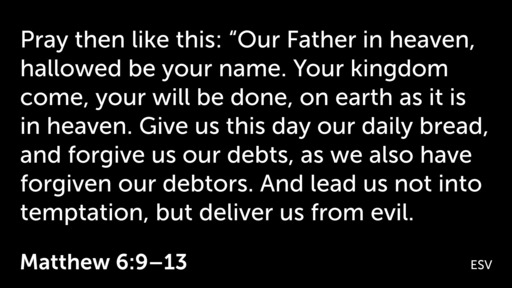
Pray then like this: “Our Father in heaven, hallowed be your name. Your kingdom come, your will be done, on earth as it is in heaven. Give us this day our daily bread, and forgive us our debts, as we also have forgiven our debtors. And lead us not into temptation, but deliver us from evil.
This prayer is the prayer Jesus taught his disciples, and we use it in our worship services to this day. It is not a bad thing to make part of your daily prayers.
