2 Thessalonians 2.3a-The Thessalonians Were Deceived By False Teaching Regarding the Timing of the Day of the Lord (Doctrinal Bible Church in Huntsville, Alabama)

Doctrinal Bible Church
Pastor-Teacher Bill Wenstrom
Sunday May 11, 2025
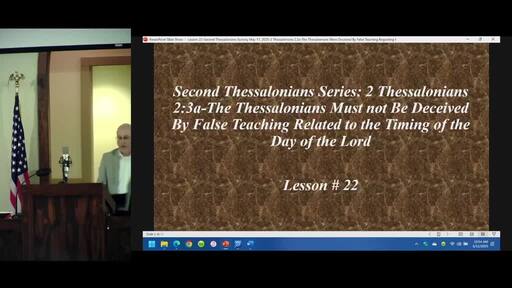
Second Thessalonians Series: 2 Thessalonians 2:3a-The Thessalonians Must not Be Deceived By False Teaching Related to the Timing of the Day of the Lord
Lesson # 22
2 Thessalonians 2:3 Do not let anyone deceive any one of you in any way. For, if the rebellion does not take place first, namely the unique person characterized by a distinguishable lawlessness has been revealed, that is, the unique son characterized by a distinguishable destruction, then the Lord’s day is absolutely not taking place. (Pastor’s translation)
In 2 Thessalonians 2:1-17, Paul attempts to correct and reassure the Thessalonians that the eschatological day of the Lord does not precede the rapture or resurrection of the church.
He teaches that the Spirit, who indwells each member of the church and prevents the appearance of Antichrist and thus the seventieth week of Daniel from beginning, must be removed from earth before the Antichrist can manifest himself.
Thus, the Spirit and the church must be removed before the seventieth week can take place since Daniel 9:27 teaches that the seventieth week begins with Antichrist establishing a treaty with the nation of Israel.
Therefore, Paul is addressing in 2 Thessalonians 2:1-17 the relationship between the church as well as the rapture and the eschatological day of the Lord, i.e. the seventieth week of Daniel and the Second Advent of Jesus Christ.
2 Thessalonians 2:3 contains a solemn prohibition followed by a causal clause which presents the reason for the prohibition and contains a third class conditional statement which, presents evidence which identifies that the day of the Lord is taking place.
So therefore, verse 3 begins by Paul, Silvanus and Timothy solemnly prohibiting any person to deceive any member of the Thessalonian Christian community in any way.
These three were concerned about false teachers who were proclaiming that the eschatological day of the Lord was taking place in their day and age and this interpretation is indicated by the contents of 2 Thessalonians 2:1-2.
The question arises to the identity of these false teachers.
Were they unbelievers or believers in apostasy?
I believe that they were Christian pastors or evangelists or both who were in a state or apostasy or like the Thessalonians were simply confused themselves with regards to the timing of the rapture in relation to the eschatological day of the Lord since only believers would be familiar or interested with the day of the Lord.
Even though they would be very familiar with the day of the Lord, it is unlikely that Jewish non-believers would be propagating this false doctrine.
This is indicated by the fact that the unregenerate Jewish community in Thessalonica would have nothing to do with the Gentile Christian community in that city because Jews had nothing to do with Gentiles.
Thus, they would never walk into the meetings of the Thessalonian Christian community or walk into the Gentile community to proclaim that the day of the Lord was taking place in their day and age.
This prohibition is modified by the prepositional phrase kata mēdena tropon (κατὰ μηδένα τρόπον), ““by either a spirit or by a message or by a letter allegedly from us” identifies the means by which the Thessalonians were not to be deceived by.
The noun tropos (τρόπος) speaks of the means by which the Thessalonians could be deceived into thinking that the eschatological day of the Lord was taking place in their day and age.
Therefore, the noun tropos refers to a spirit or a message or a letter allegedly from Paul, Silvanus and Timothy, which asserts that the eschatological day of the Lord was taking place when Paul wrote Second Thessalonians.
Therefore, this indicates that the Thessalonians were being prohibited from being deceived by these false teachers into believing that the eschatological day of the Lord was taking place in their day and age in accordance with any means such as spirit, a letter or message allegedly from Paul, Silvanus and Timothy.
Therefore, Paul is forbidding each member of the Thessalonian Christian community from allowing anyone to deceive them into believing that the eschatological day of the Lord was taking place in their day and age in accordance with any means such as a spirit, message or a letter allegedly from Paul, Silvanus and Timothy.
