Filled with the Spirit

Notes
Transcript
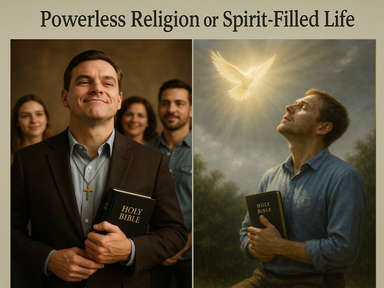
Powerless Religion or Spirit-Filled Life
2 Timothy 3:1-5; Ephesians 5:15-18; Galatians 5:22-26
In an age when appearance often replaces authenticity,
and spiritual reputation can mask spiritual emptiness, we must
ask ourselves how does one identify the highly religious among
us? Is it not often those whose outward expressions of devotion
are
most
visible—those
who bow low to
the ground in
prayer,
fold
their hands with
reverence, or
lift their eyes
earnestly
toward
the
heavens? We
tend to notice
those who, like the Psalmist, meditate on the Word of God day
and night, anchoring their hearts in Scripture as a daily rhythm
of life. Weekly worshippers—those who gather faithfully with
the community of believers regardless of weather or
weariness—are also held in high regard.
What about those who fast for extended periods—not for
public recognition, but in quiet pursuit of spiritual clarity and
deeper fellowship with God? Do we not also esteem the
1|P age
compassionate—those who care for widows, feed the hungry,
and clothe the poor? Their sacrificial generosity and service
often mark them as models of true religion in action. And then
there are those whose lives appear distinctly set apart—who
resist
cultural
trends
that
oppose Scripture
and
pursue
righteousness,
not only in belief
but
in daily
conduct.
They
strive to emulate
Christ in purity,
humility,
and
grace—lives
shaped by obedience and empowered by divine conviction.
Surely, we think, these are the truly religious—those whose light
shines clearly in a dark world. But could it be that beyond these
visible signs of devotion, the true mark of spiritual life is this:
being filled with the Holy Spirit?
Yet religion—when reduced to a checklist of rules—
loses its heart. It becomes a hollow shell, like a lamp with no oil,
giving the appearance of light but offering none. Outward
practices only hold value when they flow from the living waters
of inward transformation. As James 1:27 reminds us, “true
religion” is not about appearance, but about a heart that lives out
God’s will in sincerity and love. When someone is born again—
born of water and the Spirit, as Jesus declared in John 3:5—they
receive the right to become children of God (John 1:12–13).
They are given a new heart and the indwelling Holy Spirit,
fulfilling the beautiful promise of Ezekiel 36:26–27. But this
spiritual birth is not the finish line—it’s the starting point of a
new life.
Spiritual maturity doesn’t happen overnight. While we
are made new in Christ, we must grow into the fullness of that
new life. Apostle Paul described the Corinthians as “carnal” and
still needing milk instead of
solid food (1 Corinthians
3:1–2). Similarly, we are
called to “be holy as God is
holy” (1 Peter 1:15–16)—a
lifelong journey that requires
continual surrender. To
avoid the trap of religious
hypocrisy—where
appearances outpace authenticity—we must choose daily to be
led and filled by the Holy Spirit (Galatians 5:16–18). Only then
can we move from spiritual infancy to Christlike maturity and
let our light shine in both word and deed.
Today’s message presents every believer with a choice:
Will you settle for a form of godliness that denies the
transforming power of the Holy Spirit? Or will you pursue the
uncomfortable, yet glorious path of spiritual growth—
confessing sin, examining your heart, and surrendering every
part of your life to God? Tragically, many perform religious
duties to impress others, but never invite the Spirit to transform
their hearts. Yet God calls us to more. He invites us not just to
look holy, but to be holy—to live a life filled with His Spirit,
growing daily in love, truth, and holiness.
2|P age
The Dangers of Powerless Religion
While outward displays of devotion may impress others,
Scripture warns that in the last days, many will hold to a form of
godliness while denying its power—embracing religion without
transformation, faith without surrender, and appearance without
the indwelling presence of the Spirit. In his warning to Timothy,
the Apostle Paul writes:
“But mark this: There will be terrible times in the last days.
People will be lovers of themselves, lovers of money, boastful,
proud,
abusive,
disobedient to their
parents,
ungrateful,
unholy, without love,
unforgiving,
slanderous,
without
self-control, brutal, not
lovers
of
good,
treacherous,
rash,
conceited, lovers of
pleasure rather than lovers of God—having a form of godliness
but denying its power. Have nothing to do with such people.”
(2 Timothy 3:1–5)
Paul lists eighteen traits that vividly describe the corrupt
attitudes and moral decay that will characterize society in the last
days—traits that reflect the values of a world that has rejected
God.1 Many of these individuals, as Paul explains elsewhere,
have been “given over to a depraved mind” (Romans 1:28),
meaning God has allowed them to spiral into spiritual blindness
and moral confusion because they persistently refused to
acknowledge Him.
we discern the tares among the wheat—those who appear
religious but are not truly born again?
When someone is openly abusive, unforgiving, arrogant,
or blatantly hostile toward truth, their lack of holiness is often
evident. Their lives
bear no fruit of
repentance,
and
they
frequently
make no profession
of
faith—some
even boldly declare
they don’t believe
in God. But the
greater challenge—
and the more subtle
danger—comes from within the church itself. How can we
recognize those Paul describes as having “a form of godliness”
yet lacking the true power of spiritual transformation? How do
There are many who enter our churches, pass through the
waters of baptism, partake in communion, read the Scriptures,
pray with intensity, and even give generously to the poor. Yet,
as Charles Spurgeon rightly warns, “Their eminently good
outward form, when
without inward life,
decays into the foulest
thing under heaven.”2
These individuals have
mastered
our
“Christianese”—reciting
Scripture and theological
phrases with ease—but
their words, as Spurgeon
put it, “do not well up from the deep fountains of the heart.”3 As
a result, their voices echo like a “resounding gong or a clanging
cymbal” (1 Corinthians 13:1),4 offering noise instead of spiritual
substance, and often resembling the Pharisees’ lip service—
empty, repetitive, and void of genuine love for God.
1
Gordon D. Fee, 1 and 2 Timothy, Titus, Understanding the Bible
Commentary Series (Grand Rapids, MI: Baker Books, 2011), 270–
271.
3
2
4
C. H. Spurgeon, “The Form of Godliness without the Power,” in The
Metropolitan Tabernacle Pulpit Sermons, vol. 35 (London: Passmore
& Alabaster, 1889), 302.
3|P age
C. H. Spurgeon, “The Form of Godliness without the Power,” in The
Metropolitan Tabernacle Pulpit Sermons, vol. 35 (London: Passmore
& Alabaster, 1889), 304.
C. H. Spurgeon, “The Form of Godliness without the Power,” in The
Metropolitan Tabernacle Pulpit Sermons, vol. 35 (London: Passmore
& Alabaster, 1889), 304.
Why are they among us? Some attend because their
parents did. Others come to soothe their conscience or to appear
spiritual in the eyes of others. But their religious efforts, absent
the indwelling power of the Spirit, are what Spurgeon describes
as “religion walking
forth in her velvet
slippers”5 — an
elegant
disguise
that
conceals
whitewashed tombs
full of decay and
death
(Matthew
23:27–28). Their
lives are not rooted
in grace but in
performance, not in faith but in pretense. Paul warns us plainly:
“Have nothing to do with such people” (2 Timothy 3:5). This
does not mean we withhold love or compassion, but that we
refuse to imitate their hollow religiosity. We are not called to
look spiritual, but to be transformed. We are not meant to remain
infants in Christ—we are called to grow into maturity, led and
filled by the Holy Spirit.
Two trees stand side by side. One is leafy, tall, and
admired—but bears no fruit. The other, less glamorous, is heavy
with fruit that feeds others. The first is admired for its
appearance; the second is valued for what it produces. So, it is
5
C. H. Spurgeon, “The Form of Godliness without the Power,” in The
Metropolitan Tabernacle Pulpit Sermons, vol. 35 (London: Passmore
& Alabaster, 1889), 306.
4|P age
with the Christian life—fruit, not form, is the true measure of
Spirit-filled living.
Before we move into how to be filled with the Spirit,
pause and ask yourself this essential question: Am I living by
religious habit, or do I truly know the transforming power of
God in my life?
The Call to Spirit-Filled Living
“Fire is quenched by pouring on water or withdrawing fuel; so
the Spirit is quenched by living in sin, which is like pouring on
water; or not improving our gifts and grace, which is like
withdrawing the fuel.”6
Thomas Manton
King Saul stands as a sobering example of someone who
started well but finished in spiritual ruin. He was anointed by
God, empowered to lead, and given every opportunity to walk in
the fullness of God’s calling. But over time, Saul became more
concerned with how he appeared before the people than with
obedience to the Lord. When confronted by Samuel, Saul
offered excuses, clung to appearances, and refused to repent. In
1 Samuel 15:22, Samuel speaks words that still echo today:
6
Elliot Ritzema and Elizabeth Vince, eds., 300 Quotations for
Preachers from the Puritans, Pastorum Series (Bellingham, WA:
Lexham Press, 2013).
“Does the LORD delight in burnt offerings and sacrifices as
much as in obeying the voice of the LORD? To obey is better
than sacrifice…”
Saul looked the part. He
talked the part. But he
lost the kingdom because
he refused to be fully
surrendered to the Spirit
of God. His life warns us:
it is entirely possible to
be called by God and still
miss your potential if
you resist His Spirit.
If appearance alone is not enough, and religious routine
leaves us spiritually dry, then what does it truly mean to walk in
the Spirit? Let us now turn our hearts to discover what it means
to live each day filled with His presence and led by His power.
To the believers in Ephesus, Paul gave this charge:
“Be very careful, then, how you live—not as unwise but as wise,
making the most of every opportunity, because the days are evil.
Therefore, do not be foolish, but understand what the Lord’s will
is. Do not get drunk with wine, which leads to debauchery, but
be filled with the Spirit.”
(Ephesians 5:15–18)
7
Klyne Snodgrass, Ephesians, The NIV Application Commentary
(Grand Rapids, MI: Zondervan, 1996), 289.
5|P age
The Holy Spirit is not only the agent of our new birth, but also
the one who sustains, empowers, and transforms us daily. 7 Upon
conversion, we are given a new heart (Ezekiel 36:26) and the
Spirit comes to dwell within us. No longer slaves to sin (Romans
6:6), we are now free to live lives that are worthy of the gospel
of Christ (Philippians 1:27).
Paul’s contrast between being drunk with wine and being
filled with the Spirit is intentional. Drunkenness leads to
debauchery—a life
of
excess,
indulgence, and loss
of control (1 Peter
4:3).8 But being
filled with the Spirit
results in selfcontrol,
discernment, and
joyful obedience.
To walk in the Spirit
is to walk in step-by-step submission, inviting God to search our
hearts, confessing sin, and allowing the Spirit to replace impurity
with holiness.
Conversion is a once-for-all moment of salvation—but
spiritual maturity is a lifelong journey. We are called to grow
from spiritual infancy to Christlike maturity through the daily
renewal of our minds (Romans 12:1–2). Holiness is not achieved
8
Klyne Snodgrass, Ephesians, The NIV Application Commentary
(Grand Rapids, MI: Zondervan, 1996), 290.
by human striving, but by surrender—as we yield each day to
the Spirit’s leading, we are shaped more and more into the
likeness of Christ.
“God commands us to be filled with the Spirit, and if we are not
filled it is because we are living beneath our privileges.”
Dwight Moody
Signs of a Spirit-Filled Life
When we truly walk in step with the Spirit, the
transformation is unmistakable. The fruit we bear, the power we
carry, and the peace we live with all testify to a life no longer
ruled by the flesh but guided and empowered by the very
presence of God. Apostle Paul described this Spirit-shaped life
to the church in Galatia:
“But the fruit of the Spirit is love, joy, peace, forbearance,
kindness, goodness, faithfulness, gentleness and self-control.
Against such things there is no law. Those who belong to Christ
Jesus have crucified the flesh with its passions and desires. Since
we live by the Spirit, let us keep in step with the Spirit.”
(Galatians 5:22–25)
These nine virtues are not the product of human willpower or
religious striving. They are the supernatural evidence of a life
9
David Platt and Tony Merida, Exalting Jesus in Galatians (Nashville,
TN: Holman Reference, 2014), 115.
6|P age
rooted in Christ and nourished by His Spirit.9 The Spirit-filled
believer does not simply act more loving, joyful, or patient—
they become so, because the life of Christ is being formed in
them from the inside out (Galatians 2:20).
But walking in the Spirit isn’t only about inward
transformation—it also brings outward boldness and purpose.
Jesus said, “But you will receive power when the Holy Spirit
comes on you; and you will be my witnesses…” (Acts 1:8). The
Spirit empowers
us to proclaim the
gospel, to make
disciples, and to
carry the light of
Christ into a dark
world, just as
Jesus commanded
in
the
Great
in e we li e the irit,
Commission
let us ee in ste with the irit
(Matthew 28:19–
20). And finally, the Spirit brings a deep, abiding peace—a
peace that comes from knowing we are no longer slaves to sin,
no longer orphans in this world. When the Spirit takes up
residence within us, we are sealed for eternity as children of God
(Ephesians 1:13–14), and no force in heaven or on earth can
break that seal (Romans 8:38–39). This is the peace of the Spiritfilled life: freedom, assurance, and unshakable identity in Christ.
So how do we move from acknowledging the truth to living it?
What are the next steps toward a life marked by the Spirit’s
power?
Walking by the Spirit
It begins with a thirst for more of God—as Jesus said in
John 7:37, “If anyone thirsts, let him come to me and drink.” A
deep hunger for God is the starting place; He fills those who truly
desire Him. Next, we must surrender everything. Paul urges us
in Romans 12:1 to “present your bodies as a living sacrifice.”
We cannot be full of
the Spirit if we are
Thirst for God
full of ourselves—
sin, pride, control,
urrender er thin
and
worldly
distractions must be
s in F ith
laid down. Third, we
are called to ask in
faith. Jesus promised
e in is ll
in Luke 11:13 that
the Father will “give
the Holy Spirit to those who ask Him.” This is not a passive
request but a sincere, expectant asking, trusting God’s goodness.
And finally, we must walk in obedience. Acts 5:32 tells us that
God gives the Holy Spirit “to those who obey Him.” The Spiritfilled life isn’t reserved for the perfect—it’s given to the
obedient. Thirst, surrender, ask, and obey—this is how we move
from hollow religion to a life empowered by the Spirit of God.
7|P age
Conclusion
As we close, let’s be honest: it’s entirely possible to look
religious on the outside while remaining spiritually dry on the
inside. Jesus did not die and rise again so we could settle for
hollow habits and surface-level holiness. He came to give us
life—abundant, Spirit-filled, transformative life (John 10:10).
The call today is not to try harder, perform better, or fake it
longer. The call is to surrender, to thirst, to ask, and to walk in
obedience. The Holy Spirit is not reserved for pastors,
missionaries, or the spiritually elite—He is the promised gift to
every believer who hungers for more of God.
So, I ask you:
Are you tired of dry religion?
Are you done going through the motions?
Do you long to know the living presence of God, to walk in His
power, to bear His fruit, and to live with His peace?
Then come. Come and be filled.
The invitation is open.
The Spirit is willing.
The only question left is—are you?
