John 17:20-26 Prayer
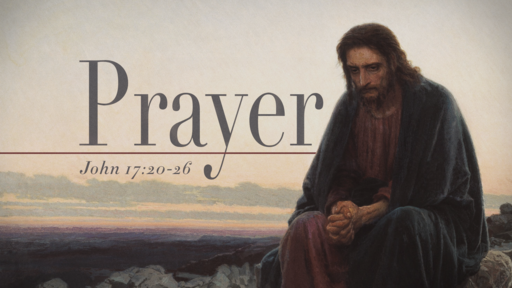

John 17:20-26 (Evangelical Heritage Version)
20“I am praying not only for them, but also for those who believe in me through their message. 21May they all be one, as you, Father, are in me, and I am in you. May they also be one in us, so that the world may believe that you sent me. 22I have given them the glory you gave me, so that they may be one, as we are one: 23I in them, and you in me. May they become completely one, so that the world may know that you sent me and loved them even as you loved me.
24“Father, I want those you have given me to be with me where I am so that they may see my glory—the glory you gave me, because you loved me before the world’s foundation. 25Righteous Father, the world did not know you, but I knew you, and these men knew that you sent me. 26I made your name known to them and will continue to make it known, so that the love you have for me may be in them, and that I may be in them.”
Prayer
I.
How much do you think about prayer? In today’s service there will be the “Prayer of the Day,” the “Prayer of the Church,” an “Offering Prayer,” the “Prayer of Thanksgiving,” the “Lord’s Prayer,” and a “Post Communion Prayer.” Six times we will pray as part of our service.
The “Prayer of the Day,” near the beginning of the service, is designed to coordinate with the readings of the day, especially the Gospel, and focus the worship for that day. The “Prayer of the Church” is intended to address God concerning of the needs of the congregation, the nation, the church at large, and sometimes individual’s needs and concerns. We use an “Offering Prayer” to remind ourselves that everything ultimately belongs to God, and ask him to bless the offerings we bring. The “Prayer of Thanksgiving” is used in services with the Lord’s Supper; it focuses our attention on the blessings given to us in the eating and drinking in this Sacrament. The “Lord’s Prayer” is the prayer Jesus taught us to pray; it puts the focus on spiritual things, rather than on earthly blessings. A “Post Communion Prayer” is spoken to once again give thanks to God for the blessings we receive in the sacrament of the Lord’s Supper.
In your daily life, you have other moments of prayer. You pray at mealtimes; you pray at your devotion time; when getting up in the morning or going to bed at night. Paul says: “Pray without ceasing” (1 Thessalonians 5:17, EHV). Your prayers don’t have to be long and involved. A quick “Help, Lord,” while driving in your car, or picking something up at the store, or while taking care of your children, or doing your job, or doubled over in pain can all be moments of prayer.
As you think about all these different types of prayers, you can see that some are deeply personal, while others are intended to be group prayers. Some are intended to be overheard, others are meant to be private.
It would only be a little while after today’s Gospel when Jesus would pray in the Garden of Gethsemane. John doesn’t record that prayer, but Matthew does. Jesus told his disciples: “Sit here, while I go over there and pray” (Matthew 26:36, EHV). He took the three innermost circle of his disciples a little farther. Matthew reports: “[Jesus] said to them, ‘My soul is very sorrowful, even to the point of death. Stay here, and keep watch with me.’ 39He went a little farther, fell on his face, and prayed” (Matthew 26:38-39, EHV). Jesus didn’t intend this prayer to be overheard at the time; it was deeply personal. Matthew, Mark, and Luke recorded it later, under the inspiration of the Holy Spirit, but all the disciples slept through Jesus’ troubled prayers in the Garden.
II.
Have you ever been guilty of eavesdropping on a conversation? Introverts like I am sometimes do that—we hover around the edges of a group because we don’t really want to put in our two cents worth; after all, we might be wrong, or people might think we’re trying to be funny when we were serious, or whatever nerve-wracking reason we have for not wanting to participate.
Introvert or not, maybe there are times when you have been on the other side of eavesdropping, and someone has been listening in on your conversation. There may even have been times when you said something you hoped would be overheard.
Today’s Gospel is part of Jesus’ High Priestly Prayer; the first two parts are the other sections of John 17. Jesus intended his disciples to overhear this prayer.
“I am praying not only for them, but also for those who believe in me through their message. 21May they all be one, as you, Father, are in me and I am in you. May they also be one in us, so that the world may believe that you sent me” (John 17:20-21, EHV).
Jesus had important things in this prayer he wanted his disciples to overhear. He prayed, both for them who were sitting with him on Holy Thursday evening and overhearing this prayer as well as for his Church of all time. He was praying for you and me. We are among the millions and billions throughout the centuries who have believed in Jesus through the message of his followers. Isn’t it encouraging to find yourself in Jesus’ prayer?
You can find yourself in more than those who would believe through their message, too. Jesus prays assuming that you will be another messenger. You share the news with your children and grandchildren. You mention it in passing to coworkers and friends; or maybe you speak about Jesus very deliberately to those you know. Even though you and I are nothing but clay pots, Jesus gives us the privilege of being part of God’s plan of salvation for those who have not yet believed.
“May they all be one.” The message about Jesus—the Gospel—brings unity. You may not think of yourself as a great evangelist or preacher. The Eleven listening to him that night were not great preachers, either—at least, not at the time. Some aren’t heard from all that much in the rest of the New Testament; others play prominent roles. None of them, however, were excluded from what Jesus prayed. People would believe through their message. People will believe through your message.
The power isn’t in you. The Apostle Paul said: “I did not come with superior speech or wisdom in order to proclaim to you the testimony of God” (1 Corinthians 2:1, EHV). No ambassador for Christ has power in and of him or herself to make believers. No, Paul says: “I am not ashamed of the gospel, because it is the power of God for salvation” (Romans 1:16, EHV). God’s Word has the power to draw people to himself.
When Jesus prayed for those who believe through the message of his followers, he was praying that the power of the Gospel would continually go out into the world. He prayed that you and I would be the ones who would use it.
III.
“I have given them the glory you gave me, so that they may be one, as we are one: 23I in them, and you in me. May they become completely one, so that the world may know that you sent me and loved them even as you loved me” (John 17:22-23, EHV).
“May they become completely one.” In Greek, “become completely” is in the passive voice. In other words, Jesus’ prayer is that oneness—unity—is something that happens to us, not something produced by us. Unity of the capital-C Church—all true believers—is something given to us by the Gospel. It comes from the relationship of the Father to the Son.
Disunity is always around. When sin entered the world, disunity came with it. Disunity is apparent in nearly every snippet of news. Violence is perpetrated by one human being on another. The disunity isn’t just out there among nations or on the streets, it’s in our homes: it rears its ugly head between husbands and wives, parents and children, siblings. The greatest disunity of all is that sin separated every human being from God.
The whole Easter season—and the Lenten season before it—reminds us of all Jesus did to bring unity back to a disunited world. In his prayer Jesus says: “as we are one.”
Throughout his earthly life, Jesus lived in perfect unity with God’s holy Law. “My God, my God, why have you forsaken me?” (Mark 15:34, EHV). So Jesus cried out from the cross. The only possible way to buy back unity for human beings was for the perfect unity of God the Father and God the Son to be severed as Jesus suffered hell for all people. He cried out again from the cross: “‘It is finished!’ Then, bowing his head, he gave up his spirit” (John 19:30, EHV). Even before Jesus died, unity between God the Father and God the Son was restored.
IV.
It wasn’t only Jesus’ declaration from the cross that proves that unity was restored, both between Jesus and the Father, and also for you and me. Jesus was raised again from the dead so that we would know the Father’s high price was satisfied.
“Righteous Father, the world did not know you, but I knew you, and these men knew that you sent me. 26I made your name known to them and will continue to make it known, so that the love you have for me may be in them and that I may be in them” (John 17:25-26, EHV).
Jesus prays that his love might continue to be in you and me. We are those who know that the Heavenly Father sent Jesus to carry out his plan of salvation. We are the ones who know that the plan was completed. The love of Jesus continues to live inside us and keep us close to him in the unity he created for us.
“Father, I want those you have given me to be with me where I am so that they may see my glory—the glory you gave me because you loved me before the world’s foundation” (John 17:24, EHV). From eternity God had his plans for us, plans to bring salvation for the world, plans to bring you and me to faith in Jesus, who won our salvation. Jesus prays, even before he goes to the cross to win that salvation, that you and I would be brought to everlasting glory with him in heaven, to experience the fulness of his unity.
You know, there are more than six prayers in our service today. The Psalm was a prayer, praising God for the unity he gives us in the gospel. The hymns praise God for the unity he has given us, and urge us to share that unity with others. The “Kyrie,” or “Lord have Mercy,” is a prayer that God would show mercy on sinners like us who look to him for his forgiveness. The liturgical songs are prayers to God, declaring the great things he has done and thanking him for it all. Since today’s Gospel reading was part of Jesus’ High Priestly prayer, even the Word of God spoken to us was a prayer. Today’s service has been filled with prayer.
And God refreshes us with those great things once again, as we hear of his great deeds this day, and receive the sacrament of the Lord’s Supper to strengthen our faith and keep us firm as we live in the unity Jesus has given us.
What a prayer we have reviewed today! How awesome that Jesus let his fabulous prayer be overheard! Humbly we thank you, Lord Jesus, for your goodness in dying for us and praying for us. Be with us, Lord Jesus, and empower us by your Holy Spirit, so that we show the unity you brought us to others, that they might be drawn to you and become one with you, along with us. Fill us with your body and blood, given and poured out for us for the forgiveness of sins. Amen.
