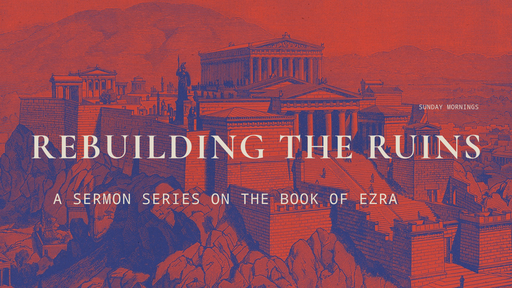
Faith and Faithfulness (Ezra 8:21-36)
Notes
Transcript
Introduction
Introduction
A. Preliminaries
A. Preliminaries
Good morning. We continue our sermon series on the book of Ezra this morning, and we find ourselves in Chapter 8
It’s been 2 weeks since we were last in Ezra, so let me refresh your memory. Ezra is looking back on the preaparations he made for the journey before coming to Jerusalem.
Last time we were here, we looked at the first part of Chapter 8, and how Ezra took great care to prepare for this journey before it happened. We continue where we left off, in verse 21.
B. Sermon Text
B. Sermon Text
Then I proclaimed a fast there, at the river Ahava, that we might humble ourselves before our God, to seek from him a safe journey for ourselves, our children, and all our goods. For I was ashamed to ask the king for a band of soldiers and horsemen to protect us against the enemy on our way, since we had told the king, “The hand of our God is for good on all who seek him, and the power of his wrath is against all who forsake him.” So we fasted and implored our God for this, and he listened to our entreaty. Then I set apart twelve of the leading priests: Sherebiah, Hashabiah, and ten of their kinsmen with them. And I weighed out to them the silver and the gold and the vessels, the offering for the house of our God that the king and his counselors and his lords and all Israel there present had offered. I weighed out into their hand 650 talents of silver, and silver vessels worth 200 talents, and 100 talents of gold, 20 bowls of gold worth 1,000 darics, and two vessels of fine bright bronze as precious as gold. And I said to them, “You are holy to the Lord, and the vessels are holy, and the silver and the gold are a freewill offering to the Lord, the God of your fathers. Guard them and keep them until you weigh them before the chief priests and the Levites and the heads of fathers’ houses in Israel at Jerusalem, within the chambers of the house of the Lord.” So the priests and the Levites took over the weight of the silver and the gold and the vessels, to bring them to Jerusalem, to the house of our God. Then we departed from the river Ahava on the twelfth day of the first month, to go to Jerusalem. The hand of our God was on us, and he delivered us from the hand of the enemy and from ambushes by the way. We came to Jerusalem, and there we remained three days. On the fourth day, within the house of our God, the silver and the gold and the vessels were weighed into the hands of Meremoth the priest, son of Uriah, and with him was Eleazar the son of Phinehas, and with them were the Levites, Jozabad the son of Jeshua and Noadiah the son of Binnui. The whole was counted and weighed, and the weight of everything was recorded. At that time those who had come from captivity, the returned exiles, offered burnt offerings to the God of Israel, twelve bulls for all Israel, ninety-six rams, seventy-seven lambs, and as a sin offering twelve male goats. All this was a burnt offering to the Lord. They also delivered the king’s commissions to the king’s satraps and to the governors of the province Beyond the River, and they aided the people and the house of God.
This is the Word of the Lord
Thanks be to God!
C. A Journey Through the Text
C. A Journey Through the Text
So I wanted to start by doing something a bit different this morning and that is before actually getting to the content of the sermon, I wanted to do a kind of verse-by-verse walk through the text, so we are clear what’s happening.
What he have starting in verse 21 is that Ezra calls a fast. They are waiting to leave, to begin a 900 mile journey to Jerusalem, and Ezra calls for a fast. And we are given the purpose, it is a safe journey for ourselves, our children and all our goods (v. 21).
Why do they need God’s protection? Verse 22 tells us that Ezra did not want to ask the king for soldiers and horsemen to protect them. He wanted God’s glory to be displayed in the protection of his people. That his hand of goodness is on all those who seek him, and his wrath is against all those who forsake him.
So (verse 23) they fasted and implored God, and he listened.
Starting in verse 24, Ezra weighs out all the silver and gold vessels and the offering for the temple that they were taking with them. He tells them the vessels and the offering is holy (v. 28) and he tells the men to guard these carefully. And we get a sense that they are traveling with a lot of gold and silver and money, which demonstrates why they might have a concern about safety on a 900 mile journey.
Verse 31 they depart on the twelfth day of the first month for Jerusalem, and we read that the hand of their God was on them, and he delivered them from the hand of the enemy, and from ambushes along the way. Verse 32 they arrive in Jerusalem, and they weigh out and record all the vessels. And in verse 35 they make sacrifices as an offering of thanksgiving.
D. Sermon Points
D. Sermon Points
So we have here in our text this morning at least three things that I want to explore together with you.
1. A Call to Fast
2. A Call to Trust
3. A Call to Give Thanks
E. Sermon Prayer
E. Sermon Prayer
Let’s Pray
Holy Spirit, come and illuminate the words of our God. Show us the wealth of glory that lies beneath the old, familiar stories. Teach us the meaning hidden in the songs of Zion. Raise us to the heights of aspiration reached by the wings of the prophet. Lift us to the summit of faith that is trod by the feet of the apostle. Open our eyes that we may behold wondrous things out of your law, and Amen.
(Based on a prayer by George Matheson)
So, our first point is A Call to Fast.
I. A Call to Fast
I. A Call to Fast
As we have already said, Ezra calls for a fast in verse 21, and I wanted to take some time this morning to talk about fasting. It’s in the text—it’s actually a big part of our passage. And so I wanted to talk about it.
First of all, what is fasting? Fasting is temporarily replacing food with prayer. That’s the most succinct defenition I can give. It could be skipping one meal. It could be fasting for a day. Or several days.
Fasting has always been a part of the life of God’s people. In fact, Jesus had more to say (in terms of word count) about fasting than he ever said about Baptism or the Lord’s Supper.
And the whole Bible has a lot to say about it.
Judges 20 records the people fasting before they went into battle. And Ester 4 records the people fasting when they heard the King’s terrible decree.
2 Samuel 12:16-23 records David fasting with the hope that God might spare the life of his infant son.
Fasting was common when grieving, for instance 2 Samuel 1:12 records the people fasting after Saul and Jonathan were killed.
Deuteronomy 9 records the people fasting when they are seeking God’s forgiveness after the incident with the Golden Calf.
There were even calls for special days of fasting on the anniversary of certain calamities like the burning of the temple or the fall of Jerusalem.
And, this is not only an Old Testament practice.
On the eve of the first missionary journey, Acts 13:2 records that the church in Antioch was “worshipping the Lord and fasting.”
And after calling Matthew the tax collector to follow him, Jesus he went to Matthew’s house for a meal. And the Pharisees asked why he and his disciples didn’t fast. To which Jesus replied,
And Jesus said to them, “Can the wedding guests mourn as long as the bridegroom is with them? The days will come when the bridegroom is taken away from them, and then they will fast.
Jesus was speaking of the time following his death and resurrection—in other words, now!
What are we to make of this?
Well, it seems that in the Bible, God’s people fast when they are afraid or anxious and need God’s help. And when they are grieved and are crying out to God.
John Calvin said
Whenever men are to pray to God concerning any great matter, it would be expedient to appoint fasting along with prayer.
And if you ask why, there is a simple that I can give to you in a few seconds, but it’s worthy of hours of reflection. The simple answer is that fasting synchronizes the longings of the body with the longings of the soul. It uses hunger in the body, to amplify hunger for God in the soul. And all I can offer to you is, it will intensify your prayers like nothing else can.
It is not going on a hunger strike to force God to answer your prayers with the answer you want. We must be clear about this. Fasting transforms your prayers. It does not change God. But it drives us to communion with God in the way that only neediness before God can do.
And if it still seems odd to you, just consider this. Think of fasting as the opposite of using food to medicate your sadness.
When we are sad or angry or lonely or tired, what is often the temptation? It’s food. Comfort food. High calorie, low nutrition comfort food. To stuff my face so that I feel better. But do you ever really feel better after that? I don’t! Imagine fasting as the opposite of that. Of turning away from cheap comforts, to the God of all comfort, and saying to him “Lord there is a deep hunger in my belly, let my soul long for you even more than this.”
Now, there are all sorts of details I want to express on this. Dangers of legalism. Questions about specific circumstances and health conditions. Questions about duration. If you want to learn more about fasting, I would direct you to the book A Hunger for God by John Piper.
But I want to say that more important than all those questions about nature or duration is the question of purpose. When we fast why are we doing it? Well, why was Ezra doing it?
That is our second point. The first point was A Call to fast. The second point is a call to trust.
II. A Call to Trust
II. A Call to Trust
We find the purpose for the fast in verse 22. Ezra says they fasted, and then he gives the reason.
For I was ashamed to ask the king for a band of soldiers and horsemen to protect us against the enemy on our way, since we had told the king, “The hand of our God is for good on all who seek him, and the power of his wrath is against all who forsake him.”
In other words, Ezra refused to ask the King for a military escort back to Jerusalem. His reasoning is because he had already told the King that their God was sovereign, and would protect them. His hand is on us for good, and his wrath is against all those who forsake him.
In other words, we have faith that God is faithful.
Now it’s interesting to note that for Ezra, here in this chapter, he believed that accepting the King’s help would threaten their testimony. And yet over in the next book, in Nehemiah 2, Nehemiah is confronted with a very similar situation and makes a different call.
And I said to the king, “If it pleases the king, let letters be given me to the governors of the province Beyond the River, that they may let me pass through until I come to Judah, and a letter to Asaph, the keeper of the king’s forest, that he may give me timber to make beams for the gates of the fortress of the temple, and for the wall of the city, and for the house that I shall occupy.” And the king granted me what I asked, for the good hand of my God was upon me. Then I came to the governors of the province Beyond the River and gave them the king’s letters. Now the king had sent with me officers of the army and horsemen.
Notice. Same language—good hand of God was upon me. And I had the King’s officers and horsemen with me.
Both Ezra and Nehemiah are godly men. Both are prayerful men. And yet they came to opposite conclusions about what faith meant in their circumstnaces. One said that military protection would be a lack of faith, the other saw it as a blessing from God.
And that teaches us something really important: That it is possible for two equally godly believers to come to different conclusions about a matter. Christians can disagree on many different things. In fact, funnily enough, speaking of fasting, the first fight in the New Testament was a fight about food!
New Testament Christians differed on whether it was right to eat meat that had been sacrificed to pagan idols. And Paul urged them “pass judgment” why? Because when it comes to your brother and his conscience,
...It is before his own master that he stands or falls. And he will be upheld, for the Lord is able to make him stand.
And what I also love about the passage in Ezra and the passage in Nehemiah is that neither one of those men was given direct unmediated revelation about the matter before them.
Ezra did not say “Guys, God told me that we’re going to fast, and God also told me, no help from the King.” And Nehemiah did not say “Guys, God told me that we are going to get some help from the king, and He’s good with it.”
Both appear to have reasoned from their knoweldge of biblical principles and made a judgment call. I think J.I. Packer is really helpful here, he says:
God’s guidance is more like...guidance received from counselors than it is like being “talked down” by the airport controller as one flies blind through clouds. Seeking God’s guidance is not like practicing divination or consulting oracles, astrologers, or clairvoyants for information about the future. Rather, this quest is comparable with everyday thinking-through of alternative options in given situations to determine the best course open to us. The inward experience of being divinely guided is not ordinarily of seeing signs and hearing voices, but rather of being enabled to work out the best thing to do.
J. I. Packer, “Guidance,” in God’s Plans for You (Wheaton, IL: Crossway, 2001), 97–98. As cited in Derek W.H. Thomas, Ezra and Nehemiah (Phillipsburg, NJ: P&R, 2016), 154.
In other words, can God give guidance through internal impressions? Yes. He absolutely can. But ordinarily...
underline “ordinarily” in the Packer quote
...the way God leads us is by calling us to apply the wisdom given to us in His Word, and to trust him.
So, are you anxious? Are you worried? Are you worried about the future of your marriage? Future of your kids? Future of your job? Future of your church? Future of your nation?
Well let me ask—have you taken it to the Lord in prayer? Have you considered occasionally joining fasting to your prayers?
Have you joined together with fellow believers in prayer? Brothers and sisters, let me urge you once more—this is why we have our Sunday Night prayer gathering at the Ida Street House at 5:00. Because that is where we get together to approach the throne together, to strengthen our bonds of fellowship, to encourage each other, and to absolutely murder our anxiety by the violent grace of God.
We bring our petitions before the Lord, our thanksgivngs, our fears, our uncertainties, and everything else and we trust the Lord with them together.
So there is in our text A Call to Fast, there is A Call to Trust, and there is finally, A Call to Give Thanks
III. A Call to Give Thanks
III. A Call to Give Thanks
Look at verse 23. Best verse in the whole chapter.
So we fasted and implored our God for this, and he listened to our entreaty.
And the rest of the chapter is a movement toward a celebration of God’s faithfulness to his people. They weigh out all the gold and silver vessels destined for the temple. They are set apart as holy. They are traveling with an enormous amount of wealth. A large chunk of this chapter is given over just to reminding us that they weighed all this stuff before they left, and they weighed it again when they got to Jerusalem.
Some commentators estimate the amount of gold to have been 7,500 pounds or 3¾ tons and the silver to have been 49,000 pounds or 25 tons. Others put the figures at 3 and 19 tons.
In other words, they are sitting ducks for bandits and thieves.
And that’s the glory of verse 31
Then we departed from the river Ahava on the twelfth day of the first month, to go to Jerusalem. The hand of our God was on us, and he delivered us from the hand of the enemy and from ambushes by the way.
And what do they do when they get home to Jerusalem? They give thanks.
At that time those who had come from captivity, the returned exiles, offered burnt offerings to the God of Israel, twelve bulls for all Israel, ninety-six rams, seventy-seven lambs, and as a sin offering twelve male goats. All this was a burnt offering to the Lord.
They began with fasting and prayer in Babylon. They ended with worship in Jerusalem. Why? Because they had hard evidence of God’s faithfulness. And celebration is part of thanksgiving. We know that we should pray hard when trouble comes. But what should we do when deliverance comes. My pastoral theologically centered, biblically informed answer is we should throw a party.
Honestly. Renee got healed of her cancer. Let’s throw a party. Sarah made it through her surgery. Let’s throw a party. Dion got that job he’s been waiting for (it’s coming brother). Let’s throw a party. My prodigal kid came home—let’s throw a party! There’s literally biblical precedent for that one!
In fact, you’re going to hear more about this next Sunday—we’ve been invited to participate in the Louisiana Life Parade in Opleousas. It’s a parade for the whole state of Louisiana to celebrate the anniverary of the fall of Roe v. Wade. God took down Roe v. Wade. Let’s throw a party.
In fact, when I was preparing this sermon, one of the commentaries that I use, when it talked about the good work of fasting said “Have you considered fasting on the anniversary of when Roe v. Wade went into law, in the hopes that God might bring it down?”
And I just thought “Oh praise God!” That commentary was printed in 2016, and the author had no idea that only six years later, God would answer those prayers. Now there is still plenty of work to do as self-managed abortions are still legal. Innocent blood is still being spilled. But there is still plenty enough reason to celebrate God answering the years of prayer from his people to overturn that wicked piece of legislation.
Conclusion
Conclusion
The title of this sermon is “Faith and Faithfulness.” Because we are called to believe and trust in all the words of our God, and to believe and trust in all he is for us in Jesus. That’s faith. And we are called to be his body in the world, and to accomplish the work he has put before us. That’s faithfulness. But far more important is God’s own faithfulness which remains firm when our faithfulness falters and fails.
Our hope is in Jesus Christ, the true and better Ezra, who fasted 40 days while quoting scripture to the Devil, and passed his test in the wilderness so that he could deliver us out of the wilderness of our own sin. And we trust him to keep all his promises. Both promises of grace and mercy. And promises of wrath and judgement. We can say with Ezra
“The hand of our God is for good on all who seek him, and the power of his wrath is against all who forsake him.”
And that is why we continue to make known the hope of the Lord Jesus Christ who has turned all our sin into opportunities to praise his grace. All our failure into opportunities to trust his providence. All our fear into opportunities to bank on his promises.
And on this day when we remember not only his resurrection, but his ascension, we are confident that Jesus Christ is today ruling and reigning at the right hand of the Father. A rule and reign that we proclaim with fearless joy, and call all men to know and believe and rejoice alongside us.
You have raised our human nature
in the clouds to God's right hand;
there we sit in heav'nly places,
there with you in glory stand:
Jesus reigns, adored by angels,
man with God is on the throne;
mighty Lord, in your ascension
we by faith behold our own.
(“See, the Conqueror Mounts in Triumph” by Christopher Wordsworth, 1862, third verse. As printed in the Trinity Psalter Hymnal, Hymn #373).
In the name of Jesus, Amen.
