Ephesians 4.17c-The Futility Produced by the Thinking of the Non-Christian

Wenstrom Bible Ministries
Pastor-Teacher Bill Wenstrom
Tuesday June 3, 2025
Ephesians Series: Ephesians 4:17c-The Futility Produced by the Thinking of the Non-Christian
Lesson # 254
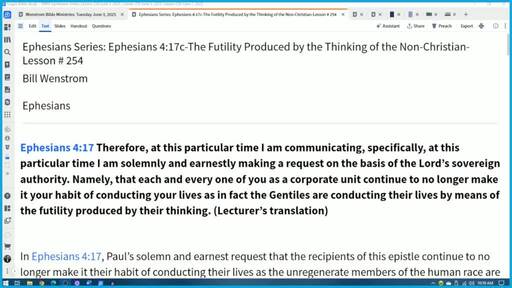
Ephesians 4:17 Therefore, at this particular time I am communicating, specifically, at this particular time I am solemnly and earnestly making a request on the basis of the Lord’s sovereign authority. Namely, that each and every one of you as a corporate unit continue to no longer make it your habit of conducting your lives as in fact the Gentiles are conducting their lives by means of the futility produced by their thinking. (Lecturer’s translation)
In Ephesians 4:17, Paul’s solemn and earnest request that the recipients of this epistle continue to no longer make it their habit of conducting their lives as the unregenerate members of the human race are conducting their lives presents an inference from the contents of Ephesians 4:7-16.
Thus, Paul’s solemn and earnest request is based upon the fact that the communication gifts were given to the church in order that the individual members of the body of Christ could grow to spiritual maturity with the result that this body would grow to spiritual maturity as a corporate unit.
The implication is that by reverting back to their preconversion lifestyle would hinder their spiritual growth as individuals and as a corporate unit and which spiritual growth is the purpose for which the Lord generously gave them the communication gifts of apostleship, prophecy and teaching.
Ephesians 4:17 is composed of the following:
(1) Declarative statement: Touto legō kai martyromai en kyriō (Τοῦτο λέγω καὶ μαρτύρομαι ἐν κυρίῳ), “At this particular time I am communicating, specifically, at this particular time I am solemnly and earnestly making a request on the basis of the Lord’s sovereign authority.” (Lecturer’s Translation)
The declarative statement asserts that Paul was communicating instructions to the recipients of this epistle, who we noted many in our study of Ephesians was the Gentile Christian community in the Roman province of Asia.
Specifically, he was making a solemn, earnest request of these Gentile Christians.
The basis for this solemn, earnest request was the Lord Jesus Christ’s sovereign authority.
(2) Appositional infinitival clause: mēketi hymas peripatein, kathōs kai ta ethnē peripatei en mataiotēti tou noos autōn (μηκέτι ὑμᾶς περιπατεῖν, καθὼς καὶ τὰ ἔθνη περιπατεῖ ἐν ματαιότητι τοῦ νοὸς αὐτῶν), “Namely, that each and every one of you as a corporate unit continue to no longer make it your habit of conducting your lives as in fact the Gentiles are conducting their lives by means of the futility produced by their thinking.” (Lecturer’s translation)
The infinitival appositional clause is in the form of a prohibition and identifies for the recipients of this epistle the content of this solemn, earnest request that Paul is making of them.
It prohibits them from conducting their lives like the Gentiles are conducting their lives.
This reference to the Gentiles refers to the unregenerate members of the human race.
The apostle identifies the means by which the unregenerate community conducted their lives as the futility produced by the particular way they think or in other words, their attitude in life.
The noun mataiotēs (ματαιότης) refers to the fact that unregenerate humanity consumes itself in the pursuit of goals that are purely selfish, in the accumulation of that which is temporary and in looking for satisfaction in that which is intrinsically deceptive and disappointing.
It indicates that they make plans and revolve everything based upon their own way of thinking and thus are an authority unto themselves because they follow their own way of thinking to its ultimate result of futility, aimlessness and meaninglessness.
They are self-centered, self-absorbed and self-deceived and empty.
A life apart from a relationship with Christ is a life of futility.
Ecclesiastes 1:14 I have seen all the works which have been done under the sun, and behold, all is vanity and striving after wind. (NASB95)
The unbeliever is futile in his thinking because Satan has deceived him.
2 Corinthians 4:1 Therefore, since we have this ministry, just as God has shown us mercy, we do not become discouraged. 2 But we have rejected shameful hidden deeds, not behaving with deceptiveness or distorting the word of God, but by open proclamation of the truth we commend ourselves to everyone’s conscience before God. 3 But even if our gospel is veiled, it is veiled only to those who are perishing, 4 among whom the god of this age has blinded the minds of those who do not believe so they would not see the light of the glorious gospel of Christ, who is the image of God. (NET)
The noun mataiotēs (ματαιότης) appears in 2 Peter 2:18 in relation to Peter’s description of false prophets.
2 Peter 2:17 These men are waterless springs and mists driven by a storm, for whom the utter depths of darkness have been reserved. 18 For by speaking high-sounding but empty words they are able to entice, with fleshly desires and with debauchery, people who have just escaped from those who reside in error. (NET)
In Romans 8:20, the noun mataiotēs (ματαιότης) means, “imperfection” and is used to describe creation existing under the curse God placed upon it as a result of Adam disobeying the Lord’s prohibition to not eat from the tree of the knowledge of good and evil.
It was subjected to futility in the sense that it does not fulfill the purpose for which God created and restored it.
Romans 8:20 For the creation was subjected to futility—not willingly but because of God who subjected it—in hope 21 that the creation itself will also be set free from the bondage of decay into the glorious freedom of God’s children. (NET)
In Ephesians 4:17, the noun nous (νοῦς) refers to the particular manner or way of thinking.
It denotes an attitude, practical reasoning or intellect that enables a person to arrive at a conclusion regarding a matter.
The referent of the genitive third person neuter plural form of the personal pronoun autos (αὐτός) is the members of the unregenerate community.
It functions as a genitive of possession expressing the idea that this particular way of thinking or attitude belongs to the members of the unregenerate community.
The genitive form of the noun nous (νοῦς) functions as a genitive of production, which expresses the idea that this futility is “produced by” the thinking or attitude of the unregenerate members of the human race.
The noun mataiotēs (ματαιότης), “futility” is the object of the preposition en (ἐν), which functions as a marker of means, which indicates that it presents “the means by which” the unregenerate members of the human race exist in the state of conducting their lives.
Therefore, this prepositional phrase en mataiotēti tou noos autōn (ἐν ματαιότητι τοῦ νοὸς αὐτῶν) expresses the idea that the unregenerate members of the human race exist in the state of conducting their lives “by means of the futility produced by their thinking.”
