The Transformative Power of God’s Discipline

Notes
Transcript
Handout
The Transformative Power of God’s Discipline
The Transformative Power of God’s Discipline
Bible Passage: Hebrews 12:5–13
Bible Passage: Hebrews 12:5–13
Summary: Hebrews 12:5–13 teaches that God's discipline is an essential part of our relationship with Him. It emphasizes that enduring hardship is a necessary process for spiritual growth and maturation, leading us toward a life that reflects His holiness. This discipline, while difficult, is a sign of our identity as His children and serves to correct and guide us toward a fruitful life in Christ.
Application: This sermon will help Christians recognize that the challenges they face are often God's hand at work, shaping their character and guiding them toward righteousness. Understanding that discipline is not punishment, but a means of attracting believers closer to Him, can provide comfort and strength in difficult times.
Teaching: The sermon could teach that all believers will encounter discipline from God as part of their journey toward holiness. This discipline should not be feared, but rather embraced as a loving opportunity for growth that leads to a more profound faith and closeness to God.
How this passage could point to Christ: This passage points to Christ's role as the perfect example of enduring hardship, as He faced suffering for our sake. In His life, through the challenges He encountered, believers find a model for understanding their own trials as transformative opportunities that lead to greater holiness, ultimately bringing glory to God.
Big Idea: Through God's loving discipline, believers are shaped into vessels of holiness, reflecting His character as they navigate life's trials, ultimately revealing His glory to the world.
Recommended Study: In your study, consider exploring the intricate relationship between discipline and divine love in the context of early Christian thought using Logos. Additionally, examine biblical examples of discipline's impact on figures like David and Paul, as these stories can illustrate the transformative effects of God's guidance through trials.
5 And ye have forgotten the exhortation which speaketh unto you as unto children, My son, despise not thou the chastening of the Lord, nor faint when thou art rebuked of him: 6 For whom the Lord loveth he chasteneth, and scourgeth every son whom he receiveth. 7 If ye endure chastening, God dealeth with you as with sons; for what son is he whom the father chasteneth not? 8 But if ye be without chastisement, whereof all are partakers, then are ye bastards, and not sons. 9 Furthermore we have had fathers of our flesh which corrected us, and we gave them reverence: shall we not much rather be in subjection unto the Father of spirits, and live? 10 For they verily for a few days chastened us after their own pleasure; but he for our profit, that we might be partakers of his holiness. 11 Now no chastening for the present seemeth to be joyous, but grievous: nevertheless afterward it yieldeth the peaceable fruit of righteousness unto them which are exercised thereby. 12 Wherefore lift up the hands which hang down, and the feeble knees; 13 And make straight paths for your feet, lest that which is lame be turned out of the way; but let it rather be healed.
In ancient Rome, a father possessed the power of 'patria potestas', which granted him authority over his children even into adulthood. While this might seem harsh by today's standards, it was understood that discipline was rooted in love, meant to forge a character that would honor family and society. The culture deeply valued this transformation, just as we recognize God's loving discipline in guiding us toward righteousness.
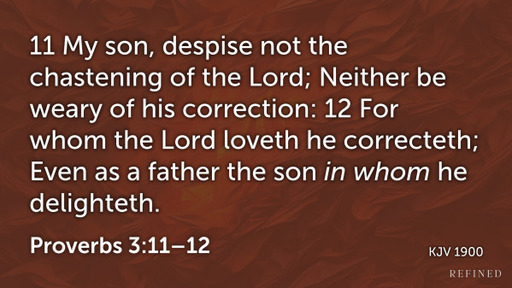
11 My son, despise not the chastening of the Lord; Neither be weary of his correction: 12 For whom the Lord loveth he correcteth; Even as a father the son in whom he delighteth.
1. Cherished by His Correction
1. Cherished by His Correction
Hebrews 12:5-6
Perhaps open by discussing how God’s discipline is a demonstration of His love and care for us as His children. These verses highlight the intimate relationship between God and His followers, where discipline shows belonging. You could encourage the congregation to view challenges as a source of comfort, knowing they are expressions of divine care designed to nurture their spiritual growth and endurance.
As a father, I can relate that when I give discipline, it is from a heart that my child will learn to do what is right.
Why is discipline important and necessary?
To not discipline shows a lack of care and love for one’s growth and development.
Because God loves us, He disciplines us.
We often like to think about how God loves us and that encourages us.
My mentor used to say that:
God receives you just as you are, but He loves you too much to leave you that way.
Meaning that God will receive a person in the lost sinful state that they are in, but God loves them far too much to leave them in life full of sin.
God will bring discipline.
I believe that if a believer does not yield to God’s working in their life and continually rebels, He will take you from this world.
I gave my testimony about repentance when I was backslidden and it was the conviction that God would take my life if I did not repent that drew me to a place of repentance.
2. Confirmed Through Challenges
2. Confirmed Through Challenges
Hebrews 12:7-8
Perhaps delve into the idea that facing discipline is a confirmation of belonging to God’s family. By understanding that undergoing hardship is evidence of our status as God's children, believers can find reassurance in their identity in Christ. Emphasize that true sons and daughters are not exempt from trials but are shaped through them, reflecting God’s family values.
How do we know that we are one of God’s children?
God’s chastening in our life.
What is a bastard?
It is an illegitimate child.
A bastard is one who is illegitimate, born of an unmarried couple.
Jesus was accused of being a bastard by the rulers of His day.
We know that God’s working in us and the trials we face reveal our identity in Christ.
The world may have some difficulties and there are people in the world who have them.
But take a person who is holy and striving to live for God and I will show you a person full of trials and difficulties.
Some of the most godly people I have ever met have been full of trials and difficulties.
3. Conformed to His Holiness
3. Conformed to His Holiness
Hebrews 12:9-10
You might explore how earthly fathers discipline us for our good, as a shadow of God’s perfect fatherly discipline. This suggests that God disciplines us not to harm us, but to help us become partakers of His holiness. Encourage the audience to trust in God’s wise guidance, which aims to nurture holiness and align our lives with His will, bringing peace and righteousness.
What is the purpose of God’s chastening on us?
That we may be partakers of His holiness.
When I learned that God was chastening me for my benefit, that I may be a partaker of His holiness, it changed my perspective about trials and God’s chastening.
I never enjoyed being disciplined as a child, nor do I enjoy it as an adult.
I know that when the Lord is chastening me, or a trial has come, that God is working in my life to teach me more about Himself and myself. Ultimately God is teaching me to draw closer to Him and partake of His holiness, not mine, but His.
4. Cultivated Through Pain
4. Cultivated Through Pain
Hebrews 12:11
Discuss how discipline, though painful initially, ultimately yields a harvest of righteousness for those trained by it. Emphasize that growth often comes through discomfort. Maybe reassure the congregation that God’s discipline produces lasting benefits of peace and righteousness, encouraging them to stay steadfast in their journey toward spiritual maturity.
What does God’s chastening yield in our lives?
A harvest of righteousness.
It births in us a growth that goes beyond our discomfort.
God’s discipline produces lasting benefits of peace and righteousness in our lives.
5. Strengthened for the Journey
5. Strengthened for the Journey
Hebrews 12:12-13
Conclude by highlighting that God’s discipline empowers and strengthens believers to continue their journey of faith. These verses suggest taking proactive steps—lifting drooping hands and strengthening weak knees—as symbols of perseverance. Urge the congregation to embrace God’s discipline as an opportunity to enhance their spiritual walk and witness to others.
What happens when we endure God’s chastening and have felt the peace of God again?
We can lift our hands and stand.
Remember that Dr. Harmon has been preaching about Standing and holding our ground.
This verse reminds me of Moses when he stood and lifted up his arms as the children of Israel were fighting with Amalek in Exodus 17.
What happened during that battle, when did the children of Israel prevail?
When Moses’ lifted up his arms.
I want to read something written by
Watson, George D. (George Douglas), 1845-1924 George Douglas Watson was a Wesleyan Methodist minister and evangelist based in Los Angeles. His evangelistic campaigns took him to England, the West Indies, New Zealand, Australia, Japan and Korea. He also wrote several books. It was while serving in the confederate army that the Lord became a living reality to him.
If God has called you to be really like Christ in all your spirit, He will draw you into a life of crucifixion and humility and put on you such demands of obedience, that He will not allow you to follow other Christians, and in many ways He will seem to let other good people do things which He will not let you do.
Others can brag on themselves, and their work, on their success, on their writings, but the Holy Spirit will not allow you to do any such thing, and if you begin it, He will lead you into some deep mortification that will make you despise yourself and all your good works.
The Lord will let others be honored and put forward, and keep you hid away in obscurity because He wants to produce some choice fragrant fruit for His glory, which can be produced only in the shade.
Others will be allowed to succeed in making money, but it is likely God will keep you poor because he wants you to have something far better than gold and that is a helpless dependence on Him; that He may have the privilege of supplying your needs day by day - out of an unseen treasury.
God will let others be great, but He will keep you small. He will let others do a great work for Him and get credit for it, but He will make you work and toil on without knowing how much you are doing; and then to make your work still more precious, He will let others get the credit for the work you have done, and this will make your reward ten times greater when He comes.
The Holy Spirit will put strict watch over you, with a jealous love, and will rebuke you for little words and feelings, or for wasting your time, which other Christians never seem distressed over.
So make up your mind that God is an infinite Sovereign, and has a right to do what He pleases with His own, and He will not explain to you a thousand things which may puzzle your reason in His dealing with you. He will wrap you up in a jealous love, and let other people say and do many things that you cannot do or say.
Settle it forever, that you are to deal directly with the Holy Spirit, and that He is to have the privilege of tying your tongue, or chaining your hand, or closing your eyes, in ways that others are not dealt with.
Now, when you are so possessed with the Living God that you are, in your secret heart, pleased and delighted over this particular personal, private, jealous guardianship and management of the Holy Spirit over your life, you will have found the vestibule of heaven.
--G. D. Watson
