Pentecost (June 8, 2025)

Notes
Transcript
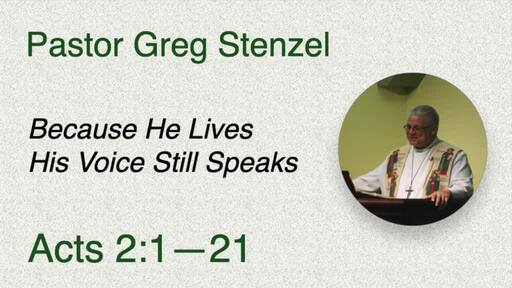
Because He Lives, His Voice Still Speaks
Because He Lives, His Voice Still Speaks
Grace, mercy, and peace to you from God our Father, and from our risen, ascended, and reigning Lord Jesus Christ. Amen.
Introduction – When Silence Feels Heavy
Introduction – When Silence Feels Heavy
Have you ever waited for a phone call?
Waited to hear news from someone, and it seemed like forever?
Maybe you asked your child to call
when they got home.
Well, it was Ten days.
That’s how long the disciples had waited.
Jesus had ascended—visibly, bodily, triumphantly.
He had promised that the Holy Spirit would come.
But for ten days, there was no movement.
No sound. Only prayer. Watching. Waiting.
They were not abandoned.
They were not alone.
But they were—at least for a time—silent.
Then, suddenly, without warning, everything changed.
A sound from heaven,
like the rush of a violent wind, filled the entire house.
Tongues as of fire came to rest on each of them.
And they began to speak—not nonsense—
but the mighty works of God,
in languages they had never learned.
The Holy Spirit had come.
The promise was fulfilled.
And the silence of the upper room gave way
to the voice of the risen Christ.
Dear brothers and sisters in Christ,
Because He lives—His voice still speaks.
And so this morning, as we consider the events of Pentecost,
let’s first acknowledge that this moment
was not an abrupt or random occurrence.
Instead, Jesus promised the Holy Spirit’s coming
and the action that morning was deliberate.
I. The Spirit’s Coming Was Promised by the Living Christ
I. The Spirit’s Coming Was Promised by the Living Christ
We must understand Pentecost as fulfillment—not spontaneity.
The outpouring of the Holy Spirit was not a new plan.
It was a long-awaited promised event in God’s redemptive story.
From the Old Testament prophets like Joel and Ezekiel
to the lips of Jesus Himself, God had foretold this outpouring.
Jesus had promised:
“I will ask the Father, and He will give you another Counselor to be with you forever.” (John 14:16)
“When the Spirit of truth comes, He will guide you into all truth... He will glorify Me, for He will take what is Mine and declare it to you.” (John 16:13–14)
You see, the Holy Spirit is not an impersonal force.
He is not a divine spark waiting to be awakened within us.
He is God, living, active, and all powerful.
who comes from outside ourselves—
entering us by Word and Sacrament.
At Pentecost, this promise was visibly kept.
The risen Jesus, now exalted to the right hand of the Father,
poured out the Spirit upon His Church (Acts 2:33).
And with the Spirit’s arrival, the disciples were changed.
They became what they had not yet been before:
bold witnesses of Jesus and His resurrection.
This is how Christ continues His ministry in the world today.
Jesus is ascended—but not absent.
He is reigning—but not silent.
His Spirit is here—and He still speaks.
[PAUSE]
You see, Pentecost was the fulfillment of a divine promise,
demonstrating that the living Christ's words are trustworthy and intentional.
The sending of the Holy Spirit was not an afterthought
but a long-awaited event woven into God's redemptive plan,
bridging prophecy with present reality.
Because Jesus keeps His promises,
we can have full confidence that His Spirit is with us,
empowering and guiding us in the same way
that the early apostles were transformed
into bold witnesses of His resurrection.
So, having looked a little into the promise surrounding the coming of the Holy Spirit, it becomes clear that Pentecost was orchestrated as a pivotal moment in God's plan to redeem you and the world.
This profound fulfillment directs us to consider not only the faithfulness of Christ's promises but also where Holy Spirit's power lies—a power manifest not in mere spectacle, but in His transformative Word.
II. The Spirit’s Power Is Found in the Word, Not in Spectacle
II. The Spirit’s Power Is Found in the Word, Not in Spectacle
The miracles at Pentecost are stunning:
Wind, fire, and unlearned languages.
But the true miracle was not in the sights or the sounds.
It was in the hearing.
Luke records:
“Each one was hearing them speak in his own language” (v. 6)... “We hear them telling in our own tongues the mighty works of God” (v. 11).
This was not ecstatic utterance. It was clear communication.
The apostles were speaking actual languages
—languages they had never studied—
and the people understood them.
This was no emotional display, no private spiritual experience.
It was God making Himself known through human words.
The miraculous gift of tongues in Acts 2 was unique.
It served as a sign—
a proof of the Spirit’s presence
at the beginning of a new era.
Such signs marked the beginning of a new era,
but they were never intended to be the norm.
Even St. Paul proclaimed the Gospel not by tongues,
but in common Greek, the world’s accepted language.
This was no accident.
It was God’s providence—
preparing a language in which His New Testament would be written
and read across the world.
The signs would fade. But the Word would remain.
Why?
Because the true power of Pentecost is not in unusual spectacles
—but in the spoken Word of God.
As Paul says in Romans:
“Faith comes from hearing, and hearing through the preached Word of Christ.” (Rom. 10:17)
And as our Lutheran Confessions declare so clearly:
“Therefore, we must constantly maintain this point: God does not want to deal with us in any other way than through the spoken Word and the Sacraments.”
(Smalcald Articles, Part III, Article VIII, 10)
Allow me to illustrate what I mean:
During a time of deep division and uncertainty, a simple signature on a document reshaped a nation's future. During the American Civil War the nation was captivated by battlefield heroics and the tumultuous shifts that occurred. However, one of the most transformative moments in American history wasn't marked by the clash of arms or the thunder of cannon fire, but by the quiet act of signing a document.
On January 1, 1863, President Abraham Lincoln signed the Emancipation Proclamation. This simple act didn't involve grand speeches or dramatic gestures on the battlefield. Yet, the power of those words fundamentally altered the course of the nation, proclaiming freedom for slaves in Confederate territories and redefining the purpose of the war itself.
So,:
Just as Lincoln's signature on a piece of paper carried the power to change lives and transform a nation, the Word of God, though delivered quietly through Scripture and preaching, carries immense power. This Word, spoken clearly and truthfully, accomplishes what spectacle alone cannot—it brings real transformation, conviction, and the advancement of God's kingdom. As we confess in our catechism, the Holy Spirit calls, gathers, enlightens, and sanctifies through the Word of God.
In the same way, the miracle of Pentecost wasn't just wind and fire or unlearned languages, but the clear communication of the mighty works of God. The real miracle is that through ordinary means—the spoken word—God makes Himself known and imparts His Spirit. Just as people heard and understood the apostles in their own languages without the need for visual wonders, we too continue to encounter God through the simple yet powerful truth of His Word.
This is why preaching is central to worship.
Why Baptism and the Lord’s Supper are not mere symbols,
but powerful means of grace.
Why the Spirit’s work cannot be separated from the Word.
If you want to know where God is working…
If you long to be filled with the Holy Spirit…
Then come to where Christ speaks—in the Word.
Open your Bible. Hear the sermon. Receive the Sacrament.
Because He lives, His voice still speaks.
In Pentecost, we see that it's not just the sights and sounds that matter, but the message—that Christ's voice continues to speak through His Word and Sacraments, offering us the very life He promises.
With the power of Pentecost grounded in the spoken Word, let us now turn our focus to the profound simplicity and effectiveness of the Word in action.
As we've seen, the Word's centrality at Pentecost reveals a deeper truth about our mission: that the same Spirit who empowered the apostles continues to empower us to be His witnesses.
III. The Spirit’s Presence Means We Now Speak for Christ
III. The Spirit’s Presence Means We Now Speak for Christ
And so in our text this morning we have Peter, standing before the crowd—not in confusion, but in confidence—and declares:
“This is what was spoken by the prophet Joel… In the last days, I will pour out My Spirit on all flesh.”
This is no distant prediction. The “last days” have arrived.
With the resurrection and ascension of Christ,
the final chapter of God’s plan for the world has begun.
The Church is now God’s instrument of mission—
and the Holy Spirit, through the Word, is her voice.
Notice the breadth of the Spirit’s reach:
All flesh—sons and daughters,
young and old, men and women,
servants and leaders.
And notice what they do:
They shall prophesy.
Now, prophesy here does not mean
foretelling the future.
It means speaking God’s truth—
telling of Christ crucified and risen.
It is the bold, Spirit-given testimony
that Jesus is Lord.
This kind of speaking is not limited to the apostles.
It is not the domain of pastors alone—
Yes, the pastor is the one called to do the public preaching,
But the speaking is the gift of the whole Church.
“Repent and be baptized,” Peter says later, “and you will receive the gift of the Holy Spirit.” (Acts 2:38)
And where the Spirit is present, the Word will be spoken.
The Church, then, is not just a place—
a building where we listen.
It is people of God sent to speak.
To speak truth.
To speak grace.
To speak Jesus.
Luther’s Lectures on Joel, explains that the dreams, vision, and prophecies of Joel 2:28 are not extraordinary revelations, but vivid ways of describing the Spirit-given knowledge of Christ through the Gospel. These things point to one thing—
God making Himself known through Christ. This is kindled and ignited in the hearts
of believers by the Holy Spirit, through the Word.
The point is:
the Spirit does not lead us away from the Word,
but deeper into it.
He doesn’t replace the Gospel—He delivers it.
He doesn’t bypass the Church—He speaks through it.
And that means, dear brothers and sisters,
if you have the Word, you have the Spirit.
And if you have the Spirit, you are a witness of Christ.
With the Spirit’s presence, the call to speak God’s truth
transcends the apostles to include all believers.
This new era of the Last Days, unleashed at Pentecost,
positions the Church as God's voice in the world.
Our role isn’t passive but active;
we are invited and empowered by the Spirit
to be God’s Ambassadors
by proclaiming Christ crucified and risen.
This isn’t just a task—
it’s the very essence of our faith community,
carrying forward the message that because He lives,
His voice will continue to be heard through us.
Equipped with the Spirit’s presence
and guided by His Word,
the Church is not just a receiver of truth,
but a bearer of it.
The Spirit’s gift isn't locked in the pages of history;
it transcends time and place,
urging us to see Pentecost not merely as an ancient occurrence,
but as a continuing reality in our lives today.
IV. The Spirit’s Gift Is for Today—and for You
IV. The Spirit’s Gift Is for Today—and for You
This means, don’t leave Pentecost in the past.
The same Spirit who came in wind and fire is still blowing today.
Not in signs and wonders—but in the Gospel.
Pentecost did not end with Acts 2.
It continues wherever the Gospel is purely taught
and the Sacraments are correctly administered.
Wherever Christ is confessed.
Wherever the broken are forgiven.
Wherever a sinner calls on the name of the Lord.
And that’s where Peter concludes his Pentecost message:
“Everyone who calls on the name of the Lord shall be saved.” (v. 21)
Salvation is not earned. It is received.
And it begins the moment the name of Jesus is called upon in faith.
That name—the name of the crucified,
risen, and ascended Christ—is still proclaimed.
That Spirit—the Spirit of truth—is still poured out.
That voice—the voice of Jesus—is still speaking.
Pentecost is not a distant event
confined to the pages of Scripture;
it is an ongoing reality wherever the Gospel is proclaimed
and the Sacraments are administered.
Today, the same Spirit who descended in wind and fire
continues to blow through our lives,
filling us with fresh purpose.
His gift is personal and present,
inviting each of us into a living relationship with Christ.
Because the Spirit’s promise endures,
the voice of Jesus still speaks today,
assuring us of salvation and inviting us
into His ongoing work in the world.
As we reflect on Pentecost’s enduring implications,
we are reminded that the Spirit who once came in fire and wind
continues to enliven and direct us,
ensuring His voice fills our world as effectively
as it did in the beginning.
Conclusion – The Voice Still Speaks
Conclusion – The Voice Still Speaks
Dear friends, don’t wait for the wind.
Don’t look for fire.
Don’t seek a sign.
You have something better.
You have the Word of God—clear, sufficient, alive.
You have the Spirit of God—given in Baptism,
speaking in Scripture, nourishing in the Supper.
You have the name of Jesus—called upon, trusted, proclaimed.
Because He lives, His voice still speaks.
And because His voice still speaks, you still live.
So as bearers of His living Word,
let us leave this place renewed and ready
to carry Christ’s light into every corner of the world.
Come, Holy Spirit.
Speak, Lord Jesus.
We are listening.
Let us pray:
[Brief Silence]
Gracious and living God,
You have not left us in silence.
You have not abandoned us to find our own way.
Because Your Son lives, His voice still speaks—
through Your Spirit, in Your Word, and even through us.
We thank You for the gift of the Holy Spirit,
who kindles in us the flame of faith,
who opens our ears to hear and our mouths to speak.
O Lord, by Your Spirit,
renew in us a hunger for Your Word,
a boldness to proclaim Your name,
and a willingness to be Your witnesses
in whatever circle of life You have placed us.
We confess that we have not always listened when You speak,
nor have we always spoken when we should.
Forgive us. Cleanse us. Empower us again.
Come, Holy Spirit. Fill our hearts.
Make us eager hearers and faithful proclaimers—
that in all we say and do,
Your Son may be known, believed, and glorified.
We ask this in the name of Jesus Christ,
who lives and reigns with You and the Holy Spirit, one God, now and forever.
Amen.
Prayers of the Church – The Day of Pentecost
Prayers of the Church – The Day of Pentecost
Acts 2:1–21; John 14:23–31; Genesis 11:1–9
Let us pray for the Church of God in Christ Jesus and for all people according to their needs.
For the Holy Church:
For the Holy Church:
Almighty God, on this day You poured out Your Spirit upon Your Church. Strengthen us by Your Word and Sacraments, that we may faithfully proclaim Christ to the nations, speaking Your truth with courage, clarity, and love.
Lord, in Your mercy,
Hear our prayer.
For the Preaching of the Gospel:
For the Preaching of the Gospel:
Grant that, through the ministry of Your Word, many may hear of the mighty works You have done and call on the name of the Lord to be saved. Open ears, awaken hearts, and send forth laborers into the harvest.
Lord, in Your mercy,
Hear our prayer.
For Unity in Christ:
For Unity in Christ:
Where once language divided, now unite Your people in the one language of faith. Break down barriers of division and confusion in the Church, that we may reflect the harmony and peace brought by the Spirit.
Lord, in Your mercy,
Hear our prayer.
For a Spirit-filled Witness:
For a Spirit-filled Witness:
Fill us anew with Your Spirit, that we may be bold to confess Christ in our homes, workplaces, and communities. Let sons and daughters, young and old, joyfully bear witness to Your saving name.
Lord, in Your mercy,
Hear our prayer.
For the Nations:
For the Nations:
Pour out Your Spirit of peace upon the nations of the world. Guide leaders with wisdom and integrity. Where there is conflict, bring justice and reconciliation. Where there is need, provide through generous hands.
Lord, in Your mercy,
Hear our prayer.
For Those in Need:
For Those in Need:
Be with all who suffer in body, mind, or spirit, especially Gabe, Sharon, Tom, and Paul, and those we now name silently before You…
[Pause for silent prayer]
Bring healing, strength, and hope by Your gracious presence and the comfort of the Gospel.
Lord, in Your mercy,
Hear our prayer.
For Our Redeemer’s:
For Our Redeemer’s:
Renew us, O Lord, by Your Spirit. Deepen our devotion to Your Word, increase our love for one another, and equip us for every good work. Bless our ministries, our homes, and our worship this day.
Lord, in Your mercy,
Hear our prayer.
For Grateful Remembrance:
For Grateful Remembrance:
We remember with thanksgiving those who have gone before us in faith and now rest from their labors. Keep us in communion with them until that great and final day when all Your people will be gathered as one around the throne of the Lamb.
Lord, in Your mercy,
Hear our prayer.
Into Your hands, O Lord, we commend all for whom we pray, trusting in Your mercy, through Jesus Christ, our Lord, who lives and reigns with You and the Holy Spirit, one God, now and forever.
Amen.
Our Father, who art in heaven…
