Ephesians 4.20a-Contrast Between Unregenerate Gentiles and Regenerate Gentiles

Wenstrom Bible Ministries
Pastor-Teacher Bill Wenstrom
Thursday June 26, 2025
Ephesians Series: Ephesians 4:20a-Contrast Between Unregenerate Gentiles and Regenerate Gentiles
Lesson # 264
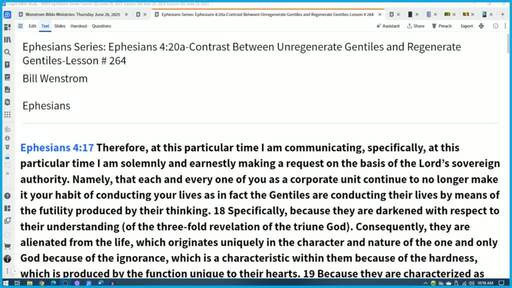
Ephesians 4:17 Therefore, at this particular time I am communicating, specifically, at this particular time I am solemnly and earnestly making a request on the basis of the Lord’s sovereign authority. Namely, that each and every one of you as a corporate unit continue to no longer make it your habit of conducting your lives as in fact the Gentiles are conducting their lives by means of the futility produced by their thinking. 18 Specifically, because they are darkened with respect to their understanding (of the three-fold revelation of the triune God). Consequently, they are alienated from the life, which originates uniquely in the character and nature of the one and only God because of the ignorance, which is a characteristic within them because of the hardness, which is produced by the function unique to their hearts. 19 Because they are characterized as insensitive (to God and His will and ways), each and every one of them as a corporate unit have given themselves over to self-indulgence for the purpose of practicing every type of sexual immorality in an inordinate and insatiable manner. 20 On the contrary, by no means whatsoever in this manner did each and every one of you as a corporate unit learn about the one and only Christ through experience. (Lecturer’s translation)
The contents of Ephesians 4:20 present a contrast with the statements in Ephesians 4:17-19, which describe the ungodly mind-set and resultant ungodly lifestyle of unregenerate Gentile humanity.
In verse 17, on the basis of the Lord Jesus Christ’s sovereign authority, Paul issues a solemn and earnest request of the recipients of this epistle who we noted were Gentile Christians in the Roman province of Asia.
He requested that they continue to no longer make it their habit of conducting their lives as in fact the unregenerate Gentiles were conducting their lives by means of the futility produced by their thinking.
In verse 18, Paul describes further in greater detail the mind-set of unregenerate Gentile humanity as being darkened with respect to their understanding of the three-fold revelation of the triune God.
Consequently, they are alienated from the life, which originates uniquely in the character and nature of the one and only God.
The reason for this is their ignorance of this three-fold revelation and the reason for this ignorance is that the hardness, which is produced by the function unique to their hearts.
In verse 19, the apostle asserts that because unregenerate Gentile humanity is characterized as insensitive to God and His will and ways, they have given themselves over to self-indulgence for the purpose of practicing every type of sexual immorality in an inordinate and insatiable manner.
Now, in Ephesians 4:20, Paul emphatically asserts that the recipients of this epistle by no means whatsoever in the manner described in Ephesians 4:17-19 learned about the person of Christ through experience.
When Paul speaks of these Gentile Christians learning about the person of Jesus Christ, he is speaking of learning about Christ in an experiential sense.
In other words, they possessed an experiential knowledge of Him by obeying Paul’s Spirit inspired teaching.
Thus, he is speaking of them learning through experience about the person of Christ and to experience the person of Christ is to live the Christian way of life.
The statement in verse 20 contains the figure of speech called “litotes,” which is a statement negated in order to emphasize a positive notion.
Therefore, this figure expresses the idea that it is an utter impossibility that the recipients of this epistle learned about Christ through experience so as to possess the ungodly mindset and resultant ungodly lifestyle of unregenerate Gentile humanity as described in Ephesians 4:17-19.
In other words, their experiential knowledge of Christ through obedience to the Word of God emphatically did not result in them thinking and living like unregenerate Gentile humanity think and live their lives.
So therefore, this figure emphatically affirms that the Gentile Christian community in the Roman province of Asia by no means whatsoever learned about the person of Christ experientially so as to think and live like the members of the unregenerate Gentile community.
Therefore, the contents of Ephesians 4:20 presents a contrast between the experience of these Gentile Christians in the Roman province of Asia and the experience of unregenerate Gentile humanity.
Specifically, it marks a contrast between these Gentile Christians learning about the person of Christ through their life experience with that of the life experience of unregenerate Gentile humanity.
The former is based upon obedience to Paul’s Spirit inspired teaching and results in a godly mindset and lifestyle, which results in pleasing God and doing His will.
The latter is based upon obedience to the sinful desires of the indwelling old Adamic sin nature and obeying the lies of Satan’s cosmic world system, which results in sin and rebellion against God.
As has been the case throughout this epistle, the referent of the accusative second personal plural form of the personal pronoun su (σύ) is the recipients of this epistle who we noted many times are described in Ephesians 2:11 as Gentile Christians.
The word means “each and every one of you as a corporate unit” or “all of you without exception” because it not only refers to them as a corporate unit but is also used in a distributive sense emphasizing no exceptions and thus referring to them also as individuals.
The use of this word here in Ephesians 4:20 is unnecessary in Greek since the form of a finite verb in this language indicates the person, number and gender of the subject.
In this context, we have the second person plural aorist active indicative conjugation of the verb manthanō (μανθάνω).
The referent of the second person plural form of this verb is these Gentile Christians.
This is what makes Greek an “inflectional” language.
When the personal pronoun is used therefore, it may serve to clarify the subject or contrast the subject with someone else or for emphasis.
Here in Ephesians 4:20, the use of this pronoun is not only for emphasis but also to mark a contrast.
It emphasizes with the recipients of this epistle that their personal experience with Jesus Christ stands in contrast to the life experience of unregenerate Gentile humanity.
The former we noted is the result of a mindset and lifestyle based upon adhering to Spirit inspired Christian instruction concerning the mindset and lifestyle of Jesus Christ.
We also noted that the latter is the result of a mindset and lifestyle based upon obedience to the ungodly desires of the indwelling Adamic sin nature and the lies of Satan’s cosmic system.
In other words, the contrast is between the Christian way of life the Gentile Christian community was experiencing and their unregenerate lifestyle, which they abandoned at justification and after justification.
The correlative adverb houtos (οὕτως) marks the correlation between the life experience of unregenerate Gentile humanity as described in Ephesians 4:17-19 and the Gentile Christian community’s personal life experience with Jesus Christ.
The former we noted is the result of a mindset and lifestyle based upon obedience to the ungodly desires of the indwelling Adamic sin nature and the lies of Satan’s cosmic system, which is described in Ephesians 4:17-19.
The latter is the result of a mindset and lifestyle based upon adhering to Spirit inspired Christian instruction concerning the mindset and lifestyle of Jesus Christ.
The figure of litotes emphasizes with the recipients of this epistle that there is absolutely no correlation whatsoever between the two.
