Throwback of Thrones

Notes
Transcript
Handout
Intro
Intro
Throwback of Thrones. Throwbacks are something that has been popular for a few decades now. People of my generation might want to throwback by wearing denim jackets, listen to the backstreet boys or brittney spears on the CD players or Walkmans, playing Zelda on nintendo 64, sucking on a whistle pops, with flashy neon signs outside the window.
But Throwback has a slightly different historic meaning. In the 1800s, it was a breeding term for a reversion to a ancestoral characteristic in terms of biology. So if an animal seemed to possess a non-domesticated characteristic, it was a throwback to it’s earlier ancestors.
This week, we saw this first hand. Most of you know our dog Meaka, she is calm, docile, a loving giant who will snuggle anyone. Our mail people think she is the best. She is the worst guard dog as she runs to everyone to greet them with a wagging tail. But Wednesday after bible study, Meaka decided it would be a good idea to grab a porkiepine with her mouth. She ended up with nearly 200 quils in her mouth, nose, chest, tongue, and esophagus. When Erika and I found her, she was not a docile lover, she was a dangerous out-of-control wild animal in panic. This was a throwback from her kind and gentle nature to a more wild and dangerous ancestory. Meaka is going to be okay by the way.
But today, we consider some of the throwbacks of the Matthew. Matthew loves to hold Jesus up as as the Christ, and then throwback to an earlier ancestry. Matthew’s throwbacks are references, quotations, or allusions to the Old Testament. Matthew uses these throwbacks help us understand who Jesus is better. Today, we look at the first of 15 throwbacks that Matthew explictly calls out. I’m calling them throwback because I don’t want you to think of them as simple prophecy-fulfillments. Matthew intends them to be more meaningful for us.
I thought about doing them all in one sermon, or 3 sermons of 5 throwbacks each, but you know me. I love the Old Testament. Heaven forbit we quickly skip over and brush past Matthew’s references to the Old Testament.
The first throwback narrative is the birth of Jesus. We talked last week about how Matthew is not just giving history or writing down narrative data he remembers. Rather, he is carefully crafting his message to present Jesus as the Christ, the one who fulfills the Old Testament, and rescues the nations. We saw this last week in the terms Son of David and Son of Abraham. If you missed this sermon, i would encourage you to go back and listen to it this week.
MAIN POINT: Because of Jesus being God with us, we can now follow him in faithful living.
Lets jump into the text this morning.
I. The Messiah’s Identity (18)
I. The Messiah’s Identity (18)
First, we see the Messiah’s identity in verse 18. Remember that Matthew is Making a case for Jesus being the Messiah. This narrative is not meant to tell us a cute story about baby Jesus, rather, Matthew is presenting the Messiah to us and showing us who he is.
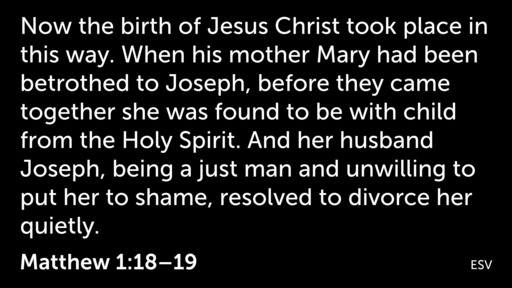
Mary is mentioned here, and unlike Luke, Mary will not be the primary character. Other than Jesus, the Matthew’s focus is on Joseph. We see a few things initially in this verse. Joseph is betrothed to Mary. We might think of this as an engagement, but it was more than that in ancient times. The engagement in Jesus’s day had three stages.
(1). Phase 1 meant selecting a spouse. This was usual chosen by parents. Some sources we have show that this would have been young teens, but other rabbi’s say that the normal marrying age during Jesus’s day would have been 18.
(2). Phase 2 a prenuptual document would have been signed, and only broken by divorce or death. It was stronger than our engagements and more like premarriage. At this stage, a Bridegroom gift would have been presented as a token of engagement. They referred to each other as husband and wife. If one of them died, the other would have been known as a widow or widdower. The wife would have still lived with her parents and no sexual activity would have happened at this phase.
(3). Phase 3 was coming together. Notice this phrase in verse 18. That Mary has a child before the “coming together.” A ceremony to show the wife coming to forever be with the husband in his dwelling place. This was the Wedding event where the groom and his companions in a procession would go to the bride’s house, pick up the bride and bridesmaids, and take them back to the grooms house for the wedding supper. This will be relevant for latter chapters of Matthew. During this event, the couple would pray together and consummate their marriage, followed by more celebration, possibly lasting a week.
But here, we see that the womb of Mary is opened in a supernatural way. Usually, when God opens wombs in a supernatural way, he is showing that he is working with his people. Think about Sarah, Rachel, Samson’s mom, Hannah, the Shunnamite Woman with Elisha, and Elizabeth.
And here in our text, we see God opening a womb in a special way. This is a reversal of the Genesis curse. This is God being with his people.
Mary is about three or four months pregnant at this time, and she isn’t trying to hide it from Joseph, rather, it became obvious to joseph at four months what was going on. Obvious to Joseph, but not known to everyone, so he tries to take care of it secretly.
And notice how the verse ends, with the Holy Spirit. This is keying us into how this came about. This is keying us into who Jesus is.
Matthew’s gospel wants to pay close attention to the Holy Spirit in his gospel as a part of the trinity. He is telling us that this is not a natural birth, this is a birth that is done out of the work of God.
While Matthew and Luke have very different birth accounts, one thing is clearly shared, this birth came about by the Holy Spirit. In Luke’s account, Mary is confused how this birth could happen, and in Matthew, Joseph is confused also. Both accounts refer to her as a virgin.
This is not a natural birth, but a supernatural one. Matthew is subtly presenting Jesus as the son of God. He is revealing in a subtle way Jesus’s identity.
You remember from last week that we saw that everyone in the genealogy list parented the next person in the list, except mary and joseph. Rather, jesus was begotten of them. The divine passive where God is actively at work. And here we see the divine at work through the Holy Spirit.
The virgin Birth is important for several reasons:
The Bible is true and has miracles.
No curse (corrupted file) from Jechoniah
The Hypostatic Union (Fully God, Fully Man)
Announcement of something new and grand.
Jesus is not just a human, he is divine as well. He is fully human and fully God. this is what Matthew will be showing us the rest of his gospel. This is just a taste.
II. The Messiah’s Lineage (19-20)
II. The Messiah’s Lineage (19-20)
Next, we see the Messiah’s lineage.
Last week, this was a important to what Matthew was trying to show us through the genealogies. Then here, we see this focus Jesus’s line continued.
The angel comes to Joseph, and notice what he calls him. Not simply Joseph. Not Joseph of Nazareth or Joseph of Bethlehem, Not Joseph of the tribe of Judah. He calls him Joseph son of David.
The angel comes to remind us of what is going on here. What Jesus is doing. Jesus comes to be the son of David. He is coming to be the legal Jewish King.
But the angel is also showing what is at stake here if Joseph is not willing to take on this role as legal Father of Jesus. Looking at the first part of verse 20, the text says that he was considering these things. Though he had made up his mind in verse 19, the angel comes to him while he is considering.
We see in verse 19 that he is a righteous or just man who is unwilling to put her to shame, and decides to divorce her quietly.
Sometimes we might get the idea that Joseph is hurt by the perceived adultery by Mary, and that is why he is unwilling to get married to her. But verse 19 give a different reason. Rather, he is a righteous man. Joseph wants to keep the law. To marry her would be to affirm sin and show his approval of her sin. While the Romans abolished the death penalty for adultery, there was still a possibility that the jewish people would have stoned Mary.
But we not only see the righteousness of Joseph here, we also see his compassion as well. He certainly had the right to publicly divorce Mary, but instead, to protect her, he wants to do this privetly. His righteousness does not keep him from compassion. And Joseph in this text is trying to figure these things out as he contemplates them.
But the angel is making the point in the title given “son of David” that Jesus’s lineage, his kingship, is at stake here. Joseph taking Jesus on as a legal son is critical to Jesus fulfilling the David throne. And this is better understood in light of the genealogy in the first half of this chapter. We remember that this isn’t a mindless boring historical record, but a case being made that Jesus has the legal right to rule on David’s throne through the lineage of Jesus.
III. The Messiah’s Mission (21)
III. The Messiah’s Mission (21)
Then we get to verse 21 and see the Messiah’s mission.
And we see his mission found in the name that would be given to him.
When we look at chapter one, we ask, why does Matthew go through all of this detail about the legal lineage to the throne going to Joseph, and then Jesus does not come from Joseph? This is the point. This verse central for us.
By Joseph taking on this role to name Jesus he was acting as Jesus’s father. So the angel telling him to name Jesus was another way of saying to father him. Take him as your son. Naming Jesus was Joseph saying that Jesus was Joseph’s heir, with a legal right to the throne.
Consider Isaiah 43:1 “1 Now, this is what the Lord says, the one who created you, O Jacob, and formed you, O Israel: “Don’t be afraid, for I will protect you. I call you by name, you are mine.” This is a reminder that God is the one who named Israel, and then they became his.
Then we get to the name Jesus, for he will save his people from their sins. A couple things are interesting here in the angel’s description of the name.
First, the name “Jesus” based on the hebrew name Yehoshua, does not mean “he will save.” It actually means “YHWH will save or YWHW is salvation.” Do you see how significant this is? The angel is saying that this salvation that comes from God is actually going to come from Joseph’s son. The OT name spoke of God as Savior, but Joseph’s son himself is going to be the agent of salvation.
This is not just a human son, he is being elevated to God himself. The angel is telling us that this Jesus is doing things that are reserved for YHWH, namely, salvation.
Second, this name Jesus is rooted in Old Testament Character of Joshua. Remember in the sermon last week about hyperlinks? Matthew loves hyperlinks and wants us to think of this Old Testament character. What is Joshua known for? Delivering the people of God back to the promise land and completing the redemption process from Egypt.
Jesus is the one who is going to do this spiritually. He is going to deliver the people back to God and complete the relationship through his process of redemption.
Third, notice who Jesus is coming for here. Jesus comes to save “his people.” It would be too small of a think for us to limit the salvation work to the jewish people. This is not what the angel, or Matthew has in mind here. Remember fromt he genealogies who gets to be included in the covnenat people of God, gentiles like Ruth, and Bathsheba, and Tamar and Rahab. God wants the nations. Later in the gospel of Matthew we will that Jesus talks about his people as “my ecclasia” or “my church.” These are his people.
Fourth, notice what Jesus comes to save his people from. Their sins. The prophets Isaiah, Jeremiah, Ezekiel, deal with the problem of humanities sin. Sin that we can do nothing about ourselves. Sin that we cannot save ourselves from. But all of these prophecy about a future time when God will rescue us from our SIN. He will be the one to cleanse us from all of the filth in our lives. What have we contributed to our salvation? The sin that made it necissary.
We looked last week about Jesus being the son of Abraham found in the first verse of this chapter. The one who would be a blessing to save the nations. He would fulfill the Jewish role to bring the nations to God.
If people want to know what this Jesus thing is about, why Jesus came to earth, what was his mission, we need to look no further than verse 21 “he will save his people from their sins.”
IV. The Messiah’s Fulfillment (22-23)
IV. The Messiah’s Fulfillment (22-23)
Next, we see the Messiah’s fulfillment in verses 22 through 23.
This is the first throwback that Matthew has. And we see this language being set up, that we will hear many other times in his book Matthew 1:22 “22 This all happened so that what was spoken by the Lord through the prophet would be fulfilled:”
And then Matthew tells us what OT throwback is being fulfilled: Matthew 1:23 “23 “Look! The virgin will conceive and bear a son, and they will call him Emmanuel,” which means “God with us.””
Now we might quickly read this in this context here and say “yes, that was clearly talking about Jesus.” But what i want to show us is that there are layers to these throwbacks.
Notice I am not calling them prophecies, because prophecy-fulfillment is two simplistic for what Matthew is doing here. We have this idea sometimes that prophecy is that “God said this would happen, look, then it happens.” But this is not what a vast majority of Biblical prophecy is, and especially prophecy about the messiah.
There is a simple fulfillment, and then there is much deeper meanings and layers of meanings that we could spend mass amounts of time looking at.
Think about computers vs tea. And don’t mix these two things. But sometimes we think about Bible study as input output data. Enter data into a computer and then get out data. I put in my time reading the word and then i’m done and will live my life. But think about the way that God’s people deal with the word. They meditate on it day and night. The ponder it. Think about tea. A tea bag needs time to seep into the water to change the water into something that the water is not, a different substance, tea. The longer the tea bag sits in the water, the more the liquid in that come becomes tea and less like water. This is what we are meant to do with the word of God as well.
We are meant to just say “Isaiah said prophecy, Jesus fulfilled it.” Rather, we are meant to sit and soak for a while. Consider and ponder it’s affects on our lives.
If I told you to think about a brain, you might have some idea in your mind. But maybe you picture something like this.
But the complexity of the brain is far beyond not just our own comprehension, and much more complex that this picture.
Google and Harvard recently teamed up to study the complexity of the brain. And the took a brain sample smaller then a grain of rice, and ended up with 1400 terabytes of data. If you aren’t a computer person, that is about 1 billion books. They would cut this sample thinner than a human hair, invisible to the human eye, and this is the image that they did with color dye metals
Then, they were able to zoom, each of those dots is a single neuron, this is what a single neuron looks like
Remember, this is just one tiny, piece of the brain. The people in this study say that the data storage needed to map an entire human brain would be nearly impossible with the current computer storage.
This is what biblical typological fulfillment is like.
So today, we will take a slightly closer look at this “prophecy” that Matthew mentions.
I want to read to you in the context of Isaiah. At this time, Judah is under the treat of invasion. Israel and Syria are aligning and going to conquer Judah. King Ahaz (mentioned in Matthew 1:9) is deciding what to do. He can align himself with Assyeria which would give him security, but Isaiah the prophet of YHWH reminds him that he doesn’t need a alliance, he needs to align with God and trust God and be faithful to God.
Here is what I want you to do. Imagine you in the court room listening to this conversation between King Ahaz and Isaiah. Would you have known that Isaiah was talking about Jesus if you didn’t live on this side of history?
1 During the reign of Ahaz son of Jotham, son of Uzziah, king of Judah, King Rezin of Syria and King Pekah son of Remaliah of Israel marched up to Jerusalem to do battle, but they were unable to prevail against it.
2 It was reported to the family of David, “Syria has allied with Ephraim.” They and their people were emotionally shaken, just as the trees of the forest shake before the wind.
3 So the Lord told Isaiah, “Go out with your son Shear-Jshub and meet Ahaz at the end of the conduit of the upper pool which is located on the road to the field where they wash and dry cloth.
4 Tell him, ‘Make sure you stay calm! Don’t be afraid! Don’t be intimidated by these two stubs of smoking logs, or by the raging anger of Rezin, Syria, and the son of Remaliah.
5 Syria has plotted with Ephraim and the son of Remaliah to bring about your demise.
6 They say, “Let’s attack Judah, terrorize it, and conquer it. Then we’ll set up the son of Tabeel as its king.”
7 For this reason the sovereign Lord, says: “It will not take place; it will not happen.
8 For Syria’s leader is Damascus, and the leader of Damascus is Rezin. Within sixty-five years Ephraim will no longer exist as a nation.
9 Ephraim’s leader is Samaria, and Samaria’s leader is the son of Remaliah. If your faith does not remain firm, then you will not remain secure.’ ”
10 The Lord again spoke to Ahaz:
11 “Ask for a confirming sign from the Lord your God. You can even ask for something miraculous.”
12 But Ahaz responded, “I don’t want to ask; I don’t want to put the Lord to a test.”
13 So Isaiah replied, “Pay attention, family of David. Do you consider it too insignificant to try the patience of men? Is that why you are also trying the patience of my God?
14 For this reason the Lord himself will give you a confirming sign. Look, this young woman is about to conceive and will give birth to a son. You, young woman, will name him Immanuel.
15 He will eat sour milk and honey, which will help him know how to reject evil and choose what is right.
16 Here is why this will be so: Before the child knows how to reject evil and choose what is right, the land whose two kings you fear will be desolate.
So when we read this, does it seem like a Messionic prophecy about Jesus?
You good students of the Word remember from our hermenuetics class that context is important. You don’t want to take a new testament thing and smash it into and Old Testament passage. We want to understand what the Original passage said, then update it with the New Testament.
Isaiah comes to Ahaz to remind him and instill faithfullness to God instead of aligning with something or someone else. And Isaiah tells him he can ask for a sign, even something miraculous. And Ahaz doesn’t take this offer So God gives him a sign anyway. And the sign for Ahaz is found in verse 14.
Let me ask this, in context, what encouragement would it have been for Isaiah to say “you can be faithful to God King Ahaz in this moment of fear of current powers, the sign to encourage you to be faithful is that someday, 700 years from now, messiah is going to be born.”
No, this is reading the New Testament into the Old Testament. Rather, we want to understand what verse 14 would have meant at this time.
14 לָ֠כֵן יִתֵּ֨ן אֲדֹנָ֥י ה֛וּא לָכֶ֖ם א֑וֹת הִנֵּ֣ה הָעַלְמָ֗ה הָרָה֙ וְיֹלֶ֣דֶת בֵּ֔ן וְקָרָ֥את שְׁמ֖וֹ עִמָּ֥נוּ אֵֽל׃
We are going to get a little bit technical here, but i promise it is important. My point is to show that Isaiah is not prophecying about Jesus. Yes, i just said those words out loud. My point is to show you that Isaiah is prophecying about something in his moment, not about Jesus, and then Matthew, through the inspiration of the Holy Spirit tell us that Jesus the messaiah is a typological or throwback fulfillment which has deeper meaning. This is not the only time this will happen. Go look at the other things that Matthew calls fulfillments. When you go back to the Old testament context, you say “that isn’t a prophecy about Jesus!” And you are meant to do that!
EXPLAIN HEBREW
Now, that we have gone down a massive rabbit trail of language, lets see why this is important for us. Isaiah 7:9 is encouraging Ahaz toward faithfulness and warning him if he is unfaithful.
Notice in verse 13, the family of David is referenced. The one who is meant to be bringing the people to God through the reign of God is failing in faithfulness to God. Failing to uphold and trust God in his ways to be faithful. The treat again Ahaz is not just his house, but the kingdom through the throne of David.
This Sign in Isaiah 7:14 is meant to be a present persuader for King Ahaz to be faithful to God. It is a reminder that God was with King Ahaz and that he could in response be faithful and trust God in loyal devotion.
And just like Immanuel in Isaiahs day, Jesus comes to restore faith. And in the immediate context of Matthew, Jesus comes be Immanuel for Joseph, God with us, to restore Josephs faith and call him to trust God. (if you haven’t figured it out yet, Joseph is king Ahaz). Joseph is called “son of David” just like Ahaz was. This is not a prophecy fulfillment, it is typological story narrative connection.
Jesus does not just come to display God, rather he comes to be immanuel, he US god with us. It’s interesting that matthew actually misquotes the Isaiah passage. He said “and they will call his name Immanuel” pointing us to a more universal redemption plan of this Messiah.
We have scratched the surface of this typological fulfillment, but we have to move on for the sake of time.
V. The Messiah’s Restoration of Faithfulness (24-25)
V. The Messiah’s Restoration of Faithfulness (24-25)
Last today, we see the Messiah’s restoration of faithfulness.
We’ve already looked at this a little. We’ve seen how the Old Testament throwback influences how we understand the Joseph’s story. Lets look at this a bit.
Joseph is Matthew’s focus for this part of the story. And i should say, Matthew if focusing on how Jesus is having an effect on Joseph toward his restoration to faithfulness.
Because Jesus is the fulfillment of Isaiah’s prophecy, Joseph gets to live in this fulfillment. Immanuel is a sign for Joseph to be faithful and trust God.
Matthew is not telling us what Jesus does, but showing us what Jesus does. Not only does he come to save people from sin, he comes to instill faithful living in his people.
Notice verse 24. Joseph awakes from the dream and does what the angel says. He took mary as his wife just and the angel commanded. And he is compassionate and loving to Mary, and then he takes on his fatherly duty and names Jesus. Showing that Jesus is a heir to the throne of David, the rightful king of Israel, the chosen one of God.
Because of the Immanuel coming, Joseph now knows how to live out his life in holiness and compassion. He holds both of these things in tandem.
Even though we haven’t even met Jesus of the New Testament yet, we see the effect he is having on the world.
Beyond the Walls (Grace and Growth)
Beyond the Walls (Grace and Growth)
Now we get to the beyond the walls section.
If you are here and you are not saved, God send Jesus when we didn’t deserve it. We have all rejected God and tried to go our own way like King Ahaz, but God sent Jesus in spite of us. When I like king Ahaz wanted to rely on my own self for the solution rather than God, God knew what was best for us and sent Jesus to be God with us, to be Yehoshua, Savior of our sin. If you have come to realize that your sin is great, we have a savior who is greater. One who has come to take on your sin. He came to bring you a relationship with God, remove your sin, and restore you. If you are looking for this type of restoration, please come and talk to us after the service.
Those of us who are already following Jesus, Joseph is a great figure for all of us and an example of how Jesus coming to be Immanuel changes our lives continually.
Joseph does not live as an incredible church leader. We don’t even know if he saw beyond the life of Jesus and the churches explosive growth. But what we do know about him, he was faithful with the promise that God was with him in the Messiah Jesus. He lived an ordinary life as a carpenter, and was faithful to live right and live compassionately to others.
God is not looking for everyone in this room to be a missionaries pastors and church leaders. He wants you to live in the knowledge that Jesus came to save you and be God with us. He wants us live as faithful homemakers, office workers, blue-collar workers, community members where we live out righteousness and compassion to the people around you.
Just like Joseph, our faith will be put to the limits, but we can know we can trust God.
Faithfulness to Immanuel overruled the downsides for Joseph. He might have been concened about how it would look to be married to someone perceived to be an adulteress. But Joseph is faithful inspite of what the world would think about him. People may look at us and say “why are you a Christian?” “You really believe that stuff?” “you really have to live that way?” But we have experienced the kingdom of Immanuel and live with Jesus as our King.
Let me ask us, in what ways are we not looking to Jesus and being faithful to his kingdom? This passage is meant to be an encouragement toward faithfulness with Jesus being God with us, calling us to his kingdom. Let me encourage you to find life, find freedom in following Jesus as our King.
Let’s bow our heads and close our eyes as we respond to the text today:
Pray and thank God for sending us Jesus to be the God with us.
Pray and thank Jesus for sending us Jesus to rescue us from sin and make a way into his kingdom.
Pray and ask the Holy Spirit to help you live for righteousness and compassion this week.
