Longing for Peace in a Hostile World
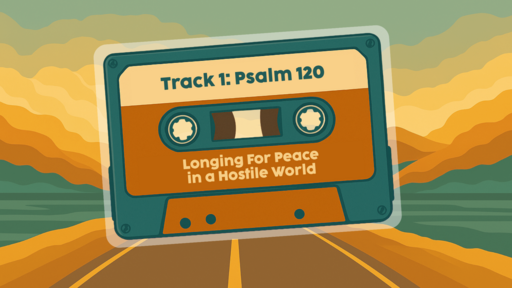
Road Trip Mixtape (Psalms of Ascent) • Sermon • Submitted • Presented • 37:06
0 ratings
· 38 viewsFiles
Notes
Transcript
Series Intro
Summer is road trip season. Many of us will pack up the car, load the kids, roll down the windows, and hit the road. And when I was growing up, a good road trip needed a great mixtape.
Now for those of you who are 30 or younger, you may have no idea what I’m talking about. So think of a mixtape as an analogue version of a Spotify Playlist.
At the top of my family’s road trip playlist is Willie Nelson’s “On The Road Again.”
But long before Spotify or mixtapes, God’s people had their own road trip mixtape—a collection of songs they would sing as they traveled up to Jerusalem for various annual feasts.
These are referred to as the Psalms of Ascent (Psalms 120–134)—songs for the journey.
Songs for weary travelers and hopeful pilgrims.
Songs that remind God’s people who they are, where they’re headed, and why the journey is worth it.
This summer, we’re going to push play on 8 these 15 tracks together. As we do, we’ll find that they speak to us right where we are—offering honesty for the hard days and hope for the journey ahead.
Sermon Thematic Intro
Every journey has to start somewhere—and Psalm 120 is track 1 on this mixtape. But it doesn’t start on a mountaintop or in a worship service. It starts in the valley— and as exiles in a place of deep frustration and longing.
The first note of this mixtape — is a cry.
The psalmist is surrounded by lies, hostility, and conflict. He lives in a culture that not only rejects peace but seems to hate it. And he feels like a foreigner—like he doesn’t belong.
Can you relate?
We were made for something more than this. We were made for wholeness, contentment, harmony with God and others. But we live in a world that promises peace while waging war against our souls.
A world filled with lies about what will make us happy, fulfilled, and free.
So what do we do when we long for peace but live among people who hate it?
That’s the tension Psalm 120 confronts—and that’s the journey we begin today.
Scripture
Grab your Bibles and turn with me to Psalm 120. If you need to use a pew Bible, you’ll find today’s text on page 611. Once you’re there, please stand with me if you are able and follow along with me as I read...
In my distress I called to the Lord, and he answered me.
Deliver me, O Lord, from lying lips, from a deceitful tongue.
What shall be given to you, and what more shall be done to you, you deceitful tongue?
A warrior’s sharp arrows, with glowing coals of the broom tree!
Woe to me, that I sojourn in Meshech, that I dwell among the tents of Kedar!
Too long have I had my dwelling among those who hate peace.
I am for peace, but when I speak, they are for war!
This God’s Word!
Prayer
Declaration of the Word: (Ps. 119:97, Isaiah 40:8, 2 Tim. 3:16, Ps. 19:7, Job 23:12, Heb. 4:12)
Lord as we’ve opened Your Word, we ask that you would open the eyes of our hearts to see the beauty of Christ. Holy Spirit revive our weary souls and restore our joy even in the midst of a world that is hostile to our souls. — AMEN!
Intro: Formal (give context to passage, setting the scene, big idea)
Psalm 120 is the first of the 15 songs of Ascent — These were spiritual songs for the heart. They helped God’s people look upward to Him and forward to His promises, even as they walked through a world that often felt far from home.
And Psalm 120 sets the tone. It starts not with joy or celebration, but with anguish—with a cry from someone who feels trapped in a world of lies and hostility. He’s surrounded by people who despise peace, and he’s weary of it. This isn’t a song of arrival; it’s a song of longing. It’s a voice saying, “I don’t belong here… I want something better.”
And that’s what makes this psalm so powerful for us today. Because we, too, live as sojourners in a world that resists the peace of God.
We feel the friction.
We hear the lies.
We ache for wholeness.
But Psalm 120 gives us more than just a lament. It gives us a pattern—a path forward for how to live as faithful exiles in a hostile world.
Here’s the big idea of the sermon today:
In a world of lies and hostility, God’s people long for true peace—so we cry out to the Lord and trust Him to make all things right.
We’ll walk through this psalm in three parts:
Longing for Peace
Crying Out to God
Trusting God to Make It Right
Let’s walk this road together, starting with that deep, God-given longing for peace.
Longing for Peace
Longing for Peace
To first understand the distress of the Psalmist in verse 1, we need to skip ahead to verses 5-7 to understand where this comes from.
First, notice the expression "Woe to me" -- This is an expression of deep spiritual and emotional distress. Why? He says that he sojourns in Meshech and dwells in the tents of Kedar! Now it would be impossible for one person to live in both these places at the same time. These two locations are far apart from each other. Both are outside of Israel — with Meshech in the far north and Kedar in the southeast.
Because of this, I think we are meant to understand these locations as being symbolically to represent living among people who don’t know God and are opposed to His truth and values.
The psalmist describes himself as a sojourner - a pilgrim - a traveler passing through… He feels this deeply. He knows, “this is not my home!”
This is exactly how Peter describes the life of the Christian in 1 Peter 2:11
Beloved, I urge you as sojourners and exiles to abstain from the passions of the flesh, which wage war against your soul.
The second half of this verse is key. The passions of the flesh that Peter says are waging war against your souls are the values of this world.
This helps us understand what the psalmist means the world is “for war.”
To see this, look more closely with me at this Hebrew word for peace — It’s the word Shalom. This is a word loaded with rich meaning. It's not just the absence of hostility - It means…
Wholeness,
Delight
Contentment
Perfect harmony with God and others,
It means flourishing in all dimensions of life—
physical,
spiritual,
emotional,
social,
societal.
All this and more is packed into this word "Shalom" and this is what we were made for. This is what the Psalmist is FOR! This is how God originally created the world to be.
But Shalom was lost in Genesis 3 - How? - By embracing a lie.
You see, we were made to live for God and serve Him as our highest good. This the only way to experience Shalom! But the first people embraced the serpent’s lie: that you can have Shalom by putting yourself first!
The lie was that true shalom could be had by living for ourselves first (Not God) as our highest good!
Paul makes this crystal clear in Romans 1:25
…they exchanged the truth about God for a lie…
I saw a reel recently of a Satanist who explained that they don't teach people to worship Satan. They are all about love. Loving yourself first to be the best version of you possible...WOW!
This is the same lie Satan told in the garden! Just dressed up with affirmations and hashtags!
“You do you!”
“Live your truth!”
We are lied to constantly in our world…
Advertisers tell us what will make us happy apart from God.
The entertainment industry promises us cheap and easy joy.
Politicians promise peace through policies and elections.
Social media gives us filters with no foundation.
Our world tells us about life but never mentions the author of life!
We're lied to about where we came from.
We're lied to about our bodies - that they are just erector sets for us to shape into our own image, not made in God’s image!
Hollywood has deceived us into thinking that Satan wages war with pitch forks and pentagrams, hexes and curses. But the truth is this lie that has been his chief weapon of waging war against our souls all along!
This is why the Psalmist prays in verse 2 for deliverance from lying lips and a deceitful tongue - Because lies are not just false — they’re weapons!
Scriptures likens them to sharp arrows in Psalm 64:3-4
who whet their tongues like swords, who aim bitter words like arrows, shooting from ambush at the blameless…
And James 3:6 says the tongue is a fire, set on fire by hell!
And the tongue is a fire, a world of unrighteousness. The tongue is set among our members, staining the whole body, setting on fire the entire course of life, and set on fire by hell.
These lies do violence to our souls because they promise Shalom without God—but always lead deliver the opposite.
Believing this lie is what unraveled the whole fabric of the this world. It's the reason for
disease,
famine,
natural disasters,
injustice,
violence,
strife,
oppression,
aging, and death.
Paul says in Romans 8 that "all creation was subjected to futility by this lie and now groans along with us for things to be made right (Romans 8:19-23).
So, this is why the psalmist cries "woe is me" in verse 5, because he knows he does not belong here. He doesn’t fit in — and that his soul is under constant attack by the lies of this world. And he is feeling the effects of living in a world that is coming undone around him.
He longs for something better — He longs for SHALOM!
APPLICATION:
Before we move on, let me ask you:
Do you know and feel that this world is not your home—or have you started to get comfortable here?
Have you made peace with some of the world’s values and slowly absorbed some of its lies?
Maybe it’s the lie that a new job, a new body, a new relationship, or a new politician will give you lasting peace.
Maybe it’s the lie that you can craft your own identity and be your own source of truth.
Maybe it’s the quiet lie that you don’t need God—you just need a little more rest, a little more money, or a little more control.
In your longing for shalom, have you settled for the world’s counterfeits?
The world hands you knockoffs—
Comfort without repentance,
Affirmation without truth,
Pleasure without holiness.
But the world cannot give you the Shalom your soul longs for. It can only give you the opposite—restlessness, guilt, brokenness, and emptiness.
Understand that we are all being shaped by something. And we are either being shaped for Shalom or away from it.
So What’s shaping you right now?
Is it God’s Word—or is it reels, headlines, podcasts, or popular opinion?
Someone is shaping you.
Is it Jesus—or is it some algorithm?
Let me encourage you:
To see that longing in your soul for Shalom for what it is — a holy homesickness.
A sign that your soul still remembers something of Eden. It still remembers what it was made for.
Don’t numb that longing.
Don’t drown it in distractions or entertainment.
Let it drive you to something real… to someone real.
That deep ache you feel, that longing for wholeness, for peace, for rest—that’s not something to suppress.
It’s something to bring to God.
And that’s exactly what the psalmist does in verse 1.
Let’s look now at how this longing leads him to cry out to the Lord.
Crying Out To God
Crying Out To God
It’s the distress of verses 5-7 that leads the psalmist in verse 1 to call to the LORD.
First understand that the root of this Hebrew word for DISTRESS carries a meaning of narrow or tight. It describes a feeling of being trapped or squeezed in—like you can’t breathe — you can’t move, or escape.
And this is what lies do: They promise to liberate you — but they end up making you a slave!
And as we live as exiles in a world that wages war against God’s peace with its lies, we often feel alone—like strangers in a strange land. Have you ever felt that kind of spiritual isolation?
So, what does the Psalmist do?
He doesn’t give in as John wisely instructs us in 1 John 2:15
Do not love the world or the things in the world. If anyone loves the world, the love of the Father is not in him.
Instead he does what so often marked God’s people in exile — He cries out to God in his distress. And don’t miss the beautiful comfort of the second half of this verse…AND HE ANSWERED ME!
Let that truth lift your heart: God hears you. You are never calling into a cosmic voicemail system. The line is never busy. The signal is never weak. Your call never drops. God always answers His people.
Today we live in a world with unprecedented access to each other. We can make and receive calls, texts, and emails, anytime of day — no matter where we are!
But even still we all know that person who doesn’t return texts promptly or doesn’t take our calls (sometimes for good reason). We are humans with limitations and cannot be available to everyone 24/7.
But this is the point. We are humans and not gods. We cannot be there for everyone in the ways we would like sometimes. We let people down because we’re limited—but God is not. He is always near, always attentive, always ready to hear the cry of His children.
The Lord is not like your friend who never answers his phone! God always takes your call! He answers His people! So, let this encourage you to call out to him in your distress. He will always take your call!
Do not hide your face from me in the day of my distress! Incline your ear to me; answer me speedily in the day when I call!
In the day of my trouble I call upon you, for you answer me.
But understand that God doesn’t always answer the way we expect.
Sometimes He says, “Yes.”
Sometimes He says, “No.”
And sometimes He lovingly says, “Wait.”
But whatever His answer, you can trust this:
He is good. He is wise. And His best is always better than whatever we would come up with on our own.
Now before we move on ask yourself…
Have you stopped calling out to Him?
Or have you grown quiet in your distress? Maybe you’ve been disappointed by how God has answered you. But silence only pushes you deeper into the pressure.
Don’t stay quiet. Call out to Him again. He hears. He cares. He answers.
Do you turn to God first—or last?
When the pressure of life closes in—what’s your instinct? Do you vent online? Numb yourself with screens? Grasp for control? Or do you go to God? The psalmist gives us the pattern: Distress → Crying out → Answer.
Model this for your family.
If you’re a parent or grandparent, your kids need to see this. Let them see you pray when you’re stressed. Let them hear you cry out to God. Teach them: “When life gets hard, we don’t run from God—we run to Him.”
So what happens when we do cry out to God in our distress? What assurance do we have that He’s not only listening—but also acting?
That’s what the psalmist turns to next: he takes comfort in knowing that God will not only hear—but that He will make things right. Let’s look now at verses 3–4 in my final point.
Trusting God To Make It Right
Trusting God To Make It Right
The psalmist now directs his attention away from the lies and to what he knows to be true…
That God will act to make things right!
Sometimes it can be difficult to see people in the world prosper in their deceit. And it can be easy to wonder… “Where is God?” “When will He do something?”
The psalmist doesn’t take matters into his own hands like some kind of vigilante because he believes that God is absent or too busy. He doesn’t compromise but he doesn’t retaliate either!
In verse 3 he addresses the deceivers with a confident trust in what God will do.
He uses a common biblical phrase of judgement. “What shall be given to you, and what more shall be done to you.”
He’s doing what Paul teaches in Romans 12:18-19
If possible, so far as it depends on you, live peaceably with all.
Beloved, never avenge yourselves, but leave it to the wrath of God, for it is written, “Vengeance is mine, I will repay, says the Lord.”
The psalmist confidently and patiently trusts that God will make all things right. That justice and judgement will come for those who make war against God and His people.
Then in verse 4 the tables have turned. For so long the godless have let the arrows of their lies fly and the fire of their tongues burn. — But now these weapons are turn against them.
The sharp arrows of the Lord and His burning coals of judgement are now directed at these deceivers.
This is what we see in Psalm 64:7-8
But God shoots his arrow at them; they are wounded suddenly.
They are brought to ruin, with their own tongues turned against them; all who see them will wag their heads.
The psalmist is saying, “You may be slinging your arrows now, but it is God who will take the last shot and it is He who will have the final word!
So, if you’ve ever wondered where is God when the deceitful are prospering and seeming to get away with injustice — This truth should give you great hope…perfect and complete justice is real, and is coming.
But this should be sobering too because the justice of God is not just something out there for the world—it’s also pointed toward us.
We have all sinned. We’ve all sought peace on our own terms. We’ve all made war with God by putting ourselves at the center.
And the arrows of God’s judgment are aimed not just at “those people”—but at you and me.
But here’s the good news…
This psalm points us to a greater Sojourner — Jesus!
Who entered a hostile world that was not His home…
Was slandered and falsely accused…
Who experienced great distress in the garden…
War was waged against Him
And when the arrows of God’s justice were aimed at you — Jesus stepped into the line of fire for you!
He bore the judgement you deserved to give you the shalom you long for! He died to take your place. He rose to give you new life!
So how do you receive this peace? The same way the psalmist did in verse 1 — You call out to the Lord in faith, knowing that He WILL hear you and He WILL answer you!
Romans 10:13 says…
For “everyone who calls on the name of the Lord will be saved.”
“Seek the Lord while he may be found; call upon him while he is near;
let the wicked forsake his way, and the unrighteous man his thoughts; let him return to the Lord, that he may have compassion on him, and to our God, for he will abundantly pardon.
But what does it look like to turn to the Lord in faith, forsaking your old ways?
C.S. Lewis once wrote in an essay about what it means to turn to Jesus. He explains that it is both the hardest and the easiest thing in the world.
What’s hard is that so many try to come to Christ like an honest taxpayer—we give what we think we owe: a little time, a little money, a little morality. But we hope we still have enough left over to live the life we want.
But Jesus doesn’t come asking for a portion of your life — He doesn’t want your things — He wants YOU! — All of you. Because He didn’t die on the cross and rise again to reform your old life — He came to give you an entirely new one!
And that’s what makes it hard: coming to Jesus means dying to self-rule and surrendering your whole self!
But while this is hard, here’s why it’s also easy: Because surrendering your life to Jesus is easier than anything you’ve been trying to do all along. It’s impossible to have shalom by our own efforts. So, when you finally stop trying to run your life on your own terms…
That’s when you find rest.
That’s when you find life.
That’s when you find peace.
Lewis puts it like this: “If I am a grass field, all the cutting will keep the grass less, but it won't produce wheat. If I want wheat, I must be plowed up and resown.”
Surrendering to Jesus may feel incredibly hard — like being plowed up—but it’s easier than anything else you’ve been trying!
So let me ask you:
Are you tired of trying to find peace on your own terms?
Are you ready to stop running and surrender everything to Jesus?
Are you willing to be “plowed up” so that He can sow something new and living in you?
Don’t wait. Don’t harden your heart. Don’t settle for fake peace when Jesus offers the real thing.
Call on Him today. Trust in Him. Give Him your whole self.
And He will give you His.
He will answer you.
He will forgive you.
He will give you life.
He will give you Shalom.
Conclusion/Response (Gospel & Repent/Believe)
So church, as we begin this journey through the Psalms of Ascent, let this first track from Psalm 120 remind you of this:
When you are worn down by the world’s lies,
When you feel like a stranger in this life,
And when the ache for peace feels unbearable—
Don’t give in. Don’t grow numb. Don’t run away.
Cry out. Trust. Keep walking.
Because the God who answered the psalmist is the same God who has answered you in Jesus Christ.
He is the God who stepped into your distress,
Who took the arrows of judgment in your place,
Who rose to give you a new life—and a living hope.
And one day—
Your journey will end.
The road will stop.
The longing will be fulfilled.
You will be home.
And will stand in the city of peace—the new Jerusalem—where Shalom is not just a hope, but a reality.
So church—
Keep longing.
Keep crying out.
Keep trusting.
Because the One who calls you is faithful—and He will get you home.
Prayer
Closing Song: Teach My Thy Way O Lord (#395)
Benediction
Take your next step [Orange Card]
Baptism, Membership, Discipleship, Learn more about Jesus…
Church, remember — How beautiful are the feet of those who bring good news.
So, may you go now as those who bring good news of peace—
not a peace the world can offer, but the peace that comes through Christ alone.
May your lives be distinct, your words be bold, and your hope be contagious.
And now, may the God of hope fill you with all joy and peace in believing, so that by the power of the Holy Spirit you may abound in hope.” ~ Romans 15:13
