The Seven Essentials of a Productive Prayer Life (Doctrinal Bible Church in Huntsville, Alabama)

Doctrinal Bible Church
Pastor-Teacher Bill Wenstrom
Wednesday June 25, 2025
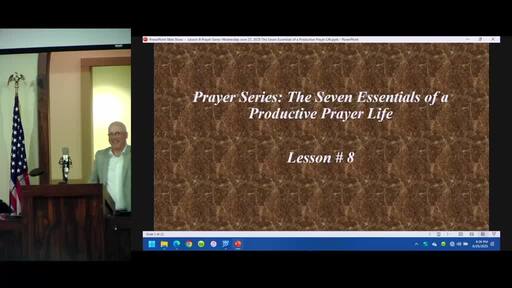
Prayer Series: The Seven Essentials of a Productive Prayer Life
Lesson # 8
There are seven essential elements that should be included in every prayer offered to God: (1) confession, (2) Filling of the Spirit, (3) faith, (4) worship, (5) thanksgiving, (6) intercession, and (7) petition.
Once becoming a child of God and establishing access to the Father in prayer, it is vital that a believer consistently practice the seven essential elements to a prayer.
In other words, we must always be consciously aware of the seven elements to a prayer and must practice them as part of our prayers if we ever hope to experience a productive prayer life.
Confession of sin is the first essential element to a healthy and productive prayer; since, without it, the believer cannot have fellowship with God, which results in not having one’s prayer received by God, let alone receiving an answer to one’s prayer.
Fellowship with the Lord demands that the believer confess any known sin to the Father when necessary in order to be restored to fellowship.
Maintaining that fellowship is accomplished by obedience to the Father’s will, which is revealed by the Holy Spirit through the communication of the Word of God.
Psalm 66:18 If I regard wickedness in my heart, the Lord will not hear. (NASB95)
1 John 1:5 This is the message we have heard from him and declare to you: God is light; in him there is no darkness at all. 6 If we claim to have fellowship with him yet walk in the darkness, we lie and do not live by the truth. 7 But if we walk in the light, as he is in the light, we have fellowship with one another, and the blood of Jesus, his Son, purifies us from all sin. 8 If we claim to be without sin, we deceive ourselves and the truth is not in us. 9 If we confess our sins, he is faithful and just and will forgive us our sins and purify us from all unrighteousness. (NIV84)
After confessing our sins to the Father, we are automatically restored to fellowship with Him.
Fellowship is maintained by obeying the Word of God, which constitutes the second essential element—being filled or influenced by means of the Spirit.
Therefore, after confessing our sins, we are to obey the Word of God and in particular, we are commanded to bring our thoughts into obedience to Christ, which constitutes obeying the commands to be filled with the Spirit (Eph 5:18) and to let the Word of Christ richly dwell in our souls (Col 3:16).
The commands are synonymous, since each bears the same results: fellowship with the Father.
Ephesians 5:18 And do not permit yourselves to get into the habit of being drunk with wine because that is non-sensical behavior, but rather permit yourselves on a habitual basis to be filled by means of the Spirit. (Pastor’s translation)
Colossians 3:16 The teaching originating from and about the one and only Christ must continue dwell abundantly among each one of you. Each of you must execute this command by continuing to make it your habit of providing instruction, specifically by providing instruction for one another with regards to proper conduct. Each of you must provide this instruction by means of a wisdom which is absolute, by means of psalms, hymns, spiritual songs. Each of you must execute the command by continuing to make it your habit of singing with gratitude with your entire being for the benefit of God the Father. (Pastor’s translation)
The commands, “be filled by means of the Spirit” and “let the Word of Christ richly dwell within you,” are synonymous because the Holy Spirit speaks to the believer through the communication of the Word of God regarding the Father’s character and nature, will, provision for doing His will, and consequences for not doing His will (Rev 2:7, 11, 17, 29).
The third essential element, therefore, is demonstrating faith that God will hear and answer our prayers (James 1:5-7).
Matthew 21:22 And all things you ask in prayer, believing, you shall receive. (NASB95)
Answered prayer requires faith and is thus an expression of confidence in God’s ability to meet one’s need (Matt. 8:10; Luke 7:9; Matt. 9:22; Mark 5:34; Luke 8:48; Matt. 9:29; 17:20; Luke 17:5; Mark 9:29; Matt. 21:22; Mark 11:24; 1 John 3:21-22; James 1:5-8; 5:15).
The worship and reverence of God is the fourth essential part to an effective, productive, and joyful prayer (Phi 4:6) since prayer is a means by which the believer can worship, adore, and revere God.
To worship is to adore God, as the Holy Spirit reveals Him in the Scriptures and through the person of Christ.
It is the act of paying honor and reverence to God, and it derives from love.
Where there is little love, there is little worship.
Worship is the loving ascription of praise to God for whom and what He is and it is the bowing of the soul and spirit in deep humility and admiration before Him (Psalm 2:11-12).
The believer is to worship the Father spiritually by means of truth, i.e. the Word of God (John 4:23-24) and the church ’s destiny is to worship the Lord, as revealed in Revelation 4-5.
The Lord Jesus Christ taught His disciples that the second part of a prayer is the worship, reverence, honor, and respect for the Father.
Luke 11:1 One day Jesus was praying in a certain place. When he finished, one of his disciples said to him, “Lord, teach us to pray, just as John taught his disciples.” 2 He said to them, “When you pray, say: “ ‘Father, hallowed [hagiazo: to revere, honor and respect] be your name [onoma: the person and character of God], your kingdom come. (NIV84)
“Hallowed” is the verb hagiazō (ἁγιάζω), which literally means, “may your person be revered, honored, and respected” and to “hallow” God’s name means to worship His person.
Not only is thanksgiving is a characteristic of a productive prayer life but it is also an essential element of a prayer (John 6:11; Rom. 1:8; 6:17; 7:25; 1 Cor. 1:4; 11:24; 15:57; 2 Co 2:14; 4:15; 8:16; 9:11; Eph. 1:15-16; 5:4; 5:20; Phlp. 1:3; Col. 2:7; 3:15; 1 Thess. 1:2; 2:13; 2 Thess. 1:3; 2:13; Phlm. 4).
Colossians 4:2 Devote yourselves to prayer, being watchful and thankful. (NIV84)
The sixth essential element to a prayer is intercession, which means to pray for both the temporal and spiritual needs of believers and unbelievers, friends and enemies (Luke 23:34; Eph 1:16-23; 3:14-19; 6:18; 1 Ti 2:1-4).
Intercessory prayer refers to praying for both the temporal and spiritual needs of believers and unbelievers, friends and enemies (Luke 23:34; Eph 1:16-23; 3:14-19; 6:18; 1 Ti 2:1-4).
It is an expression of the love of God in our lives and, therefore, directly relates to what the Scriptures teach on love.
Intercessory prayer is a function of the church-age believer’s royal priesthood, which allows the believer to represent himself in prayer before the Father.
God calls every church-age believer to intercede on behalf of all men, especially one’s fellow believers, since every church-age believer is a royal priest.
The seventh and final essential part to a productive prayer is petition, which is a prayer request for your own particular spiritual and temporal needs (Rom. 1:10; 2 Cor. 12:8; 1 Thess. 3:10; Heb. 4:16).
God encourages us to pray for our own needs because it teaches us to depend upon Him and His wonderful provisions.
Psalm 55:22 Cast your burden upon the LORD and He will sustain you; He will never allow the righteous to be shaken. (NASB95)
1 Peter 5:6-7 encourages us to claim God’s promises and trust in them to combat any fear or worry in our lives.
1 Peter 5:1 To the elders among you, I appeal as a fellow elder, a witness of Christ’s sufferings and one who also will share in the glory to be revealed: 2 Be shepherds of God’s flock that is under your care, serving as overseers—not because you must, but because you are willing, as God wants you to be; not greedy for money, but eager to serve; 3 not lording it over those entrusted to you, but being examples to the flock. 4 And when the Chief Shepherd appears, you will receive the crown of glory that will never fade away. 5 Young men, in the same way be submissive to those who are older. All of you, clothe yourselves with humility toward one another, because, “God opposes the proud but gives grace to the humble.” 6 Humble yourselves, therefore, under God’s mighty hand, that he may lift you up in due time. 7 Cast all your anxiety on him because he cares for you. (NIV84)
