Counterfeit gods - Introduction
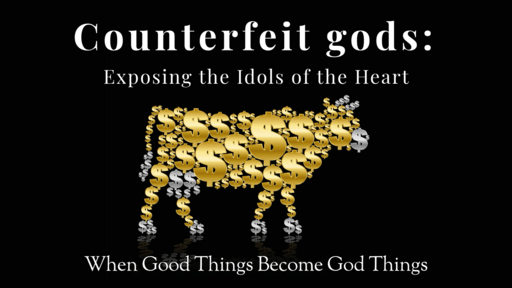
Counterfeit gods: The Idols of the Heart • Sermon • Submitted • Presented • 36:44
0 ratings
· 35 viewsFiles
Notes
Transcript
Title: Discerning the Gods We Worship
Title: Discerning the Gods We Worship
Main Texts:
1 And God spoke all these words, saying, 2 “I am the Lord your God, who brought you out of the land of Egypt, out of the house of slavery. 3 “You shall have no other gods before me. 4 “You shall not make for yourself a carved image, or any likeness of anything that is in heaven above, or that is in the earth beneath, or that is in the water under the earth. 5 You shall not bow down to them or serve them, for I the Lord your God am a jealous God, visiting the iniquity of the fathers on the children to the third and the fourth generation of those who hate me, 6 but showing steadfast love to thousands of those who love me and keep my commandments.
1 Then certain of the elders of Israel came to me and sat before me. 2 And the word of the Lord came to me: 3 “Son of man, these men have taken their idols into their hearts, and set the stumbling block of their iniquity before their faces. Should I indeed let myself be consulted by them? 4 Therefore speak to them and say to them, Thus says the Lord God: Any one of the house of Israel who takes his idols into his heart and sets the stumbling block of his iniquity before his face, and yet comes to the prophet, I the Lord will answer him as he comes with the multitude of his idols, 5 that I may lay hold of the hearts of the house of Israel, who are all estranged from me through their idols.
22 So Paul, standing in the midst of the Areopagus, said: “Men of Athens, I perceive that in every way you are very religious. 23 For as I passed along and observed the objects of your worship, I found also an altar with this inscription: ‘To the unknown god.’ What therefore you worship as unknown, this I proclaim to you. 24 The God who made the world and everything in it, being Lord of heaven and earth, does not live in temples made by man, 25 nor is he served by human hands, as though he needed anything, since he himself gives to all mankind life and breath and everything. 26 And he made from one man every nation of mankind to live on all the face of the earth, having determined allotted periods and the boundaries of their dwelling place, 27 that they should seek God, and perhaps feel their way toward him and find him. Yet he is actually not far from each one of us, 28 for “ ‘In him we live and move and have our being’; as even some of your own poets have said, “ ‘For we are indeed his offspring.’ 29 Being then God’s offspring, we ought not to think that the divine being is like gold or silver or stone, an image formed by the art and imagination of man. 30 The times of ignorance God overlooked, but now he commands all people everywhere to repent, 31 because he has fixed a day on which he will judge the world in righteousness by a man whom he has appointed; and of this he has given assurance to all by raising him from the dead.”
5 Put to death therefore what is earthly in you: sexual immorality, impurity, passion, evil desire, and covetousness, which is idolatry.
As the Bible tells us,
The human heart was made to worship
but when it replaces the true God with counterfeit gods,
it leads not only to sorrow but despair.
In this life and the one to come.
The only path to healing is through repentance and reorientation to the true God.
When Tom Brady won his third Super Bowl, an interviewer asked him,
“Which ring is your favorite?”
He paused and said,
“The next one.”
Then later, in a 60 Minutes interview, he confessed:
“Why do I have three Super Bowl rings and still think there’s something greater out there for me?
I mean… I think, God, there’s got to be more than this.”
The reporter asked, “What’s the answer?”
Brady just shook his head and said,
“I wish I knew.”
That the result of chasing counterfeit gods.
That’s the haunting echo of every heart that worships a counterfeit god.
It never feels like enough.
Even when we win.
Because if your identity is built on success—then failure destroys you.
But if your identity is built on Christ—then failure sanctifies you.
and brings you peace and joy.
Do you remember the old Hymn: At the Cross?
Great verses,
Verse 1
Alas! and did my Savior bleed
And did my Sovereign die?
Would He devote that sacred head
For such a worm as I?
Verse 2:
Was it for crimes that I have done
He groaned upon the tree?
Amazing pity! grace unknown!
And love beyond degree!
But, while the verses are great,
the chorus is very NOT great.
At the cross, at the cross where I first saw the light,
And the burden of my heart rolled away,
It was there by faith I received my sight,
And now I am happy all the day!
Do you see why that chorus is so bad?
“And now I am happy all the day.”
It’s just not true....
Which is too bad,
because it’s a wonderful hymn otherwise.
Someone really should come along and fix it…
and change it to something like:
At the cross, at the cross where I first saw the light,
And the burden of my heart rolled away,
It was there by faith I received my sight,
And now my hope is in His name.
Maybe that solves it, I don’t know…
But I’m sure someone could come up with something even better.
But the point is,
Yes, counterfeit gods do not satisfy,
Only the true God does…
But that satisfaction and joy that God brings doesn’t result in us being “happy all the day.”
It results in us having joy available to us every day, no matter how dark or sorrowful that day gets.
What we are talking about is the difference between sorrow and despair.
See:
Sorrow says: “I lost something I love.”
Despair says: “I lost the one thing I live for.”
And that’s what idolatry does.
It takes a good thing—and turns it into a false god.
And when it fails, it doesn’t just hurt.
It shatters.
One observer of early America saw this long before smartphones and stock markets.
Alexis de Tocqueville was a French historian and political philosopher
who toured the United States in the 1830s.
He was fascinated by the energy, equality, and opportunity of American life—
But he also noticed something deeper beneath the surface.
He described it as a “strange melancholy… in the midst of abundance.”
An ache.
An emptiness.
That sense that life is almost fulfilling—until it isn’t.
Why?
Because, as Tocqueville put it, “the incomplete joys of this world will never satisfy the human heart.”
In Exodus 20, we find what causes that ache, and it’s idolatry.
As we read: Exodus 20 begins not with rules—but with a relationship.
Someone read for us again please Exodus 20 verses 2 & 3.
First:
“I am the Lord your God… who brought you out of Egypt.”
But then comes the warning:
“You shall have no other gods before Me.”
We hear that and think—statues, temples, incense.
But God immediately expands the meaning.
“Don’t make an image of anything in heaven above or earth below.”
In other words—anything can become a god.
That includes good things.
Success.
Romance.
Money.
Family.
or even the church that you pastor.
Would someone please read Ezekiel 14:3:
3 “Son of man, these men have taken their idols into their hearts, and set the stumbling block of their iniquity before their faces. Should I indeed let myself be consulted by them?
The key part of that verse is:
“These men have set up idols… in their hearts.”
Not on shelves.
Not in shrines.
In their hearts.
What this means is:
An idol is anything you look to for ultimate meaning, identity, or security—more than you look to God.
It’s anything you say, “If I have that, I’ll be okay.”
It’s what you daydream about.
It’s what you fear losing the most.
It’s what you obey without question.
This understanding is why William Temple, who served as Archbishop of Canterbury in the early 20th century, rightly said:
“Your religion is what you do with your solitude”
William Temple
Questions:
• Why do you think the idols in our lives are usually invisible to us until they collapse?
• What kinds of lies do we believe that make idolatry seem “normal” or even “noble”?
• Can you think of something in your life that people praise—but that deep down, you know you’ve turned into a god?
• What fear would surface if God asked you to give that thing up?
• Why is it easier to notice other people’s idols than our own?
In response to that last question:
Every Culture Has Its Own Shrines
When Paul walks into Athens in Acts 17, he’s overwhelmed.
Not by chaos.
Not by immorality.
By idolatry.
He says the city is full of gods:
There’s Aphrodite—the god of beauty.
Artemis—the god of wealth.
Ares—the god of power.
Athena—the god of wisdom.
Now, just by way of a show of hands,
Does anyone here struggle to not worship any of those god’s?
Do you have any secret shrines of them at home that you occasionally bust out when things get tough?
Now maybe you don’t have a shrine with their name on it at home,
But make no mistake,
these counterfeit gods haven’t been removed,
they’ve been renamed.
Aphrodite?
She now goes by the names: “self-love”, “authenticity”, or “being true to yourself.”
She shows up on your social media feeds—telling you that your value is measured in beauty, attention, and the affirmation of others.
How about Artemis?
We now call her financial independence, or security, or just “being smart with your money.”
But when we organize our lives around income instead of integrity, we’re bowing at her altar.
Then there’s Ares…
He’s called influence, platform, or “making a difference.”
But when we let our need to be successful drive us to bitterness, division, or self-righteousness,
we’ve traded the Prince of Peace for the god of war.
Lastly, how about Athena?
She’s not gone either.
Now she’s the expert voice, the podcast, the brand, the degrees.
The always having to prove yourself to others in your relationships,
showing how smart you are.
This shows up in us when we dominate conversations,
or… if we are super introverted and don’t engage in conversations, because we believe we don’t measure up to Athena’s expectations.
But all of this promises wisdom without the God of Wisdom.
Sure, we may not burn incense to them or pray to them:
But we sacrifice time, energy, families, even integrity—to gain the favor of our gods.
We sacrifice children on the altar of achievement.
We sacrifice marriages on the altar of image.
We sacrifice rest on the altar of productivity.
And these gods never stay satisfied.
They always demand more.
When it comes to Idolatry, it is Personal, Cultural, and Spiritual
Which means that Idolatry isn’t just something “out there.”
It’s “in here.”
Would someone please read Colossians 3:5?
5 Put to death therefore what is earthly in you: sexual immorality, impurity, passion, evil desire, and covetousness, which is idolatry.
Notice this verse doesn’t say greed leads to idolatry.
It says “greed is idolatry.”
And it’s because idols hide themselves.
Like addictions,
they deceive and consume.
This is why one John Calvin once said:
“Man’s nature… is a perpetual factory of idols.”
— Institutes of the Christian Religion, Book 1, Chapter 11, Section 8
Idolatry isn’t just worshiping false gods,
it’s taking good things and turning them into ultimate things:
Which causes us to worship success.
To romanticize relationships.
To spiritualize and require immediate comfort in our lives.
And here’s what happens:
What we love most, we trust most.
What we trust most, we obey most.
Love, trust, obey—those are the actions of worship.
As the old Hymn goes: “Trust and Obey, for their’s no other way to be happy in Jesus.”
Whatever rules your emotions…
Whatever controls your fears…
Whatever makes you anxious, despondent, or irrational…
That’s what you worship.
The Bible is clear,
since humanity’s fall into sin in the garden, we are all idol worshipers at heart.
But if that’s true, and it is,
what are we supposed to do about it?
5 Put to death therefore what is earthly in you: sexual immorality, impurity, passion, evil desire, and covetousness, which is idolatry.
Colossians 3:5 doesn’t say manage idolatry.
It doesn’t say monitor it.
It says—put it to death.
Because idolatry isn’t just a habit to tweak.
It’s treason against the King.
It’s spiritual adultery.
It’s loving something else more than the God who made you and redeemed you.
And the only way to truly put it to death—
is not just to love it less—
but to love Christ more.
See, you don’t kill an idol by sheer willpower.
You kill it by seeing something more beautiful, more worthy, more satisfying.
As the Scottish pastor and theologian Thomas Chalmers once said:
“The only way to dispossess the heart of an old affection is by the expulsive power of a new one.”
Thomas Chalmers
That’s Paul says in Colossians chapter 3,
don’t just “stop worshiping idols.”
He says in verse 10,
10 and have put on the new self, which is being renewed in knowledge after the image of its creator.
And this is the good news of the Gospel:
God doesn’t just command us to tear down idols—
He invites us to be re-formed in His image.
To be completely renewed and reshaped by the gospel of Jesus.
This is why C. S. Lewis once said:
“Imagine yourself as a living house. God comes in to rebuild that house. At first, perhaps, you can understand what He is doing. He is getting the drains right and stopping the leaks in the roof and so on… But presently He starts knocking the house about in a way that hurts abominably and does not seem to make sense. What on earth is He up to? The explanation is that He is building quite a different house from the one you thought of—throwing out a new wing here, putting on an extra floor there, running up towers, making courtyards. You thought you were being made into a decent little cottage: but He is building a palace. He intends to come and live in it Himself.”
— C.S. Lewis, Mere Christianity, Book 4, Chapter 9
Let me ask you this as we close:
What would it look like for you to start dethroning one of the idols in your life this week?
What might it mean for you to re-center your hope, your meaning, and your security in Christ alone?
What rhythms or confessions or boundaries might need to change?
As a fellows idol-worshiper at heart,
Who’s tore down a few of my own idols, I can promise you this:
You’ll never regret tearing down a false god.
But you’ll always regret trusting one.
Because:
“Sin will take you farther than you want to go,
keep you longer than you want to stay,
and cost you more than you want to pay.”
- Unknown
But, the good news of the gospel is:
The true God—
the one we rejected—
has not rejected us.
Instead, He came to us.
He put on flesh.
He, God and very God, walked among idolaters.
And then He died for them.
Christ went willingly to the cross to free us not just from the penalty of sin,
but from the power of false gods.
And today, His invitation is open.
To tear down what’s false.
and turn to what’s true.
And trust in the only Savior Who,
when you fail Him,
will forgive you—
and when you follow Him,
He will not only never leave you nor forsake you,
But He will will satisfy the longing of your soul.
As the Psalmist says:
9 For he satisfies the longing soul, and the hungry soul he fills with good things.
Application Questions:
1. How do you recognize when a good desire has become a god in your life?
What signs do you see—emotionally, relationally, spiritually—that something has taken God’s place?
2. How do idols gain power over us—even when we know they’re false?
What makes them feel so necessary, and what lies do they feed us in our moments of weakness?
3. How can we begin replacing—not just removing—an idol in our heart?
What does it look like practically to cultivate a greater love for Christ in that area?
4. How can we support one another in identifying and tearing down idols without becoming judgmental or performative?
What does healthy, gospel-shaped accountability look like in a culture full of hidden altars?
5. How does God’s promise to “satisfy the longing soul” (Psalm 107:9) become more than a memory verse—and actually change how we live this week?
What rhythms, reminders, or confessions could help anchor that truth in real life?
