Worship in Spirit and Truth - 13 Worship God Reverently

Worship In Spirit and Truth • Sermon • Submitted • Presented • 38:52
0 ratings
· 14 viewsMorning Service 13th July 2025
Files
Notes
Transcript
1 In Judah God is known; his name is great in Israel. 2 His abode has been established in Salem, his dwelling place in Zion. 3 There he broke the flashing arrows, the shield, the sword, and the weapons of war. Selah
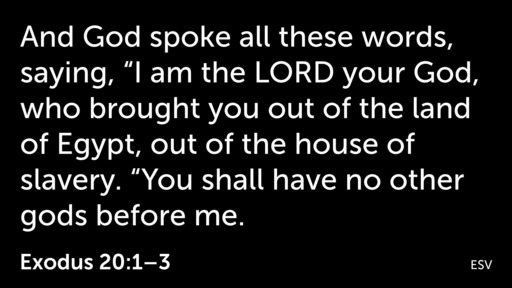
1 And God spoke all these words, saying, 2 “I am the Lord your God, who brought you out of the land of Egypt, out of the house of slavery. 3 “You shall have no other gods before me. 4 “You shall not make for yourself a carved image, or any likeness of anything that is in heaven above, or that is in the earth beneath, or that is in the water under the earth. 5 You shall not bow down to them or serve them, for I the Lord your God am a jealous God, visiting the iniquity of the fathers on the children to the third and the fourth generation of those who hate me, 6 but showing steadfast love to thousands of those who love me and keep my commandments. 7 “You shall not take the name of the Lord your God in vain, for the Lord will not hold him guiltless who takes his name in vain. 8 “Remember the Sabbath day, to keep it holy. 9 Six days you shall labour, and do all your work, 10 but the seventh day is a Sabbath to the Lord your God. On it you shall not do any work, you, or your son, or your daughter, your male servant, or your female servant, or your livestock, or the sojourner who is within your gates. 11 For in six days the Lord made heaven and earth, the sea, and all that is in them, and rested on the seventh day. Therefore the Lord blessed the Sabbath day and made it holy. 12 “Honour your father and your mother, that your days may be long in the land that the Lord your God is giving you. 13 “You shall not murder. 14 “You shall not commit adultery. 15 “You shall not steal. 16 “You shall not bear false witness against your neighbour. 17 “You shall not covet your neighbour’s house; you shall not covet your neighbour’s wife, or his male servant, or his female servant, or his ox, or his donkey, or anything that is your neighbour’s.” 18 Now when all the people saw the thunder and the flashes of lightning and the sound of the trumpet and the mountain smoking, the people were afraid and trembled, and they stood far off 19 and said to Moses, “You speak to us, and we will listen; but do not let God speak to us, lest we die.” 20 Moses said to the people, “Do not fear, for God has come to test you, that the fear of him may be before you, that you may not sin.” 21 The people stood far off, while Moses drew near to the thick darkness where God was.
Slide
7 “You shall not take the name of the Lord your God in vain, for the Lord will not hold him guiltless who takes his name in vain.
Introduction
This third Commandment deals with the way we talk about God. Many avoid offending against the second Commandment but crash into the third. This is fast becoming a significant sin of our modern society. Edwards, B. H. (2002). The Ten Commandments for today (2nd ed., p. 97). Day One Publications.
I doubt that any of us can through a day without hearing this command being broken. It is grievous thing but what is more grievous is to hear Christians doing this which I have heard many times in this building. O God, O my God, O Lord, Jesus, Christ. The command is very clear and I want to examine it with particular reference to our worship. What it commands is that we must worship God reverently and as our lives should be a constant act of worship that same reverence applies.
Slide
1. The Lord’s Name
1. The Lord’s Name
Moses, having left Egypt was in Midian.
1 Now Moses was keeping the flock of his father-in-law, Jethro, the priest of Midian, and he led his flock to the west side of the wilderness and came to Horeb, the mountain of God.
Slide
a. Moses Commissioned
a. Moses Commissioned
2 And the angel of the Lord appeared to him in a flame of fire out of the midst of a bush. He looked, and behold, the bush was burning, yet it was not consumed.
The Lord called to Moses
5 Then he said, “Do not come near; take your sandals off your feet, for the place on which you are standing is holy ground.” 6 And he said, “I am the God of your father, the God of Abraham, the God of Isaac, and the God of Jacob.” And Moses hid his face, for he was afraid to look at God.
The Lord commissions Moses to go back to Egypt and command Pharaoh to let the people go.
Slide
b. What is Your Name?
b. What is Your Name?
13 Then Moses said to God, “If I come to the people of Israel and say to them, ‘The God of your fathers has sent me to you,’ and they ask me, ‘What is his name?’ what shall I say to them?”
Slide
c. God’s Name
c. God’s Name
Slide
14 God said to Moses, “I am who I am.” And he said, “Say this to the people of Israel: ‘I am has sent me to you.’ ” 15 God also said to Moses, “Say this to the people of Israel: ‘The Lord, the God of your fathers, the God of Abraham, the God of Isaac, and the God of Jacob, has sent me to you.’ This is my name forever, and thus I am to be remembered throughout all generations.
The name Yahweh (lord) was the description of the God who entered into a covenant with his people. It was the word that reminded them of the fact that they were a chosen people with whom God had entered into a special relationship and had promised that he would never abandon them.
To show their reverence for this name, and so that their enemies could not learn of it and either ridicule it or add it as another in the list of their own pantheon, the Israelites later refused to speak the name aloud when they were reading the Law of God; instead, they would substitute the vowels of the common word for ‘master’—the word that a servant would use of his ‘lord’. The Hebrew for that is adonay.
The vowels of adonay put to the consonants of ‘Yahweh’ formed an unpronounceable word so that to this day no one can be sure how the word should be pronounced. Whether or not they were right never to utter the sacred word aloud is a matter for debate, but at least it demonstrated their deep reverence for ‘the name’. Edwards, B. H. (2002). The Ten Commandments for today (2nd ed., pp. 98–99). Day One Publications.
Slide
d. Misuse of God’s Name
d. Misuse of God’s Name
Slide
So, this third commandment is not merely about the misuse of a word consisting of four Hebrew consonants, but an abuse of all that the name means. To misuse his name is to tread carelessly upon God’s covenant offer of salvation and to treat his holy character with contempt. We may therefore break this commandment even though we never allow the words ‘God’ or ‘Christ’ to pass our lips as a swear-word. Edwards, B. H. (2002). The Ten Commandments for today (2nd ed., p. 100). Day One Publications.
Slide
2. Misusing God’s Name in False Worship
2. Misusing God’s Name in False Worship
The translation: ‘You shall not misuse’ is in some ways unfortunate. The emphasis of the original word in Hebrew is to ‘lift or raise up’. Psalm 24:4 captures the meaning perfectly in the words ‘who does not lift up his soul to what is empty (an idol)’; and there it is used in the context of worship. Perhaps the most significant use of this Commandment has to do with worship. Edwards, B. H. (2002). The Ten Commandments for today (2nd ed., pp. 101–102). Day One Publications.
Slide
3 Who shall ascend the hill of the Lord? And who shall stand in his holy place? 4 He who has clean hands and a pure heart, who does not lift up his soul to what is false and does not swear deceitfully.
2 You shall surely destroy all the places where the nations whom you shall dispossess served their gods, on the high mountains and on the hills and under every green tree. 3 You shall tear down their altars and dash in pieces their pillars and burn their Asherim with fire. You shall chop down the carved images of their gods and destroy their name out of that place. 4 You shall not worship the Lord your God in that way.
Slide
8 “You shall not do according to all that we are doing here today, everyone doing whatever is right in his own eyes,
Slide
3. Blaspheming the Lord’s Name in False Worship
3. Blaspheming the Lord’s Name in False Worship
Slide
1 Guard your steps when you go to the house of God. To draw near to listen is better than to offer the sacrifice of fools, for they do not know that they are doing evil. 2 Be not rash with your mouth, nor let your heart be hasty to utter a word before God, for God is in heaven and you are on earth. Therefore let your words be few.
61 But Nadab and Abihu died when they offered unauthorized fire before the Lord.
Slide
In our search for happiness we become careless in our worship. But the test of true worship is not whether it makes us happy but whether it makes us holy; not whether it pleases us, but whether it pleases God. Worship is not always a pleasure, sometimes it is very painful. Edwards, B. H. (2002). The Ten Commandments for today (2nd ed., p. 104). Day One Publications.
We sing of God’s character and use magnificent words extolling his worth, but our mind is a thousand miles away from our hymn book.
We sing of deep and serious commitment, pledging our life, our soul and our all to the service of Christ our King, but we have no intention of leaving the building any differently from the way we came in.
We sing of Calvary and the broken body of Christ on the cross, and we can sing it a hundred times with our mind everywhere except at the cross.
We make serious promises to God that we do not keep—and often have no intention of keeping. We can pledge to do all manner of things in the name of our God but fail to keep our word.
It has been well said that Christians do not tell lies, they just sing them in their hymns! All this is a violation of the third Commandment. Edwards, B. H. (2002). The Ten Commandments for today (2nd ed., pp. 104–105). Day One Publications.
We appear to have forgotten the awesome privilege of being adopted into the family of the Sovereign of the universe. It has been wisely commented that the Almighty has too often become the ‘all-matey’ in some of our contemporary worship. Edwards, B. H. (2002). The Ten Commandments for today (2nd ed., p. 105). Day One Publications.
Slide
4. Blasphemy Mocking God
4. Blasphemy Mocking God
5 Now therefore what have I here,” declares the Lord, “seeing that my people are taken away for nothing? Their rulers wail,” declares the Lord, “and continually all the day my name is despised.
‘The concept of an offence to God is beyond the philosophical concept of most Englishmen.’ Modern man has drifted so far away from truth that he does not even realise that he is blaspheming the name of God when he turns his back upon God and dismisses as irrelevant the laws of this holy Creator. Edwards, B. H. (2002). The Ten Commandments for today (2nd ed., p. 108). Day One Publications.
David’s double sin, exposed by Nathan
14 Nevertheless, because by this deed you have utterly scorned the Lord, the child who is born to you shall die.”
16 They profess to know God, but they deny him by their works. They are detestable, disobedient, unfit for any good work.
Slide
5. Blaspheming the Name of Lord in Idle Oaths
5. Blaspheming the Name of Lord in Idle Oaths
Slide
33 “Again you have heard that it was said to those of old, ‘You shall not swear falsely, but shall perform to the Lord what you have sworn.’ 34 But I say to you, Do not take an oath at all, either by heaven, for it is the throne of God, 35 or by the earth, for it is his footstool, or by Jerusalem, for it is the city of the great King. 36 And do not take an oath by your head, for you cannot make one hair white or black. 37 Let what you say be simply ‘Yes’ or ‘No’; anything more than this comes from evil.
Taking an Oath in court is not wrong.
Witness I swear by Almighty God that the evidence I shall give shall be the truth, the whole truth, and nothing but the truth.
“You shall not take the name of the Lord your God in vain,” it says. “In vain” means “for unreality.” What is forbidden is any use or involvement of God’s name that is empty, frivolous, or insincere. This touches three things at least. Packer, J. I. (2007). Keeping the Ten Commandments (p. 60). Crossway Books.
Conclusion
Slide
7 “You shall not take the name of the Lord your God in vain, for the Lord will not hold him guiltless who takes his name in vain.
