Baptism of Jesus

Notes
Transcript
Handout
Intro
Intro
Today, we consider the act of dunking in the water. Water submersion is kind of reserved for baths and swimming. And...oh yea...Baptisms of Christians.
It’s an odd practice when we think about it. Going up and down in the water. But why? why be baptized? While many reasons could be given, and I will give you all the opportunity in little bit to give reasons for baptism, today I want to focus on one specific reason:
In baptism, we follow the example of Jesus.
Why do we get baptized? Well, because Jesus was baptized. And where do we get that? In our text for this morning. This is one of the rare gospel stories that is in all four gospel books, Matthew, Mark, Luke, and John. We remember that not all gospel writers are writing a historical record or biography of Jesus of all the things they remember, but they are instead writing with a purpose and for a purpose. And though they might have slightly different purposes, all of them include the baptism of Jesus. Besides the events surrounding Jesus’s death and resurrection, only a handful are shared between all four. But all Four wanted us to know about Jesus’s baptism. It must have significance for us.
Today, we want to explore the significance of Jesus’s baptism and what that means for us today.
Main Point: In baptism, we proclaim that Jesus has come to identify with us in our sin, save us from it, and restore us to God.
I. The Human Disagreement
I. The Human Disagreement
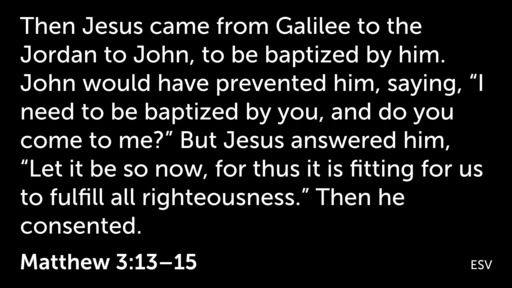
First today, we see Human disagreement. We see this in verses 13-14 in our text.
If you are confused on why we are here in this text today, it is because we are doing three baptisms at the end of our service today. So we have skipped chapter 2 and half of chapter three in Matthew. If you are new with us, we preach verse by verse and we are going through Matthew. So we made a special exception to jump out of order today, and next week, we will be going backward and pick up at the beginning of chapter 2.
A. Advance of Jesus V13
A. Advance of Jesus V13
Looking at verse 13, we see the advance of Jesus. This is the first time in the New Testament that we see Jesus not as a Child. This is his grand entrance into humanity. This baptism is the way that he starts his ministry and mission here on earth.
If you look at this map, the text tells us he went from Galilee. We know from chapter two that he was living in the town of Nazareth. And he travels about 70 miles to where John is baptizing. Jesus intentionally begins his ministry this way.
This verse is giving us more than historical facts of Jesus’s journey. It is also giving us Jesus’s intentions. He is coming to identify with John’s baptism.
Why would Jesus do this? Why does Jesus desire to be a part of John Baptism?
John’s baptism is a baptism of repentance. It is a slightly different baptism than we do today, but it certainly has similarities. John is baptizing for sins. People are recognizing their sins and turning from them. This baptism is a symbol of washing from sin.
Jesus comes to John to identify with Sinners.
Certainly, Jesus was holy and without sin. He could have been preaching to people about their sins, but instead, he comes down to the level of sinners to be one of them.
Remember earlier in Matthew that we are told his name would be Jesus because he will save his people from their sins. And here, we see him coming to be Immanuel, God with us, and he comes in his humanity to identify with our sins.
Matthew is setting Jesus up to be the representative of humanity. The representative of his people. And to do this, he needs to identify with them.
B. Decline of John V14
B. Decline of John V14
Then we see the decline of John in verse 14.
John says “I need to be baptized by you, and yet you come to me?”
Why does John think he needs to be baptized by Jesus?
Previously, John stated that the Messiah would come to baptize with the Spirit and Fire, not a water baptism. This may have been what John was looking for.
John recognizes that he, just like the people he has been baptizing, is a sinner, in need of washing and cleansing.
Here is a key aspect we learn about baptism, baptism is an act of humility. It is recognizing that we have done nothing to save ourselves. We are affirming that we need rescued from our sin and we can’t do it. We can’t be the solution to our problem.
Very interestingly, John earlier in chapter three will not baptize the Pharasees because they are not worthy. But then he also will not baptize Jesus because he is worthy. And because Jesus is worthy, John is humbled.
John is probably a pretty righteous and Holy guy, but compared to Jesus, even he is unworthy.
We respond this way as well. In light of the perfect sinless character of Jesus Christ, we recognize who we are, sinners before him. We are humbled and unworthy before a perfect and worthy Savior.
II. The Divine Agreement
II. The Divine Agreement
Next we see the Divine Agreement. While humans disagree and are lost, this divine reconciling, or making right in unity comes from God in a Holy, Trinitarian agreement. One of the key passages for the doctrine of the trinity is found here in verses 15-17 where we see all three persons of the one God active and working together. Father, Son, and Spirit. Something about baptism is trinitarian. Jesus’s baptism shows us the trinity. And in Baptism, we continue to proclaim the Trinity.
You will remember in the great commission that we proclaim the trinity in baptism.
19 Go therefore and make disciples of all nations, baptizing them in the name of the Father and of the Son and of the Holy Spirit,
Baptism is a picture of Salvation. In Salvation, we experience all three persons of the Trinity at work. The Father plans and initiates salvation, the Son accomplishes it through his sacrifice, and the Holy Spirit applies it to believers.
Jesus tells us that no one comes unless the father calls him. Ephesians 1 tells us that God chose his people before the foundations of the world. God initiates salvation.
Jesus then comes to accomplish salvation. He is the suffering servant. He comes to take on sin, while not sinning himself. No one could take on our sin, because we all have our own sin to deal with. But Jesus was sinless, so he could take on our sin. And he take on our sin to himself, and sacrifices himself on the cross. He take our guilt, our punishment, our shame, our judgement on the cross.
And the Spirit comes to show us our sin and who we really are in light of God. The Spirit comes to us to give us a new spiritual life from our spiritually dead state. The Spirit comes to us at salvation to be with us and continue pointing us toward Jesus as we become more like him day by day.
This is why we baptize and say “in the name of the Father, the Son, and the Holy Spirit.”
A. Fulfilling of Jesus V15
A. Fulfilling of Jesus V15
We see the first part of the trinity in the fulfilling of Jesus in verse 15.
Jesus answers Johns question with a command to Baptize now, for it is fitting for them to fulfill all righteousness. And then John is willing. Just like that. Jesus plays the “fulfill all righteousness” card and John drops the argument.
I’m fairly certain that we don’t have any TSA workers here today. I have some beef with the TSA. For many reasons. I was relieved with the announcement this week that we will now be able to keep our shoes on in the Airport. One of my favorite things to do is play the baby card in the TSA and all arguments are dropped. We have done it many times. We walk through with applesause in a bag, and they begin to treat us like a hostile terrorist and questioning why in the world would we think it was okay to bring that on a plane. But the moment we say “it’s for the baby,” they drop all arguments. Sure you can walk on with it.
We all know the liquid rule at airports. You are in line, and all of a sudden, you forget that you water in your bottle. You panic to dump it in the trash can or quickly turn into a fish to drink it all. Because if you forget about that small amount of liquid, and leave it in your bag, the DEFCON level will certainly need to be raised. But if you tell them it is for a baby, they drop all arguments and let you carry on whatever you would like.
Jesus’s one statement results in John’s complete agreement and willingness.
But what does it mean that they would be fulfilling all righteousness?
What does “Fulfill all righteousness” mean?
We might think that Jesus is fulfilling an Old Testament command. But there are no real commands for baptism in the Old Testament. This wasn’t a practice of the normal Jewish person at this time. So what does Jesus mean that he would be fulfilling all righteousness?
We remember that Matthew loves to use this fulfillment language. We already have seen several in chapter 1, we will see a handful more in chapter 2. But here Jesus is fulfilling righteousness. Matthew loves to hyperlink and point us to the Old Testament to show how Jesus in the Long awaited Messiah.
Many have seen a connection to Isaiah 53:11
11 Out of the anguish of his soul he shall see and be satisfied; by his knowledge shall the righteous one, my servant, make many to be accounted righteous, and he shall bear their iniquities.
Is this not what Jesus is showing us he will do? He is taking on sins and iniquities, he is identifying with humanity, so that he can make them righteous.
Jesus, who is the righteous one, comes to make righteousness for the ones who have no righteousness. The sins that these people are being baptized for, Jesus comes to remove them. This is the reason he comes to John’s baptism.
The one who is righteous could have been calling sinners to repent, but unlike John who has been calling for sinners to repent, he affirms oneness with them.
Mahatma Gandhi is an imperfect and lesser illustration of this point. He was born in India to a high caste in India. If you don’t know about the caste system in India, it is kind of like a ranking of humans. But there is a caste at the bottom that often gets mistreated. In the 1900s, in Gandhi’s day, the lowest class was trampled by society and suffered many abuses. They were seen as less than human. But Gandhi and his wife, who were from a better class, went to them to be with them. They humbled themselves to identify with the untouchables of society. They did what they did, ate what they ate, lived where they lived.
We also see Jesus doing this in a much greater way. The creator of the world, the ruler of the universe, the one from heaven, God very God coming to be with sinful humanity in our filth and identify with us. Making himself one of us to accomplish salvation for us. This is what Jesus is doing in his identifying with baptism.
When Jesus comes to fulfill all righteousness, he comes to be the righteousness for us.
Notice that in verse 15 he says “it is fitting for US to fulfill all righteousness.”
This is something that John is going to participate in. This baptism is going to be fulfilling righteousness.
This baptism would be a picture of fulfilling all righteousness. A foretelling of how Jesus would fulfill all righteousness. Through his sacrifice.
We remember that baptism is a picture of death and resurrection. When we baptize in a few moments, we say “buried in his likeness, and raised to new life.”
Jesus in baptism is showing his future. That he would die for the sake of sinners. But then he would not stay dead, He would be the first fruits of resurrection, the firstborn from the dead, breaking a way for us to follow through and have life. This is how Jesus accomplishes righteousness, giving us his righteousness.
He comes to fulfill what we could not, and then through attaching to him, we can also fulfill all righteousness. Not because of what we have done, but because of what he has already done.
B. Endorsement of the Holy Spirit V16
B. Endorsement of the Holy Spirit V16
In verse 16, we see the endorsement of the Holy Spirit.
Verse 16 says
Matthew 3:16 “16 After Jesus was baptized, just as he was coming up out of the water, the heavens opened and he saw the Spirit of God descending like a dove and coming to rest on him.”
The greek has the word for behold here is Idou it happens twice in this paragraph. Once to introduce the Holy Spirit and once to introduce the Father in verse 17.
Matthew loves to use the word Idou to introduce new or amazing things. Mathew uses this word more than any other writer in the Bible, Luke and James being a close runner up.
Here are some examples from the first four chapters:
Matthew is cueing us and letting us know that something significant is going on here. And in verse 16, it is the Holy Spirit and the heavens being opened.
The heavens being opened happens a few times in scripture. But it is always significant. We don’t want to miss what Matthew is communicating here through this phrase.
Notice that the ESV says that the heavens were opened “TO HIM.” This is an indication of Jesus’s purpose and what he would be doing.
The two separate worlds, Heaven and Earth, and being joined. And this incredible task would be done by the Christ.
Jesus comes to unite the sinful world to God’s world by removing the one thing that separates us from God’s world, namely, our sin. Matthew loves the idea of Kingdom of Heaven, and here we see a little introduction. Jesus comes to bring the kingdom of heaven to us.
We might ask the question, why a dove? Why does the Holy Spirit get introduced as a dove here? Is the Holy Spirit a dove?
The word “like” here lets us know that the Holy Spirit is not a dove, but is being compared to a dove. When we think of the Holy Spirit, we don’t think he is a bird, but in what way is the Holy Spirit “like a dove”?
1. The Holy Spirit as Peace
1. The Holy Spirit as Peace
Doves symbolize peace, even in the ancient world.
Remember after the flood and all of the chaos in the world, Noah sends out a dove, when the dove rests on land, Noah knowns God has finally allowed peace for the World.
Think about the first time we are introduced to the Holy Spirit in Genesis 1:2. The earth was formless and void and chaotic, and the Holy Spirit moved over it and brought peace through creation.
Through the Chaos of sin in the world, the Holy Spirit is doing a work to bring peace. Jesus comes into the Chaos of the messy world, made messy by our sin, and comes to bring peace.
This is not the first time in scripture that the Holy Spirit comes upon a person. In the Old Testament, it is a sign that the individual would be used by God in a special way.
2. The Holy Spirit as Commissioning
2. The Holy Spirit as Commissioning
One example is Ezekiel in chapter 1 having the Holy Spirit come on him as he is commissioned for God’s work.
3. The Holy Spirit as affirmation of the prophetic Messiah
3. The Holy Spirit as affirmation of the prophetic Messiah
The Holy Spirit’s coming is tied to the Messiah in prophetic literature. Take a look at Isaiah 42:1. This is just one example for us.
1 Behold my servant, whom I uphold, my chosen, in whom my soul delights; I have put my Spirit upon him; he will bring forth justice to the nations.
We see the Holy Spirit coming on the special chosen one from God.
Or Isaiah 61:1
1 The Spirit of the Lord God is upon me, because the Lord has anointed me to bring good news to the poor; he has sent me to bind up the brokenhearted, to proclaim liberty to the captives, and the opening of the prison to those who are bound;
This Spirit coming on the Messiah is being fulfilled here in Matthew 3. Remember from Chapter One that this is what Matthew is doing. He is showing Jesus to be the fulfillment of the Messiah.
4. The Spirit as Identifier, not changer of the person of Jesus
4. The Spirit as Identifier, not changer of the person of Jesus
It’s important for us to note that the Spirit coming on Jesus does not change who he is. He is already God’s son, and the Holy Spirit has already been involved in him coming to earth through the virgin birth. The Spirit coming on Jesus is not changing who Jesus is, rather it is identifying him as the Messiah.
C. Acceptance of the Father V17
C. Acceptance of the Father V17
Last today, we see the acceptance of the Father in verse 17.
Matthew 3:17 “17 And a voice from heaven said, “This is my one dear Son; in him I take great delight.””
—-This speaking is significant as it is the first time that God has spoken in hundreds of years. The people of God have been waiting to hear from God and now he speaks to introduce us to his Son.
Of course this message from God does not change who Jesus was, he was not a normal human and then at his baptism became the son of God. His whole life he was the son of God. But here he gets a public declaration of his Sonship.
Most scholars believe this to be an allusion and fulfillment of the Old Testament. There is a few places we can go here.
Psalm 2 is significant for us.
7 I will tell of the decree: The Lord said to me, “You are my Son; today I have begotten you.
This is a Messiaonic Psalm about Jesus, and him being God’s son to come and rule the world.
There may also be a connection to Abraham and Isaac. You will remember that God tests Abraham to see if he would sacrifice his own son. And we know that Abraham does not have to fully carry out the sacrifice of his son. But in Genesis 22, Isaac is referenced multiple times as the beloved son, the only son, your son, the one who Abraham loves.
2 He said, “Take your son, your only son Isaac, whom you love, and go to the land of Moriah, and offer him there as a burnt offering on one of the mountains of which I shall tell you.”
There a sense here of Jesus being a parallel to Isaac. Except Isaac was spared. Jesus will not be spared.
In this story, this comissioning of Jesus or his inaguration of his ministry comes with God saying with an echo to Abraham, my son, the one I love.
For God so loved the world that he gave his one and only, his beloved son, that all who believe in him should not perish, but have everlasting life.
Here are four implications of the voice from heaven.
It’s the declaration to Jesus being the Suffering Servant in Isaiah. God is declaring that this is the one we have been waiting for.
Jesus is God’s son. This is more than a paternal relationship. Son of God is a title. A title that is referenced throughout the Old Testament. Jesus comes to be the son of God in relationships, but also he comes to be the son of God in title.
He is beloved by God or the chosen one of God. God is affirming that this is the means by which he will bring himself to his people. This is God with us.
This statement from God links everything together. Jesus’s public ministry, his father presenting him, the David Messiah, the Son of God, the representative of the people, the suffering servant, the one who will reach the nations. This verse ends this portion of Matthew, letting us know that Jesus is all and in all as Colossians says.
Beyond the Walls: Grace and Growth
Beyond the Walls: Grace and Growth
This is the part of the sermon where we consider how this text affects our lives. How does this change the way we think, feel, believe, and live.
Why do we baptize? One reason is because Jesus was baptized, and we follow his example. In the picture of Baptism, we see Jesus’s death, burial, and resurrection. And in Baptism, we identify with Jesus as our sin has been put to death and buried, and he has raised us to new life in Him.
Baptism is meant to be a testimony to those of you here who are not followers of Jesus. If you have yet to recognize your sin, and your need for a Savior, today can be the day of salvation for you. Saved from you sin, Saved from the guilt, saved from the coming Judgement, Saved to new life with God, Saved to eternal life. Jesus Christ knows your sin, and didn’t leave you in it, he took it to the cross. And died for it. Please come and talk to us today.
If you are withholding yourself from being baptized, you are living in disobedience to Jesus and missing out on the joy of identifying with Christ. We would encourage you to come and talk to us if you are interested.
There are many ways that we can profess Christ as our Savior, but baptism is the way that Jesus commands us to go public with our faith.
To those of us who are saved and baptized. Baptism is a picture to remind us of the Gospel. We can get wrapped up in a lot of different things in our life, or even in our Christianity. But baptism is a reminder of the simple truth of the Gospel, that Jesus has saved us from death to life. As we participate in the baptisms of these three here today, we remember the gospel that has changed our lives. This is not something that simply saved us, but something that changed the way we live our lives today.
As we participate in these baptisms, we are reminded that baptism is not a solo event, but a way that they are uniting to Christ and his Church. This is one step in discipleship. We continue to engage with them, to love them like Jesus and disciple them in all the things that Jesus commanded.
I want to end with a story that I found encouraging. This is from the the Summer of 1748 in England. Early in Baptist history when it was only barely legal to baptize.. When those who were baptized as believers were mocked, slandered, and persecuted by infant baptizers. A fragile political time when a wrong move could mean a banning of baptisms entirely.
Andrew Gifford (1700–1784) Baptizes Mrs. Deschamps
A wonderful appearance of providence at baptism. Mrs. Deschamps had been long disabled from walking alone by a rheumatic gout, but sometimes after the Lord was pleased to call her by his grace, she told the writer this: She was convinced that baptism by immersion was both her duty and privilege. He endeavoured to evade it and dissuade her from it as not absolutely necessary to salvation, but, not … satisfied with his arguments, she, after some time, solemnly demanded it of him as a minister of Jesus. Upon this the church was consulted, and after solemn searching the Lord it was agreed that if she persisted in the demand, it should be complied with. To this the pastor, A[ndrew] G[ifford], was forced to comply—with great reluctance, fear and trembling, lest it should be attended with any ill consequence. To this she said, “Don’t you be afraid, I am persuaded God will prevent any scandal.…” Accordingly the ordinance was administered. Unable to walk, she was carried down into the water. She went out of the water well and rejoicing and triumphing in the Lord Jesus. Blessed be his name.… Sister Deschamps was so lame as to be carried down into the water. She went up out of it, rejoicing.”
Excerpted from the Eagle Street Baptist Church Minute Book, cited in A. T. Ward, Kingsgate Chapel (1912), 16–17.
I’m thankful that we get to participate in baptism in just a few moments.
