Living Like Simeon

Notes
Transcript
Living Like Simeon in the Last Days
Luke 2:25-32; Matthew 24:36-42
There is an old fable in which three apprentice
devils were talking to Satan. The first one said, “I
will tell people there is no God.” Satan replied,
“That will not fool many, because they know there
is a God.” The second devil said, “I will tell them
there is no hell.” Satan said, “You will never fool
many that way, because they know there is a hell.”
The third said, “I will tell people there is no
hurry.” Satan said, “Go, and you will ruin
millions.”1
That fable still strikes a nerve. It speaks to the danger of
spiritual procrastination.
Many know the truth—
they believe in God. They
believe Jesus is coming
again. But they live as if
there’s no urgency to be
ready—as if eternity can
wait. As if there’s still
plenty of time. When
Jesus told His disciples,
1
James Montgomery Boice, The Gospel of Matthew (Grand Rapids,
MI: Baker Books, 2001), 521.
1|P age
“Where I am going, you cannot follow now, but you will follow
later” (John 13:33), they were deeply troubled. For three years
they had walked with Him, witnessed His miracles, heard Him
teach with authority, and glimpsed His divine identity. And now,
Christ spoke of going away—to suffer, to die—and they
couldn’t come with Him… not yet.
Sensing their confusion and sorrow, Jesus gave them this
unshakable promise:
“Let not your heart be troubled: ye believe in God, believe also
in me.
In my Father’s house are many mansions: if it were not so, I
would have told you.
I go to prepare a place for you. And if I go and prepare a place
for you,
I will come again, and receive you unto myself; that where I am,
there ye may be also”
— John 14:1–3 (KJV)
What a hope! Christ is preparing a place for us—and He will
return to take us home.
But it’s been over 2,000 years. And though many still
scoff, the faithful still wait. In our youth, the return of Christ can
seem like a distant thought. Life stretches out before us, full of
dreams and plans. But as time passes—as our bodies slow down,
and the world grows darker—our spiritual vision sharpens. We
begin to see, more than ever, how much this world groans for
redemption, how ripe it is for judgment, and how near His return
may truly be. Just as the early church cried out, “Even so, come,
Lord Jesus!” (Revelation 22:20), so do we. We long to be with
Him—and to be found ready.
Though we do not know the day or the hour (Matthew
24:36), we do know what God requires of us: ‘Be ye holy; for I
am holy’ (1 Peter 1:16). To be
ready for His return means not
merely
knowing
about
holiness but living it out
daily—moment by moment,
thought by thought, choice by
choice. This is not a call to
panic—it’s a call to prepare.
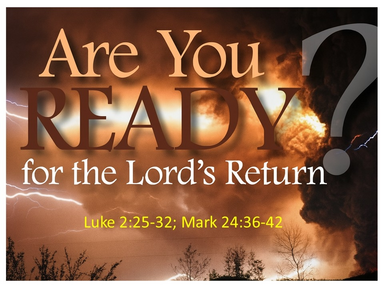
So, today we’re going to ask
the question: What does it
mean to be ready to meet
Jesus? And more importantly: Are we truly living in a way that
reflects the urgency and beauty of His return? Let’s open our
hearts to God's Word and let the Spirit prepare us for that
glorious day.
2
Stanley E. Porter, “Simeon (Person),” in The Anchor Yale Bible
Dictionary, ed. David Noel Freedman (New York: Doubleday, 1992),
26.
3
Walter L. Liefeld, “Luke,” in The Expositor’s Bible Commentary:
Matthew, Mark, Luke, ed. Frank E. Gaebelein, vol. 8 (Grand Rapids,
MI: Zondervan Publishing House, 1984), 849.
2|P age
Simeon’s Life: A Model of Faithful Readiness
If we’re wondering what it truly looks like to live ready
for Christ’s appearing, we need look no further than Simeon—
an ordinary man who lived with extraordinary expectation.
While some scholars
have speculated about
Simeon’s
identity—
suggesting he may have
been the successor to
Zechariah, the father of
John the Baptist, or even
Gamaliel the elder2—
Luke offers us none of
that.
No
priestly
credentials. No ties to the Sanhedrin. No religious pedigree. 3
Instead, Luke paints a simple yet profound picture: Simeon was
a righteous and devout man, filled with the Holy Spirit, who was
waiting for the consolation of Israel (Luke 2:25).4
4
Walter L. Liefeld, “Luke,” in The Expositor’s Bible Commentary:
Matthew, Mark, Luke, ed. Frank E. Gaebelein, vol. 8 (Grand Rapids,
MI: Zondervan Publishing House, 1984), 849.
I believe Luke intentionally leaves Simeon’s background
obscure—not to downplay his importance, but to highlight
something greater: that anyone—regardless of title or status—
can live a life ready to meet the Lord.5 Simeon’s greatness didn’t
come from his position, but from his posture before God. He
listened, he watched,
and he waited. And
because he walked in
the Spirit, the Lord
revealed to him a
personal promise—
that he would not see
death until he had
seen
the
Lord’s
Messiah (Luke 2:26).
For years, perhaps decades, Simeon clung to that promise.
Anchored in the hope spoken through Isaiah—“Comfort,
comfort my people, says your God” (Isaiah 40:1) and “I will heal
them and guide them and restore comfort to Israel” (Isaiah
57:18)—Simeon lived with holy anticipation, trusting that God's
Word would come to pass.6
Paul says, “desires what is contrary to the Spirit” (Galatians
5:17), or to the influence of “the prince of this world” (John
12:31), who entices us with self-gratification, moral
compromise, and the shifting sands of relativism. But deep
down, we know better. We carry the weight of respectable
sins—those
attitudes and actions
we’ve grown too
comfortable with:
gossip that passes as
concern, impatience
we blame on stress,
and
greed
we
disguise
as
ambition. And when
we look in the
mirror, clothed in what Isaiah called “filthy rags” (Isaiah 64:6),
we sometimes wonder if true holiness is even possible for people
like us. Legalism whispers shame. The enemy says we’ll never
be worthy. And the goal of Christlikeness can feel
discouragingly out of reach.
Hearing that Simeon was devout and righteous naturally
causes us to reflect on our own lives—and all the ways we fall
short of God's call to holiness. It's tempting to excuse our
spiritual complacency by pointing to our sinful nature, which, as
But praise God—those voices are not the final word.
Holiness is not about being sinless but being submissive. It’s
about yielding to the Holy Spirit, who produces in us a harvest
of fruit: “love, joy, peace, forbearance, kindness, goodness,
5
6
James R. Edwards, The Gospel according to Luke, ed. D. A. Carson,
The Pillar New Testament Commentary (Grand Rapids, MI;
Cambridge, U.K.; Nottingham, England: William B. Eerdmans
Publishing Company; Apollos, 2015), 83–84.
3|P age
Thabiti Anyabwile, Exalting Jesus in Luke, Christ-Centered
Exposition Commentary (Nashville, TN: Holman Reference, 2018),
51.
faithfulness, gentleness, and self-control” (Galatians 5:22–23).
To be holy is not to live perfectly—but to live surrendered. It’s
to sit at the Master’s feet, daily accepting His invitation to walk
in grace and truth. It’s in that quiet submission that we, like
Simeon, learn how to wait well—faithful, watchful, and ready.
they encountered Simeon—it was by the leading of the Holy
Spirit (Luke 2:27). And at that divinely appointed moment,
Simeon took the child in his arms and lifted his voice in what the
church would later call the Nunc Dimittis— a song of peace that
has echoed through evening prayers since the fourth century.7
“Sovereign Lord, as You have promised,
Simeon’s Reward: He Held the Fulfillment
You may now dismiss Your servant in peace.
For my eyes have seen Your salvation,
In the quiet of his submission and the depth of his
devotion, Simeon was granted what generations before him had
only dreamed of—
he saw the Christ,
So erei n Lor , s ou
and he held in his
e romise ,
ou m no ismiss
arms
the
our ser n in e e
fulfillment
of
or m e es
e seen
our s
on, i
God’s salvation.
ou
e re re in e
When Mary and
si
o
n ons
i
or re e on o e
Joseph entered the
en es, n
e or o
temple to present
our eo e sr e
Luke
Jesus and offer the
required sacrifices
according to the
Law of Moses (Luke 2:22–24), it was not by coincidence that
which You have prepared in the sight of all nations:
7
8
James R. Edwards, The Gospel according to Luke, ed. D. A. Carson,
The Pillar New Testament Commentary (Grand Rapids, MI;
Cambridge, U.K.; Nottingham, England: William B. Eerdmans
Publishing Company; Apollos, 2015), 85.
4|P age
a light for revelation to the Gentiles,
and the glory of Your people Israel.”
(Luke 2:29–32, NIV)
In this beautiful, intimate “I-Thou” doxology—between a
trusting servant and his benevolent Master8—Simeon proclaims
that the long-awaited Consolation of Israel is also the Light of
the world. The salvation he holds is not only for the Jews, but
also for the Gentiles, just as Isaiah had foretold (Isaiah 49:6).
With overflowing joy, Simeon reminds God’s covenant people
that they were never meant to be the end of God's revelation, but
rather the channel through which the Messiah would be made
James R. Edwards, The Gospel according to Luke, ed. D. A. Carson,
The Pillar New Testament Commentary (Grand Rapids, MI;
Cambridge, U.K.; Nottingham, England: William B. Eerdmans
Publishing Company; Apollos, 2015), 85.
known to all nations.9 So complete was his joy and peace that he
declared with bold contentment: “You may now dismiss Your
servant in peace” (Luke 2:29). His watch was over. The promise
had been fulfilled. And his heart was at rest. To be ready when
Christ returns, we must walk like Simeon—Spirit-filled,
watchful, and holy.
Our Call: Be Found Ready when Christ Returns
False messiahs and prophets will deceive many (vv. 5, 11,
24)
Wickedness will increase, and love will grow cold (v. 12)
The gospel will be preached to all nations (v. 14)
Wars, famines, earthquakes—these are the beginning of birth
pains (vv. 6–8)
Believers will face persecution and death (v. 9)
The abomination of desolation will appear (v. 15)
Just as Simeon was ready when the Messiah came the
first time, we too must be ready for His return—for unlike
Simeon, who was told by the Holy Spirit that he would not see
death before seeing the Lord’s Christ, we have not been given
the timing
of
His
coming
again.
When the
disciples
asked
Jesus, “What will be the sign of Your coming and of the end of
the age?” (Matthew 24:3), He gave what is now known as the
Olivet Discourse, recorded in Matthew 24:3–44. In it, our Lord
described many signs that would precede His return:
The sun will be darkened, the moon won’t shine, and stars
will fall (v. 29)
9
Cambridge, U.K.; Nottingham, England: William B. Eerdmans
Publishing Company; Apollos, 2015), 86.
James R. Edwards, The Gospel according to Luke, ed. D. A. Carson,
The Pillar New Testament Commentary (Grand Rapids, MI;
5|P age
Because many of these signs seem present in our world today,
some theologians—both scholarly and armchair—argue that we
are living in the end
times. But is this not,
at best, speculation?
After all, when have
these signs not been
present in this broken
world, a world still
groaning under the
“bondage
of
corruption” as Paul describes in Romans 8:20–22?
Yes, we are certainly closer to His return than ever before, but
Scripture reminds us with clarity and finality:
“But of that day and hour knoweth no man, no, not the angels of
heaven, but my Father only.”
— Matthew 24:36 (KJV)
To be ready when Christ returns, we must walk like Simeon—
Spirit-filled, watchful, and holy. So then, if even the angels do
not know, and speculation offers no certainty, what can we do to
be found faithful when Christ does return?
To answer the question of how we can be found faithful,
Jesus first warns us how easy it is to be caught unprepared. In
the days of Noah, people were eating, drinking, marrying, and
going about their ordinary routines right up until the flood
came—and
swept them all
away
(Matthew
24:38–39).
They lived as
though
judgment
would never
come, or at
least not in
their lifetime.
Noah’s faithful obedience in building the ark for decades
provoked mockery in some and indifference in others. The
problem wasn’t ignorance of the warning—it was spiritual
apathy. When the heart is consumed with the “god of self,”
6|P age
holiness becomes optional, and complacency takes root. We
slowly become friends of the world and imitators of the prince
of this world rather than followers of Christ.
To be found faithful when Christ returns requires that we
keep our eyes fixed on Him. Simeon met and held the infant
Jesus in his arms because he walked in step with the Spirit
(Galatians 5:25). Likewise, we are called to live not in anxious
striving but in Spirit-led obedience. We are not to worry about
what we will eat, drink, or wear—for the Good Shepherd knows
our needs. Instead, Jesus tells us to:
"Seek ye first the kingdom of God, and his righteousness; and
all these things shall be added unto you."
— Matthew 6:33
Since our lives are but a vapour that appears for a little time and
then vanishes (James 4:14), it is vanity to store up treasures on
earth, where moth and rust destroy (Matthew 6:19). Instead, we
are called to run the race to win the prize—not for earthly
applause, but to please our Lord (1 Corinthians 9:24). So, we
watch. We pray. We repent. We walk in step with the Spirit, and
we live with reverent awe before the Father’s throne.
Don’t let Satan deceive you into wasting your opportunity to be
found faithful. Live ready. Live holy. Will you be found ready?
Will you be walking in the Spirit, clothed in holiness, and
watching with joy? Today is the day to cast off complacency and
cling to Christ. The time is short. The promise is sure. Live filled
with the Spirit—so that when the trumpet sounds, you can
joyfully and boldly cry:
Come, Lord Jesus, come!
