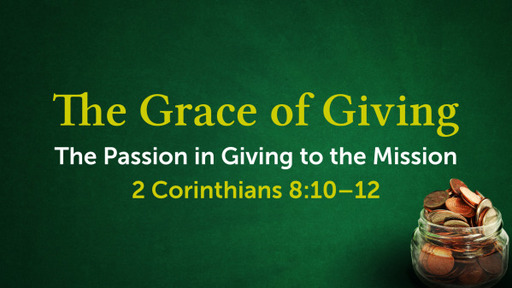
The Grace of Giving (3)

Notes
Transcript
“The Passion in Giving”
Text: 2 Corinthians 8:10–12 (KJV)
Introduction:
Introduction:
Many believers intend to give, few follow through.
In these verses, Paul gently urges the Corinthians to move from good intentions to godly action.
He emphasizes that willingness is the first mark of grace giving
but willingness must be followed by faithful execution.
The Corinthian church had promised to participate in the offering for the saints in Judea but had failed to fulfill it.
Paul is not demanding or commanding; instead, he appeals to their heart.
His words in 2 Corinthians 8:10-12 show us that giving is not just about resources—it’s about a readiness to give, a willingness to give, and the heart to give.
Giving is an act of grace, and grace stirs passion in the heart of the believer.
Let’s read the passage:
“And herein I give my advice: for this is expedient for you, who have begun before, not only to do, but also to be forward a year ago.
Now therefore perform the doing of it; that as there was a readiness to will, so there may be a performance also out of that which ye have.
For if there be first a willing mind, it is accepted according to that a man hath, and not according to that he hath not.”
— 2 Corinthians 8:10–12, KJV
We have seen so far, the practice of giving by the Maccadoians, the pattern of giving from the Messiah and tonight I want us to see the Passion in giving for the Mission
So the first thing we see is
I. The Promise Made
I. The Promise Made
v. 10)
“...ye who have begun before, not only to do, but also to be forward a year ago...”
A. The Initial Zeal
The Corinthians were the first to be excited about the offering for the saints.
A year earlier, they had been among the first to express a zeal to give (10c)
They had the desire and even began to do something about it. (10c)
Good intentions are a great beginning, without good intentions nothing would ever get done.
But Good intentions do nothing to reach a goal.
Passion in giving begins with zeal
—a heart eager to participate in God’s work.
But just having a zeal for the work of God does nothing to accomplish the work.
Paul said you had it but you did nothing with it.
A. The Initial Zeal
B. The Interruption of Indifference
..who have begun before, not only to do, but also to be forward a year ago.
He pretty much said, “hey look up here, you started out right. You started out with a zeal, with a desire but something hindered you”
Time passed, enthusiasm cooled, and no action was taken.
The delay reflected a spiritual lapse, not a financial one.
Paul reminds them it’s time to finish what they started.
Passion in giving is not just about good intentions but faithful completion.
Application:
Have you started something for the Lord but haven’t followed through?
Has your passion cooled?
Let this word rekindle your fire to finish what you’ve begun in the grace of giving.
II. The Performance Needed
II. The Performance Needed
(v. 11)
“Now therefore perform the doing of it; that as there was a readiness to will, so there may be a performance also out of that which ye have.”
Paul gives godly advice—not a command, but wise counsel.
Giving should be led by the Spirit, not forced by guilt.
A passionate giver listens to godly guidance and responds with joy.
A. Willingness Must Lead to Action
It's not enough to say, “I want to give.”
Paul does not accept willingness as a substitute for obedience.
Philippians 2:13 “For it is God which worketh in you both to will and to do of his good pleasure.”
Passionate giving moves from desire to deed, from willing to working.
God places a willingness in us, so that we will do it so He is pleased.
A. Willingness Must Lead to Action
B. Give According to What You Have
God never asks us to give what we don’t have.
He honors proportionate giving
—faithful stewardship, not forced sacrifice.
Up until this study I believed that giving to missions was based all on faith. Faith that God would provide that which I dont have so that I can give.
But from what I have seen, God has already given it to us, we are just using it for the wrong things.
be a performance out of that which ye have.” Pretty plain to me.
I should be a good steward of that which He has already given me so that I can give more to missions.
Instead of going out to eat 3 times a week, only go out 1 time a month.
Thank about all the extra money you would have to give
God has given us all plenty, we just use it on the wrong things.
That is why it is called grace giving.
Grace giving means giving from what you have, not what you wish you had.
God measures not by portion but by proportion.
Illustration:
A man once accidentally gave his week’s expense money as an offering. The pastor said, “God saw your heart—He recorded what you intended to give.”
The principle?
God honors the heart that wants to give more, but He also notes the heart that could give more and chooses not to.
Application:
You may not have abundance, but you do have something. Passion in giving isn’t measured by the size of the gift but by the sincerity of the heart.
III. The Perspective Honored
III. The Perspective Honored
(v. 12)
“For if there be first a willing mind, it is accepted according to that a man hath, and not according to that he hath not.”
A. The Heart Comes First
God sees the willing mind before the open hand.
Passionate giving is about heart posture, not bank balance.
Mark 12:43–44 “And he called unto him his disciples, and saith unto them, Verily I say unto you, That this poor widow hath cast more in, than all they which have cast into the treasury: For all they did cast in of their abundance; but she of her want did cast in all that she had, even all her living.”
– The widow’s mites were counted as much because of her motive.
Just how small was here offering:
became used as a noun, denoting a small copper coin, often mentioned in the Mishna as proverbially the
So how much is one farthing, it is 1/4 of a penny
a denarius was considered a days wage
so it would take 128 mites to make up a days wage
it would take 3 mites to make a farthing which would take 46 of to make a denarius.
You have a big bank account and give but still can do all that you did before, did you really give in grace?
You have nothing to give but 2 pennies yet you gave them. God honors that over someone giving 1000$ yet still has in abundance.
Dave Ramsey is very wealthy, but one thing I do know he is very genorus when it comes to giving. Im sure he could more and I am sure he knows he could give more.
but you dont have to be a dave ramsey to give
You can give what you have now and watch God give back in abundance. (more than financial)
He doesn't demand beyond your means.
Giving is grace-based, not performance-based.
A. The Heart Comes First
B. Giving Reflects Grace, Not Guilt
It’s not about equal amounts—it’s about equal sacrifice and love.
No manipulation, shame, or pressure is needed.
God desires cheerful, not compelled, givers (2 Cor. 9:7).
Grace motivates us to give willingly, cheerfully, and passionately.
Application:
Never underestimate the value of your gift when it’s given with a sincere heart.
God accepts and honors every act of grace-filled generosity.
Conclusion:
Conclusion:
Paul wanted the Corinthians to rediscover the passion they once had for giving.
He wasn’t just after their money—he was after their hearts.
True giving flows from a heart touched by the grace of God.
When grace grips us, generosity becomes a joy, not a job.
Have you lost your passion in giving?
Has the fire gone out?
Let the grace of God rekindle that fire today.
