The Star: A Cause For Invitation And Interrogation

Notes
Transcript
Handout
Intro
Intro
The Word of God is like an Onion in two ways. It is alive, and it also has layers. I have talked about Layers in the Bible. The word of God is a not a static textbook for us. We do not read a text and say “yep, got it!” The Word of God is described to us as alive, actively working. This is one aspect that I love. I have read Matthew 2, our text today, many times before. And this week, I was blessed to understand it new and fresh. And knowing that it is a live and active, I look forward to the next time I read it, maybe years from now, and the Spirit reveals new insights to me. Not that the message is changed, but that we can grasp new truths and applications that we did not see before.
Sometimes, we are not good at accepting the reality that we need Jesus, and that we must worship Jesus.
My youngest girl has entered the terrible twos. And with the twos comes independence. She thinks she is able to do everything all on her own. She is unwilling to admit she needs help, even when it will benefit her most, even when she is most harmed by not accepting help.
One recent one, she loves to climb into mom’s car by herself. She feels so big and loves the challenge of climbing into her seat herself. But then she wants to climb up into my truck herself. She says “me! me! me!” And I first I just picked her up and was going to shove her in her seat. But she screamed and started to cry and scream because she wanted to do it herself.
I know it’s not good parenting to give into your kids, but this time, I gave into her screams and cries. I said fine, do it yourself. I set her on the ground, and watched her do her herself. She began with such confidence, and kept trying, much to my amusement. She tried and tried, and then realized, the loving and helping offered to her should be graciously received.
We can do this ourselves also. We can be unwilling to accept the one being offered to us as well. This is going to be the focus of our story today.
MAIN POINT: True seekers of Jesus are called away from worldly concerns toward true and active worship of King Jesus.
I. Searching Magi Verses v1-2
I. Searching Magi Verses v1-2
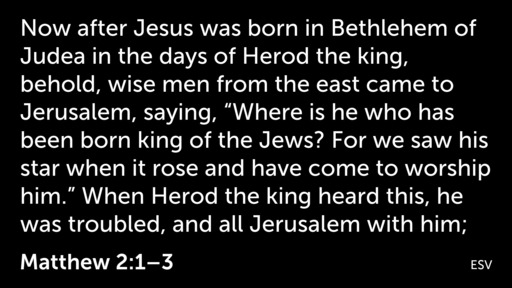
First today, we see the Search of the Magi. We see this in Verses 1-2
This chapter opens with the Magi coming from the east.
Magi were a priestly caste. Magi existed in other places like Israel and Egypt, but these ones are coming from the east, most likely from Persia or Babylon. The same title is given to a Jewish man who practices magic that Paul and Barnabas find in Acts 13.
They were less likely to be kings, despite the song “we three kings” and more likely to be wise men.
These Magi were well studied and known for using a myriad of studying methods. They would consult ancient texts from many different religions and ethnicities. But, Magi were also known for using other means for knowledge as well such as astrology and occult practices.
While we don’t know exactly who these Magi were or even exactly where they were from, they were important. important enough to upset the city of Jerusalem, and were able to get a meeting with the King right away.
We also remember that Daniel had some major influence into eastern Magi. The Jewish captives would have had a lasting effect even for these people.
Some of the great mysteries of the Bible are around this star. What was it? How did it come about? How did the Magi know to follow it? How did they know it was bringing the King of the Jews? Why did they think the King of the Jews was so significant?
One textual thing to note is the difference between in translation that happens in verse 1 and 2. Some of you will want to ignore this, and that is just fine, but some of you are interested in translation information. Some of your translations might say “we have seen his star in the east.” But this is not the best way to translate the original languages here. We have some words in English that have multiple meanings, like the word Trunk. I might be thinking about a tree, a swim suit, a piece of luggage, or an elephant nose when I say trunk. The Greek word here is ἀνατολῇ and it has multiple meanings as well. And it is actually used in two different ways in our passage. Vs 1 it is wise men from the ἀνατολῶν, and then in verse 2, it is a star that is ἀνατολῇ. This Greek verb that gives us the noun means “rising.”
The best way to translate verse two or ἐν τῆ ἀνατολῇ from Greek is “at it’s rising” or “when it rose.”
Why is this important? Because they don’t see the star in the east, they come to follow the star to Judea.
Some have postulated that this star could have been a supernova that was recorded by Chinese and Korean authors around the time of Jesus’s birth. Some say it was an aligning of Jupiter and Saturn that happened near Jesus’s birth, some say an aligning of Jupiter and Venus that happened around Jesus’s birth, or maybe it was something special God revealed to those Magi.
Speaking of the star in the sky, John Piper says that God “wields the universe to make his Son known and worshiped.”
We might be tempted to think one of these star events happened to come at the time of Jesus, or that God made it so that Jesus would be born when the stars were aligning, as if God was fitting his plans into what was naturally happening in the skies. But this is the wrong way to think about this event. God made the stars do this for his Son. God was showing the majesty of Jesus.
But how did they know to follow this star? This is a tricky questions, but one that is not without explanation. We read the passage in Isaiah 60 about a bright light coming to shine into the darkness, and the nations, aka the Magi, coming to gather around it. Psalm 72 is another reference. But I believe a key text for these Magi was Numbers 24:17
17 I see him, but not now; I behold him, but not near: a star shall come out of Jacob, and a scepter shall rise out of Israel; it shall crush the forehead of Moab and break down all the sons of Sheth.
Most pastors might just give a quick quote and say “fulfilled.” But you know how we do things here. We love the Old Testament. And so does Matthew. We want to know what is going on.
You might have heard about the story of Balaam and the talking Donkey. In Numbers 22, the Children of Israel have been freed from bondage in Egypt, and are sweeping their way back to the promised land, conquering and destroying anything that stands in their way because of the almighty power of YHWH. King Balak is the Moabite who is scared and also frusterated with these people coming into his land. He desires to spiritually curse them so he can physically conquer them.
So he calls on this guy Balaam who is a spiritually connected person, who has some relationship to YHWH, the God of Israel. He wants Balaam to pronounce a divine curse on them. Balaam tries go curse these people, but his donkey and him end up having a conversation that changes his mind. Three times when he is meant to be cursing them, he blesses comes out of his mouth.
This odd gentile individual cannot help but worship YHWH and praise the star who would be coming to crush evil.
There is an allusion happening between this story in Matthew, and the ancient story in Numbers. More to come on this. But for now, these gentile worshipers realized that their best human fulfilment would be found in worshiping this King, just like Balaam.
Verse two is the first of 10 times that Matthew will use the word Worship. One time is Herod and false worship, twice the word is used in conversation between Jesus and Satan. Two other times we see false worship, and three times we see true worship of gentiles. Again, pointing us to Matthew theme of gentile inclusion.
And what we see is the Magi responding. God is able to use the un-jewish means of astrology to bring these unlikely worshipers to king Jesus.
There is a point being made to us about the gentiles being the seekers, not Jews who should be the seekers. These gentiles are eager to worship.
We as humans have been created to worship. This is what humans do. We worship. And there are a lot of things in this world for us to worship.
When we think of worship, I don’t just want us to think of bowing down to an image. Rather, what are we devoting our lives to?
We might be devoting our lives to work, family, sports, community, school. It could be said that we “worship” these things and put them in a higher place than God.
Many of us fill out lives with so much stuff. Many of us are worshiping multiple things. When it comes to sacrificing something in our lives, Jesus and his church are first, and these other things we worship take precedence and priority.
Certainly for these wise men, worshiping Jesus was not convenient or easy. They had to leave their homeland. Leave their lives and the things they think are important, to travel for months, to worship this born King. They gave up everything, to dedicate their lives to the worship of this King.
Nothing will fulfill our desire and longing to worship like Jesus will.
II. Self-Centered Herod Verse v3-4
II. Self-Centered Herod Verse v3-4
Second, we see the Self-Center of Herod. We see this in verses 3-4.
While the gentiles are excited for the new King of the Jews, the current King of the Jews is troubled.
Notice in verse three, all of Jerusalem with Herod are troubled. This new king might upset the current life that they all lived.
What is baffling is that the wise men, who weren’t Jewish have figured out the Jewish King out on their own. But Herod, has to assemble a group of people to figure out the Jewish King. It’s great irony.
Herod feels threatened because he was not the rightful Jewish king, he was a Roman puppet. We will talk about that more next week.
Glover says “He was more interested in saving his throne than his own soul.”
Herod here links Messiah and King of the Jews. Interestingly, the next King Herod at the time of Jesus’s death also would make the connection to him being the Christ and King of the Jews.
Back to the story of Balaam and King Balak in Numbers, Herod is an allusion to King Balak. He is self-centered, only thinking about his own kingdom. He cannot understand the larger thing happening beyond himself.
For us, are we willing to submit to the one true king, or will we serve ourselves for our own glory?
III. Static Jews Verses v5-6
III. Static Jews Verses v5-6
Third, we see the Static Movement of the Jews. We see this in verses 5-6.
This is the Matthew Throwback. And if we set this section up as a Chiasm as I have done on your notes, you see that this might be what Matthew is pointing us toward.
You will remember that this Chiasm is a ancient literature structure of parallel thoughts pointing us to a central point.
But this Matthew throwback is interesting for a few reasons. First, this throwback doesn’t come from Matthew’s insights, but rather from the Jewish leaders themselves. They are unintentionally helping us understand how Jesus comes to fulfill prophecy of the Old Testament. God is so powerful that he is able to use their unintentional insights to help us understand fulfillment.
Several things are odd about this quote. It doesn’t exist in the Old Testament. It is actually a mash up of two verses. It is Micah 5:2 and 2 Samuel 5:2. Interestingly, though they didn’t have verse numbers back then, both are 5:2.
2 But you, O Bethlehem Ephrathah, who are too little to be among the clans of Judah, from you shall come forth for me one who is to be ruler in Israel, whose coming forth is from of old, from ancient days.
2 In times past, when Saul was king over us, it was you who led out and brought in Israel. And the Lord said to you, ‘You shall be shepherd of my people Israel, and you shall be prince over Israel.’ ”
The Jewish leaders have connected this idea that the Messiah, the true Jewish King is going to come to Bethlehem, and that he will shepherd his people. Something they were meant to be doing.
Another odd item is that the Jewish leaders add “by no means.” Emphasizing that if the Messiah is coming from Bethlehem, it is certainly going to be significant. More significant that everything they thought was significant in Jerusalem.
So, these scribes and pharasees, these experts of the Jewish religion, have figured out that this one being born really could, quite possible be, the Messiah, the one they had been hoping for. They have figured it out! They have searched the scriptures and found that this baby is fulfilling the prophecy.
But even with this knowledge, what is their response?
They don’t do anything. There is no “ah ha!” moment that they have. They don’t drop what they are doing, after understanding the scriptures, and run to Bethlehem. They don’t go with the Magi. Rather, their response is no response at all. They are static. Though they understood the truth, the did not respond to the truth.
Notice they did not sin because they did something, they sinned because they didn’t do something. They failed to act. Their sin was passiveness. Not taking action.
We can be like these religious leaders. Especially, those of us who have grown up in the church or been in church for a long time. We know the Bible, we understand it. We have everything in our heads correct, but we are unwilling to run to Jesus and worship. Maybe we are leaning on our past accomplishments or past relationship with Jesus rather than actively walking towards him to Worship him in this moment.
In our last house, we had a three way circut that never worked. I don’t know what was wrong with it, but we couldn’t figure it out. We worked on everything else in the house, except for this one thing. It was something we knew we needed, and would bennefit us, but we just didn’t take the time to fix it. We constantly frusterated ourselves with walking back and forth to try to figure out this odd lighting system. We made it work. But in order to sell the house, we wanted to fix it. So i ran knew wire for the entire circut, new switches, the whole thing. For the last couple of months we lived at that house, we took great joy in having a three way circut that worked! We loved it an apprciated it!
We can do the same thing in our lives with Jesus as well. We become complacent in our relationship with Jesus. We know that maybe there is a problem, something that we need to change, something that is keeping us from walking closer to Christ, we’ve been presented with the truth, but we are just complacent. We are static in our walk. The passive relationship with Jesus can be just as much of a problem as active sin in our relationship.
IV. Self-Preserving Herod Verses v7-8
IV. Self-Preserving Herod Verses v7-8
Four, The self-Preservation of Herod found in verses 7-8.
This is almost the same point as his self centeredness in point two, but we needed this point to complete the Chiasm, and the text called for it.
But Herod makes this secret meeting to tell of this secret plan will ill intension. He doesn’t want people to know his real intensions. He tells them to go and “search dillegently” and report back. He is unwilling to search, but encourages their search for the king. But his desire to find the Jesus is not to worship, but rather to ensure he is still worshiped.
Jesus came to choke out the authority and self centered focus of these religious leaders. And Jesus comes to do the same in our hearts as well. He comes to remove the self-centered focus, and what we think is best for our lives to show us what is truly best for our lives. He comes to be the one we were made to worship, yet, sometimes, we trust ourselves, and attempt to save our own kingdom for me, myself, and I.
Maybe they thought their way was better. Though confronted with truth, they were not willing to change and give up what they thought was best.
Illustration: In 1847, a Hungarian doctor by the name of Ignaz Sammelweis did a study on patients helped by physicians who washed their hands, and patients who were helped by physicians who didn’t wash their hands. This was at the time of the Puerperal fever which affected many children. Though this would be obvious to us, they did not have a real understanding of the micro world beyond what they eye could see. But Dr. Sammelweis determined that some sort of unseen particle from sick and dead patients, was getting healthy people , especially kids, sick.
In his clinic, he made a simple solution to have physicians under his care wash their hands in a chlorinated solution. And he noticed that the great mortality rate almost completely went away.
When Dr. Sammelweis attempted to publish and tell other doctors to start washing their hands, he was met with ridicule, hostility, and skepticism. Other doctors did not want to think that they, the healer, were the ones spreading the disease. Also, unseen particles don’t exist. They trusted their own knowledge and feelings rather than change based on the presented truth. Because of their pride, fear of change, or unwillingness to understand something new, countless people continued to die when an easy solution was being offered.
Much like these terrible doctors, we can be the same. Knowing in our heads that Jesus is truly who he says he is, but unwilling to change our lives and practices in light of that. Unwilling to commit fully to this King’s Kingdom. We continue in the mundane worship of other things around us, when we are being offered true fulfillment of worshiping Jesus.
V. Sincere Worshipping Seekers v9-12
V. Sincere Worshipping Seekers v9-12
Last today, we see the sincere worship of the seekers. We see this in verses 9-12 today.
We see in verse 9 that this star seems to reappear. If you were questioning whether or not this was a supernatural event, we are being reminded here that something supernatural is happening. This star that had originally brought them to Jerusalem is now leading them to the place where the child was. Maybe this star is only being seen by them as it appears to be being used to lead just the Magi.
Verse 10 is great. When they saw this star reappear, they were thrilled. The greek is literally “they rejoiced with very great joy.” The ESV does a great translation here of “they rejoiced exceedingly with a great joy.”
This great rejoicing is meant to be a contrast to the previous actions of Herod and the Jewish leaders. Herod and the Jewish leaders had the truth clearly presented to them from the Word of God, and did nothing. Their response given to us in verse two is that it troubled them. Their response to Jesus was anxiety and fear.
But these gentile believers, who had much less, just a vague star to follow, were joyful as they continued to seek the king.
Notice that they come into the house, they see Mary and and child, but the worship the child alone.
Jesus was in a house, quite possible the same house the shepherds came to.
These gentile seekers are allowed to go in and worship. His presence, the presence of Jesus is accessible to all.
These gifts have a lot of information read into them. While it might be possible that Gold represented Jesus’s royalty, Frankincense his Divinity, and Myrrh his burial and sacrifice, this might be giving to much credit to the Magi. While they have a grasp on Jesus being the King of the Jews in Royalty, they likely did not understand his divinity and coming sacrifice. Likely, they were giving valuable gifts to one they believed deserved it.
The Bible does mention these three gifts explicetly and they do have ties to the Old Testament. In our passage that we started the service with, the nations bring him Gold and Frankincense.
Gold is the most prominant metal in temple worship, tabernacle worship, and the high priests garments.
Frankincense was involved with priests as they worshipped.
Myrrh was used as a holy anointing oil for priests at ordination.
These gifts items are tied to worship. Worship of God.
The word here in verse 11 in the ESV is “offered” him gifts, and it is the same word used in verse 2 for their desire to “worship” him. Worship and offering are tied closely together. When we worship Jesus, we are willing to give up what is most valued and treasured in our lives to him.
The queen of Sheba who we will consider later on in Matthew presents Gold and spices to the Son of David. Here, it is foreign people who come, like the queen of Sheba, to present valuable gifts to a different Son of David.
While the identity of these Magi remain a mystery, what is important is that they were significant and important people. And even they fall down and worshipped this King.
And then in verse 12, we see that they have a dream not to return to Herod, but to go back to their own country in a different way. You will remember the significance of dreams with the wise men when we studied Daniel. And here, God uses what they would have known, dreams, to communicate a message to them.
Beyond the Walls: Grace and Growth
Beyond the Walls: Grace and Growth
Now we get to the Beyond the Walls part of this sermon where we consider the grace and growth that will continue to impact our lives.
Today, we think about worship. Worship goes far beyond what we do right here for this hour. Worship is meant to extend to all of our lives. In every part of our lives we are worshiping something. And if we say you are worshiping nothing, we might be worshipping ourself.
First, if you are here today and do not yet follow Jesus, he is being revealed to you today. Jesus comes to be accessible to all of us. Not just to the smart, not just to the strong, not just to the weak, not to the ones who thing they deserve it, but to the ones who don’t deserve him. He is here for you. He has come to restore you and make you whole. To rescue you from sin and from yourself. He comes to be all and in all for you. Will you accept him today and begin the worship of Jesus with your life as you follow him?
To all of us, we like Herod, are we blinded by our ambition, desires, and life business to miss what God is doing in our lives to bring us a relationship with Jesus? Have we filled our lives with the worship of stuff to where we are missing the worship of what we were really created for? All of this stuff in our lives is meant to bring us to the Savior, but are we letting it distract us from the savior?
What areas or your life have you become complacent and passive in? What areas of your life do you know you need to change and submit to Jesus? What is the burning thing on your mind right now that is keeping you from pursuing Jesus with everything?
We, like the Magi have been given a great blessing. A great joy. To joyfully offer our worship to this Savior. To do the thing that we were made for! Let us embrace the worship of this savior this week.
Let’s take a moment to bow our heads and close our eyes as we respond to the text together.
Pray and thank God for sending Jesus who is accessible to us.
Pray and thank Jesus that he is worthy of our worship as our King.
Pray and ask the Spirit to help us give up the pursuit of ourselves and worldly things to actively worship Christ as King.
