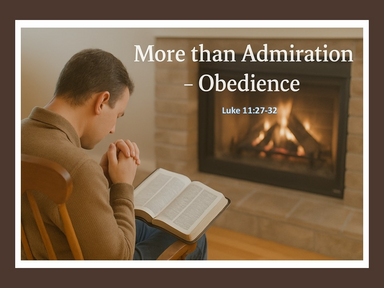
More than Admiration

Notes
Transcript
More than Admiration
Luke 11:27-32
Have you ever longed to see Jesus perform a miracle—
to witness the blind receive sight, the mute speak, or demons cast
out? Many in Jesus' day saw exactly that… and still walked away
unconvinced. Why? Because what God seeks is not spectators—
but surrendered hearts.
In Luke 11, we witness a dramatic moment—Jesus casts
out a demon from a man who had been mute. Instantly, the man
begins to speak. But he’s not the only one—Christ’s critics
suddenly find their voices too. Some accuse Him of performing
miracles by the power of Beelzebul, the prince of demons (Luke
11:15). In response, Jesus delivers a striking rebuke:
“Every kingdom divided against itself will be ruined, and a
house divided against itself will fall. If Satan is divided against
himself, how can his kingdom stand? … But if I drive out
demons by the finger of God, then the kingdom of God has come
upon you.”
— Luke 11:17–20
Still others demand more signs, refusing to believe despite all
they’ve seen. Jesus warns them soberly:
“When an impure spirit comes out of a person… it returns with
seven other spirits more wicked than itself… and the final
condition of that person is worse than the first.”
— Luke 11:24–26
1|Page
It’s easy to read these accounts and imagine what it would’ve
been like to see Jesus in action—healing the sick, giving sight to
the blind, making the lame walk, and even raising the dead.
Surely if we saw those things, we’d believe, right?
And yet, even when the One greater than the temple
stood before them, many in power felt threatened. The religious
leaders rejected Him. The crowds demanded more signs. Even
surrounded by truth, their hearts were hardened. Their response
wasn’t devotion—it was doubt. Today, we live on this side of
the cross. We know the full story—His atoning death and
victorious
resurrection.
Yet even with
that clarity, are
we not still
vulnerable to a
half-hearted
response?
Have we truly
grasped
the
worth of the
hidden
Treasure and
the Pearl of great price (Matthew 13:44–46)? Or are our spiritual
eyes clouded by the specks of sin (Luke 6:41) and our lives
dressed in the filthy rags of our own righteousness (Isaiah 64:6)?
The question before us is not just whether we believe the
Gospel—it is whether we are living lives worthy of it. Have we
responded to Christ not just with admiration, but with surrender?
Not just with respect, but with repentance and devotion?
Admiration without Obedience Falls Short
It’s one thing to admire Jesus—to be amazed by His
power, His wisdom, His compassion. But admiration alone falls
short. Jesus made this clear in a powerful moment, right after
confronting His critics and casting out a demon. Luke records:
“As Jesus was saying these things,
a woman in the crowd called out,
‘Blessed is the mother who gave
you birth and nursed you.’
He replied, ‘Blessed rather are
those who hear the word of God
and obey it.’”
— Luke 11:27–28
While Mary, the mother of the
Messiah, would indeed be called
blessed by all future generations
(Luke 1:48), 1 and while Israel was
blessed for being chosen to be a light to the nations (Isaiah 49:6),
Jesus redefines true blessing—not as something inherited by
association or ancestry, but by obedience. To be truly blessed is
to hear God’s Word and respond to it with faith and action.
Marveling at Christ’s authority—even His dominion over the
1
James R. Edwards, The Gospel according to Luke, ed. D. A. Carson,
The Pillar New Testament Commentary (Grand Rapids, MI;
Cambridge, U.K.; Nottingham, England: William B. Eerdmans
Publishing Company; Apollos, 2015), 348.
2|Page
unseen spiritual realm (Colossians 1:16)—is not the same as
entering into a saving relationship with Him.2 Those who
witnessed His miracles had a choice to make: would they receive
His works as confirmation of divine authority and submit to
Him, or remain skeptical and resistant?
How we respond to God’s Word still matters today. In
the Parable of the Sower, Jesus warns that the seed—the Word
of God—can be received with initial joy, but if it doesn’t take
root, the cares and distractions of this world will choke it out
(Luke
8:4–15).
Paul
exclaims,
“How beautiful are
the feet of those
who bring good
news”
(Romans
10:15), yet the
beauty
of
the
message demands a
response.
The
Word is living and
active—sharper than any two-edged sword. It penetrates deeply,
dividing soul and spirit, and exposing the thoughts and attitudes
of the heart (Hebrews 4:12–13). Each of us is faced with a
decision: Will we believe in Christ’s atoning sacrifice and yield
to His ways—which are higher than ours (Isaiah 55:8–9)—or
2
I. Howard Marshall, The Gospel of Luke: A Commentary on the
Greek Text, New International Greek Testament Commentary
(Exeter: Paternoster Press, 1978), 480.
will we dismiss His call in passive complacency or outright
rebellion? Jesus warns that casting out evil is not enough. Unless
we are filled with His Spirit and aligned with His kingdom—
gathering with Him, not against Him—the end will be worse
than the beginning (Luke 11:24–26). Mary was truly blessed to
bear the Savior, but Jesus reminds us: even more blessed are
those who hear and obey the Word of God.
The Dangers of Demanding Signs
But even as Jesus called the crowd to hear and obey
God’s Word, many remained unsatisfied. They wanted more
signs—more proof,
more spectacle—as
if the Son of God
needed to perform
on demand. But
their insistence on
additional miracles
exposed something
deeper: a heart
hardened
by
unbelief.3
In a
world where competing worldviews are constantly clashing, and
3
Walter L. Liefeld, “Luk ,” in The Expositor’s Bible Commentary:
Matthew, Mark, Luke, ed. Frank E. Gaebelein, vol. 8 (Grand Rapids,
MI: Zondervan Publishing House, 1984), 953.
3|Page
where accusations of “fake news” are used to discredit anything
inconvenient, truth often gets buried beneath spin and
skepticism. It's no wonder that many today—like the crowds in
Jesus’ time—demand absolute, irrefutable evidence before
they’re willing to believe.
Yet that was exactly the spirit Jesus rebuked in Luke
11:29. As the crowds swelled—not to follow Him in obedience,
but to witness
more wonders—
Jesus called them
what they truly
were: a wicked
generation.
Not
because they asked
questions,
but
because
they
refused to let His
words take root in
their hearts. They
were chasing signs, not truth. Jesus described that kind of heart
perfectly:
“To what, then, can I compare the people of this generation?
What are they like? They are like children sitting in the
marketplace and calling out to each other: ‘We played the pipe
for you, and you did not dance; we sang a dirge, and you did not
cry.’”
— Luke 7:31–32
Nothing satisfied them—John called them to repentance, and
they shrugged. Jesus offered grace, and they looked away.
Whether from skepticism or selfish expectation, they wanted a
version of the Messiah who would entertain their curiosity,
affirm their lifestyles, and fulfill their desires—without
demanding anything in return.
And so we must ask: after all the miracles recorded in
Scripture—after the cross, the empty tomb, and the transforming
power of the Gospel—why are we still looking for more signs?
Could it be that the problem is not the absence of revelation, but
the unwillingness to receive and obey what’s already been
given? But Jesus didn’t stop there. To expose the depth of their
unbelief, He pointed them to an old prophet with a familiar
story—a story that carried a sobering call to repent.
A Greater Jonah is Here – So Repent
In response to their demand for more miraculous signs,
Jesus pointed the crowd not to a new wonder, but to a familiar
and striking example from the Old Testament: the prophet
Jonah. To grasp what Jesus meant, we must first recall the story
He referenced. When the word of the Lord came to Jonah,
commanding him to go to the great city of Nineveh and preach
against its wickedness (Jonah 1:1–2), Jonah deliberately fled in
4|Page
the opposite direction—to Tarshish (1:3)—seeking to escape the
presence of the Lord. But God pursued him. A violent storm
threatened the ship he boarded, and when the sailors cast lots,
they discovered Jonah was the cause of their trouble. At his own
request, they threw him overboard (1:4–16), and God appointed
a great fish to swallow him.
For three days and three nights, Jonah remained in the
belly of the fish, where he cried out to God and vowed to fulfill
his mission. After being delivered, God spoke to Jonah a second
time, commanding
him again to go to
Nineveh
and
proclaim that in
forty days the city
would
be
overthrown (3:1–
4). Remarkably,
the people of
Nineveh believed
God.
They
declared a fast, wore sackcloth, and humbled themselves—
sitting in the dust from the least to the greatest (3:5–9). Even the
king arose from his throne, covered himself with sackcloth, and
called the nation to turn from their evil ways and violence,
hoping that “God may yet relent and with compassion turn from
his fierce anger.” And that is exactly what God did—He saw
their repentance and withheld the judgment they deserved
(3:10).
With all that God has already done, it’s not just
unreasonable—it’s sinful—to demand more proof of His right to
rule our lives. We live in a generation that eagerly investigates
the spiritual—seeking signs, experiences, and insights—yet
when it comes to the Word of God, they often read it with
skeptical eyes. They are, as Paul wrote, “always learning but
never able to come to a knowledge of the truth” (2 Timothy 3:7),
even as the very world around them testifies to God’s existence
and power (Romans 1:20). Deep within, they long to satisfy the
eternity God has placed in their hearts (Ecclesiastes 3:11),
aching for purpose and meaning. Yet when they encounter
God’s Word—His love letter of truth and redemption—they
recoil at its demands, as if the call to holiness were unattainable
(1 Peter 1:15–16).
But if our knowledge of Jesus is to move beyond mere
admiration, must we not honor Him by meditating on His Word
day and night (Psalm 1:2), allowing His truth to reshape our
thoughts
and
direct our steps?
His ways are
indeed
higher
than our ways
(Isaiah 55:9), but
they are not
unreachable—
they are revealed
and
made
possible through His Spirit. When His Word exposes the
darkness within us, the only right response is to seek His
mercy—like the people of Nineveh—through repentance and
faith, and to receive the forgiveness He graciously offers (Jonah
3:5–10). If we truly desire to live lives marked by holiness,
5|Page
where the devil finds no foothold, we must first—by the power
of the Holy Spirit—sweep our hearts clean of all sin and
unrighteousness. For genuine admiration of Christ always
begins with repentance.
A Great Solomon is Here – So Listen and Obey
To understand what it means to truly admire the Lord,
we need only look to the Queen of Sheba. Upon hearing of
Solomon’s fame—specifically his relationship with the Lord—
she undertook a long and difficult journey to see for herself and
test his wisdom (1
Kings 10:1). She
came not emptyhanded
but
bearing
extravagant gifts:
“camels carrying
spices,
large
quantities of gold,
and
precious
stones” (1 Kings
10:2). With deep curiosity, she brought hard questions, and
Solomon answered everyone (v. 3). Her response reveals both
awe and humility. She said, “The report I heard in my own
country about your achievements, and your wisdom is true. But
I did not believe these things until I came and saw with my own
eyes. Indeed, not even half was told me; in wisdom and wealth
you have far exceeded the report I heard” (vv. 6–7).
She went on to commend the joy of Solomon’s people
and then praised the Lord Himself: “Praise be to the Lord your
God, who has delighted in you and placed you on the throne of
Israel. Because of the Lord’s eternal love for Israel, He has made
you king to maintain justice and righteousness” (v. 9). It was a
long journey—but it was worth every step. She witnessed the
beauty, wisdom, and glory of a kingdom established by God and
led by a king who honored Him. And if the Queen of Sheba
rejoiced over Solomon, how much more should we rejoice in the
presence of One greater than Solomon—Jesus Christ, the true
and eternal King!
If the Queen of Sheba was willing to travel great
distances to hear the wisdom of Solomon, how much more
should we incline our
ears and open our
hearts
when
the
Living
Word
of
God—Jesus Christ—
speaks to us today? To
rightly respond to the
voice of the One who
calls us by name (John
10:3), are we not also
called to walk in His
footsteps?
True
reverence for the Lord
requires more than
admiration—it
demands submission. As the psalmist declares, “Your word is a
lamp to my feet and a light to my path” (Psalm 119:105), but
6|Page
that light must guide more than our thoughts—it must direct our
actions. We can’t ask God to cleanse us and then refuse to follow
Him. Those who read God’s Word are not only urged to turn
from sin but to do what is right in His sight (James 1:22). Even
when we walk through valleys of darkness and uncertainty,
when the end isn’t in sight, we must hold fast in faith. He is there.
He rewards those who earnestly seek Him (Hebrews 11:6). If we
are to give Him the worship He deserves—marked by reverence,
obedience, and wholehearted love—then we must live by “every
word that comes from the mouth of God” (Matthew 4:4).
Obedience is Possible
Before I conclude, let me offer a word of encouragement.
I know that the Word of God—rich in wisdom, poetry, prophecy,
parables, and end-times imagery—can at times feel
overwhelming
to
understand.
That
challenge
is
compounded by the
lingering “motes of
sin” in our own
eyes, which often
blind us to the truth
(Matthew 7:3), and
by the internal
struggle we face: “For the flesh desires what is contrary to the
Spirit” (Galatians 5:17). We are not only up against our sinful
nature but also spiritual opposition from “forces of evil in the
heavenly realms” (Ephesians 6:12). Considering this, reading
God’s Word with reverence—and obeying it—can feel beyond
our reach.
full revelation of God in the face of Jesus Christ (2 Corinthians
4:6). And the question that remains is not whether God has
spoken—it’s whether we will listen and obey.
But here is the Good News: obedience is not only
possible—it is promised to those who walk by the Spirit. God
has not left us alone. He has given us the Spirit of truth to guide
us into understanding (John 16:13), and the armor of God to help
us stand firm against temptation (Ephesians 6:13–17). By His
grace, we can rightly know the truth He has lovingly written in
His Word, and we can respond with humble submission. When
we lift our eyes to Him, we meet the gaze of a Father who
delights in being found by those who seek Him (Jeremiah
29:13). True admiration flows not from knowledge alone, but
from a heart that submits—and by the Spirit’s power, every child
of God can do just that.
Let us not be like those who admired Jesus from a
distance, applauding His works yet resisting His call. Let’s not
settle for a faith that demands signs but refuses surrender. Like
Nineveh, let us respond with repentance. Like the Queen of
Sheba, let us pursue the wisdom of Christ with all our hearts.
And like true disciples, let us receive His Word—not as
spectators, but as those who hear and obey. Blessed are those
who hear the Word of God and obey it (Luke 11:28). That is the
mark of true discipleship, the path of true blessing, and the
worship our Savior rightly deserves.
Conclusion
The people in Jesus’ day stood in the very presence of
God in the flesh. They saw miracles. They heard divine wisdom
from His lips. Yet many walked away unchanged—some
resistant, others passive, still others demanding more signs. But
Jesus declared, “Now something greater than Jonah is here…
something greater than Solomon is here” (Luke 11:31–32). That
declaration still rings true. We are not left waiting for a sign.
We have the cross. We have the empty tomb. We have the
written Word of God and the living presence of the Holy Spirit.
We have something even the Queen of Sheba never saw—the
7|Page
