Covenant and Covering (2)
Notes
Transcript
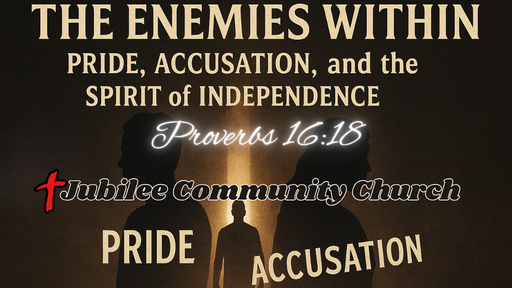
The Enemies Within: Pride, Accusation, and the Spirit of Independence
The Enemies Within: Pride, Accusation, and the Spirit of Independence
Wednesday Night Bible Study – Session 3
Series Title: Covenant and Covering
Session 3 Title: The Enemies Within: Pride, Accusation, and the Spirit of Independence
Date: Wednesday, July 23, 2025
Primary Text: Proverbs 16:18
18 Pride goeth before destruction,
And an haughty spirit before a fall.
I. Division Doesn’t Always Start Loud—It Often Starts Hidden
I. Division Doesn’t Always Start Loud—It Often Starts Hidden
Some of the most destructive spirits in relationships don’t come in violent rebellion or outright betrayal—they come subtly, quietly, and spiritually cloaked in self-righteousness or emotional independence.
Every broken covenant can be traced back to a spiritual intrusion—a foreign spirit that slipped in undetected.
II. The Spirit of Pride: The Root of All Rupture
II. The Spirit of Pride: The Root of All Rupture
A. Pride Resists Correction
A. Pride Resists Correction
Proverbs 13:10 – “Only by pride cometh contention…”
Pride makes you unteachable, unreachable, and eventually unrelational.
B. Pride Blocks Repentance
B. Pride Blocks Repentance
James 4:6 – “God resisteth the proud, but giveth grace unto the humble.”
In marriage or close relationships, pride says:
“I was right, even if it hurt you.”
“I don’t need to apologize.”
“I’ll wait for them to come to me.”
Pride is the spiritual cancer of covenant—it defends ego at the cost of unity.
1. Cuts Off Empathy
1. Cuts Off Empathy
Pride says, “I don’t need to feel your pain.” It distances you from the emotional experience of others.
Luke 18:11 (KJV) – The Pharisee stands apart and prays:
“God, I thank thee, that I am not as other men are…”
He shows no empathy, only superiority.
2. Blocks Vulnerability
2. Blocks Vulnerability
Pride fears exposure. It builds emotional walls and pretends to be invincible. Vulnerability requires humility.
Proverbs 11:2 (KJV)
“When pride cometh, then cometh shame: but with the lowly is wisdom.”
Shame hides behind pride. People disconnected emotionally often carry deep shame that they bury under arrogance.
3. Dismisses Correction
3. Dismisses Correction
A prideful heart is too emotionally disconnected to receive reproof. It won’t feel remorse or conviction easily.
Proverbs 13:10 (KJV)
“Only by pride cometh contention: but with the well advised is wisdom.”
Pride disconnects people from teachability and honest relationships.
4. Elevates Image Over Intimacy
4. Elevates Image Over Intimacy
Pride says, “Protect the image at all costs.” That kills intimacy—with people and with God.
Revelation 3:17 (KJV)
“Because thou sayest, I am rich, and increased with goods, and have need of nothing…”
Pride says: “I don’t need to change.”
Accusation says: “You’re the problem, not me.”
Independence says: “I’ll handle this myself.”
Let’s shine the light on these spirits and learn how to guard our relationships from their influence.
III. The Spirit of Accusation: Satan’s Native Tongue
III. The Spirit of Accusation: Satan’s Native Tongue
A. The Devil Is the Accuser
A. The Devil Is the Accuser
Revelation 12:10 – “The accuser of our brethren is cast down…”
Accusation is Satan’s primary ministry—it’s how he destroyed heaven’s unity, and it’s how he tries to destroy your marriage.
B. Accusation Distorts Motives
B. Accusation Distorts Motives
Instead of dealing with behavior, accusation labels identity:
“You always…”
“You never…”
“You only care about yourself…”
Job 1:9-11 – Satan accused Job of false motives: “Does Job fear God for nothing?”
The spirit of accusation replaces discernment with judgment and turns covenant partners into combatants.
IV. The Spirit of Independence: The Counterfeit of Intimacy
IV. The Spirit of Independence: The Counterfeit of Intimacy
A. God Designed Us for Interdependence
A. God Designed Us for Interdependence
Genesis 2:18 – “It is not good that the man should be alone…”
But independence says:
“I don’t need you.”
“I’m better off figuring it out myself.”
This is especially dangerous in marriages and leadership—it creates emotional walls, separate lives, and the illusion of peace through distance.
B. The Danger of Isolated Decision-Making
B. The Danger of Isolated Decision-Making
Proverbs 18:1 (AMP): “He who [willfully] separates himself [from God and man] seeks his own desire…”
When spouses stop involving each other in prayer, planning, and priorities, the covenant begins to unravel in silence.
Independence is not maturity—it’s rebellion in disguise.
V. Exposing These Spirits in Relationships
V. Exposing These Spirits in Relationships
A. Signs You’re Battling These Spirits
A. Signs You’re Battling These Spirits
Spirit Symptoms in Relationships
Pride Defensiveness, blame-shifting, coldness
Accusation Harsh words, suspicion, labeling
Independence Silence, solo decision-making, emotional distance
B. Spiritual Response
B. Spiritual Response
Pride must be humbled
Philippians 2:3 – “In lowliness of mind let each esteem other better than themselves.”
Accusation must be replaced with intercession
Luke 22:31-32 – Jesus didn’t accuse Peter—He prayed for him.
Independence must be exchanged for mutual submission
Ephesians 5:21 – “Submitting yourselves one to another in the fear of God.”
VI. Restoring the Covenant Through Humility and Honor
VI. Restoring the Covenant Through Humility and Honor
If these spirits are active, they must be cast out and replaced by the Spirit of Christ—who is:
Humble (Philippians 2:5–8)
Merciful (Lamentations 3:22–23)
Relational (John 15:15)
A. Covenant thrives where there is:
A. Covenant thrives where there is:
Repentance without resistance
Correction without condemnation
Unity without ego
If pride builds walls, humility builds bridges.
If accusation sows fear, intercession sows healing.
If independence isolates, intimacy reconnects.
Closing
“Lord, we renounce the spirits of pride, accusation, and independence. Expose their works in our lives and relationships. Teach us to walk in humility, speak life, and stay deeply connected in covenant. Cover our homes with the Spirit of unity and the bond of peace. In Jesus’ name, Amen.”
Quote
“You can’t carry the spirit of Christ and the spirit of accusation at the same time—one must bow.”
— Watchman Nee
