Meeting Unexpected Expectations

Notes
Transcript
Handout
Intro
Intro
Some of the best met Expectations we have are from unexpected places.
Sometimes, what makes a great employee is someone who does things they weren’t asked to do, or things that you didn’t know needed done.
Many of you know that before coming here, I was working for a high end cabinet company in Colorado. At the beginning 2024, the person above me was removed or left their post, and the company was sent into a tailspin without this critical member who held all the keys and processes. The company asked me to take her place, and I initially said no and told them i would not be with the company come fall (because I would be here with you). But after watching them flounder a bit, i reluctanlty took the position to stabilize the situation. I told them that I needed an assistant, and the assistant had better be able to do my job in 6 months, because I would be gone. So they hired one.
Some of the best assistance are ones that we don’t know we need, and find things better ways to do things that we don’t know. This is true for all employees. The employees that go above and beyond, find the ways to help in ways that are unexpected. This assistant helped me in ways I didn’t know I needed help in. She did everything I asked and then found other ways to be helpful.
In our passage today, Jesus comes to us in a similar way. He comes to meet expectations we didn’t know we had, and fulfill what we didn’t know needed to be fulfilled. This is the point that Matthew is driving home.
Main Point: Believers embrace Jesus as the one who fulfills unexpected and unknown expectations.
I’m going to warn you on the onset. This sermon is a bit nitty gritty, because these fulfillments that we deal with in our text today are nitty gritty. They are challenging. The gospel is there, but challenging for us.
We will look at three more throwbacks today. You will remember that Matthew loves to use throwbacks to the Old Testament. He loves to point us to the Old Testament and show us how Jesus is the fulfillment of it.
When we think about Fulfillment, we want to think of three different types of fulfillment we see in the Bible.
Actualization of predictive prophecy. This is the Prophecy...Fulfilled. Model. This would be like when Micah 5:2 says that Jesus would be born in Bethlehem, and then he is born in Bethlehem. When we think of prophecy, we can sometimes think that fulfillment just ends with this first one. But two other type of fulfillment also occur in Matthew.
Fruition or full intended meaning. This is like when Jesus says he is the fulfillment of the law. He comes to be the fruition of them, their fully intended meaning. He comes to be the end point of them. He shows us what they were really about because he is who they were really about.
Typology. This is what Matthew focuses on a lot. We might call these throwbacks. We might also call them Analogy or allegory. We can sometimes be skeptical when we hear the word “allegory,” but Matthew has been showing us how the biblical authors do this. Typology is a kind of allegory, but is different than allegory. The AntiType, or the object has to be better than the Type. So think about Adam. Jesus is the typological fulfillment of Adam. Adam represented all humanity, and failed. Jesus comes to be like Adam in that he the representitive of humanity, but he actually suceeds.
These typological fulfillments are much deeper and more complex than a simple “prophecy fulfilled” situation.
Think of typology as transferable models, not predictions. These transferable models are intended to teach us a deeper meaning.
We’ve talked previously about the story of Judah and Tamar and the discusting chapter of Genesis 38. But Perez, as his name implies, comes to be the one who makes a breech, the one comes through the yucky, messy, corrupted world to make a way for hope, fulfillment, and blessing. Perez is an Allegory for Jesus being the one who comes through the yuck, the mess, the corrupted world, and tragedy of our lives to bring hope, fulfillment, and a way for blessing.
Typology fulfillment is far deeper and more complex than prophecy fulfillment. Prophecy Fulfillment can be grasped pretty quickly, typology fulfillment takes more time and might not be realized for a while.
When we got to our house last fall, we thought we knew everything about our yard, but this spring and summer has been such a joy for us! We had some wonderful flowers come up in the spring, and then we thought we fully understood our yard. Then more came up and we were delighted and better understood our yard. Then more, and new one, and more new things. All of this wonderful beautiful life coming from the same ground we thought we knew. This is typology. We thing we have a grasp on it and understand the base layer, but we continue to be surprised as God reveals new life and beauty in his word.
And in our passage today, we see Jesus being this typological or allegorical fulfillment of the Old Testament in three ways that Matthew is going to show us. Matthew intends to show us how Jesus is the better and greater fulfillment of Israel. Let’s get into them today.
I. The Unearthed Gospel v13-15
I. The Unearthed Gospel v13-15
First today, we see the unearthed gospel.
What I mean by this is that we see Jesus coming from a place we didn’t even know about. Like when your kids are digging in the yard and find something cool they didn’t know existed. We see this happen in verses 13 through 15.
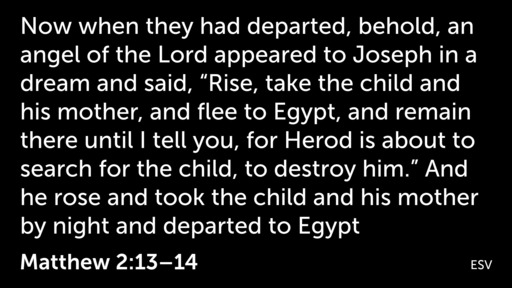
In 13, we see that after the Magi left, the angel comes to tell joseph to go to Egypt because Herod is going to be seeking to destroy the child.
Destroy is an odd word to use instead of kill. Herod does not just want to kill Jesus, he wants to destroy the threat to his thrown, everything he stands for, all that he is. Herod knows and has been shown that he is the prophecied King, and he needs to destroy it.
And we see Joseph, who is the second main character in these first few chapters, doing as he was commanded, even going at night. Night would have been a far more dangerous time to travel, but he is committed to God and obedience. The Journey would probably take a week and about 150 miles to travel.
Egypt has become a refuge place for Jews at this time. Some estimate that one million jews lived there to escape the terrible reign of Herod the Great. So many jews existed in Alexandria Egypt, that they had build a significant structure to represent the temple for Jews who were away from home.
There is an Irony being set up here for us. In the Old Testament, Egypt was a place to be escaped from and the Land of Israel was meant to be a refuge, but here, Egypt is the place of refuge and the land of Israel is being escaped from.
Then we see in verse 15, that all of this was to fulfill something in the Old Testament. Notice that it does not say “what the prophet spoke” but rather, “what the Lord spoke.”
This keys us into who inside the quote is the “I”. It is God doing the calling.
What is interesting about this prophecy, if we go back and look at it, is that it is not a prophecy at all. Lets read this section of Hosea 11:1
1 When Israel was a child, I loved him, and out of Egypt I called my son.
This section if we were to continue is God talking about Israel, who is his son, and how they turned away from God after he rescued them.
But here, Matthew is pointing us to this text saying that Jesus is fulfilling this text, this text that points us backwards further into history to see Israel.
But where we see Israel fail to live up to being God’s child, Jesus will succeed. He comes to be the true Israel and fulfill all the ways that they could not live up to being God’s child. He comes to complete what they could not and live as God’s perfect son. He comes to be God’s true and faithful son.
This Old Testament narrative of God calling Israel from Egypt turns out to be a prophetic pointing toward Jesus. Old Testament narratives point us toward Jesus. This is what they are meant to do. They are not meant to be moralistic stories for us to “live better” or good life lessons, they are meant to show us a need for and longing for the Messiah. And now for us they intend to help us understand the Messiah more fully.
This Exodus story symbolizes God establishing a new group of people. This is the transferable model to Jesus. God is doing something new. He is establishing a new group of people through his true son, Jesus.
In this, we see God unearthing the gospel for us in this Old Testament story. Jesus is revealed to us as the true son.
Galatians tells us that we are now fellow sons and daughters if we belong to Christ in our faith in him.
Not because of what we have done, but because of what Christ has fulfilled and accomplished as the true son.
This is Gods grace in unearthing Christ to us.
II. The Undeterred Gospel v16-18
II. The Undeterred Gospel v16-18
Speaking of finding a way when there was no way, we now get to the undeterred Gospel. We see this in verses 16-18.
Undeterred carries the idea of persisting through something despite difficulty and opposition. And we see the opposition in verse 16.
Herod attempts to thwart God’s plans, just like Pharoah in Egypt. You can see that on the screen here.
But the Gospel and God’s plan for the Messiah will be undeterred. Even, by the most outrageous of human efforts.
Because Herod is tricked, he doesn’t know which specific Child he needs to kill, so his plan is to kill all of them just to be safe. Remember the wise men were supposed to tell him which child was the Jewish King and they didn’t.
Herod is a well known all around evil bad guy in history. He is known for being a paranoid ruler. Part of that comes from his illegitimante claim to the throne. He wasn’t from the line of David, he wasn’t even a Jew. He was an Edomite that Rome put on the throne. This illegitimatecy leads to his paranoia and his insane protection of his throne.
Historian Josephus says that he killed his brother in law, his mother in law, three of his own sons, and his favorite wife because he thought they were threats to his throne. He killed large numbers of prominent citizens and their families. other people who were a threat to his throne. At his death, he commanded that all of the Jewish nobility that opposed him be put to death so that his death would have a proper mourning and not be celebrated.
Killing all of the babies under two years, while extreme for us, would have been nothing for him. While media has painted this as a mass homicide, it was hardly that. With population estimates of Bethlehem, most commentators say that it was less than 20 boys two and under. While still a great tragedy, this was small potatoes for this king.
And we cannot help but see a connection being made between Jesus, and Moses. Herod as the Pharoah figure, attempting to thwart God’s plans and kill all the baby boys. Moses is rescued by God from the death of God’s people to be a deliverer of those people. Jesus, in a greater way, is rescued by God from the death of God’s people to be a deliverer of those people.
In verse 17, we see another throwback or fulfillment. But a different language is used than Matthew’s other fulfillments.
We could quickly get out our fulfillment rubber stamp and say “look, a tragedy was predicted, and a tragedy was fulfilled.”
But you all know that’s not the way we do things here. Remember that we treat the Word of God like tea, and it’s good to seep in it. Matthews readers would have been well seeped in the Old Testament and known what he was talking about.
Just like all of Matthews fulfillments, this one is challenging.
This is a quote from Jeremiah 31. It is Rachel, a figurative mother of God’s people crying out from the grave for her children that are being lost in exile. What is interesting, is that this crying out in Jeremiah is for Children going into exile, they are not being killed. But rather, the nation is seemingly destroyed as God’s establishment.
The location of Ramah is important for two reasons. Many people think it is likely the burial place of Rachel. Additionally, Ramah is place where Nebuchadnezzar gathers God’s people up to take them into captivity back to Babylon in 586BC. What is interesting is that Jeremiah is one of the gathered ones in Ramah, but is released or escapes.
Jeremiah 31 is an initially dark passage about a reason for the figurative mother of Israel Rachel to be figuratively crying for her children. But God then tells Rachel to stop her crying, because there will be a return from exile. From a hopeless situation, God is doing something new. God would make a new covenant with them. Jeremiah 31 becomes one of the most important passages for understanding the New Covenant.
Jesus comes through the tragedy to be the hope through the tragedy. He comes to a people who seem all but lost to show that God’s plan for the Gospel will not be deterred. Jesus comes to be the new covenant that Jeremiah prophecied, making a way back to God.
And this is true for us also. That through through the tragedy and sadness and hopelessness in our lives, Jesus comes to be new and fresh and undeterred by the situations in our lives to bring us the hope of the Gospel.
When we feel most hopeless is when God loves to in his grace show us the hope of Jesus. When we feel overwhelmed by sin in the world, the sin that is around us, and even the sin in our own hearts, Jesus comes undeterred by the sin to bring us life with him. Freedom from all the sin that we think we are lost to. Freedom to have a relationship with God.
III. Unlikely Gospel v19-23
III. Unlikely Gospel v19-23
Last, we see the unlikely Gospel in verses 19-23.
This story of Jesus, his coming to give us the good news is unlikely, and not what we expected.
We see in Verse 19 that Herod the Great dies. The historian Josephus gives a lot of writing space to Herod’s death and discusses God’s retribution for all of his evil and cruelty. But Matthew doesn’t. He simply says that Herod died and moves on.
This character that thought he was massively significant in Jewish history, really means nothing. His death is his end. The story moves on to the one who is forever establishing his throne.
In verse 20, we see the angel coming to Joseph to tell him that “those who sought the child’s life are dead.”
Why does Matthew say “those” in the plural form in verse 20? It was only Herod that was seeking his life, and it is only Herod who dies which now makes is safe. The Jewish leaders were certainly still around. Why does Matthew use the word “those” when he should have said “he”?
“Those who sought your life are dead” is a intentionally awkward quote from Exodus 4:19. Awkward in that Matthew forces the language in an unnatural way to ensure you know that it is an allusion to Exodus, further enforcing that Herod is the antitype of Pharoah, and Jesus is the antitype for Moses. Matthew is forcing this connection so that you see how Jesus is the fulfillment of the Old Testament.
The angel tells him he can go to Israel, but doesn’t say where. So Joseph realizes that it is not safe for him back in Bethlehem with Archelaus, Herod’s son, reigning. So he decides to go to the region of Galilee.
When Herod the great died, he split his kingdom to his three sons. Archelaus reigned in Judea, Phillip in the Northeast, and Antipas in Galilee. Archelaus was worse than his father, killing 3000 travelers during a passover festival. So Joseph decides to go back to the place where Joseph and Mary were from.
Then we get to verse 23. An extra challenging verse. Verse 23 lets us know they go to Nazareth, and lets us know not that this was Joseph’s purpose, but that this was the design of God to show us the Messiah’s fulfillment of the Old Testament.
Matthew ends this section with his fifth fulfillment throwback that Jesus would be called a Nazarene.
Guess what, there is no prophecy in the Old Testament telling us that the messiah would be called a Nazarene. So what is Matthew Doing?
A) Nazarite like Samson
B) NZR as the shoot of Jesse
C) Nazarene regarding location.
You might think Samson was a Nazarene, but he was not. He was a Nazarite. Samson was someone who took a Nazarite vow. Two things that Nazarites were not allowed to do was drink wine, and touch dead bodies. Both of these things Jesus did. Jesus was not a Nazarite. Also, Matthew’s context would not make sense. Him going to Nazareth was not fulfilling a Nazarite vow. Rather, him being called a Nazarene was about location.
NZR is the Hebrew word for branch or shoot. it appears a few times in scripture, but most notable is Isaiah 11:1
1 A shoot will grow out of Jesse’s root stock, a bud will sprout from his roots.
We’ve looked at this before. This is a messianic passage pointing us to Jesus. Out of something that seemed lifeless and dead, out of something that maybe we gave up hoping in, new life would come and spring forth. Jesus being the initial vine from which other new life could come.
The problem is that the Hebrew word NZR and the greek word Nazarene are not the same. Without getting really nitty gritty, Jewish readers would have had a really difficult time making this connection.
This has kind of been a theme that Matthew has been giving us. That Jesus comes from something that seems unexpected.
While this could be Matthew doing a bit of word play, it is a stretch to say that the prophets said he would be called a Nazarene.
But, there is potentially a double meaning here.
Also again, this prophecy seems to be location based, this is why Jesus has to go to Nazareth. But there is a problem here for us, Nazareth does not exist during the time of the prophets. The village was probably established after the time of the prophets. The prophets don’t talk about Nazareth, and neither does any other ancient literature until a few hundred years after Christ.
So what did Matthew mean he would be called a Nazarene based on location?
We know from Matthew, Mark, Luke, John, and Acts that Jesus was in fact called “Jesus the Nazarene” or “Jesus from Nazareth of Galilee.” Last names were not a thing at the time of Jesus, so another idenifer was needed for Jesus, and here, it is location based or origin based. The Jesus from Nazareth. So the rest of the Gospels and Acts tie Nazarene to Jesus’s origins, more than a title of him being the branch or shoot of Jesse, or taking Nazarite vows.
Also notice Matthew mentions the prophets in the plural. That multiple prophets, or the prophets in general discuss Jesus being called a Nazarene. This is a theme of prophetic literature.
I believe that Matthew is pointing us to Jesus’s uncommon, obscure, unlikely origins. And this is a theme we can trace in the prophets. That Jesus has an unlikely origin.
Think of Nathanael’s comment in John 1:26, “can anything good come out of Nazareth?”
The crowd in John 7 says “the messiah can’t come from Nazareth can he?”
When Nicodemus attempt to defend Jesus, the Pharisees say “you aren’t from Nazareth too are you? No prophets come from Nazareth!”
Christians would be later associated with Nazareth. Paul before a Roman Governer is accused of being a ringleader among the Nazarene people.
This unlikely beginning is exactly how the prophets describe the Messiah.
Zechariah describes the messiah as a royal figure who has a humble beginning, not a royal beginning like the Jewish people were expecting. Zechariah says he will be a shepherd who would be accepted by his sheep. Shepherds were some of the lowest people in society, not a well respected place to come from. Sheep keeping doesn’t seem like a grand title for the Messiah.
Psalms often describe the Messiah as the righteous sufferer. Psalm 68 talking about the Messiah says his own brothers would treat him like a stranger from a foreign land.
Isaiah 52 and 53 describe the messaiah as unimpressive, nothing to catch our eye with. Nothing special that we should follow. Verse 3 says that the people would consider him insignificant.
This is a theme or a mottiff of the Old Testament. God loves to use unlikely things for his plans. He uses Rahab from a wicked city. David, as a scrawny young scrapper is chosen by God. God chooses Abraham from the moon worshipping people of Ur to start a great nation. Many more examples could be given.
This is the theme of the Messiah coming from no where and nothing. Jesus was a messiah pretender, just like the prophets predicted, who didn’t conform to what people expected. His embarrassing geographical origin ironically ends up being proof of his messiahship. “Jesus of Nazareth” is intended to be a name of defamation and slander, but ends up showing his Messianic fulfillment.
Jesus comes from nothing to become everything.
So maybe, there is a double meaning in Matthew’s use of NZR Nazareth. Out of an unlikely place, a place that we had saw no hope in, Jesus would come to be hope for us.
And this is true in our lives as well. We can go through times of discouragement, trials, heartache, but do you know where our hope is found? In the unlikely person of Jesus. We can run to him for hope in this life and the life to come.
Beyond the Walls (Grace and Growth)
Beyond the Walls (Grace and Growth)
Now we get to the Beyond the Walls part of our sermon where we think about grace and growth and how this passage changes our lives.
Today we end the Jesus narrative story. Jesus’s birth story has little to do with a cute baby that we tilt our heads at and say “aw.” Jesus’s birth story has everything to do with ensuring we know that he is the Messiah fulfilled and we bow down and say “My King.”
The gospel is simple enough for a child to believe, and complex enough to keep scholars busy for their entire lives.
We initially come to Christ in simple Child like faith and believe that he rescues us from sin. Matthew is also showing us that the gospel is deep and rich and greater still for our lives continually.
I am more saved now than I was when I first came to Christ. Not that I was at risk of loosing salvation, but that the gospel is truer and more sure and deeper in my life now than ever before.
This is what Matthew is attempting to show us. That Jesus comes to fulfill for us more than we ever thought we needed or expected. He comes to be the fulness of humanity and complete everything we lost in our sin. Maybe, you don’t think you need Jesus. Maybe you think you are doing alright on your own. Jesus comes to be the unexpected expectation that you didn’t know you had. A savior from your sin.
If you are new to Jesus, the gospel is being offered to you today. Pure and simple. Jesus comes to rescue you from sin.
And if you are not new to Jesus, and have been a believer for a while, the gospel is being revealed to you in a deeper and more full way through this text today. Will we allow it to continue to captivate our lives?
God now uses us, an unlikely people to share the gospel with others. When we look around the room we might say “us? really God? you sure?” God loves to bring the gospel from unlikely places, just like he brought Christ from an unlikely place. Acts says that Christians were called people of Nazareth, because it would be unlikely that God was really doing a work from a place like that.
Just like Jesus wore the badge of “Nazareth” we in Maine today carry a similarly slanderous badge “Christian church goers.” It is meant to be scorn for us but it is our honor to be associated with Christ. Just like Christ was mocked and looked down upon, we too should expect this.
But, from an unlikely place like us Christians, a place that doesn’t seem expected according to the world, we can show them the love, kindness, compassion, life to come from, we can show it to the people around us.
But I am excited for what God is doing here in Maine, a place like our church for the gospel of Jesus. A place that a lot of the US has written off and said “ah, they are too far gone, post christian like Europe.” It is these unlikely places that God loves to bring the gospel from. I’m excited for what he will do in Maine, and through our church.
On a personally level, I am thankful for this church and what you all mean to Erika and I. I started this message talking about the thing that we didn’t know we needed, coming to us in Jesus. You all have exemplified Christ to us in your unexpected love and kindness toward us. God has used you all to be exactly who we didn’t know we needed. God knew that we needed to be reminded of who he is. That he is kind, and loving, and has our good in mind. And God used you all to do that for us. Thank you for that.
Let’s take a moment to bow and heads and close our eyes as we respond to the text together.
Pray and thank God for making a way to give you Jesus.
Pray and thank Jesus for coming to be what you didn’t know you needed, the saving Messiah.
Pray and ask the Holy Spirit this week to help you shine the light of Christ in unexpected places to the people around you.
