2 Thessalonians 2.13b-God Chose the Thessalonians for His Own Glory as Firstfruits for Experiencing Salvation (Doctrinal Bible Church in Huntsville, Alabama)

Doctrinal Bible Church
Pastor-Teacher Bill Wenstrom
Sunday July 13, 2025
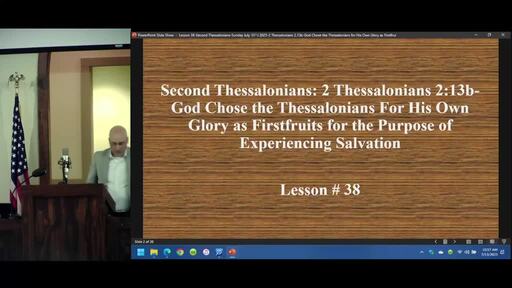
Second Thessalonians: 2 Thessalonians 2:13b-God Chose the Thessalonians For His Own Glory as Firstfruits for the Purpose of Experiencing Salvation
Lesson # 38
2 Thessalonians 2:13 But now, each one of us are obligated to always make it our habit of giving thanks to the one and only God on behalf of each and every one of you brothers and sisters, who are divinely loved by the one and only Lord. For this God for His own glory chose each one of you as firstfruits for the purpose of experiencing salvation by means of sanctification through the personal agency of the Spirit and correspondingly, by means of faith in the truth. (Pastor’s translation)
In 2 Thessalonians 2:13, the apostle Paul addresses each member of the Thessalonian Christian community as “brothers and sisters” and he also describes them as “divinely loved by the one and only Lord.”
In this verse, he informs them that he, Silvanus and Timothy are obligated to always make it their habit of giving thanks to the one and only God on behalf of each one of them.
He then gives them the reason that this is the case by asserting that God for His own glory chose each one of them as firstfruits for the purpose of experiencing salvation by means of sanctification through the personal agency of the Spirit and correspondingly, by means of faith in the truth.
Now, in 2 Thessalonians 2:13, the noun aparche (ἀπαρχή), “firstfruits” describes in Biblical terms an offering of any kind, animal as well as grain and represents the first portion of offering set aside specifically for the Lord.
The first portion of the harvest was regarded both as a first installment and as a pledge of the final delivery of the whole.
Here in 2 Thessalonians 2:13, the noun aparche (ἀπαρχή) identifies the Thessalonian Christian community as “the firstfruits” of those who experience eternal salvation.
The verb haireomai (αἱρέομαι) expresses the idea that the Father for His own benefit, purposes and glory chose for Himself the Thessalonians as the firstfruits in order to experience eternal salvation by means of sanctification through the personal agency of the Spirit and correspondingly, by means of faith in the truth.
The middle voice of the verb is an indirect middle which indicates that the Father “for His own glory” or “for His own benefit” chose the Thessalonian Christian community as the firstfruits for the purpose of experiencing eternal salvation.
This verb does not speak of election of the Thessalonians but rather, it speaks of justification, which is indicated by the prepositional phrase, which modifies it, namely, en hagiasmō pneumatos kai pistei alētheias (ἐν ἁγιασμῷ πνεύματος καὶ πίστει ἀληθείας), “by means sanctification through the personal agency of the Spirit and correspondingly, by means of faith in the truth.”
This prepositional phrase identifies when God chose the Thessalonians and as we will note, this prepositional phrase speaks of positional sanctification.
This took place through the baptism of the Spirit, which took place at the moment of justification when the Father declared the Thessalonians justified as a result of them exercising faith in the truth about Jesus Christ’s death and resurrection which is communicated in the gospel.
Therefore, in this verse haireomai (αἱρέομαι) speaks of the Father choosing the Thessalonians when He declared them justified through faith in His one and only Son, Jesus Christ rather than His electing them in eternity past.
Ephesians 1:3 The God, namely the Father of the Lord ruling over us, who is Jesus Christ, is worthy of praise. Namely, because He is the one who has blessed each and every one of us by means of each and every kind of Spirit appropriated blessing in the heavenlies in Christ. 4 For He chose each and every one of us for His own purpose because of Him alone before creation in order that each and every one of us would be holy as well as uncensurable in His judgment. (Pastor’s translation)
“Elected to privilege” is the verb eklegomai, which means, “elected and set apart for privilege.”
When Paul speaks of God choosing the Thessalonians for salvation in 2 Thessalonians 2:13, he asserts that this was accomplished by means of sanctification through the personal agency of the Spirit and correspondingly, by means of faith in the truth, i.e., the gospel.
This work of the Spirit in relation to sanctification was accomplished in time when the Thessalonians were declared justified by the Father through faith in His one and only Son, Jesus Christ.
Simultaneously, at their justification, the Spirit identified them with Jesus Christ in His crucifixion, death, burial, resurrection and session at the Father’s right hand.
This work of the Spirit is called the baptism of the Spirit and it resulted in the Thessalonians being sanctified positionally, experientially and in a perfective sense.
These three stages of sanctification, we will explain later in this study of 2 Thessalonians 2:13.
Therefore, since election took place in eternity past and the work of the Spirit in relation to sanctification is accomplished at justification, this verb haireomai (αἱρέομαι) in 2 Thessalonians 2:13, must be speaking of the Father choosing the Thessalonians at justification.
In 2 Thessalonians 2:13, the prepositional phrase eis sōtērian (εἰς σωτηρίαν), “for the purpose of experiencing salvation” which modifies the verb haireomai (αἱρέομαι) indicates that experiencing eternal salvation is the purpose for which God the Father chose the Thessalonians as firstfruits.
Now, as was the case in 1 Thessalonians 5:8-9, the noun soteria (σωτηρία) here in 2 Thessalonians 2:13 speaks of their deliverance from personal sins the sin nature, Satan, his cosmic system, condemnation from the Law, spiritual and physical death and of course eternal condemnation.
Specifically, it speaks of all three stages of the Christian’s salvation.
This word here in 2 Thessalonians 2:13 contains the figure of metonymy which means that salvation is put for experiencing it.
The offer of eternal salvation to sinners is made possible through the Lord Jesus Christ’s crucifixion, death, burial, resurrection and session at the right of the Father, which provided this salvation for all of unregenerate sinful humanity.
The unregenerate sinner appropriates this salvation as a result of being declared justified by the Father through faith in His one and only Son, Jesus Christ.
This justifying faith appropriated the divine omnipotence which was manifested through the Lord Jesus Christ’s crucifixion, death, burial, resurrection and session at the right of the Father.
The manifestation of this divine omnipotence delivered the entire human race from personal sins, enslavement to the sin nature, Satan, his cosmic system, condemnation from the Law, spiritual and physical death and of course eternal condemnation.
