John the Baptizer

Matthew Series • Sermon • Submitted • Presented • 44:59
0 ratings
· 18 viewsJohn the Baptizer (Matthew 3:1-12)
Files
Notes
Transcript
Handout
Intro
Intro
We can sometime wonder what it means to be a Christian, and what it looks like to follow God. What does it look like to be a part of God’s realm?
John focuses his message on one aspect, repentance. So today we look at this aspect of the Christian life. Repentance.
This is a tricky topic that we often leave out of our evangelism. But for John, and the New Testament Authors, it is central.
When we consider aligning ourselves to God’s Kingdom, it often times means removing what is wrong. Most of you know we drive that Purple Sequoia out there. We have a great story with how God gave that vehicle to us. But a year after having it, we had tire shaking. We took it in, it wasn’t the roaters, so we were led to believe it could be alignment. We took it to a place that said “yes it was so bad, you will notice a difference with the adjustement.”
We didn’t. So we took it to another place in colorado, they said they fixed the alignment, no change.
Then we drove it across the nation here with the shakes. Nearly 40 hours of driving with shakes. We took it somewhere here that will remain unmentioned, and they said “it was really bad alignment, we adjusted it, you are good to go! Again, no change.
We took it to TopTech, not a sponsor, and told them the problem. They found it right away. They said it wasn’t the alignment that needed adjusted, it was a spacer on all four tires. It was beginning to get warped. They said, do you want to leave it on or get a new one or take it out? i said take it out! Guess what, our car was all better.
This is what repentance is like. To align with God’s reign, we don’t need a life adjustment, we must repent of what is against Him, namely our sin.
MAIN POINT: Because of God’s reign, we must repent of sin.
I. The Kingdom Announced by John v1, 3-4
I. The Kingdom Announced by John v1, 3-4
First today, we see the Kingdom announced by John.
John is presented to us as one preaching, with a message of repentance in light of the kingdom.
To be clear, this is not John, one of Jesus’s 12 disciples, and not the John that wrote Revelation, the Gospel of John, or 1st 2nd 3rd john. This is a different character. This is John the son of Zechariah and Elizabeth. He is the cousin of Jesus.
Also, though we call him “John the Baptist.” He was not part of the denomination we would associate with. I like to call him “John the Baptizer.” to be clear.
People didn’t have last names in the first century. There were many Johns at this time, and so John gets the name associated with what he does “John the Baptizer.”
John is a peculiar character for many reason. All of them are intentional.
First, this chapter starts with “In those days.” This is an Old Testament way of speaking, a subtle Matthew Throwback that John is being tied to the work of people from the Old Testament.
We are told he preaches in the wilderness. This also has many allussions to the Old Testament prophets. Many Old Testament prophets spent much of their ministry in the Wilderness.
There is potentially another aspect of this wilderness theme. Many spend time in the wilderness before something grand, the Main thing their life was about. The nation of Israel, Moses, and David all spend time in the wilderness before God brought them to a new place. The prophets talk about the wilderness as a place where God starts something new.
John is doing this transitional interm work before the Main thing: Jesus, comes on the scene.
John comes to be a new hope of a new exodus from the wilderness of our sin and wandering from God.
In verse 4, we see this peculiar description of John. He wears camel’s hair cloths, a leather belt, and eats locusts and honey.
This picture of John is meant to show us his modest and humble life. Material possessions didn’t mean much to him.
The camel’s hair garments would have been humble lowly cloths for the time. His rough and rugged close are a symbol of his message. A bit rugged and rough.
His leather belt was also common, but also something that Elijah wore, tying him, pun intended, to Elijah.
The Honey and Locus were commonly found in the dessert. Locus are something that were permitted in the Jewish law. They might preserve these insects in honey, or they might grind them down into a powder, make bread, and have honey with it.
Locus are still eaten today by nomadic dessert peoples.
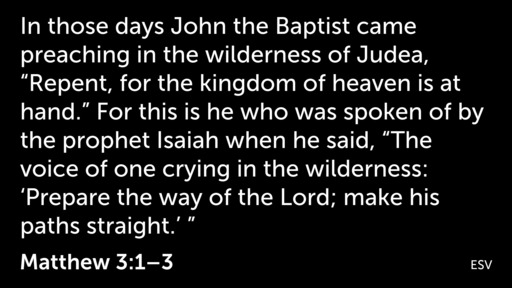
We also see that Matthew points to John fulfilling prophecy in verse 3.
“The voice of one crying in the wilderness: Prepare the way of the Lord; make his paths straight.”
This quotation is from Isaiah 40:3
This concept of preparing the way was what people did when a King would be coming to town. Someone would go ahead of him and smooth out the road, mending it and preparing it for the royalty. This is the work of John. In preparation to Jesus coming, he is prepare their lives. Rebuilding the highway of holiness. Look at this verse
8 And a highway shall be there, and it shall be called the Way of Holiness; the unclean shall not pass over it. It shall belong to those who walk on the way; even if they are fools, they shall not go astray.
This is a prophecy that John is beginning to see come to fulfillment and is telling people to prepare for God’s reign in their hearts through Jesus.
For John, this meant preparing people through repentance.
II. The Kingdom Requires Repentance v2
II. The Kingdom Requires Repentance v2
This idea of repentance takes us to the next point. The Kingdom requires Repentance. We see this in verse 2.
Matthew 3:2 “2 “Repent, for the kingdom of heaven is near.””
John message is short and not very sweet. Short and harsh maybe.
But The kingdom of heaven being near is good news.
Kingdom of Heaven is a huge theme in Matthew. We will probably deal a little more with it in chapter 4 when Jesus first announces it. But John also gets to announce it here.
Some will want to differenciate the Kingdom of Heaven and the Kingdom of God. Some people say that Jews did not want to speak the name of God, so they might say heaven instead. I would say these are one and the same.
The Kingdom of Heaven is not a place or location, or a presence of God, rather it is a realization of God’s reign, and then a submission to it.
This is the way that Haven is used in the Old Testament. Think about Daniel that we just finished. Remember in Daniel chapter 4, Nebuchadnezzar must realize that heaven reigns. That the kingdom of heaven is over his kingdom. And then he had to submit to it. He had to allign himself with it.
I want to be clear on this topic. It is not that God over stopped reigning. Like he walked off his throne, or the etherial Kingdom disappeared. Rather, we humans fell out of alignment from it.
I did this picture to maybe help us. You can see how the Kingdom of Heaven continues, God’s reign hasn’t stopped. Rather, we fell out of alignment with the Kingdom of God. We failed to recognize God’s reign and Acknoledge God’s reign. Rather, we wanted it our way. We rejected the reign of God in our lives and followed our hearts toward sin.
This is what John’s message is. God’s reign is here, you must acknoledge it in a way that leads to you submitting to it by turning away from sin.
I want you to think of the kingdom of Heaven as something that is happening, rather than something that exists.
When John says the Kingdom of Heaven is at Hand, the verb is in the perfect tense, letting us know that it is already here and having affects on our lives. The emphasis that John is presenting is the present affects today of the Kingdom of Heaven. God’s promised reign is not something we continue to wait for, but something that is already happening in our hearts as we repent.
Let’s talk about repentance. Repentance is a huge theme in the scripture both from the Old Testament to the new. This is not just the message of John the Baptizer, but the same message that Jesus gives his disciples. The message of repentance is the same message given by the rest of the New Testament authors.
Have you ever heard statements like “come as you are” or “Jesus wants you just like you are” or “God welcome all.”
In a way, these statements are semi true. Yes, because of God’s Grace, we can come to him as we are. We don’t clean up our act before we come to Jesus. If we had to be clean before we come to Jesus, no would would ever be ready to come to Jesus.
But we do not expect to not change when we come to Jesus. We don’t say to Jesus, “accept me like I am and let me keep living my life the way I want to!”
This seems absurd, but many of us internally think this way.
To come to Jesus is to submit to him and his authority. To come to Jesus and be a part of his kingdom is to turn from what we think is best for us and submit to what God says is best for us.
When my oldest son was 2, he loved to drink from puddles. They were his favorite. Maybe he saw the dog do it. We thought we were giving him enough water. But if you didn’t have a close eye on Leland, he would be drinking from a puddle. We could have just had a drink inside, go outside to play in the yard, and he would drop down to drink from the puddle. On several occations, we would be walking through a parking lot after a rain, and Leland would drop down to take a drink. We would quickly pull him away from it and tell him no. We often carried water with us. All he had to do was ask!
Though we accepted Leland as he was, we didn’t want him to stay the way he was. Leland, ask us for a drink of water. We will give it too you. We have cool refreshing water in your bottle for you.
This is what it is like coming to Christ. Though he accepts us as we are, with a mouth full of mud and rocks, He doesn’t let us stay that we. He wants us to spit out the mud and embrace the pure waters of his grace and mercy.
Repentance is a radical call to radically change because I am out of alignment with God.
Repentance is fundamentally a Christian message found throughout the entire Bible.
Repentance is not being sorry for sin, it is not feeling guilt because of our sin, it is an active turning away from sin. This is what the word itself actually means. This is my definition of repentance and you can see it on your handout.
Repentance: The acknowledgement that my sin does not align with God’s reign, and the action to turn from it.
Lots look at a few aspects of repentance that John gives to us.
A. By Commitment v5-6a
A. By Commitment v5-6a
First in Verse five, we see commitment. Repentance is a commitment to change.
We see lots of people coming to John to be baptized. I think we under estimate how significant John’s ministry was. He is the greatest prophet that Israel has seen in centuries. Historians like Josephus make a bigger deal about John than Jesus. He was having a massive impact on lives.
But these people are making public commitment to repent of their sins. To turn away from them. To get rid of them. And the way that they are doing this is through baptism.
Baptism here is not a sprinkling, but a dunking. The word itself means “to immerse, to plunge, to drown.” John was not sprinkling water on people, if so, he would not have needed a body of water like the Jordan. Also remember that Jesus went into the water and comes up from the water later in this chapter. Early people who were convinced of believers baptism were drowned as a penelty for their belief in immersion of believers. It was a way for other protestants to say “so you believe in dunking of believers? You like water that much? Let us help you with the dunking.”
Anneken Jans in 1539 was one such woman drowned for her commitment to Christ through believers baptism. Taken to the Rotterdam River in the Netherlands to be executed by drowning for her belief baptism, would famously carry her 15 month son and offer him to anyone who would take him before her execution.
Critical here for us to discuss is that John is not baptizing for repentance, see verse 11. He is baptizing because of repentance. He is baptizing in light of repentance. To show the repentance.
This is what 1 Peter talks about:
21 And this prefigured baptism, which now saves you—not the washing off of physical dirt but the pledge of a good conscience to God—through the resurrection of Jesus Christ,
22 who went into heaven and is at the right hand of God with angels and authorities and powers subject to him.
This is in reference to the flood of Noah. Not that Baptism is washing away dirt, but that it is a pledge, a commitment in light of the work that Christ has done through us. To call us out of sin and change us. And just like everything else is now subject to him, so we subject ourselves and our will to God.
When someone is baptized, before baptism, we ask them the question that is traditional from the early church “do you commit to a life of repentance from sin?”
Repentance is a commitment to change. A confirmation of repentance and a seal of forgiveness.
B. By Confession v6b
B. By Confession v6b
Notice in the second part of verse 6 that repentance happens by confession. These who came to John were not only willing to see their sin, but confessed their sins. They verbally acknowledge the sins they would be repenting of. We see this also in Romans 10:10 “10 For with the heart one believes and thus has righteousness and with the mouth one confesses and thus has salvation.”
Proverbs reminds us that the person who confesses and forsakes sins finds mercy.
You might remember that Daniel spends a significant amount of time in his 12 chapter book confessing sin. The Psalmist confesses sins.
James tells us to confess faults to each other so that we can pray for each other, showing that the church is God’s grace in helping us repent of sin.
There are a myriad of other texts we could look at about confession of sin being a part of repentance.
C. By Humility v11
C. By Humility v11
We also see how Repentance involves humility. We see this found in verse 11.
John is acknowledging who he is in light of the Savior. Though he is possibly the best prophet they have had for centuries, he wants to ensure everyone knows he is nothing compared to the one coming after him.
John, though a prominant figure of his day, says that he is nothing compared to Messiah. He is unworthy to even carry or unloose the shoes of this one.
One teaching in Jewdism not found in the bible says “Every service which a slave performs for his master shall a disciple do for his teacher, except the loosing of his sandals.”
This was a task reserved for the lowest of low. Though disciples were supposed to take on servant tasks, they didn’t have to touch their masters feet. This would be even to lowly for most slaves.
This is how John views himself in light of the Christ.
He is not lacking self-image, or deprecating himself. He is realizing his place.
We also don’t need to be self deprecating, or have a false sense of humility, we don’t compare ourselves to others. We compare ourselves to Jesus.
Usually, disciples who come after their rabbi or teacher are lesser, but Jesus reverses this stigma. Jesus comes and is mightier and stronger than all who come before him.
We should discuss the way in which Jesus comes. He comes to baptize not with water because of repentance like john, but in Spirit and fire.
John is not saying that Jesus will have a different Christian initiation process, but rather a different type of baptism. An inward baptism, while his is more symbolic and outward.
Fire in this passage is both good and bad. To the ones who repent, the Fire comes to purify them and make them clean.
God’s reign does not mean that we have blessings, goods, and services, it means that we have been rescued from judgement, but will be refined, the evil parts of us burned away by the work of the Holy Spirit so that we can now live in God’s reign.
To the ones who do not repent, Fire is meant to be a judgement against them as we will see in verse 7, 10, and 12.
The Messiah prophecied about in the Old Testament is connected with the coming and bringing of the Holy Spirit.
John is telling people to get clean outwardly, but Jesus will truly make us clean inwardly by giving us the Holy Spirit.
Ezekiel 36 describes the Spirit’s coming having an effect on our obedience to God’s law, again, aligning ourselves to God’s reign in humility.
D. By Action v8
D. By Action v8
Another way that John talks about repentance is by action. We see this in verse 8
Matthew 3:8 “8 Therefore produce fruit that proves your repentance,”
This is John’s warning that true repentance does not just look like turning away from sin, but turning towards something.
We are given examples in scripture of people who confess sin, but still do not change. Think about Pharaoh in Egypt who acknowledges his sin against YHWH, of Achan admitting his sin to Joshua, or Saul confessing his sin to Samuel.
And in contrast to that, You will remember Zacchaeus who not only stops stealing, but then starts giving.
This change of heart towards doing good actions does not save us, but is evidence of our salvation and a truly changed heart.
If you say to yourself “what actions should I take?” Luke records Johns answer to that very question. It looks like contentment for what you have been given, and generousity and kindess towards others. It looks like giving up the pursuit of yourself, and living for others. And not just in the things you do with Christians, but in every aspect of your life.
JC Penny, the founder of the famous department store was an example of this type of lifestyle. His faith and business lifestyle were not seperate, but intertwined. He said publically that he would rather be known as a Christian than a merchant. He held strongly to do unto others as you would want done to yourself and gave generously. He focused on what he could give to people rather than what he could get from people.
The scripture is commanding us as well to repent in our actions by giving up selfish living and begin living for the Glory of God and the good of others.
One specific area of application I was thinking of for us is our church life. Is there fruit from our life towards the church? Do we view the church as something which we get something from? Or do we view the church as people to which we can give and serve?
Don’t seek what we can get out of this experience and these people, but look for ways and then take action toward giving and serving these people here.
III. The Kingdom Warns Judgement
III. The Kingdom Warns Judgement
Next, we see the Kingdom also Warns of Judgement.
There is a spectrum that exists with what we think about regarding Christianity. At the far extreme on one side is love, acceptance, grace. And the far opposite side is Judgement and a turning from sin.
What I want us to think about for a moment is why become a follower of Jesus?
Certainly here at Hope church, we emphasize aspects of abundant life, a relationship with God, love from God, community found Christ’s people. This is all stuff in our life and practice statement.
But there is another aspect of why we become followers of Jesus. Because of the coming judgement.
This is an aspect we might want to shy away from, but it is part of John’s teaching, and Jesus’s teaching as well.
I grew up in the Hell Fire and Brimstone churches where the pastor would get up and yell at you for the length of his sermon. Where your repentance is emphasized and grace was lacking. I want to be careful to not swing toward either side of the spectrum, but faithfully teach the text of God’s word.
God’s reign demands either repentance or wrath.
And here in this text, John is harsh with a warning of Judgement.
If we choose to ignore God’s reign, or acknowledge it but do not change, there will be judgement. Many people in scripture believe in Jesus, or acknowledge God, but do not turn from sin.
Think of James who says that even the demons believe in God. Or the rich young ruler who believes in Jesus, but does not turn away from his desire for material possessions.
Lets see what in what ways the Kingdom comes in judgement.
A. Against Rituals v7
A. Against Rituals v7
First, we see it against rituals in verse 7.
John sees the religious leaders of his day coming to his baptism. While the people are coming for baptism, the religious leaders are coming to his baptism, not to be part of it.
When John sees them coming, he calls them offspring of the vipers!
This would be harsh thing to say to someone even today. But I think John statement has an even harsher message that the surface level. You will remember Genesis 3 and that Satan is described as a snake figure, and his curse is that he will be a snake figure. And then here in our text, John is saying that they are snake offspring.
Certainly, you don’t want this guy running for office. His diplomatic skills are lacking.
These Pharisees and Sadducees were well respected religious leaders of their day. They were the most spiritual people of their day. They were known for their strict keeping of religious rituals and laws.
But John is telling them that their religious law keeping doesn’t matter. It doesn’t matter how much good you do if you don’t repent of sin and produce fruits of that repentance in your life. Reading your Bible, praying, going to church are good things, but mean nothing if you do not repent of sin.
A question that is often asked is if someone is saved, maybe a close relative, if they are say a prayer, but don’t repent of sin. The answer from John, Jesus, and the rest of the New Testament is a solid No. If you are doing religious things, or saying you believe in Jesus, but continuing in sin, you are not part of the kingdom of God and should expect judgement. We will see latter when Jesus says “you will know them by their fruits.” Do they have fruits of repentance? Or are they continuing to live opposed to God’s reign?
B. Against Heritage v9
B. Against Heritage v9
Notice in Verse 9, we see that there is judgement against the heritage.
John seems to know what the religious leaders are thinking. Some of them tied their relationship with God to their heritage. They were from Abraham!
But heritage is not an automatic alignment to God’s reign. The Kingdom of Heaven requires individual, personal, decision to repent of sin and turn to Jesus.
We do not entrust our relationship with God to our parents, or to our faith from years ago.
NT writers would teach that not all descendents of Abraham are true children of God. Gentiles who have faith like Abraham are of equal status to Jews.
John points to “these stones” maybe the stones of the river where he was baptizing, that they have more of a chance of being children of Abraham.
We cannot rely on our religious past, we must rely on Jesus in this moment as our salvation.
C. Applying Visuals
C. Applying Visuals
Then we see a two visuals John gives us in the text here. Two images of judgement. Throughout Matthew, Jesus will give us many other images to help us understand judgement.
1. Ax 10
1. Ax 10
First, the Ax. This is a common judgement from the old testament for something that is not producing fruit.
Notice that the roots and heritage, and belonging to a religious family do not matter here. What matter is fruit. And if fruit is not being produced, the individual is chopped down and thrown into the fire.
2. Winnowing Fork 12
2. Winnowing Fork 12
And then he gives us another image of the winnowing fork. This is a pitchfork like tool that was used to throw grain up in the air. There would be a stone or brick wall to separate the wheat from the chaff. Wheat have an outer shell that is removed. And when thrown up, the wind could blow again the chaff that was meaningless and did not produce anything for the future. The wheat berries that were heavier would fall to the ground. Then they workers would gather the wheat for use, and would sweep up the chaff and then set it afire.
Don’t miss both sides of this illustration. That the grain is being rescued and saved. If you are repenting of sin, you are showing that you have been rescued by Jesus.
But the other side is the chaff that is sent to the fires of God’s wrath.
But the chaff that Matthew talks about is an unquenchable fire. This description gives us the idea that A) this judgement does not end, and B) this judgement cannot be escaped.
Beyond the Walls
Beyond the Walls
One of my early jobs in high school was on a peach and cherry orchard. Colorado has this special type of peach that unmatched. It is worth a trip to Colorado if you have not tried a Palisade peach. I did all kinds of orchard tasks on this farm. But one of the best was determining what to do with the specific trees. The farmer that I worked for loved to prune trees. He thought of it as an art which brought him joy. He loved to remove the branches and shoot offs that were unhealthy for the tree, and keeping it from it’s true potential. He wanted to see the tree be all that it could be in production of fruit. The first time I watched him I was a bit appauled that he would cut of seemly good branches from the tree. But he knew that cutting these off would make the tree produce better and more fruit. But there were other types of trees as well. The unprunable ones that were unwilling to change no matter how hard you pruned them. They might look okay, but not really changing to produce good fruit. We didn’t use as ax, we used a tractor and a chain, but the result was still the same as John’s example: thrown into the fire.
When we think about the Kingdom of Heaven, and God’s reign, we willing to submit to it? Or do we put on a faced of belief? Is life here on earth for us a life of continual repentance as the Holy Spirit removes what is bad within us to enable us to produce fruit? Or do we continue in our sin? If we continue in our sin, the passage is very clear of our end. Thrown into the fire.
If you are not yet following Jesus, and have yet to repent of sin, today can be the day of salvation for you.
Let’s pray as we respond to the text together.
Thank God for reigning over us.
Thank Jesus who made a way to free us from the judgement of our sin.
Maybe take a moment longer to reflect on your own life in regards so sin that needs to be repented of. As we consider communion, ask the Holy Spirit to remove what is out of alignment with God’s Holiness.
