The Continuing Brightness of Jesus's Ministry in Us

Notes
Transcript
Handout
Intro
Intro
Today, we actually get to see Jesus begin his ministry. And at the end of the fourth chapter of Matthew, we say “it’s about time!”
Jesus’s ministry takes place over three years, and these years could be summed up in three ways. The first year was about subtle and slow beginning to ministry. The second year was about popularity. The third year was about rejection.
Today we look at the beginning of the first year, and we see that it is a pretty fast beginning.
The encouraging aspect of todays sermon, is this is not just a story about something that has happened in the past a long time ago. But something that is still happening today. Something that Jesus began, but that we now are called to be a part of as well.
Remember having those glow in the dark sticky stars growing up? Or maybe you bought them for your kids? They were just the best things weren’t they? Kids could arrange them how they wanted with lots of sticky tack that would end up ruining the ceiling, but would make night time so much better. For kids afraid of the dark, these stars were the best. They would “charge” or get their light from the main room light being on. The main thing was the room light. But then when it went out, all of these little stars would keep showing.
This is Jesus for us. Jesus came to be the light in the darkness. He came to be light, but then also to create smaller lights that would carry on the mission in to the darkness.
Main Point: In discipleship, you are joining to Jesus’s mission to live in God’s reign and be a light to the world.
I. Grasping the Needed Hope v12-16
I. Grasping the Needed Hope v12-16
First today, we see grasping the Needed Hope. We see this in verses 12-16.
In verse 22, we see that John’s ministry is coming to an end as he is arrested. Matthew doesn’t give us details for his arrest, but we know from history that his popularity was growing and Herod Antipas was concerned.
If Jesus was going to continue John’s message and start something new, it could not be with threats of Antipas.
But what John announced, Jesus will now do. Jesus picks up the baton that John held and will carry it all the way to the finish line.
Galilee becomes the place where Jesus’s message is developed and launched. It’s also going to be the place of the relaunch after his death.
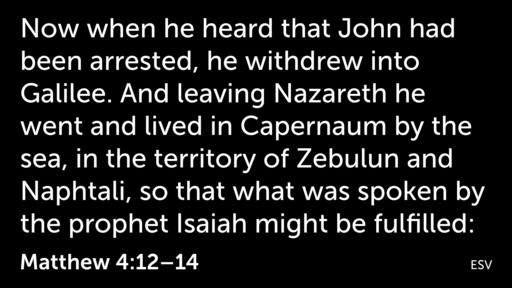
And in verse 13, we see Jesus leaving his hometown of Nazareth, and making his new base in Capernaum. Capernaum would be the place of Peter’s house, the town that Matthew was from and collected taxes in.
Capernaum is a thriving village with about 10,000 people. And we get two details about Capernaum. It is by the sea, and it is part of Naphtali, and Nazareth was part of Zebulun. These details will be important as we look at the prophecy from Isaiah.
This brings us to verse 14 where once again, just like we have already seen many times, Matthew will tell us how what Jesus does, fulfills the obscure prophecies of the Old Testament.
If you don’t know where in Isaiah this is coming from, it is from chapter nine. Let me read to you a familiar verse that gets read at Christmas time. Isaiah 9:6 “6 For a child has been born to us, a son has been given to us. He shoulders responsibility and is called Wonderful Adviser, Mighty God, Everlasting Father, Prince of Peace.”
But before this verse, at the beginning of the chapter, Matthew is going to give us a quote.
A. Where Hopelessness Exists v15
A. Where Hopelessness Exists v15
And it’s in this first part of the quote that we see how we grasp the needed hope where Hopelessness exists.
When this promise is given, it is during Assyrian captivity. And during this captivity, Isaiah comes to give them a much needed passage of hope.
Look at these verses. Matthew 4:15-16
15 “Land of Zebulun and land of Naphtali, the way by the sea, beyond the Jordan, Galilee of the Gentiles— 16 the people who sit in darkness have seen a great light, and on those who sit in the region and shadow of death a light has dawned.”
By the sea. And we see that these lands are “by the sea” just like Jesus chooses Capernaum by the sea.
We also see that this is called Galilee of the Gentiles. This is keying us into the fact that Jesus’s focus is again, far beyond just the jews. The initial place of his ministry is a place where jews and gentiles co-exist.
While the South area of Jerusalem and Judea would have not taken well to outsiders, this region would have been more accepting of the mixed diversity of culture.
Because it was not purely Jewish like the south, this region was looked down upon because of their mixed ethnicity. Some jews had lost faith in this region and saw the south as the place of true Jewish hope.
But Jesus comes to be hope for a place that people have lost hope in. Jesus love to show up when people least expect it in places where people least expect it. This is how the Messiah chooses to come.
The Messiah should have been building reputation with jewish authorities and leaders. He should have been spending time with religiously pious and the holy people. But he doesn’t. Jesus comes to the lowly.
And through this, he is showing us that he comes to be hope for us as well. To the ones who wonder if we will ever be enough and are not. The ones who feel like we are far from what we should be. To the ones who feel like we might be too far gone. To the ones who feel like we will never measure up. To the ones who feel like we are broken. These ones, Us, Jesus comes to be hope for.
We can rest in this truth that Matthew is pointing out, Jesus comes to be hope for the ones who don’t have hope. In this hopelessness, Jesus comes to us.
B. Where Darkness Exists v16
B. Where Darkness Exists v16
We also see in the second half of this quote that we grasp the needed hope where Darkness exists.
The people who sit in darkness, have seen a great light. Those who sit in the shadows of death, light has risen to them.
Notice the passive nature of the ones in darkness. They are not walking into darkness, they are sitting in it. They are not trying to escape it, they are sitting in it. They are not trying to find the light, they sit in darkness.
Almost like the ones sitting have accepted their reality to permanently dwell in darkness. Until the light comes to them.
This describes our standing before we come to God. In our sin, we sit in darkness. Not able to do anything. No matter how much we try to remove our sin, we continue to sit in darkness. No matter how much we try to clean up, we sit in our sin. We were hopeless until the light of Christ came to us in our darkness.
Remember, Darkness does not go seeking for light, light goes seeking darkness. And the darkness does not overtake light, light overtakes darkness.
When I was working in Coal mines, i never knew darkness like the darkness of a coal mine. We would drive 7 miles into the earth. Not down, but into a mountain. Darkness like you have never experienced. Darkness that would disorient you and even make you dizzy. Darkness that might even make you get lost. They had reflectors everywhere to show you where to go, but without a light, you would not be able to see reflectors, and would be completely lost. Usually, one of the initiation things they would do is to take you to the farthest part of the tunnel, as far as you could go in the earth. And then they would have you turn off all your lights. This was two fold. To understand and feel the gravity of darkness, but also to ensure you cling to the headlight. If you were to loose your headlight, or it was to go out, you could not walk around. You could not try to find your way out. Not for 7 miles of intricate tunnels. You didn’t have a hope. The only thing you could do was to sit and to wait. The mine had an intricate GPS tracking system where on one screen, everyone could be found. So if your light went out, and you stopped moving for to long, they would send someone to you. The only think you could do was to sit in the darkness, and wait for the light to come.
This is our situation before God. We can strive and try to get out of the darkness, but it does not work. We need the light of Christ to come to us.
Something interesting happens here in the original language of greek. The original language of Isaiah 9:6 is Hebrew. Hard to exactly translate with our western verbs. But It just means light shine. When the LXX translators worked on the greek translation, they thought, well this is a prophecy about a future time, it we have to choose a greek verb to take the place of this Hebrew work, what tense or time should we put the verb in? Has to be future. Matthew is referencing and using the LXX, not the Hebrew Old Testament. But he is saying, the LXX translates were wrong, or now i’m translating this Hebrew word differently. This light has already come. It is already shining. It is not a future event, it is here for us!
Sometimes, it gets portrayed that Galilee was a backwoods hillbilly country. But Galilee was not this way. Its not that Galilee was a terrible place full of immense darkness, rather, it was a beautiful land that is still today one of the most wonderful places in Palestine. But it was spiritually dark. Spiritually, they needed the good news. They needed hope.
I think this must parallel to our lives as well. We in New England don’t think of our time here as dark. It’s a pretty great place to live. People love living here. Most people are pretty happy. But the spiritual darkness is real. So many people who need a light in their lives. So many people who are sitting in darkness spiritually. Content to go though life as is. Maybe not really grasping the the hope that they need.
This is what Christ is using us his people to do.
God is using his Church and specifically our church, to be a light to this area and show them Jesus.
II. Announcing the Kingdom v17
II. Announcing the Kingdom v17
Next, we see Announcing the Kingdom in verse 17. This is a verse that belongs all by itself. How is the light coming? By Jesus coming to bring the Kingdom of heaven. And how will he do that? We found out in the rest of the book.
This is the same message that John was preaching in his ministry, but Jesus picks it up. What John was announcing, Jesus will bring to fruition. Jesus up to this point has been a reactionary, passive character in the story, but he is about to become the supreme character as he takes the helm from John.
Like a ship at BIW, BIW has made the ship, but the US military will use it to bring dominance and the kingdom of the US to high seas. John the Baptist has done some ship building, but Jesus is show us this ship capability by bring God’s sovereign reign to the people of earth.
And the message that Jesus has stays consistent with John. it’s a message of repentance. Because the kingdom is here, repent. Remember a few weeks ago we discussed this idea and the meaning of the kingdom of heaven. It is God reigning here being realized. And because we realize God’s reign, we submit to it by turning from our ways and to his ways. This is what Jesus preached.
Jesus is not going to sugar coat the reality. We aren’t mostly whole and need a little help. We don’t need to work on ourselves more. We don’t need a little change or adjustment. We have a massive sin problem against a Holy God and need to turn away from it. This is what his kingdom is coming to do. To show us a better way. That you were created to live under God’s reign in God’s kingdom. And now Jesus is telling you that because and through him, you can live the way you were created to live. Not submitted to your own way, but to God’s way.
The Kingdom of Heaven idea is huge in Matthew. And many scholars debate if Jesus was announcing a future kingdom or bringing the kingdom during his life. And then there are some who believe the answer is to mash this up and see Jesus announcing something and bringing something at the same time. We call this the “already and the not yet” kingdom. Is here? Yes. Is it still coming? Yes.
The last few weeks, many people have been gathering at Popham Beech to watch the latest finished ship do it’s sea trials. I’ve heard of people waiting many hours on the rocky beech to see this ship pass. But when it goes back to BIW to fix everything and make adjustments, and the people are there at the yard to accept the ship. When it starts to come close, we could ask the question, is the ship there? Yes. Is it still yet to come? It is here, but it is not fully here. Are we currently working to tie it off the boat with those big fat ropes? yes. Our actions and lives are being changed by the ships arrival. But is it here fully? No, we can’t fully get on it or embrace it being here.
This is the kingdom of Heaven for us. Has it come? Yes. Is it actively changing the way we are living our lives right here and now in this moment? Yes. Is there still more yet to come? Yes. The kingdom is here in word and deed, but is still yet to be realized here on earth.
III. Following the Given Hope v18-22
III. Following the Given Hope v18-22
Second Today, we see following the Given Hope. We see this in verses 18-22.
In this section we see Jesus calling people to himself and his mission. This is a kingdom that goes beyond just himself. This kingdom is more than just one man. This kingdom is about a new kind of people that come because of the work of this one man, who is the Messiah.
What we see in verse 18 is the calling of Jesus’s first disciples, Andrew and Simon. What is great about these two is that we see the mix of ethnicities in this region. Simon is a Jewish name, Andrew is a Greek name.
Jesus finds them casting their nets as he walks by. These nets are not like our type of fishing today. Our fishing is leisurely, casually waiting for a bite. This type of fishing is labor intensive as you continually throw nets hoping to catch something. These nets would be thrown and thrown and might not catch any fish. Persistence and dedication were needed.
James and John are also called in verse 21. It would appear from the gospels that their father Zebedee and family were more invested in the industry of fishing, not just throwing nets from the shore, but also having boats and hired workers.
We sometimes have this idea that it would be a no brainer for these fisherman to follow Jesus. That they were just poor, illiterate, dumb, and their lives amounted to nothing.
But this is just not true. They would not have been trained as well as scribes and religious leaders, they were literate and grew up with the Torah and Jewish teaching. They were of a lower class, but not a meaningless class. Life of fishing was a life.
Peter reminds Jesus later on in the book that they left everything to follow Jesus, it was not a life of nothing that they were leaving behind.
James and John do not leave their father without help, the other Gospels inform us that Zebedee had other hired works who worked for him.
But the point is that allegiance to Jesus is stronger than any earthly attachment.
But Jesus tells them “Follow me, and I will make you fishers of men.”
Some debate on if Jesus had already had encounters with them or not, and it’s hard to say. Regardless, this would have been a jarring request.
Typically, followers of rabbis would take the initiative. Rabbis did not call followers.
And Jesus does not just call them to be followers, he doesn’t invite them. He demands them. This was not a polite reasonable invitation, but an unconditional, unexplained, demand.
This following is not simply a request to travel with him, but to align themselves ethically to his teaching. This obedience to Jesus’s teaching practically showing what it looks like to repent, because the kingdom of heaven is here. This is a call for them to submit themselves to God’s reign through Jesus. Do you want to know what it looks like to repent in light of the Kingdom? Matthew is starting to show us here.
He calls them not primarily to the task of learning, but action and living. This is the mission.
Dietrich puts Jesus’s call this way, “It is no longer a question of taking fish from the lake, but of drawing people up out of the abyss of sin and death, catching them in the great nets of God!”
This is a rescue mission that they are called to.
Matthew tells us in verse 20 and 22 that they Immediately left their nets and followed him.
They leave behind what is comfortable, familiar, and secure, to trust in the unknown.
When they “leave their nets,” they aren’t planning to come back to them, they are leaving that life behind to follow this mission.
Their response is not made with all of the data, they aren’t weighing out all of the facts for their decision, because they don’t have all of the facts.
They are asked to follow Jesus, not to an easier life, but to the unknown. Trusting Jesus more than my own knowledge of the future.
This is not blind faith, this is faith in the one who knows the unknown. This is faith in the one who would make the unknown known. This is faith in the one who gives them life more than other things they value in life.
This is true for our lives as well. Jesus does not provide us all of the logical answers and knowledge of exactly how our lives will go so that we can make an informed decision to follow him. He is asking us to trust who he is, more than anything else in our lives. Beyond the security and the familiar, to submit to what might be uncomfortable for us.
Following Jesus requires us to give up what we think is important to us, to follow what God knows to be far more important to us.
In discipleship, we are joining to Jesus’s mission to live under God’s reign and be a light to the world.
There is an encouragement by Jesus calling fisherman. Jesus calls ordinary people.
The World tells us that the most useful people are the brightest, the best, the intellectual, and most skilled.
But think about those glow in the dark stars. If you lined up a gold star, silver star, bronze star, purple stair, glitter star, and a glow in the dark star, without knowing what it will do, you would pick all the other stars. The ungly greenish yellow one seems so ordinary.
But Jesus loves to use ordinary greenish yellow stars for his glory.
Jesus wants to use nobodys, ordinary people to accomplish his plans. It is through the ordinary people that he is magnified.
IV. Manifesting the Kingdom v23-25
IV. Manifesting the Kingdom v23-25
Last today, we see manifesting the Kingdom Hope. We see this in verses 23-25.
This section describes the expansion of Jesus’s ministry. It starts with Jesus, and then his disciples, and then more people. His fame is spreading verse 24 says.
In verse 23, we see Jesus doing three things, teaching, preaching, and healing.
This is the first mention of Gospel, or the “good news” in Matthew. While Jesus is proclaiming repentance and it might seem harsh, this is good news. Good news that he comes to bring a new way of life to people. Repentance is not simply turning away from something we think is good for us, it is turning towards what God has declared is good for us!
Notice also the mention of healings. Matthew wants you to know the holistic nature of Jesus’s ministry.
He is healing the sick the afflicted, the various diseases, the pains, the demonic possessed, seizures, and paralytics.
Some might want to say that the demonic possessed here are just a way for first century authors to explain medical illnesses they couldn’t explain.
But the rest of the gospels, and we will see in Matthew, that Jesus is casting out actual demons.
He is showing his power over all realms. He has already shown his authority over Satan in the beginning of this chapter, this is a continuation to show his authority over the darkness. To the people sitting in darkness, light has come.
For many of these, especially paralytics, there would have been no cure in the first century. If you were born or these ailments happened to you, you would have been expected to live the rest of your life this way. But Jesus comes to be hope where there is no hope.
Through these healings, Jesus comes to show the great reversal of the undoing of what Humanity has lost. This is what the kingdom of heaven looks like. To be restored to perfect life with God. Removing the affects of sin on the world.
Jesus comes bring good news and to do good to people. He wants belief, but also he cares about physical needs.
There is often a dichotomy in Christianity by people living missionally for the gospel. Some are only preaching the gospel and think this is all that we are meant to do. Just get everyone saved.
But, on the other side is another ditch. There are some that believe gospel work is only about caring for physical needs. That meeting peoples physical needs and caring about them is enough.
But both of these extremes are to miss Jesus’s example. He cares about people’s eternal destiny and their life with God, but also cares about their immediate needs in his compassion.
Certainly physical needs are temporary and soul work has eternal consequences of heaven and hell, but that doesn’t mean we neglect physical needs of people either.
Jesus did not spend all of his time ensuring everyone logically understood the gospel. He spent significant amounts of time healing and caring for people.
Do we do this as well? Jesus is showing us that the Gospel of the Kingdom is about care and love for others. Are we following Jesus’s example in our lives as well? Are we willing to put aside our own ambition to show kindness and care for others?
In verse 24, we see Jesus’s ministry reaching places like Syria. Syria is not a place where you would expect the gospel to go. It is not even a Jewish area. But it is a reminder of the power of the Gospel. Jesus’s Kingdom of Heaven is for all people.
It’s a reminder for us to not limit the gospel to certain types of people. The gospel goes to places and people where we least expect it.
Many had written off New England as post Christian and too far gone.
I was excited about an article from the Portland Herald this week that talked about Southern Baptists gaining traction in Maine. And that while Christianity in general is on the decline, Baptists churches are steadily growing and changing the spiritual climate of Maine. The gospel is growing in places where people thought it couldn’t grow.
Beyond the Walls
Beyond the Walls
If you are hear today, and are not yet part of the Kingdom of Heaven, and maybe you don’t even know what that means. We would love to talk to you more about it.
All of us must come to grips with the fact that we are people living in darkness. Darkness due to our sin. Sin that separates us from God and eternal life with him. Sin that condemns us to God’s judgement.
But Jesus came to not just give us the good news, but to be the good news. The Gospel or the good news is that Jesus died on the cross for our sin. He took our sin, our guilt, our punishment, our shame, our judgement to the cross. He died on our behalf to give us life. He rose from the dead showing his power over death for us. Abundant life here on earth, and abundant life for all of eternity with God.
If you have not yet been rescued from your sin, this good news is being offered to you today.
To those of us following Jesus, this text is not calling all followers of Jesus into full time vocational ministry. But it is calling you to set aside the things in your life that you value, find security in, and cherish, for the sake of Christ’s kingdom and his church.
Proclaiming the gospel to others is not the call of me your pastor, or the elders of our church. It is a calling for all of us. Gospel work is the work for every true believer in Jesus. By witnessing in the places God has planted you.
I can’t reach unsaved shipbuilders in the same way Christian shipbuilders can.
I can’t reach unsaved finance people in the same way Christian finance people can.
I can’t reach unsaved tech industry people in the same way Christian tech people can.
I can’t reach people unsaved people in your school the same way you Christian who attend public school can.
I can’t reach unsaved mom groups the same way that Christian moms can.
God wants you to faithfully be showing Jesus as light to the people sitting in darkness around you.
Think about gospel expansion here. Beginning in a odd location, and going to people that we did not expect the gospel to go to.
Individually, it is a reminder to us, that as we are called to be a part of spreading the message of the Kingdom, don’t write off anyone.
We have these square cards that we encourage you all to give out. Just a simple church invite. And we can be tempted to look at someone and say, there’s no way they are want a church invite. They wont be happy about this. They might be upset with me.
But who are we to limit the gospel? Jesus and his disciples did not. Christ is able to reach the unreachable. He came to shine as a light on their darkness. So we cast our nets for people wide.
How can they call on Jesus if they don’t believe? How can they believe unless they have heard? How can they hear unless someone proclaim the gospel to them?
Let’s bow our heads and close our eyes as we respond to the text together.
Pray to the father for sending Jesus to be the light into the darkness of our souls.
Ask Jesus to show you the people he has called you to.
Ask the Spirit to help you be a bold light to the people around you.
