Introduction to Exodus

Exodus  •  Sermon  •  Submitted   •  Presented   •  36:24
0 ratings
· 9 views
Files
Notes
Transcript

Introduction

Turn to Exodus
Remember Genesis?
Creation of universe, man, fall, death to all children of Adam, destruction in flood, tower of Babel, God dispersed the nations
Then chose to make one nation for Himself, from man He called named Abram
Ch 12–25 all about Abram, renamed Abraham. Beginning w/ God’s covenant w/ Abraham and promise of land, seed, blessing
Ch 26–36 about Abraham’s son, Isaac, and Isaac’s son, Jacob
Ch 37–50 are focused in on Jacob’s son Joseph and his brothers
You remember the story of Joseph, one of the most amazing accounts of the providence of God in all the Scripture
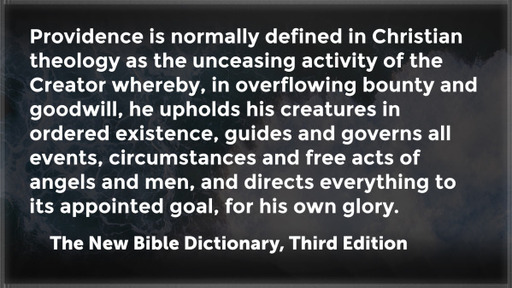
Remember that doctrine, providence? I preached a sermon on that doctrine back in May. Here’s the definition we used at that time from the NBD:

Providence is normally defined in Christian theology as the unceasing activity of the Creator whereby, in overflowing bounty and goodwill, he upholds his creatures in ordered existence, guides and governs all events, circumstances and free acts of angels and men, and directs everything to its appointed goal, for his own glory.

Yes, God’s Providence even governs the free acts of angels and men. And we saw a brilliant example of that when Joseph was reunited with his bros after they sold him into slavery in Egpyt:
Genesis 50:20 ESV
As for you, you meant evil against me, but God meant it for good, to bring it about that many people should be kept alive, as they are today.
Joseph’s bros actions were evil, but behind their actions was the wise hand of a loving God, providing for His people
That’s exactly what we find when we turn the page to Exodus
Read (seated, books)
Exodus 1:1–22 ESV
These are the names of the sons of Israel who came to Egypt with Jacob, each with his household: Reuben, Simeon, Levi, and Judah, Issachar, Zebulun, and Benjamin, Dan and Naphtali, Gad and Asher. All the descendants of Jacob were seventy persons; Joseph was already in Egypt. Then Joseph died, and all his brothers and all that generation. But the people of Israel were fruitful and increased greatly; they multiplied and grew exceedingly strong, so that the land was filled with them. Now there arose a new king over Egypt, who did not know Joseph. And he said to his people, “Behold, the people of Israel are too many and too mighty for us. Come, let us deal shrewdly with them, lest they multiply, and, if war breaks out, they join our enemies and fight against us and escape from the land.” Therefore they set taskmasters over them to afflict them with heavy burdens. They built for Pharaoh store cities, Pithom and Raamses. But the more they were oppressed, the more they multiplied and the more they spread abroad. And the Egyptians were in dread of the people of Israel. So they ruthlessly made the people of Israel work as slaves and made their lives bitter with hard service, in mortar and brick, and in all kinds of work in the field. In all their work they ruthlessly made them work as slaves. Then the king of Egypt said to the Hebrew midwives, one of whom was named Shiphrah and the other Puah, “When you serve as midwife to the Hebrew women and see them on the birthstool, if it is a son, you shall kill him, but if it is a daughter, she shall live.” But the midwives feared God and did not do as the king of Egypt commanded them, but let the male children live. So the king of Egypt called the midwives and said to them, “Why have you done this, and let the male children live?” The midwives said to Pharaoh, “Because the Hebrew women are not like the Egyptian women, for they are vigorous and give birth before the midwife comes to them.” So God dealt well with the midwives. And the people multiplied and grew very strong. And because the midwives feared God, he gave them families. Then Pharaoh commanded all his people, “Every son that is born to the Hebrews you shall cast into the Nile, but you shall let every daughter live.”

Why Were God’s People in Egypt?

1–7
Several answers to that question
Behind it all, you know why:
Genesis 50:20 ESV
As for you, you meant evil against me, but God meant it for good, to bring it about that many people should be kept alive, as they are today.
On the human level, you know why: famine, Egypt had food, Joseph in charge, family moved down
First 7 vv set scene: Jacob and all his children moved down to Egypt at Joseph’s invitation
v 6 says time has passed: Joseph and everyone in that generation is dead
In fact, it’s been hundreds of years. Total stay was 430 years
Why did they stay? Surely the famine was over
Presumably they didn’t leave b/c things were going great there—until they weren’t
But whatever their reasons for staying, we also know God’s reason behind their stay
Remember: part of God’s cov promise to Ab was children
Genesis 15:5 ESV
And he brought him outside and said, “Look toward heaven, and number the stars, if you are able to number them.” Then he said to him, “So shall your offspring be.”
God made that promise, then God confirmed the cov w/ the ratification ceremony where the smoking pot and flaming torch passed between the pieces of the severed animals
As God began that ceremony, He said
Genesis 15:12 ESV
As the sun was going down, a deep sleep fell on Abram. And behold, dreadful and great darkness fell upon him.
Genesis 15:13 ESV
Then the Lord said to Abram, “Know for certain that your offspring will be sojourners in a land that is not theirs and will be servants there, and they will be afflicted for four hundred years.
Genesis 15:14 ESV
But I will bring judgment on the nation that they serve, and afterward they shall come out with great possessions.
God prepared the way for Joseph to usher them into Egypt, and God planned for them to stay there
Why? Why would God want them stuck in a foreign place for 400 years—and afflicted, on top of that?
The key is in v 7:
Exodus 1:7 ESV
But the people of Israel were fruitful and increased greatly; they multiplied and grew exceedingly strong, so that the land was filled with them.
What’s God doing? Making the nation from whom will come the Messiah
But it started with one man. How do you make a nation out of one man? His descendants have lots of babies
But here’s an equally important question: How do you make sure the nation stays distinct from the inhabitants of the land where they’re dwelling?
Remember when Joseph was preparing to move his family into the land, and they were going to meet Pharaoh—remember what Joseph told them to say?
Genesis 46:33 ESV
When Pharaoh calls you and says, ‘What is your occupation?’
Genesis 46:34 ESV
you shall say, ‘Your servants have been keepers of livestock from our youth even until now, both we and our fathers,’ in order that you may dwell in the land of Goshen, for every shepherd is an abomination to the Egyptians.”
No Egpytian father is going to marry off his son or daughter to a shepherd, or later to a slave
So what has God arranged? He’s arranged for His people to be in a foreign land, with no hope of intermarrying with the natives, plenty to eat… and what’s happening? V 7 says, they multiplied
That language shows up again, when the new Pharaoh worries,
Exodus 1:10 ESV
Come, let us deal shrewdly with them, lest they multiply, and, if war breaks out, they join our enemies and fight against us and escape from the land.”
And what was the result of that?
Exodus 1:12 ESV
But the more they were oppressed, the more they multiplied and the more they spread abroad. And the Egyptians were in dread of the people of Israel.
As we read, Pharaoh eventually orders the Hebrew midwives to kill the boy babies. What was the result?
Exodus 1:20 ESV
So God dealt well with the midwives. And the people multiplied and grew very strong.
So why is Israel in Egypt? Because God is keeping His promises to Abraham. God is providing for them to grow into a nation—this is another classic example of the doctrine of Providence
As Charles Spurgeon put it,
Exodus—Saved for God's Glory Prosperity Under Persecution

[I]n all probability, if they had been left to themselves, they would have been melted and absorbed into the Egyptian race, and lost their identity as God’s special people. They were content to be in Egypt, and they were quite willing to be Egyptianized.

So God providentially arranges things so that does not happen
But here’s the thing about Providence: Nothing says you’re going to be able to understand it while God is working
And nothing says it’s going to feel good
Think back to Joseph’s great statement: God meant it for good
He can say that then, when he’s 2nd in command in Egypt and he sees that God has provided for his family to escape the famine
But could he have said that while he was in an Egyptian prison?
Same for the people of Israel. Looking back on the situation, we can say, wow, look at how God provided and kept His promises! But how did it feel to an Israelite in Egypt? It felt like affliction. It felt like slavery. It felt like God had abandoned His people
If you’re an Israelite in Egypt in the generations after Joseph, all the evidence of your eyes and ears and your aching back says, God does not keep His promises. Maybe we should try serving the Egyptian gods, maybe things would go better for us
This is why faith is faith, not sight
This is why, when elderly, childless Abraham believed God when God said his descendants would be like the stars in the sky,
Genesis 15:6 ESV
And he believed the Lord, and he counted it to him as righteousness.
The Israelites knew that God had promised them their own land. Their whole life experience said, God is not keeping that promise
Faith says, “But I believe He will do what He has said He will do”
But there’s more going on here than making bricks and having babies and Pharaoh’s fear. Behind all of that is

A Spiritual Battle

8–14
Exodus 1:8 ESV
Now there arose a new king over Egypt, who did not know Joseph.
Exodus 1:9–10 ESV
And he said to his people, “Behold, the people of Israel are too many and too mighty for us. Come, let us deal shrewdly with them, lest they multiply, and, if war breaks out, they join our enemies and fight against us and escape from the land.”
This pharaoh is the maybe the first racist we meet in scripture
Blame the foreigners, never mind that they haven’t done anything wrong
Make up a flimsy excuse about what they might do and use it as a pretext to persecute the foreigners
I can’t help but think about our situation with the millions of people the last administration let in and the current admin is trying to deport
This is not the same situation—but it does make you stop and examine your heart, doesn’t it?
Thank God we’re only talking about sending them back, and not about enslaving them
Do you hear the fear in Pharaoh’s reasoning? It shows up in full force in v 12:
Exodus 1:12 ESV
And the Egyptians were in dread of the people of Israel.
Does that puzzle you? It should. God promised that the descendants would be what to other nations? A blessing
Genesis 12:3 ESV
I will bless those who bless you, and him who dishonors you I will curse, and in you all the families of the earth shall be blessed.”
So why is Pharaoh so opposed to them?
Philip Ryken in his Preaching the Word commentary on Exodus points out
Pharaoh rejected God’s people. Israel is supposed to multiply and become a nation of blessing, and he’s against that
Pharaoh rejected God’s promises. God promised to make Israel into a great nation, and Pharaoh is trying to keep them small. Ryken said,
Exodus—Saved for God's Glory The House of Bondage

If Pharaoh had been God’s servant, he would have rejoiced at the birth of each new Hebrew baby. But he did not. Instead, the fulfillment of God’s promise filled him with fear and loathing.

Pharaoh resisted God’s plan, which was to give His people Israel their own land. The place Joseph made them promise to take his bones to when they went. Pharaoh is trying to make sure they never leave his land
Why all this opposition? Because behind the scenes of Pharaoh’s opposition, there is a spiritual battle going on
The new pharaoh may not understand God’s plan for Israel. But Satan does. As Ryken put it,
Exodus—Saved for God's Glory The House of Bondage

The Pharaoh of Egypt was not a private individual; rather, he represented the entire nation of Egypt, including their gods.

Exodus—Saved for God's Glory The House of Bondage

To be specific, Pharaoh claimed to be the incarnate Son of Re—the sun god—who was the primary deity in the Egyptian pantheon.

Exodus—Saved for God's Glory The House of Bondage

This means that the struggle between Israel and Egypt was not about politics but about religion.

Another scholar points to an inscription in an Egyptian temple from the time of pharaoh Rameses picturing a god registering slaves for Pharaoh
This is a spiritual issue. Pharaoh believes he is the son of their chief God Ra. Pharaoh is basically telling the Israelites: you are not free to go serve your God; you have to stay here and serve me, and my gods
He’s saying: God isn’t the lord of Israel—I am
Reminds me of scene in rev 12
Revelation 12:1–2 ESV
And a great sign appeared in heaven: a woman clothed with the sun, with the moon under her feet, and on her head a crown of twelve stars. She was pregnant and was crying out in birth pains and the agony of giving birth.
Revelation 12:3 ESV
And another sign appeared in heaven: behold, a great red dragon, with seven heads and ten horns, and on his heads seven diadems.
Revelation 12:4 ESV
His tail swept down a third of the stars of heaven and cast them to the earth. And the dragon stood before the woman who was about to give birth, so that when she bore her child he might devour it.
Revelation 12:5 ESV
She gave birth to a male child, one who is to rule all the nations with a rod of iron, but her child was caught up to God and to his throne,
Who is this dragon?
Revelation 12:9 ESV
And the great dragon was thrown down, that ancient serpent, who is called the devil and Satan, the deceiver of the whole world—he was thrown down to the earth, and his angels were thrown down with him.
That’s why Donald Grey Barnhouse said,
Exodus—Saved for God's Glory The House of Bondage

“The devil was in Egypt. The devil was ruling Egypt. Behind Pharaoh there was Satan.”

I believe he’s right. That’s why the prophets and Psalm-writers of the OT referred to Egypt as Rahab or a sea monster or a dragon
So what does Pharaoh do, instead of letting Israel serve their God? He enslaves them, and tries to work them so hard that their numbers dwindle
Pretty much throughout all of human history, worshiping demons leads to enslaving other humans
I’m not even sure humans invented chattel slavery—I suspect Satan did. I know he loves enslaving people: to sin and lusts, and also in physical slavery
And then Pharaoh orders their babies be killed. This guy was Hitler before Hitler. Worshipping demons pretty much always leads to killing babies—it did in most ancient civilizations, it did here in Egpyt, and it even does today. Back then Satan said, you have to kill your baby if you want the weather to be good for your crops. Now he says, abortion is a woman’s right—same old lies in new packaging. And people always fall for it, because they’re under Satan’s power
So that is where Israel finds herself as we start this book: enslaved, by pharaoh and ultimately by the devil, not free to serve God
Wait, wait—enslaved, unable to serve God? Does that remind you of anyone else?
Paul told the Galatians,
Galatians 4:8 ESV
Formerly, when you did not know God, you were enslaved to those that by nature are not gods.
Or as he told the Romans,
Romans 6:20 ESV
For when you were slaves of sin, you were free in regard to righteousness.
And to Titus,
Titus 3:3 ESV
For we ourselves were once foolish, disobedient, led astray, slaves to various passions and pleasures, passing our days in malice and envy, hated by others and hating one another.
John put it this way:
1 John 5:19 ESV
We know that we are from God, and the whole world lies in the power of the evil one.
So what did Jesus do? He freed the slaves
This book is about Israel being freed from slavery in Egypt by the power of God, for the glory of God
And so, this book is about salvation. Because salvation is sinners being freed from their slavery by the power of God, for the glory of God
Exodus is the salvation story of the Old Testament. Exodus is the first clear picture in the Bible of what it looks like for God to save sinners
And make no mistake: The Israelites are sinners. This is one of the ways you can tell this book is true, and really from God: because no self-respecting Jew would write Exodus on his own
The Israelites are many things in this book: victims, grumblers, traitors. But one thing they never are in this story? Heroes. This is such a good summary from Ryken’s commentary I’m just going to read it:

The twelve sons of Israel were never likely to become epic heroes. In fact, the more we know about this family, the more amazed we are that God would have anything to do with them at all. It was not a large family; there were only seventy of them to begin with. They were not very powerful. Joseph had risen to a position of authority, but his office was not hereditary, and the rest of his family were living as strangers in a strange land. They were not especially bright. Certainly they were no more talented than the Egyptians, who built a civilization that could boast some of the world’s leading intellects. Nor could this “dirty dozen” claim to be any more righteous than anyone else. Their family history was a sordid tale of treachery, philandering, and violence. Their father Jacob had betrayed his brother Esau by tricking him out of his birthright. Like father, like sons: By getting rid of Joseph, Jacob’s boys had tried to deny their father’s blessing… The sons of Israel were all sinners—ordinary mortals, as their obituary proves: “Now Joseph and all his brothers and all that generation died” (

He continues:

Joseph and his brothers really had just one thing going for them, and that was their God. What was important about these people was that they were God’s people.

Because God is the hero of the story of Exodus
Why does He do all this for these people, if they don’t deserve it? Well he tells us. God tells us what the purpose of this whole situation is, several times in this book. For instance in ch 9 God says to Pharaoh:
Exodus 9:16 ESV
But for this purpose I have raised you up, to show you my power, so that my name may be proclaimed in all the earth.
God saves Israel from Egypt for His glory
In fact, I think we could fairly say that is the whole theme of the whole book of Exodus:

Saved for the Glory of God

God is getting glory over Pharaoh in the earthly realm, and God is getting glory over the devil and all the so-called gods of Egypt in the spiritual realm
And Israel is the beneficiary of God’s work to glorify Himself—and that is how salvation always works. We get the benefit, God gets the glory
God humiliates Pharaoh for daring to exalt himself over Israel’s God, and drowns him in the sea. God defeats the dragon, snatching His child away before the dragon can swallow him

The Means to God’s Ends

15–22
I’m not going to spend a lot of time on the Hebrew midwives today
I’m not even going to try to answer the burning question: did they sin in lying?
Instead I just want to close with a focus on one issue about the doctrine of Divine Providence that’s on display in this chapter:
God works through means
Pharaoh says, kill the boy babies. God doesn’t want them dead.
He could have intervened and miraculously prevented Pharaoh’s plan from succeeding. Instead, he works through these women, who do the right thing and don’t follow their evil orders
Zoom out a little and that’s how all of this is happening, isn’t it? God is working through ordinary means to accomplish His will and keep His promises
He tells Abraham, I’m going to make you into a great nation with descendants like the stars of the sky
Could God have created a nation from Abraham miraculously? Of course—he spoke the stars in to existence
But what does He do instead? Gives Abraham one son, Isaac. Then that son has a son, Jacob. Then that son has twelve sons, named at the start of this chapter
Then they go to Egypt, and they grow—through natural means—into a great multitude
God is not opposed to working through miracles—we’ll see plenty of them in this book
But ordinarily, He provides for His people through ordinary means
God is able to zap you with a bolt of sanctification. But instead, He is gathering you together with the saints, week by week, to sing and pray and study through the book of Exodus to accomplish that very thing
May that study be blessed by our all-sufficient provider to grow you into the likeness of His Son
Pray
Invitation
As we’ll see in this book, God saved His people when they called out to Him. God still saves people who call upon Him
You can be delivered from your slavery today, by calling on God to save you. We would love to talk with you about doing that before you leave
Related Media
See more
Related Sermons
See more
Earn an accredited degree from Redemption Seminary with Logos.