Luke 13:22-30 Narrow, but Open
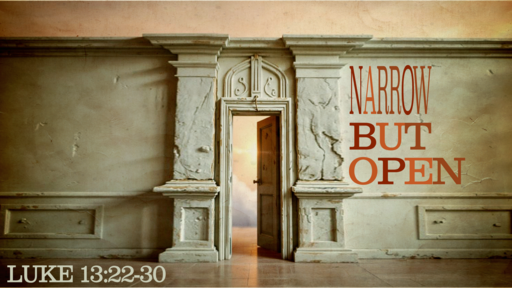

Luke 13:22-30 (Evangelical Heritage Version)
22He went on his way from one town and village to another, teaching, and making his way to Jerusalem. 23Someone said to him, “Lord, are only a few going to be saved?”
He said to them, 24“Strive to enter through the narrow door, because many, I tell you, will try to enter and will not be able. 25Once the master of the house gets up and shuts the door, you will begin to stand outside and knock on the door, saying, ‘Lord, open for us!’ He will tell you in reply, ‘I don’t know you or where you come from.’ 26Then you will begin to say, ‘We ate and drank in your presence, and you taught in our streets.’ 27And he will say, ‘I don’t know where you come from. Depart from me, all you evildoers.’ 28There will be weeping and gnashing of teeth when you see Abraham, Isaac, and Jacob, and all the prophets in the kingdom of God, but you yourselves thrown outside. 29People will come from east and west, from north and south, and will recline at the table in the kingdom of God. 30And note this: Some are last who will be first, and some are first who will be last.”
Narrow, but Open
I.
Think back. A long, long way back. It’s probably barely a memory for you now. Think all the way back to June 29, 2025. That was a Sunday; maybe you were here, maybe you were watching on the livestream. It was the Third Sunday after Pentecost. There was a sermon about “Commitment” from the First Reading for the day. We didn’t speak about Jesus’ commitment that day, but Elisha’s.
The Gospel for that day, way, way back at the end of June, started this way: “When the days were approaching for him to be taken up, Jesus was determined to go to Jerusalem” (Luke 9:51, EHV).
Maybe it was way, way back in the minds of Jesus’ followers, too, by the time of today’s Gospel. Parables had been told. The 72 had been sent out to preach about Jesus and had come back. Jesus had taught his disciples the Lord’s Prayer, and taught them about the persistence of prayer. Last week Jesus even said he brought division rather than the kind of peace many people were looking for.
Even before Jesus turned his path in determination toward his final objective in Jerusalem, John reports: “Many of his disciples turned back and were not walking with him anymore” (John 6:66, EHV). Maybe his followers had noticed the empty spaces in the moving pews as they accompanied Jesus. What Jesus taught didn’t always jibe with what the Pharisees taught, or the rest of Judaism, for that matter. As they noticed the empty pews along the way to Jerusalem, “Someone said to him, ‘Lord, are only a few going to be saved?’” (Luke 13:23, EHV).
Have you ever noticed that Jesus doesn’t always answer the question that was asked? “He said to them, 24‘Strive to enter through the narrow door, because many, I tell you, will try to enter and will not be able’” (Luke 13:23-24, EHV).
Rather than talking about how many would be saved, Jesus focuses on how to be one of them. But his answer is a little bit intimidating. Try really hard, but many won’t be able to get there. It sounds like the training for the Navy SEALs, doesn’t it? Lots of people drop out without ever making it into the SEALs. Or maybe like pre-season NFL training camps. The roster keeps getting whittled down and whittled down. Lots of athletes would like to be on the team—any team, actually—but there will be more who don’t make it than those who do.
“Many will try to enter and will not be able.” The Pharisees taught that every human being should work really hard to follow the laws of Moses. They even got nit-picky about what each and every law meant; they dissected every detail of the laws of Moses.
Today’s Second Reading talked about Moses and the laws he had received from God on Mt. Sinai. “The sight was so terrifying that even Moses said, ‘I am trembling with fear’” (Hebrews 12:21, EHV). Fear was the proper response. God didn’t just suggest, he Commanded; he demanded. He told Moses: “Speak to the whole community of the Israelites and tell them these things: You shall be holy, because I, the LORD your God, am holy” (Leviticus 19:2, EHV).
“Holy” means perfect. You can put up a false front. If you are really, really careful, you can make people think that you are an exceptionally Godly person. That’s really what the Pharisees did. They worked really hard on their persona—their image. Jesus said: “You are like whitewashed tombs that appear beautiful on the outside, but on the inside are full of dead people’s bones and every kind of uncleanness” (Matthew 23:27, EHV). Efforts to appear to be Godly are really nothing but putting on a persona. “Be perfect” doesn’t mean “look perfect to other people,” it means “be completely without sin.” That is simply not possible.
II.
“Strive to enter through the narrow door” (Luke 13:24, EHV), Jesus said. Narrow, not closed. If its narrow and open, there simply has to be a way through. Strive, he said. That certainly sounds like “work at it,” doesn’t it? So...how?
Some students work just hard enough to figure out the minimum effort required to get a passing grade—or to get whatever grade is needed to appease their parents. Maybe you’ve seen the same thing in the workplace as you got older. There always seems to be at least one employee who manages to look busy, but never really accomplishes anything—or who plots how to finagle a way in to whatever group is making headway as if he was part of the team that made everything happen.
Eventually, Jesus says, the open door won’t be open any more. “Once the master of the house gets up and shuts the door, you will begin to stand outside and knock on the door, saying, ‘Lord, open for us!’ He will tell you in reply, ‘I don’t know you or where you come from’” (Luke 13:25, EHV).
Those banging on the door might not believe they put in only minimum effort. What they did was enough. They’re sure of it. Then they hear the reply: “I don’t know you or where you come from.”
“Then you will begin to say, ‘We ate and drank in your presence, and you taught in our streets’” (Luke 13:26, EHV). “Wait a minute, Lord! We were in church...sometimes. We came to the Lord’s Supper...once-in-awhile. We did good things...occasionally.” They even insisted they listened to Jesus teach them; perhaps the only things they learned was that they ought to follow his example, but no one is able to do that perfectly.
Remember, it is perfection that is required. Membership in a church can get the pastor to perform your funeral, but it doesn’t get you through the narrow door. Showing up from time to time keeps you off the elders’ list, but it doesn’t mean you have passed the entrance exam. Banging on the door demanding entry, no matter how emphatically and insistently, won’t do anything.
“And he will say, ‘I don’t know where you come from. Depart from me, all you evildoers.’ 28There will be weeping and gnashing of teeth when you see Abraham, Isaac, and Jacob, and all the prophets in the kingdom of God, but you yourselves thrown outside” (Luke 13:27-28, EHV). Like the rich man begging for Lazarus to come dip his finger in water to give him some relief in hell, there will be no relief for those standing outside the door after it has been closed.
III.
“Strive to enter through the narrow door” (Luke 13:24, EHV). I won’t make you wait until next April to hear what Jesus says in the Gospel for Good Shepherd Sunday: “I am the door. Whoever enters through me will be saved” (John 10:9, EHV).
The problem lies in trying to get through the narrow door with baggage. It’s too narrow to get through with all our own ideas of greatness, or even goodness. So Jesus took the baggage of our sins. He took the Pharisaical whitewashed tombs of our carefully crafted image that looks so good to others, but really just conceals all the failures to be perfect. He took the beating of us pounding on the door and insisting that we listened...sometimes; that we were in church to hear his Word...occasionally. He took all our feeble failures to pass the exam on himself.
He took it all because we could never, ever hope to “be holy, because I, the LORD your God, am holy.” Way back when the summer was young we heard that Jesus was determined to go to Jerusalem. He went to be the door—to open the door. He went to be the sacrifice that was essential for all those sins that showed the lack of our own commitment—the lack of our ability to strive to enter and be able to enter on our own. Jesus was the First in heaven, but he came to earth to be considered last by God to pay the penalty for sin God demanded.
IV.
“Lord, are only a few going to be saved?” (Luke 13:23, EHV).
Here you are today. You aren’t one who thinks you have made it through the narrow door just because you are here. You don’t think it’s because of your own efforts that you will be in heaven. You don’t think that you have followed Jesus’ example. You don’t think you have been perfect and holy, just as God is holy.
Earlier I said that rather than talking about how many would be saved, Jesus focuses on how to be one of them. You are the few, the humble, the believers.
“Strive to enter through the narrow door” (Luke 13:24, EHV). You come here, week after week, knowing that you are already in—you are part of his kingdom, even now. You come, knowing that you have not been holy, confessing your sins over and over again because you know they are paid for. You come, knowing you will be comforted by the absolution—the forgiveness of sins—announced by the pastor.
But there’s still that word strive. The word is a present imperative; that means it has a continual implication: keep striving. The professional athlete doesn’t quit training after one competition or one game is over; he/she goes right back to training. You hear it in press conference after press conference: “now we have to get ready for next week.”
Until you reach heaven, you are in a never-ending training session. You struggle in an ongoing fight against sin. You wrestle with God in prayer. You keep trusting in Jesus, who fought on your behalf and mine and continues to give us the strength to resist the onslaughts of Satan against us.
“People will come from east and west, from north and south, and will recline at the table in the kingdom of God” (Luke 13:29, EHV). Jesus won salvation for all. He extended his invitation to all to enter.
While the door is narrow, it is open. It has been opened by Jesus—who is the open door. You and I will be among those reclining at the table in the kingdom of God when he calls us through that door for the last time. Amen.
