Pentecost 11—August 24, 2025

Notes
Transcript
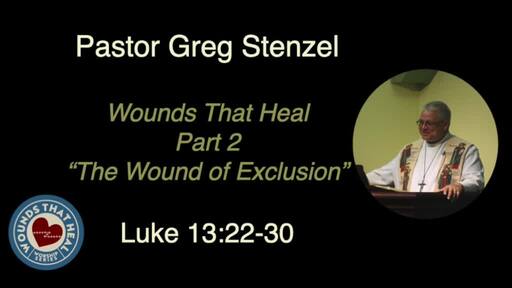
The Wound of Exclusion
The Wound of Exclusion
Luke 13:22–30
Series: Wounds That Heal
Introduction: Connecting the Series
Introduction: Connecting the Series
Grace to you and peace, from God our Father and from our risen and ascended Lord, Jesus Christ. Amen.
As we gather today, we continue our sermon series called "Wounds That Heal." Last week, we reflected on the profound teaching of Jesus as we explored "The Wound of Division"—a wound that, despite its discomfort, brings us closer to the truth of our dependency on Christ rather than earthly ties or transient peace.
Today, we turn our attention to another revelatory wound—"The Wound of Exclusion." This theme might stir within us a sense of unease as Jesus warns that many who feel secure in their standing may find themselves shut out of God's kingdom. This statement is not meant to discourage but to awaken. Much like a skilled surgeon who uses a precise incision to remove that which ails, Jesus exposes the false securities we might cling to, directing us instead to the true gateway to eternal life—Himself.
Let us consider the human inclination to wonder and debate about salvation, as seen in today's Gospel passage. Instead of being sidetracked by theoretical discussions, Jesus calls us to focus inwardly on our hearts, to strive with urgency and intention to the narrow door that leads to life. Our journey is not one of ease, but of earnest and ongoing faith, one that acknowledges our own need for grace and transformation.
As we delve into the depth of today's message, may we recognize the call to look beyond surface assurances to the deeper truth—our salvation is found not in our heritage or external rituals but in the grace and truth of Christ alone. This wound of exclusion is a call to reflection and reorientation, pushing us towards the peace and promise of true inclusion in God's kingdom.
In the name of Jesus. Amen.
I. Debate Instead of Repent
I. Debate Instead of Repent
Jesus is making His way toward Jerusalem. He knows what awaits Him there: the cross. Along the way, someone in the crowd asks Him a question: “Lord, will those who are saved be few?”
Notice what’s happening. Instead of asking about their own soul, they want to debate the numbers. Instead of repenting, they’d rather speculate.
It’s so very human. We prefer the comfort of argument to the discomfort of repentance. We want to compare ourselves with others rather than face the state of our own heart. As Luther once quipped in a sermon on this very text: “Men would rather wrangle about the fewness or greatness of the number that shall be saved than enter in themselves.”
We can imagine the crowd whispering: “What about the pagans out there? What about the Pharisees? What about Rome? Will only a few make it?” I recall when I was growing up the popular question was about the American Indians of yesteryear who supposedly never heard the gospel. Sinful man is willing to do anything to keep the focus out there—on others—rather than in here, on me.
And we are no different. We debate theology, politics, cultural battles. A few years ago we argued over mask wearing and vaccines. We wrangle over who’s in and who’s out, about which denomination has it right.
Meanwhile, Jesus is saying: “Stop debating. Repent. Strive to enter through the narrow door.”
II. The Narrow Door and the Urgency of Striving
II. The Narrow Door and the Urgency of Striving
The Greek word for “Strive” is ἀγωνίζεσθε (ago-niz-o-mai). It’s where we get our word “agonize.” It pictures a wrestler straining with all his might, or a runner pressing on in a race. Luther says: “It is not child’s play to enter heaven; it costs blood, it costs life. The door is narrow, and flesh resists.”
Another theologian (Martin Chemnitz) adds: “The striving is not about earning salvation, but about the tenacity of faith clinging to Christ amid opposition—sin, the devil, the world, even our own lazy flesh.”
Notice something else: this Greek word is a verb and grammatically is a present imperative verb. That means this striving is not a one-time thing, but an ongoing, continuous struggle.
—Faith is not passive indifference.
—It is active, daily, Spirit-driven striving.
And striving implies urgency. Jesus says many will seek to enter, but will not be able. Why?
Because they waited too long.
Because other things in life were more important.
Because they knocked when the door was already shut.
One Pastor put it this way (Ernst Wendland): “Those who want the kingdom on their own terms will find themselves outside, while those who come empty-handed, pleading only Christ, will be welcomed in.”
This is a hard word. The wound of exclusion is real.
But it heals us, because it wakes us up to urgency.
It points to repentance.
There is a door, and it is open—but not forever.
But what keeps so many from striving? False security.
III. False Security Won’t Save
III. False Security Won’t Save
In today’s text Jesus pictures the Master of the house rising and shutting the door. Those left outside cry, “But we ate and drank in your presence, and you taught in our streets!”
Here is the tragedy of false security. They knew about Jesus. They even enjoyed His company. They went to potlucks, heard His teaching, maybe even liked His sermons. But they never truly trusted Him.
It’s not enough to say, “I grew up in church. I am baptized. I was confirmed. I took Communion.”
Luther says: “To hear the Word outwardly is not enough. One must cling to it in faith.”
Luther says: “To hear the Word outwardly is not enough. One must cling to it in faith.”
Let this serve us as a warning: on the Last Day, many who relied on external connection to Christ will hear: “I do not know where you come from” (Chemnitz).
[ PAUSE ]
Think of it this way: Being near the fire doesn’t make you warm if you never step close enough. Going to the Doctor doesn’t heal you if you refuse His medicine.
And how easily we fall into this! We trust in our heritage, our attendance, our family name. Remember the account in Luke 3:8-9
Do not begin to say to yourselves, ‘We have Abraham as our father.’ For I tell you that out of these stones God can raise up children for Abraham. The ax is already at the root of the trees, and every tree that does not produce good fruit will be cut down and thrown into the fire.”
The good fruit is faith in the heart. But Jesus’ words wound us here, cutting away our false props, so we rely on Him alone.
IV. The Great Reversal
IV. The Great Reversal
Then comes the shock: “People will come from east and west, north and south, and recline at table in the kingdom of God. And behold, some are last who will be first, and some are first who will be last.”
Here’s the healing. The wound of exclusion makes way for the miracle of inclusion. Those who were outsiders—the Gentiles, the forgotten, the least—are brought in. Those who thought they were insiders—secure in their works, their rituals, their self-made religion—are shut out.
God’s kingdom is full of surprises. He delights to bring in the broken, the poor, the humble. “The shock is not that some are excluded, but that such an unexpected multitude is included” (Wendland).
This is pure Gospel. For it means that entrance is not based on merit, background, or human effort. It is by grace alone, through Christ alone.
V. And Today the Door is Open
V. And Today the Door is Open
And today, we see this miracle before our eyes. For two little ones are being baptized into Christ.
Jesus is the narrow door swinging wide open for children who cannot debate or speculate, who cannot strive in their own strength. Yet in baptism, Jesus lays hold of them. He washes them. He clothes them with His righteousness.
This is striving in its truest form—not human achievement, but Christ striving for us, Christ agonizing on the cross, Christ opening the way.
And so, even as we hear the stern warning of exclusion, we also rejoice: the door is open now. The invitation is real now. For you, for me, for our children.
Point toward the font: “In just a few moments, right here at this font, we will see it happen.”
VI. Living the Struggle of Faith
VI. Living the Struggle of Faith
What does this mean for us as we leave here?
It means the Christian life is not passive. It is a daily struggle against sin, the world, and our own flesh. Striving looks like daily repentance, daily prayer, daily clinging to Christ’s promises when the world mocks and the devil accuses.
It means urgency in mission. There are people in Williston today who are “last,” who assume they are outside. Yet Christ longs to bring them in. The door is open, but the time is short. And He sends us out as witnesses—calling them in while there is time.
It means humility. We do not presume on God’s grace as if it were automatic. We cling to Christ alone. And in clinging to Him, we have absolute confidence: the door will not shut us out. For He is the Door, and His promise is sure.
Conclusion
Conclusion
The wound of exclusion is real. It stings to hear Jesus say, “I do not know you.” But He speaks it in order to heal us—
cutting away false security,
driving us from debate to repentance,
from self-confidence to Christ-confidence.
And so, dear friends, do not delay. Strive to enter through the narrow door. Cling to Christ. For though the door is narrow, it is open. And it is open now.
—Do not delay.
—Do not delay.
—Strive to enter.
—Strive to enter.
—Cling to Christ.
—Cling to Christ.
In the name of Jesus. Amen.
Prayer of the Church
Prayer of the Church
Eleventh Sunday after Pentecost (Proper 16C)
Series: Wounds That Heal — The Wound of Exclusion
P: Let us pray for the whole Church of God in Christ Jesus, and for all people according to their needs.
For the Church and the Word
God of Abraham, Isaac, and Jacob, grant us repentant faith to strive to enter ever more deeply into Your blessings of forgiveness, life, and salvation. Guard Your Church from false security, and by the witness of Your saints, gather many from the corners of this world to enter through Christ, the narrow door. Lord, in Your mercy,
C: Hear our prayer.
For the Baptized
Gracious Lord, we give You thanks for Truett and Dwight, whom You have brought this day through the waters of Holy Baptism. Clothe them with Christ’s righteousness, guard them from the evil one, and keep them in the true faith. Bless their parents and sponsors, that they may teach them faithfully to know You, the only Door to eternal life. Lord, in Your mercy,
C: Hear our prayer.
For Families and Vocations
Lord God, heavenly Father, You have called fathers and mothers to bring up their children in Your fear and love. Sanctify and sustain them through Your Word, that they may discipline with gentleness and show forth Your fatherly care for all Your baptized children. Strengthen us all in our callings, that we may live faithfully and bear fruit in our daily lives. Lord, in Your mercy,
C: Hear our prayer.
For the Nations and Those in Authority
Eternal King, the kingdoms and nations of this world rise and fall, while Your Church remains before You. Give to our leaders wisdom and integrity; grant peace in our land and among the nations. Protect those who serve in our armed forces, police, and emergency services, that they may carry out their duties in safety and justice. Lord, in Your mercy,
C: Hear our prayer.
For the Afflicted and the Sick
Almighty God, bless those who care for the sick and attend to the dying. Be with the suffering in body, mind, or spirit. We especially lift before You: Kevin Craft, Paul Bauer, Alissa Reep, Chad Hammer, Rhonda Post, Sharon, Gabe Jensen, and Shatha Huss, together with all others we name in our hearts… Give them healing according to Your will, strength to endure, and the peace of Christ that passes all understanding. Lord, in Your mercy,
C: Hear our prayer.
For the Grieving and the Hope of the Resurrection
Merciful Father, comfort those who mourn with the promise of the great banquet to come. Strengthen us all with the assurance that, in Christ, the narrow door is open, and we will one day recline at table with Abraham, Isaac, Jacob, and the whole company of saints in glory. Lord, in Your mercy,
C: Hear our prayer.
Closing Collect
Lord God, You have drawn to Yourself believers from all nations and sanctified them in Holy Baptism as priests and Levites in Your Church. Fortify our faith and embolden our witness, that many may be gathered into Your eternal kingdom; through Jesus Christ, Your Son, our Lord, who lives and reigns with You and the Holy Spirit, one God, now and forever.
C: Our Father…
